Dialogue
Coach Adam: “We need new kits for the academy this season. Do we buy one football jersey that works for practice and match day—or separate sets?”
Club Manager Julia: “Budget is tight, but we can’t compromise on durability or breathability. The last batch faded fast and the numbers peeled after a few washes.”
Ystarwear Rep: “You don’t have to pick between price and performance. If we match the fabric, printing, and fit to your training and match demands, one premium set can deliver season-long ROI.”
Why the Right Football Jersey Matters at Every Level
A football jersey isn’t just a uniform—it’s sports equipment. The right choice affects:
- Performance & comfort: moisture control, airflow, range of motion
- Durability: seam strength, colorfastness, abrasion resistance
- Identity & brand value: consistent colors, crisp logos, sponsor readability
- ROI: fewer replacements, lower per-game cost, better resale as fanwear
Scientific studies indicate polyester’s superior moisture-management and drying behavior in active sportswear settings.
Choosing Football Jerseys for Different Levels of Play
Not every football team has the same uniform requirements. A youth academy may prioritize comfort, easy care, and flexible sizing, while a semi-professional club may focus more on fabric performance, match-day appearance, and consistent customization. Selecting the right football jersey starts with understanding the players’ age groups, training schedules, competition levels, and budget.
| Team Level | Main Requirements | Recommended Jersey Features |
|---|---|---|
| Youth Football Academies | Comfort, easy maintenance, and flexible sizing | Lightweight polyester, breathable construction, and practical size ranges |
| School Football Teams | Affordability, durability, and team identity | Easy-care fabrics, reliable stitching, and clear team graphics |
| Amateur Football Clubs | Versatility for regular training and matches | Moisture-managing fabrics, comfortable fit, and durable printing |
| Semi-Professional Teams | Consistent performance and professional appearance | Technical mesh fabrics, ergonomic cuts, and detailed customization |
| Professional Clubs | Fit consistency, match presentation, and specification control | Carefully selected fabrics, precise sizing, and strict quality inspection |
For teams with limited uniform budgets, a dual-purpose football jersey can be a practical solution when the fabric, construction, and printing method are suitable for both training and competition. However, teams with intensive training schedules may still benefit from separate training tops to reduce wear on their primary match kits.
The right choice should reflect actual usage rather than simply following the specifications of higher-level clubs.
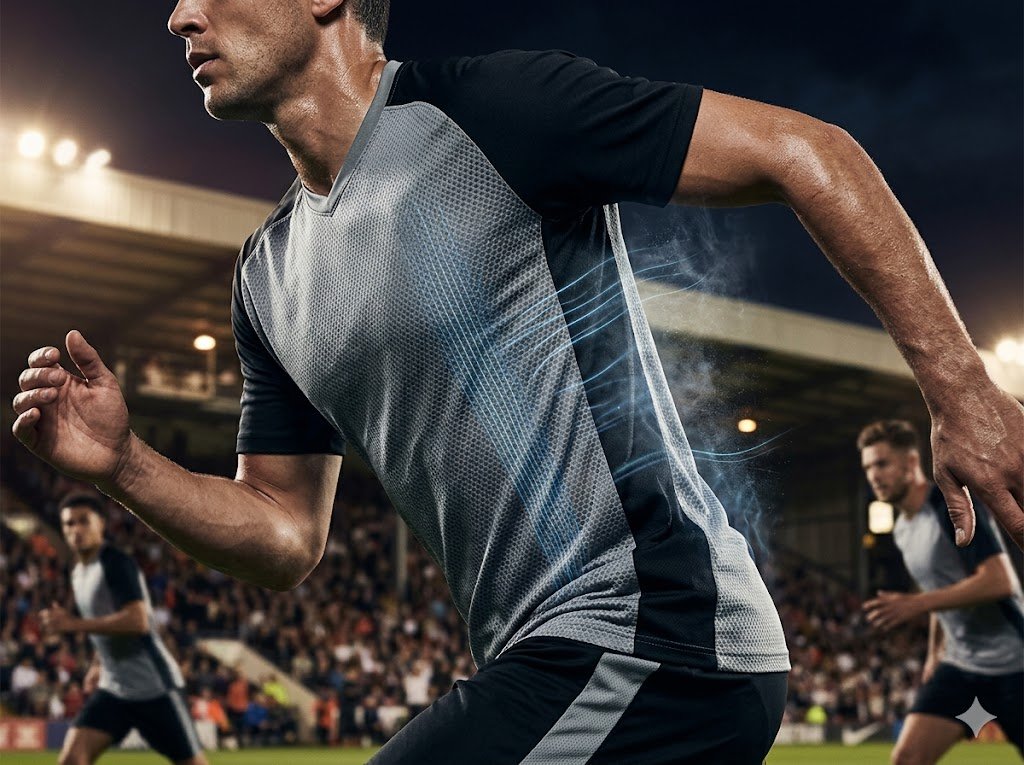
Training vs Match Day: Which Jersey—Or One for Both?
| Feature | Training Jersey | Match Day Jersey |
|---|---|---|
| Primary goal | Breathability, frequent washing | Appearance + performance under broadcast/photos |
| Typical fabric | Lightweight polyester | Durable poly mesh + Lycra stretch zones |
| Print method | Heat-transfer / screen print | Sublimation (full-color) / embroidery |
| Customization | Basic (team name, small logo) | High-detail (numbers, sponsors, gradients) |
| Expected lifespan* | 3–6 months (heavy use) | 6–12+ months(season-long) |
| Compliance | Training policies | Laws of the Game / Equipment Regulations |
*Lifespan depends on wash cycles, abrasion, and storage.
How Training Frequency Affects Football Jersey Selection
A football jersey used once or twice a week will experience different levels of wear from one worn during daily training sessions. For clubs and academies, training frequency is an important factor when deciding whether to use one uniform for all activities or maintain separate training and match-day kits.
Frequent use can expose sportswear to repeated stretching, friction, sweat, washing, and drying. Over time, these conditions may affect fabric appearance, seam integrity, print quality, and overall garment shape.
Before selecting a uniform system, team managers should consider the following factors:
- Weekly training sessions: Teams training several times per week may need more replacement tops or a dedicated training set.
- Washing frequency: Jerseys washed after every session require fabrics and prints suitable for repeated laundering.
- Playing conditions: Outdoor pitches, artificial turf, hot weather, and wet conditions can create different wear and maintenance demands.
- Competition schedule: Teams with frequent fixtures may need additional match-day sets to maintain a consistent appearance.
- Player rotation: Larger squads may require extra sizes and spare garments for substitutes and newly registered players.
A practical approach is to estimate the number of weekly uses and expected washing cycles before placing an order. This allows buyers to choose a suitable fabric specification and determine how many jerseys each player should receive.
For example, a youth academy with three weekly training sessions and weekend matches may find it more practical to allocate separate training tops and reserve the customized match jersey for competition.
Regulatory note: Match kits must comply with the Laws of the Game—Law 4 (Players’ Equipment) and confederation/federation equipment rules (colors, slogans, visibility, number placement).
What Makes Our Football Jerseys Different (Materials & Specs)
Premium Materials, Selected for Multi-Scenario Use
- Moisture-wicking polyester micro-mesh for faster sweat transport and quicker drying
- Lycra/Spandex stretch panels at underarm and side seams to keep mobility during sprints and presses.
- Targeted ventilation zones (laser-perforated or mesh) in heat-map areas (upper back, underarm).
- Colorfast fibers engineered for sublimation to maintain vibrant club colors across the season.
- OEKO-TEX® STANDARD 100 skin-safety assurance option for youth squads (every thread and accessory tested for harmful substances).
Why this beats ordinary kits: Cheaper off-the-shelf tops often use generic knits that trap moisture and rely on surface inks that crack/peel. Performance knits + sublimation = lighter feel, deeper color penetration, and season-long legibility of names and numbers.
Production & Engineering: How We Build Jerseys That Survive Practice and Shine on Match Day
Design for Fit, Movement, and Visibility
- 3D graded size blocks for youth → adult cuts; shoulder slope and chest taper tuned to prevent sagging or restriction.
- Sponsor & number layout optimized for stadium and broadcast readability, plus high-contrast color mapping.
- Collar & cuff engineering (flat cover-stitch, bartacks) for pull resistance and easy donning.
Manufacturing for Consistency
- Computer-guided cutting reduces fray and ensures symmetrical panels.
- Heat-sealed seams / flatlock stitching to minimize chafing during longer sessions.
- Sublimation printing with ICC-profiled color workflows.
- Quality gates: wash-test, colorfastness, and tensile checks; optional OEKO-TEX® documentation for youth tenders.
Expert Insights & Industry Trendlines
Emily Chen, Product Director (Ystarwear): “For clubs balancing cost and performance, a dual-purpose jersey is often the highest-ROI path—one build that breathes during drills and still looks premium on match day.”
Robert Ng, Technical Consultant: “Sublimated football jerseys avoid heavy ink layers, so they ventilate better and keep colors sharper through the season.”
Player welfare context: Global schedule congestion heightens fatigue and injury risk; while kit alone can’t fix calendars, breathable, lightweight jerseys help thermal comfort and reduce damp cling during dense periods of play.
Scientific Data You Can Use
- Moisture management: Polyester knits demonstrate higher moisture transport and faster drying than cotton in active conditions.
- Print durability & color stability: Dye-sublimation provides the most stable color after multiple wash/abrasion cycles.
- Safety standards: OEKO-TEX® STANDARD 100 certifies textiles (including threads and accessories) against harmful substances.
- Regulatory compliance: Federation equipment regulations (Law 4, confed regs) govern slogans, color clashes, and number visibility.
Real-World Ops: How Teams Implement Dual-Purpose Jerseys
- Coastal United FC (senior + U18): consolidated two sets into one hybrid set; reported ~22% lower apparel spend Y/Y and fewer mid-season replacements.
- Sunview Academy (U10–U14): 300 sublimated jerseys; retained color and structure after 50+ washes in camp rotation.
- Youth Festival (20 teams): single template with unique colorways for quick compliance and media-ready branding.
Quick application tip: Roll sizing trials in training week 1 (YS–3XL fit rails), lock sponsor art on week 2, submit POs by week 3 for on-time delivery.

How to Calculate the Long-Term Cost of Football Jerseys
The lowest purchase price does not always represent the best value for a football club. A cheaper jersey may need to be replaced more frequently, while a better-constructed uniform may remain suitable for longer under the same usage conditions.
For clubs, schools, academies, and sportswear distributors, evaluating cost per wear provides a more practical way to compare different uniform options.
A simple calculation is:
Cost per Wear = Total Purchase Cost ÷ Total Number of Garment Uses
For example, consider two hypothetical football jersey options:
| Evaluation Item | Option A | Option B |
|---|---|---|
| Purchase Cost per Jersey | $12 | $18 |
| Estimated Number of Uses | 30 | 60 |
| Cost per Wear | $0.40 | $0.30 |
In this illustrative example, Option B has a higher initial purchase price but a lower cost per use because it remains in service for more sessions.
These figures are examples for purchasing analysis, not verified product test results. Actual garment lifespan depends on fabric quality, construction, washing practices, playing conditions, and usage frequency.
When comparing suppliers, buyers should also consider customization charges, sample costs, shipping, replacement requirements, and the consistency of repeat orders. Looking at the complete cost of ownership can help clubs make more informed purchasing decisions.
Buying Checklist (Coach/Manager Friendly)
- Define use-cases: practice only / match only / dual-purpose
- Pick fabric system: micro-mesh poly + Lycra zones (match & drill)
- Choose print: sublimation for full-color durability; embroidery for crests
- Fit set: youth & adult blocks; confirm shoulder slope and sleeve length
- Compliance: verify Law 4 + federation kit rules for numbers, colors
- QA & docs: wash-test, size runs, OEKO-TEX® options for youth tenders
- Lifecycle math: estimate washes/week × season → compare cost per wear
What Should Clubs Confirm with a Football Jersey Supplier?
Once a team has selected its preferred uniform style, the next step is to confirm that the supplier can meet the required specifications and delivery schedule. This is particularly important for customized orders involving team logos, sponsor artwork, player names, and individual numbers.
Before approving production, buyers should clarify the following details:
| Purchasing Detail | Questions to Ask the Supplier |
|---|---|
| Fabric | What is the material composition and available fabric weight? |
| Customization | Can the supplier reproduce team colors, logos, names, and numbers? |
| Size Range | Are youth and adult sizes available in the same design? |
| Sample Approval | Can a physical sample be reviewed before mass production? |
| Color Consistency | How are colors checked between approved samples and bulk orders? |
| Quality Inspection | What checks are performed before shipment? |
| Production Lead Time | How long does sampling and bulk manufacturing take? |
| Packaging | Can garments be individually packed and labeled by player or size? |
For repeat orders, buyers should keep an approved sample, artwork files, size specifications, and fabric details as part of their purchasing records. This helps maintain consistency when adding new players or replacing uniforms in later seasons.
A reliable supplier should be able to explain its customization capabilities, production workflow, sample approval process, and quality inspection arrangements clearly.
Football Jersey Sizing: How to Organize Team Fitting Before Bulk Orders
Ordering football jerseys for an entire team requires more than selecting a general size range. Players may have different body proportions, fit preferences, and movement requirements. A well-organized sizing process helps reduce incorrect orders and unnecessary exchanges.
Before confirming bulk production, team managers should follow a consistent fitting process.
1. Collect Individual Measurements
Record each player’s chest circumference, body length preference, and relevant garment measurements. For youth teams, check the size requirements of growing players rather than relying only on their previous season’s uniform sizes.
2. Review the Supplier’s Size Chart
Different manufacturers may use different measurement standards. Buyers should compare actual garment measurements instead of assuming that a medium or large size will fit identically across suppliers.
3. Arrange Sample Fittings
Whenever possible, request representative samples in several sizes. Players should try them on and perform basic movements such as raising their arms, turning, stretching, and running.
4. Confirm the Fit Preference
Some teams prefer a regular fit for everyday training, while others choose a closer athletic fit for match-day uniforms. The final specification should allow comfortable movement without excessive fabric.
5. Keep a Team Size Record
Maintain a record of each player’s approved size, including the garment style and size chart version. This makes future reorders easier and helps reduce sizing inconsistencies.
| Measurement | What to Check |
|---|---|
| Chest | Comfortable fit without excessive tightness |
| Body Length | Suitable coverage during running and stretching |
| Shoulder Width | Natural movement without pulling |
| Sleeve Length | Appropriate coverage and arm mobility |
| Waist and Hem | Stable fit without unnecessary restriction |
For youth academies and clubs with frequent player changes, keeping an updated size list is especially useful when ordering replacement uniforms during the season.

FAQ
1. What Is the Best Fabric for Football Jerseys?
Polyester is one of the most widely used fabrics for football jerseys because it is lightweight, quick-drying, and suitable for regular sportswear use. Polyester mesh fabrics can also support airflow, helping players feel more comfortable during training sessions and matches. For teams that need additional flexibility, some jersey designs incorporate elastane or spandex panels in selected areas. When choosing a fabric, clubs should consider playing conditions, training frequency, fabric weight, ventilation, and maintenance requirements rather than focusing on fiber composition alone. The best option is one that balances comfort, fit, durability, and the team’s budget.
2. How Many Football Jerseys Should a Team Order per Player?
The right number of football jerseys depends on how often the team trains, how frequently players compete, and how regularly uniforms can be washed. A team that trains several times a week may benefit from having separate training and match jerseys, while a club with a limited budget may prefer a versatile design for both activities. Buyers should also consider substitute players, new team members, replacement requirements, and goalkeeper uniforms when calculating quantities. Before placing a bulk order, prepare a complete player list, confirm individual sizes, and include a reasonable reserve quantity to make future replacements easier.
3. How Do You Choose the Right Football Jersey Size for a Team?
To choose the right football jersey size, compare each player’s body measurements with the manufacturer’s size chart instead of relying only on age or standard clothing sizes. Important measurements include chest circumference, body length, shoulder width, and sleeve length. Teams should also decide whether they prefer a regular fit or a looser fit for training and match use. For bulk orders, requesting sample jerseys or arranging a fitting session can help identify sizing differences before production begins. A confirmed size list reduces ordering errors and makes it easier to organize uniforms for youth academies, school teams, amateur clubs, and professional squads.
4. Are Custom Sublimated Football Jerseys Better for Team Uniforms?
Custom sublimated football jerseys are a practical option for teams that want integrated designs, player names, numbers, sponsor graphics, and consistent color layouts. In the sublimation process, suitable inks are transferred into compatible polyester fabric using heat, rather than forming a separate thick print layer on top of the material. This makes sublimation particularly useful for detailed, multicolor designs. However, the final result depends on fabric quality, printing conditions, color management, and production quality control. Clubs should review a physical sample or approved digital artwork before bulk production to confirm the design, color appearance, sizing, and placement of logos and numbers.
5. What Should You Check Before Buying Football Jerseys in Bulk?
Before purchasing football jerseys in bulk, buyers should confirm fabric composition, size availability, customization options, printing methods, sample approval procedures, production lead time, and quality inspection standards. It is also important to check whether the supplier can maintain consistent colors, measurements, logos, and number placement across the entire order. Clubs preparing uniforms for official competitions should review the applicable competition rules and the requirements of the relevant football association. For long-term purchasing, ask about repeat-order support, replacement quantities, packaging, and documentation. Comparing these details helps team managers evaluate suppliers more accurately and avoid problems caused by unclear specifications or inconsistent production.
One Jersey. Total Performance.
From first whistle in training to kickoff on match day, the right football jerseys should breathe, move, and endure—without forcing you to buy twice. Today’s best practice-to-match builds combine micro-mesh polyester, Lycra stretch, and sublimated color systems to deliver season-long durability and professional presentation. Align that with Law 4 compliance and OEKO-TEX® options for youth, and you’ve got a kit that protects players, pleases sponsors, and maximizes ROI. That’s how you choose one jersey to do it all—confidently.
References
- Nasrin, S. (2023). Factors Affecting the Sweat-Drying Performance of Activewear. MDPI Polymers.
- Nasrin, S. (2025). Analyzing Fabric Parameters in Active Sportswear. Textile Research Journal (SAGE).
- Walker, E. B. (2024). Color Accuracy and Durability for Printed, Branded Textiles. Imaging.org CIC Proceedings.
- IFAB. (2025/26). Laws of the Game – Law 4: The Players’ Equipment.
- The FA. (2025/26). Law 4 – The Players’ Equipment (England).
- AFC. (2025). Equipment Regulations (Edition 2025).
- OEKO-TEX®. (2024). What OEKO-TEX® Labels Mean and Why They Matter.
- OEKO-TEX®. (2021). STANDARD 100 Factsheet.
- den Hollander, S., et al. (2024). Impact of Match Workload and International Travel on Injury Risk in Professional Men’s Football. Journal of Functional Morphology and Kinesiology.
- FIFPRO. (2024). Seven Key Findings from the Player Workload Report.
- Printful Editorial. (2025). Sublimation vs. Screen Printing: Which One’s Better?
- IFAB/FA (compiled). (2025/26). Law 4 and FIFA Quality Programme note (kit aspects).