Quick Summary: The right Football Jersey Size depends on body measurements, garment measurements, fit type and intended use—not simply the S, M, L or XL label. Men, women and kids should compare chest, pit-to-pit, body length and fit preference, while teams and bulk buyers should approve a size chart and fit sample before production to reduce sizing complaints and reorder risk.
Buying a Football Jersey sounds simple until two shirts carrying the same “M” label fit completely differently. One may be a relaxed fan version designed for casual wear; another may be an athletic player version built to sit closer to the torso. Add different brands, seasons, fabrics, women’s shaping, youth grading and custom-manufacturer patterns, and the label itself becomes only one part of the sizing decision. For team buyers, the risk multiplies because one incorrect assumption can affect dozens or hundreds of jerseys. Clubs, academies and distributors comparing custom Football Jersey and soccer uniform options should therefore treat size planning as part of product development rather than a last-minute spreadsheet task. The best starting point is to define who will wear the jersey, how close the fit should be and which measurements will control the order.
For manufacturing, size consistency is also a quality-control issue. A custom jersey factory does not simply print an S, M or L label onto an otherwise identical shirt; each size requires a graded pattern controlling chest width, body length, shoulder width, sleeve length, armhole, collar opening and hem dimensions. The relationship among those measurements determines whether a jersey feels athletic, regular or relaxed. YSTAR Wear describes itself as a China-based sportswear and apparel manufacturer with OEM/ODM capability, digital printing equipment and production-quality systems. Buyers evaluating YSTAR Wear’s sportswear manufacturing background should still request the exact football jersey size chart for the intended style, because even one factory can manufacture multiple fits for clubs, retail programs, players, women and youth teams. Factory identity does not replace style-specific measurements.
The safest order begins with real data. A club requesting 150 kits should ideally provide the intended fit, adult and youth size ranges, player chest measurements, height information where useful and any special requirements for goalkeepers or women-specific cuts. Retailers should also consider whether customers will wear the jersey over a base layer, T-shirt or hoodie. If sizing is uncertain, requesting a physical size set can be more reliable than guessing from normal clothing labels. Buyers can contact YSTAR Wear for custom sizing and fit requirements with a proposed size range, target market and product use. This becomes especially valuable when the buyer plans repeat orders, because the approved size chart should remain traceable alongside artwork, fabric and production specifications instead of changing quietly between seasons.
Sizing should also be connected to jersey category. A fan buying a shirt for everyday use usually wants more room than a competitive player who prefers a streamlined athletic silhouette. A collector may care about authentic match-style construction, while a school team may prioritize comfort, growth room and size availability across several ages. These buying differences are explored in YSTAR’s Football Jersey 2026 buying guide, which distinguishes supporter, player, youth, custom-team and retail use cases. For sizing specifically, the practical lesson is that “What size am I?” should be replaced by “What physical measurements and fit profile do I want this version to have?” That question produces a much more reliable answer.
For teams, sizing mistakes can also delay production. A custom order may be ready for artwork approval, fabric booking and sublimation, yet bulk cutting cannot safely begin if the final size chart or roster remains unsettled. Changing a size chart after a fit sample is approved can require pattern revision and sometimes re-sampling. YSTAR’s Custom Football Jersey production timeline guide identifies size-chart approval as one of the milestones buyers should lock before bulk production. This is why a team should collect sizing information before sending names and numbers to the factory, not after the printing files have already been prepared. Size, player identity and personalization data should ultimately operate as one controlled production file.
The issue becomes even more important as football kits expand into inclusive sizing, women-specific cuts, youth ranges, recycled fabrics and more differentiated fanwear. Current custom-teamwear programs increasingly treat size consistency and fit choice as part of the brand experience rather than an invisible technical detail. YSTAR’s overview of custom Football Jersey trends for 2026/2027 also highlights inclusive sizing, lightweight performance fabrics and more structured factory-direct sourcing. A modern size strategy should therefore cover more than the average adult male player. It should account for men, women, kids, different body types, fanwear preferences and future reorders from the start.
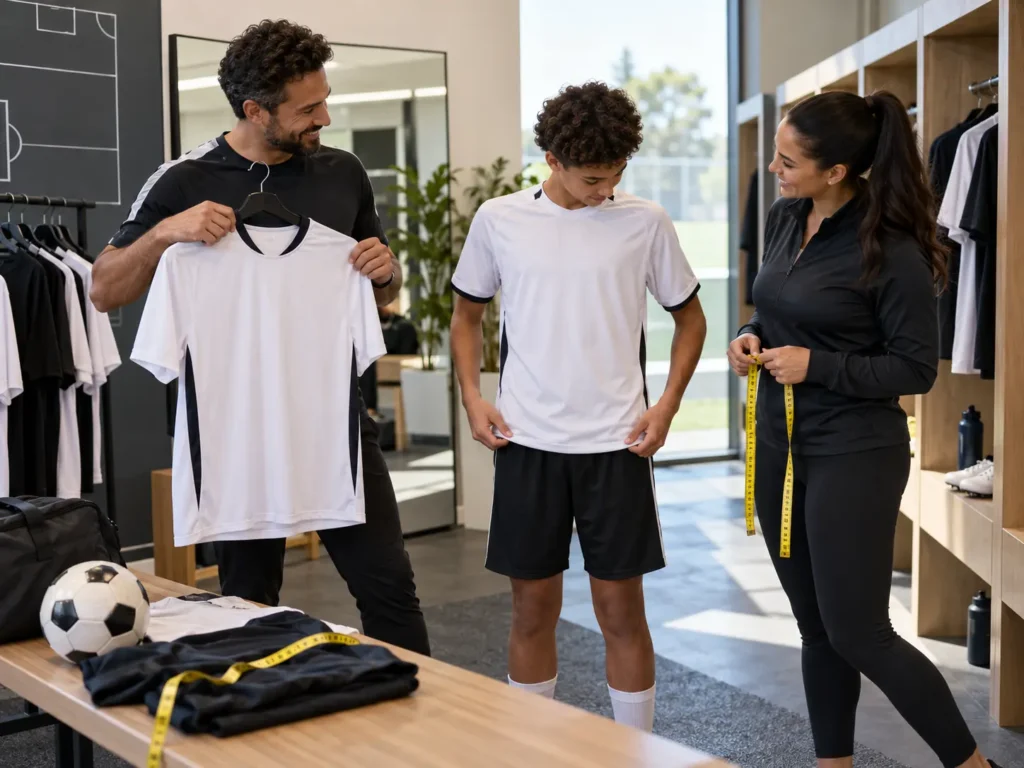
Quick Answer: What Football Jersey Size Should You Buy?
If you already know the exact brand, style and jersey version, use that product’s current size chart first. If you do not have a verified chart, use your body measurements and a well-fitting jersey as references rather than relying only on your normal T-shirt size.
| Your Situation | Best Starting Direction |
|---|---|
| Regular fan fit | Start with your normal measured size and verify chest and length |
| Player / authentic athletic fit | Check the exact chart; consider the larger size if you dislike a close fit |
| Between two sizes | Larger size usually gives more comfort; smaller only if you intentionally want a tighter fit |
| Wearing over a T-shirt | Allow additional garment ease |
| Wearing over a hoodie | Usually size up or compare pit-to-pit with the hoodie underneath |
| Retro / vintage jersey | Use actual garment dimensions, not only the historic label |
| Kids / youth | Use chest and height; age should be a secondary reference |
| Bulk team order | Collect individual measurements and approve a physical size set |
The most reliable rule: measure the jersey that already fits you the way you like, then compare its pit-to-pit and body length with the new product.
Why Football Jersey Sizing Is More Complicated Than T-Shirt Sizing
A Football Jersey is often designed around a specific use rather than a generic casual silhouette. Several factors can change fit even when the label remains the same.
Brand
Different brands use different base blocks, grading systems and intended fit profiles.
Jersey Version
A match-style or player-fit product may be narrower through the torso than a fan-focused replica.
Gender Cut
Women’s cuts can alter shoulder width, waist shaping, bust allowance and body length.
Youth Grading
Kids’ sizes often use both body dimensions and height or age categories.
Season and Product Line
A club jersey from one season does not necessarily fit exactly like a jersey carrying the same club badge five years later.
Fabric Stretch
Polyester-spandex panels can tolerate a closer fit than a low-stretch woven or dense knit construction.
Football Jersey Fit Types Explained
Player / Match / Authentic Fit
Player-oriented jerseys are generally designed closer to the body. The objective can include reduced loose fabric, lower garment weight and compatibility with high-intensity movement. Typical characteristics may include:
- closer chest fit;
- more waist taper;
- narrower sleeve opening;
- lighter fabric;
- stretch or mesh zones;
- heat-applied lightweight details.
That does not mean every authentic jersey is exactly one size smaller than a replica. The actual brand chart remains the correct reference.
Replica / Stadium / Supporter Fit
Fan-oriented jerseys are generally built for broader everyday wear. Typical characteristics include:
- more chest room;
- straighter torso;
- comfortable sleeve openings;
- easier layering;
- slightly heavier fabric direction in some collections.
Fan Version
“Fan version” is not a universal technical standard. Different sellers may use it to describe replica, supporter or budget merchandise. Always ask for the actual measurement table.
Oversized or Lifestyle Fit
Some modern football-inspired jerseys are intentionally loose. In this case, sizing down may be reasonable if the buyer wants a conventional fit, but only after checking garment dimensions.
Player Version vs Fan Version: How the Same Size Can Fit Differently
| Fit Factor | Player / Authentic Direction | Fan / Replica Direction |
|---|---|---|
| Torso fit | Close / athletic | Regular / relaxed |
| Waist | More tapered | Straighter |
| Fabric | Often lighter / more technical | Often more everyday-wear focused |
| Layering | Limited room | Easier |
| Best for | Match-style feel, playing, collectors | Fans, casual use, gifting |
| Size decision | Check chart carefully | Normal measured size often works |
Do not use the rule “player jersey = automatically one size up” for every brand. Some buyers may need the same label size; others may prefer one size larger depending on chest, shoulders and fit preference.
How Should a Football Jersey Fit?
Shoulders
The jersey should allow natural arm movement without excessive pulling around the armholes. A performance fit can sit closer to the shoulder; casual fanwear can be looser.
Chest
The shirt should not create excessive horizontal tension across the chest unless a close athletic fit is intentional.
Waist
Player-fit styles often taper more strongly. Fan versions generally leave more room.
Sleeves
Sleeves should not restrict the upper arm or create uncomfortable pulling when the wearer raises the arms.
Length
The jersey should remain long enough during movement without becoming excessively long for the wearer’s height and torso.
How to Measure Your Body for a Football Jersey
Chest
Place a flexible tape around the fullest part of the chest, under the arms and approximately parallel to the floor. Keep the tape close without compressing the body.
Waist
Measure around the natural waist or the position specified by the brand’s size guide.
Height
Height is useful for overall length and youth sizing but should not be the only measurement used.
Shoulder Width
This can be particularly useful for fitted custom jerseys or buyers with broad shoulders.
Chest measurement should usually carry more weight than height or body weight when selecting an adult Football Jersey.
How to Measure a Football Jersey You Already Own
This is often the easiest sizing method for online buyers. Lay a well-fitting jersey flat without stretching it.
Pit-to-Pit
Measure horizontally from one armpit area to the other.
Body Length
Measure from the highest shoulder point near the collar down to the hem.
Shoulder Width
Measure between the main shoulder seam points where the construction allows.
Sleeve Length
Measure using the same method shown by the seller, because sleeve construction can vary.
What Is Pit-to-Pit Measurement?
Pit-to-pit, often abbreviated as P2P, is the flat horizontal width of the garment from one armpit area to the other.
Approximate Garment Chest Circumference = Pit-to-Pit × 2 For example, a jersey measuring 52 cm pit-to-pit has an approximate flat garment chest circumference of:
52 cm × 2 = 104 cm
Garment chest circumference is not the same as body chest measurement. The difference between them creates wearing ease.
Body Measurement vs Garment Measurement
| Measurement | What It Measures | Best Use |
|---|---|---|
| Body chest | Your torso circumference | Selecting from official body-size charts |
| Pit-to-pit | Flat jersey width | Comparing one jersey with another |
| Garment circumference | Approx. pit-to-pit × 2 | Understanding garment room |
| Body length | Vertical jersey length | Tall / short fit decisions |
Men’s Football Jersey Size Chart
The table below is a general planning reference for custom teamwear and online size comparison. It is not a replacement for the current chart supplied with the exact product.
| Size | Body Chest Direction | Fit Note |
|---|---|---|
| XS | Approx. 83–88 cm | Slim adult / larger youth transition depending on product |
| S | Approx. 88–94 cm | Smaller adult fit |
| M | Approx. 94–102 cm | Common medium adult range |
| L | Approx. 102–110 cm | Regular larger adult range |
| XL | Approx. 110–118 cm | Extra chest room |
| 2XL | Approx. 118–128 cm | Extended sizing |
| 3XL+ | Product specific | Confirm manufacturer grading |
General planning reference only. Official brand and custom-factory charts vary.
Women’s Football Jersey Size Chart
Women’s jerseys may use a shaped pattern rather than simply reducing a men’s size.
| Size | Bust / Chest Direction | Fit Consideration |
|---|---|---|
| XS | Approx. 78–84 cm | Check body length and shoulder fit |
| S | Approx. 84–90 cm | Women’s slim / regular fit depends on style |
| M | Approx. 90–96 cm | Check waist shaping |
| L | Approx. 96–104 cm | Compare bust and torso length |
| XL | Approx. 104–112 cm | Extended women’s sizing |
For custom teamwear, a women-specific fit sample can be more reliable than asking women players to select from a men’s chart.
Kids and Youth Football Jersey Size Guide
Children should not be sized by age alone because two players of the same age can have very different height and chest measurements.
| Planning Group | Approx. Age Direction | Primary Measurement | Secondary Measurement |
|---|---|---|---|
| Little Kids | 4–7 years | Chest | Height |
| Younger Youth | 8–10 years | Chest | Height |
| Junior | 11–12 years | Chest | Height |
| Teen Youth | 13–14 years | Chest | Height and expected growth |
| Older Youth | 15–16 years | Chest | Adult-size comparison |
For youth team orders: use measurements first, age second, and allow reasonable growth room when the jerseys need to last an entire season.
International Football Jersey Size Conversion
Labels such as S, M and L are easier to compare internationally than numeric systems, but even those labels do not guarantee identical measurements.
| International Label | Typical U.S./UK Label | Typical EU Clothing Direction | Buyer Note |
|---|---|---|---|
| XS | XS | Approx. 40–42 men’s direction | Brand dependent |
| S | S | Approx. 44–46 | Check chest chart |
| M | M | Approx. 48–50 | Do not convert blindly |
| L | L | Approx. 52–54 | Fit varies by product |
| XL | XL | Approx. 56–58 | Verify brand chart |
International conversions should be treated as orientation only. Actual body and garment measurements are more reliable.
Do Football Jerseys Run Small?
Some do, particularly close-fitting performance or player versions. Others fit like regular sports shirts or even use oversized fashion silhouettes. A better question is:
What Fit Type Is This Specific Football Jersey Designed To Have? Check:
- player or fan version;
- brand chart;
- chest measurement;
- garment width;
- body length;
- fabric stretch.
Should You Size Up in a Football Jersey?
| Situation | Size-Up Direction |
|---|---|
| Between sizes | Usually sensible for comfort |
| Player-fit jersey | Consider if you dislike close fit |
| Wearing a layer underneath | Often useful |
| Wearing over a hoodie | Usually requires additional room |
| Broad shoulders | May help, but check length |
| Intentionally slim look | May not be necessary |
When Should You Size Down?
Sizing down can make sense when:
- the product is explicitly oversized;
- the seller’s actual measurements show significant excess room;
- you deliberately want a close streetwear fit;
- a previous jersey from the same product line ran large.
Do not size down merely because another brand’s jersey felt loose.
What If You Are Between Two Sizes?
For most casual buyers, the larger size is the lower-risk choice because it provides more movement and layering room. The smaller size may work when:
- you intentionally want an athletic fit;
- the fabric has meaningful stretch;
- the garment measurements still exceed your body measurements appropriately.
If customization is permanent, sizing conservatively becomes even more important because personalized jerseys may have stricter exchange conditions.
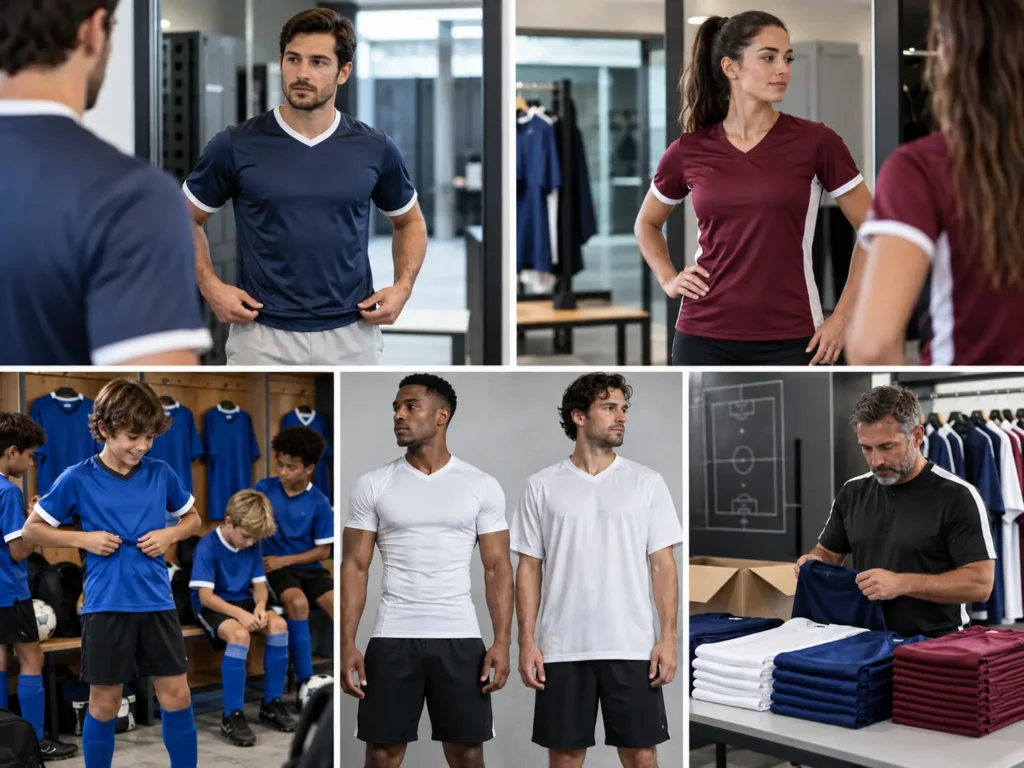
Authentic vs Replica: Why the Same Size Label Can Feel Different
The fit difference comes from the garment pattern, not from the size label itself. A player-style M may have:
- less chest ease;
- stronger waist taper;
- narrower sleeves;
- shorter or more athletic body proportions;
- stretch panels.
A fan-style M may use the same nominal body-size target but provide more wearing ease.
Retro and Vintage Football Jersey Sizing
Retro jerseys need extra caution because the label may represent a different era’s fit standard.
Original Vintage Shirts May Have
- boxier bodies;
- shorter or longer lengths;
- wider sleeves;
- fabric shrinkage from previous washing;
- label sizing that differs from modern charts.
Official Reissues
These may reproduce the visual design while using modern sizing and fabric construction.
Retro-Inspired Jerseys
These are new garments influenced by historic design and may use modern relaxed or oversized patterns.
For vintage purchases, actual pit-to-pit and body length are more reliable than the label.
How Washing Can Affect Football Jersey Fit
Most modern jerseys use polyester-based fabrics that are relatively dimensionally stable when cared for correctly, but high temperatures and incorrect washing can damage shape, prints and trims.
Good Care Direction
- follow the care label;
- wash at the recommended temperature;
- turn printed jerseys inside out where appropriate;
- avoid excessive tumble-drying heat;
- avoid ironing directly on names, numbers or heat-applied badges.
Do not assume one universal shrinkage percentage. Shrinkage depends on fiber content, knit structure, finishing and washing conditions.
Does Custom Printing Affect Size Choice?
Printing does not normally change the nominal pattern size, but fit can affect how the design looks.
A Very Tight Jersey Can
- stretch sponsor graphics visually;
- distort large back numbers;
- pull around badges;
- create excessive tension at seams.
For customized teamwear, buyers should approve the fit before names and numbers are finalized.
Football Jersey Size for Playing
A match jersey should allow movement without unnecessary loose fabric. Players should check:
- shoulder mobility;
- chest comfort;
- arm movement;
- body length during running;
- fit over any required base layer.
Close fit should not mean restricted movement.
Football Jersey Size for Everyday Wear
Fanwear can prioritize comfort over aerodynamic fit. A regular or slightly relaxed fit often works better for:
- watching matches;
- travel;
- casual streetwear;
- gifting;
- wearing over a T-shirt.
Football Jersey Size for Stadium Wear
Climate matters.
Warm Weather
The jersey may be worn alone or over a light base layer.
Cold Weather
Supporters may want enough room for:
- T-shirt;
- thermal layer;
- sweatshirt;
- hoodie.
This can justify a larger size even when the same buyer wears a smaller size during summer.
Can You Wear a Football Jersey Over a Hoodie?
Yes, but compare garment dimensions rather than guessing. Measure the hoodie pit-to-pit at its widest chest area, then compare that measurement with the jersey. The jersey needs enough additional room to slide over the hoodie without excessive pulling around the chest, shoulders and armholes.
How Much Ease Should a Football Jersey Have?
“Ease” is the difference between the wearer’s body measurement and the garment measurement.
Garment Ease = Garment Circumference − Body Circumference There is no one ideal ease value because it depends on:
- athletic vs fan fit;
- fabric stretch;
- body type;
- layering;
- personal preference.
Broad Shoulders and Athletic Builds
A buyer with broad shoulders may find that a jersey fits correctly around the chest but pulls across the upper back and sleeves. In this case:
- check shoulder width;
- check sleeve opening;
- consider a regular rather than player fit;
- compare body length before sizing up.
Large Chest and Slim Waist
A highly tapered player jersey may fit differently from a straight fan jersey. Choose based on chest first, then evaluate whether the waist shape matches the desired silhouette.
Tall and Slim Buyers
Chest size alone can produce a jersey that is too short. Check:
- body length;
- shoulder width;
- tall-size availability;
- whether sizing up creates too much width.
Shorter Buyers
Sizing up purely for chest room may create excessive body length. A different fit pattern can sometimes work better than simply increasing the label size.
Football Jersey Sizing for Bulk Team Orders
Bulk orders create a different problem from individual shopping: the factory needs one stable size system for the entire roster.
Collect
- player name;
- player number;
- selected size;
- chest measurement;
- height where useful;
- men’s / women’s / youth cut;
- goalkeeper version;
- special fit notes.
Use a Size Set
For larger clubs, producing or receiving physical samples in representative sizes can reduce risk dramatically.
Why a Fit Sample Matters More Than a Digital Size Chart
A chart provides numbers. A fit sample shows how those numbers behave on a human body. The sample can reveal:
- tight armholes;
- excessive body length;
- waist taper;
- collar comfort;
- sleeve shape;
- fabric stretch;
- print distortion.
Size Chart Approval in Custom Production
The size chart should be locked before bulk cutting. A complete custom chart may include:
- chest width;
- body length;
- shoulder width;
- sleeve length;
- hem width;
- collar opening;
- measurement tolerance;
- men’s, women’s and youth grading.
If the chart changes after the pre-production sample is approved, the pattern may need revision.
Measurement Tolerances in Bulk Football Jersey Production
Manufacturing tolerances should be agreed between buyer and supplier before production. For example, a custom program may define permissible variation around chest width, body length and sleeve dimensions, but the correct tolerance depends on:
- fabric stretch;
- size range;
- construction;
- buyer specification;
- factory process.
Do not copy one tolerance from another factory or product without checking the actual jersey construction.
How Size Grading Works in a Custom Football Jersey Range
Size grading is the controlled change from one pattern size to the next. A manufacturer may grade:
- chest width;
- body length;
- shoulder width;
- sleeve length;
- armhole;
- neck opening.
Good grading creates proportional size changes rather than simply making every dimension larger by the same amount.
Men, Women and Kids Should Not Always Share One Pattern
A unisex chart can be useful for simple club programs, but higher-level teamwear may benefit from separate pattern blocks.
| Range | Main Pattern Consideration |
|---|---|
| Men’s / Unisex | Broader general adult block |
| Women’s | Bust, waist shaping, shoulder and body length |
| Youth | Height progression, growth and shorter proportions |
| Goalkeeper | May require different sleeve or layering room |
How to Plan the Size Ratio for a Bulk Order
Do not guess the ratio from a generic S:M:L:XL formula when the team roster is available. For clubs:
Best Size Ratio = Actual Player List + Approved Fit Preference For retailers without known end users, historical sales data is more useful than a generic internet ratio.
Inclusive Football Jersey Sizing
Modern teamwear programs increasingly need extended size ranges. A good inclusive program should consider:
- smaller adult sizes;
- extended plus sizes;
- women-specific grading;
- youth transition sizes;
- consistent design across the range.
The artwork should also be checked at extreme sizes so logos and sponsor marks remain proportionate.
Common Football Jersey Sizing Mistakes
Mistake 1 — Using Height Alone
Risk: chest fit can be completely wrong. Better decision: use chest measurement first.
Mistake 2 — Using Weight Alone
Risk: two people of the same weight can have different body shapes. Better decision: measure actual dimensions.
Mistake 3 — Assuming All Brands Fit the Same
Risk: normal size does not translate. Better decision: use the product’s current chart.
Mistake 4 — Ignoring Player vs Fan Version
Risk: the jersey feels unexpectedly tight or loose. Better decision: identify the fit type before choosing size.
Mistake 5 — Using T-Shirt Size Only
Risk: sportswear cut differs from casual clothing. Better decision: compare chest and garment measurements.
Mistake 6 — Not Checking Pit-to-Pit
Risk: online fit remains guesswork. Better decision: compare with a jersey you already own.
Mistake 7 — Choosing Too Tight a Size for Custom Printing
Risk: names, sponsor logos and numbers can look distorted when worn. Better decision: approve the fit before personalization.
Mistake 8 — Forgetting Layering
Risk: winter stadium wear becomes uncomfortable. Better decision: allow additional ease.
Mistake 9 — Buying Vintage by Label Only
Risk: old sizing and previous shrinkage are ignored. Better decision: request actual garment measurements.
Mistake 10 — Ignoring Return or Customization Rules
Risk: the wrong personalized size cannot easily be exchanged. Better decision: confirm size before printing.
Football Jersey Size Decision Matrix
| Buyer Need | Recommended Starting Direction |
|---|---|
| Regular casual wear | Normal measured size |
| Close player-style look | Use authentic/player chart |
| Between sizes | Larger for comfort |
| Layering | Allow additional garment ease |
| Over hoodie | Compare jersey and hoodie pit-to-pit |
| Retro / vintage | Use actual garment dimensions |
| Kids | Chest + height + growth |
| Broad shoulders | Check shoulder and chest together |
| Tall and slim | Check body length before sizing up |
| Custom team order | Physical size set + individual roster |
How to Buy a Football Jersey Online Without Getting the Size Wrong
Before ordering, check:
- brand;
- season or product generation;
- player / authentic / replica / fan version;
- body chest measurement;
- pit-to-pit;
- body length;
- fit preference;
- layering requirement;
- custom name and number;
- return and exchange policy.
Team Buyer Checklist Before Bulk Production
| Item | Why It Matters |
|---|---|
| Approved size chart | Controls pattern grading |
| Fit sample | Confirms real wearing experience |
| Men / women / youth range | Prevents forcing everyone into one block |
| Final player list | Links name, number and size |
| Measurement tolerance | Defines QC acceptance |
| Pre-production sample | Locks fit, fabric and decoration |
| Reorder chart | Keeps future team kits consistent |
Frequently Asked Questions
1. Do Football Jerseys usually run small?
Some Football Jerseys run smaller than ordinary casual T-shirts, especially player, authentic or performance versions designed to sit closer to the body. Fan, replica and supporter jerseys are generally more relaxed, but there is no universal rule that every football jersey runs small or that every buyer should automatically size up. The safest method is to identify the jersey version, measure your chest and compare that measurement with the current product chart. If garment dimensions are available, compare pit-to-pit and body length with a jersey you already own. Buyers between two sizes who prefer comfort usually choose the larger option, while buyers seeking a deliberately close athletic fit may prefer the smaller size if the chart supports it.
2. How do I measure myself for the correct Football Jersey Size?
Start by measuring around the fullest part of your chest with a flexible tape kept approximately horizontal and close to the body without compressing it. Waist and height can be useful secondary measurements, while shoulder width may help buyers with broader upper bodies or fitted player jerseys. Then measure a football jersey or sports shirt that already fits the way you prefer. Lay it flat and record the pit-to-pit width and body length. Remember that body chest measurement and garment chest measurement are different: the garment needs additional room, called ease, unless an extremely close fit is intended. Compare both sets of measurements with the current seller or manufacturer’s chart rather than relying only on your normal T-shirt label.
3. Is a player version Football Jersey tighter than a fan or replica jersey?
Player or authentic Football Jerseys are generally designed with a closer, more athletic silhouette than fan or replica versions. They may use a more tapered torso, lighter performance fabric, narrower sleeve openings and less spare room through the chest and waist. Fan jerseys are usually designed for everyday comfort and may provide more room for casual wear or layering. However, the size difference is not standardized across every brand, so it is inaccurate to assume that a player jersey is always exactly one size smaller. Some buyers may wear the same label size in both versions, while others may choose a larger player version. The correct comparison uses the actual chest, pit-to-pit and body-length measurements of each product.
4. What Football Jersey Size should kids wear?
Kids’ Football Jersey Size should be selected primarily from chest and height measurements, with age used only as a secondary reference. Children of the same age can differ significantly in height, chest circumference and body proportions, so buying solely from an age label can produce a poor fit. For team orders, measure each player or provide a physical youth size set so children can try the jerseys before production. If a child falls between sizes and the kit needs to last through an entire season, the larger size is often more practical because it provides some growth room. However, excessive sizing up can create overly long sleeves or body length, so the manufacturer’s actual youth measurements should still guide the decision.
5. What should teams check before approving a custom Football Jersey size chart?
Teams should review chest width, body length, shoulder width, sleeve length, hem width, collar opening, men’s or women’s shaping, youth grading and the agreed measurement tolerance before approving a custom Football Jersey size chart. A physical fit sample or size set is highly recommended for larger team orders because numerical measurements do not always reveal armhole comfort, fabric stretch, waist taper or body length during movement. The size chart should be locked before bulk cutting and before final player names and numbers are sent into production. Clubs should also retain the approved chart for future reorders so new players receive jerseys that follow the same fit standard as the original team kit.
References
- ISO 8559-1:2017 — Size Designation of Clothes, Part 1: Anthropometric Definitions for Body Measurement — International Organization for Standardization — Clothing Size Measurement Framework.
- ISO 8559-2:2017 — Size Designation of Clothes, Part 2: Primary and Secondary Dimension Indicators — International Organization for Standardization — Garment Size Designation Framework.
- Men’s, Women’s and Kids’ Shirts & Tops Size Guide — adidas Product Fit Team — adidas — Official Apparel Body-Measurement Size Charts.
- Size Charts and Body Measurement Instructions — PUMA Customer Service — PUMA — Men’s, Women’s and Junior Apparel Size Guidance.
- Jersey Fit and Body Measurement Guidance — Nike Fit and Size Team — Nike — Chest, Waist, Hip and Between-Size Measurement Guidance.
- Football Jersey Size Guide: How to Choose the Right Fit — FootSupporter Editorial Team — FootSupporter — Football Jersey Fit, Player vs Supporter and Measurement Guide.
- Football Jersey 2026: A Practical Buying Guide for Fans, Players, Teams and Retailers — YSTAR Wear Editorial Team — YSTAR Wear — Football Jersey Types, Fit, Fabric and Buying Guidance.
- Top 10 Milestones to Monitor in Your Custom Football Jersey Production Timeline — YSTAR Wear Editorial Team — YSTAR Wear — Size Chart Approval, Sampling, QC and Bulk Production Guidance.
How to Choose a Football Jersey Size Without Relying Only on S, M, L or XL
At a Glance
Football Jersey Size is a relationship among the wearer’s body, the jersey’s actual physical measurements, the fit pattern and the intended use. The same person can reasonably wear one size in a relaxed supporter jersey and another in a close player version. A size label is therefore an identifier inside one sizing system, not a universal physical measurement shared by every brand or manufacturer.
| Decision | Best Evidence |
|---|---|
| What size fits my body? | Chest measurement |
| How loose will the jersey feel? | Garment pit-to-pit vs body chest |
| Will it be long enough? | Body length measurement |
| Is it a player or fan fit? | Product fit description + size chart |
| Will it fit over another layer? | Layer garment dimensions |
| Will a custom team order fit consistently? | Approved size chart + fit sample + tolerance |
What Is the Most Reliable Way to Select a Size?
Use two reference points at the same time: your body and a garment you already like. Measure your chest, then measure the pit-to-pit and body length of a jersey whose fit you consider ideal. A new jersey that matches only your body measurement but is significantly shorter or narrower than your preferred garment may still feel wrong. Combining body and garment data gives a much more complete picture.
Why Is the Size Label Not Enough?
The letters XS, S, M, L and XL describe positions in a manufacturer’s grading system. They do not specify one international chest width or body length. A men’s M from one brand can differ from another brand’s M, while an authentic M and replica M from the same brand can use different fit patterns. The label is useful only when paired with the measurements behind it.
How Should Player and Fan Fits Be Treated?
Treat them as different silhouettes, not simply different quality levels. Player fits prioritize athletic shaping and typically leave less ease. Fan fits prioritize broader wearability and comfort. A buyer who enjoys a close athletic look may use the player chart at normal measured size, while a buyer who wants casual room may choose a fan version or a larger player size. The correct decision is about fit preference rather than prestige.
What Is the Best Method for Kids?
Measure chest and height first. Age bands are useful for browsing but are too broad to guarantee fit. For a team season, consider reasonable growth while avoiding an excessively oversized shirt. Physical try-on sets are especially valuable for youth clubs because coaches can record each child’s size before names and numbers are printed.
How Should Women Choose Between Women’s and Unisex Cuts?
A women’s cut may alter bust shaping, waist taper, shoulder width and body length, while a unisex jersey usually follows a straighter general-adult pattern. Neither is automatically better. Some players prefer the closer proportions of a women’s block; others prefer the additional room of a unisex fit. Compare measurements rather than choosing only by gender label.
Why Is Pit-to-Pit So Useful?
Pit-to-pit translates an online product into a real garment dimension. It is particularly valuable for retro shirts, resale purchases, unknown brands and fan jerseys where the buyer cannot try the product on. Comparing one flat jersey with another removes much of the ambiguity created by different size labels.
What Should Buyers Do When They Are Between Sizes?
First decide how the jersey will be worn. For everyday wear, stadium use or growth room, the larger size is generally the lower-risk choice. For a deliberately close player fit, the smaller size may work if the chest and garment dimensions still allow unrestricted movement. If the jersey will be personalized and cannot easily be returned, choose only after reviewing the actual measurements.
How Should Layering Affect the Decision?
Layering increases the circumference the jersey needs to cover. A jersey worn over a hoodie needs substantially more ease than one worn directly over a base layer. The most reliable method is to measure the hoodie or underlying garment flat and compare its width with the proposed jersey rather than adding a generic size number.
Why Does Fabric Matter?
Two jerseys with identical flat measurements can feel different if one uses stretch mesh and another uses a firmer polyester interlock. Stretch affects ease, movement and perceived tightness. This is one reason physical fit samples remain valuable for custom programs even when the measurement chart is technically correct.
How Should Bulk Team Sizing Be Managed?
A team should lock the size system before personalization and cutting. Collect one final roster containing player name, number, selected size and any special fit notes. Confirm adult, women’s and youth charts separately if multiple patterns are used. Approve the pre-production fit, record the measurement tolerance and retain that information for future reorders. This prevents a mid-season replacement from arriving with a completely different fit.
What Is the Main B2B Risk?
The biggest risk is not one individual choosing the wrong jersey. It is a buyer approving an incorrect size system and reproducing that mistake across hundreds of units. A small error in chest grading, body length or youth progression becomes expensive when multiplied across a club, school league, retailer or distributor program. Fit approval deserves the same discipline as color and artwork approval.
Recommended Buyer Workflow
- Define whether the jersey is for players, fans, retail or youth teams.
- Choose player, replica, unisex, women’s or youth fit direction.
- Measure the wearer’s chest.
- Measure a preferred existing jersey.
- Compare pit-to-pit and body length.
- Review the product-specific size chart.
- Check fabric stretch and silhouette.
- Consider layering.
- Consider future growth for kids.
- Check return rules before customization.
- For team orders, create one clean size roster.
- Request a physical size set where practical.
- Approve chest width, length, shoulder and sleeves.
- Approve measurement tolerance.
- Lock the size chart before bulk cutting.
- Link each player name and number to the approved size.
- Retain the size chart for repeat production.
Soft Buying Recommendation
Before requesting a custom Football Jersey quotation, prepare the buyer type, team or market, men’s, women’s and youth size ranges, preferred player or fan fit, fabric direction, quantity, customization requirements and delivery schedule. For bulk orders, request a detailed measurement chart and physical fit sample before approving production. If the supplier offers several patterns, ask which chart belongs to the exact style being quoted. This one step can prevent a large share of size complaints, returns and remake costs.
The Best Football Jersey Size Is the Fit You Can Verify With Measurements
A Football Jersey should not be purchased simply because the label says M, L or XL.
Those letters are useful only inside the sizing system that created them.
The more reliable process is straightforward:
Measure your body. Measure the jersey you already like. Identify whether the new shirt is a player, fan, women’s, youth, retro or oversized fit. Compare chest, pit-to-pit and body length. Consider layering, customization and future use.
For clubs and retailers, take the same logic one step further: approve the chart, approve the fit sample, lock the grading system and keep it with the production record.
That turns sizing from guesswork into a repeatable specification.
The strongest buying question is therefore not:
“Do I normally wear Medium?”
It is:
“Do the actual measurements of this Football Jersey match the way I want it to fit?”
When that answer is clear, choosing the right Football Jersey Size becomes much easier for men, women, kids, players, supporters and entire teams.