A football jersey must do more than display team colors and player numbers. It needs to feel comfortable through repeated sprints, sudden changes of direction, warm-up exercises, and extended periods of play. Fabric weight is one of the first specifications that buyers notice when comparing sportswear materials, but choosing the right value requires a closer understanding of how textiles behave in real conditions.
For teams, sportswear retailers, schools, and distributors, the decision affects more than the player’s immediate comfort. Fabric selection can influence garment appearance, print quality, durability expectations, production consistency, and the overall cost of a uniform program. A jersey that feels excellent in a showroom may perform differently after repeated washing or during a humid afternoon match.
This guide explains how Football Jersey Fabric Weight influences comfort and performance, how GSM compares with other technical properties, and how buyers can evaluate lightweight, midweight, and heavier materials. It also provides practical specifications, testing considerations, regulatory guidance, and a purchasing framework for teams and businesses sourcing football kits.
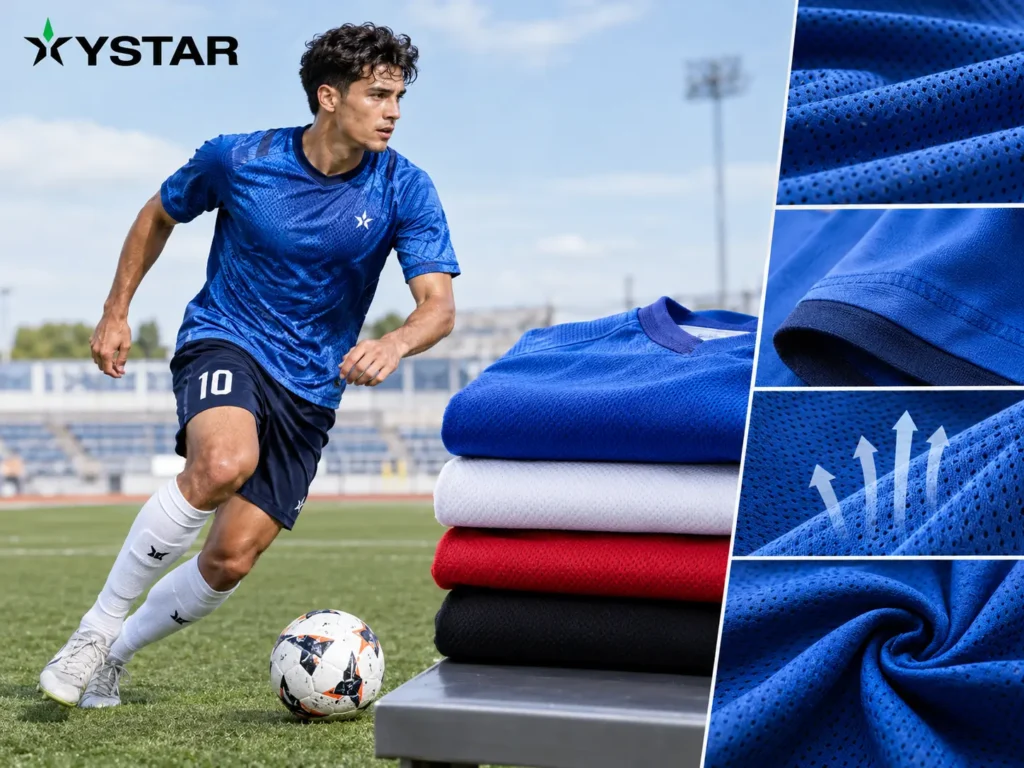
What Does GSM Mean in Football Jersey Fabric?
Understanding Grams per Square Meter
GSM stands for grams per square meter. It describes the mass of a fabric per unit of area and is commonly used to specify knitted and woven textiles. A fabric rated at 150 GSM has a nominal mass of 150 grams per square meter. This measurement helps manufacturers and buyers compare material specifications and monitor consistency between production batches.
GSM is not the same as the total weight of a finished jersey. A garment’s actual weight also depends on its size, surface area, sleeves, collar, seams, reinforcement panels, printed numbers, badges, and other accessories. Two jerseys made from fabric with the same GSM can therefore have different finished weights.
When sourcing soccer uniforms, buyers should review the complete product specification rather than relying on a single weight figure. A useful specification identifies fiber composition, fabric construction, nominal GSM, acceptable tolerance, color, finishing requirements, and the intended application. This makes quotations easier to compare and reduces the risk of receiving a material that technically matches a weight target but feels different from the approved sample.
Fabric Weight Is Not the Same as Thickness
A common purchasing mistake is to assume that a higher GSM always means a thicker or stronger fabric. GSM measures mass per area, while thickness describes the distance between the fabric’s surfaces under specified measurement conditions. The two properties can be related, but they are not interchangeable.
Fiber density, yarn fineness, loop length, stitch structure, finishing, and fabric compression all influence how a textile feels. An open-knit fabric may provide substantial airflow despite having a similar GSM to a tighter knit. Conversely, a compact structure may feel smooth and substantial without offering the same air movement.
For a reliable comparison, buyers should assess GSM alongside thickness where relevant, air permeability, stretch and recovery, abrasion resistance, dimensional stability, and the fabric’s behavior after washing. The best specification is one that describes measurable properties and a clear end use, rather than simply requesting a “premium lightweight material.”
Why Finished Garment Weight Also Matters
When a player wears a jersey, the experience comes from the entire garment. A large heat-applied number, a dense badge, a lined collar, or several reinforced seams can add weight and affect flexibility in particular areas. The effect may be more noticeable on a lightweight jersey than on a heavier fanwear garment.
Manufacturers should therefore distinguish between the fabric specification and the finished garment specification. During sample approval, record both the fabric GSM and the weight of a defined garment size. If the order includes several sizes, the parties should agree on a reference size and explain how measurements will be checked. This approach helps prevent disagreements between the approved sample and bulk production.
How Fabric Weight Affects Football Jersey Comfort and Performance
Breathability and Air Circulation
Air permeability describes how readily air passes through a textile under specified test conditions. It can be important when evaluating a Football Jersey intended for high-intensity exercise, especially in warm environments. Yet GSM alone cannot predict air permeability because yarn characteristics and knit geometry influence the pathways available for airflow.
A lightweight open-knit fabric may allow air to move readily through its structure, while a tightly constructed material of similar weight may behave differently. Ventilation panels can also create different airflow characteristics in different areas of a garment. These design choices should be evaluated as part of the finished jersey rather than in isolation.
For a summer league, a team might prioritize an open structure, a suitable fit, and low garment mass. For a retail jersey designed to emphasize a smooth appearance, the buyer may accept a more compact construction if the garment remains comfortable in its intended use. Neither option is universally superior; the decision depends on the balance between appearance, performance, and durability.
Sweat Management and Drying Comfort
Polyester is widely used in performance apparel because it can be engineered into lightweight fabrics with useful dimensional stability and moisture-management characteristics. However, fiber composition alone does not establish how quickly a jersey will dry or how comfortable it will feel when wet.
Three concepts should be distinguished. Moisture absorption refers to how much liquid a material takes up within its fibers or structure. Moisture transport describes how liquid moves across or through a textile. Drying rate concerns how quickly moisture leaves the garment under particular environmental conditions. A fabric may perform differently across these measurements.
During a training session, a jersey’s performance depends on sweat production, fabric construction, airflow, ambient humidity, garment fit, and the contact between fabric and skin. A light fabric can reduce material mass, but it will not automatically provide the best moisture management. Buyers should ask for relevant test results or compare samples under consistent conditions instead of relying on vague claims such as “quick-dry technology.”
Mobility, Stretch, and Fabric Drape
Football involves repeated acceleration, deceleration, turning, jumping, and reaching. The jersey should allow these movements without excessive restriction, unwanted pulling, or distracting fabric movement. Weight affects drape and how a garment hangs, but pattern design, stretch, recovery, and sizing are equally important.
A tightly fitted jersey can reduce excess fabric movement, but an overly restrictive fit may be uncomfortable during shoulder rotation or torso movement. A loose jersey may feel less restrictive but can create a different sensation during sprinting. Buyers should assess the garment on people who represent the intended size range and movement patterns.
Teams sourcing from a football apparel manufacturer should ask how fabric selection, garment patterning, and construction work together. The useful question is not simply whether a fabric is lightweight. It is whether the complete jersey remains comfortable, maintains its intended shape, and supports the movement demands of the target player.
Heat Retention and Perceived Comfort
In hot and humid conditions, players may notice heat buildup, sweat accumulation, or fabric clinging to the body. Lower fabric mass can help reduce the amount of material being worn, but perceived comfort is also influenced by ventilation, fit, surface characteristics, and moisture transport.
A heavier textile may provide a more substantial hand feel and support a particular design, but that does not automatically make it more durable or comfortable. A lighter textile may feel less noticeable during movement, yet could require closer evaluation for opacity, snagging, and resistance to repeated use. These trade-offs should be tested in context.
Football Jersey Fabric Weight Comparison: Lightweight, Midweight, and Heavyweight
The ranges below are practical examples for product development, not universal industry classifications or mandatory standards. Actual specifications vary by supplier, knit structure, fiber composition, finishing, and intended use. Buyers should confirm the appropriate range through material samples and product testing.
Lightweight Football Jerseys: Approximately 120–140 GSM
Lightweight materials are often considered for warm-weather training, performance-oriented match kits, and products where low fabric mass is a priority. Depending on construction, they may provide a light drape and support a less bulky garment.
The main risk is assuming that reducing GSM always improves the product. A very lightweight material may require additional checks for coverage, surface stability, snagging, print appearance, and dimensional change after washing. These checks are especially important for pale colors, large printed graphics, and products intended for frequent use.
Midweight Football Jerseys: Approximately 140–170 GSM
Midweight materials can be a useful starting point for clubs, schools, amateur leagues, and general team uniforms. They may offer a practical balance between garment mass, surface appearance, and perceived substance, depending on the construction.
For team orders, this range can be considered during initial sampling, but it should not be treated as a guaranteed solution. A well-designed fabric at the lower end may outperform a poorly constructed fabric at the higher end in a specific use case. The final decision should follow testing and wearer feedback.
Heavier Football Jerseys: Approximately 170–200+ GSM
Heavier fabrics may suit selected fanwear, retro-inspired designs, or products that require a more substantial hand feel. A denser or more structured material may also support a particular visual effect. These benefits depend on the knit, yarn, finishing, and garment design.
Potential disadvantages include increased material mass and a less suitable feel for some high-heat activities. Heavier fabric is not automatically stronger, and lower GSM is not automatically less durable. Abrasion resistance, seam construction, yarn strength, and garment care all contribute to service life.
GSM Comparison Table
| Illustrative GSM Range | Typical Feel | Potential Advantages | Checks to Prioritize | Possible Applications |
|---|---|---|---|---|
| 120–140 GSM | Light and less substantial | Lower material mass | Opacity, snagging, dimensional stability | Warm-weather training and selected match kits |
| 140–170 GSM | Balanced, depending on construction | Versatile product development options | Airflow, stretch, wash performance | Clubs, schools, and general teamwear |
| 170–200+ GSM | More substantial in many constructions | May support a structured hand feel | Heat comfort, flexibility, end-use suitability | Selected fanwear and retro-inspired products |
Important interpretation: The table provides illustrative development ranges, not measured performance results. It does not establish that every fabric within a range has the same breathability, durability, or drying behavior. Those properties must be verified separately.
Which Football Jersey Materials Work Best at Different Weights?
Polyester Performance Fabric
Polyester is common in football apparel because manufacturers can develop different yarns and knit constructions for specific garment requirements. It can support lightweight products, vivid graphics, and practical care characteristics. However, not all polyester fabrics are identical. Yarn type, filament structure, surface treatment, and knitting method can produce very different results.
When reviewing a Football Jersey Material specification, buyers should request the fiber composition and construction details instead of accepting “100% polyester” as a complete performance description. They should also confirm whether the material is intended for sublimation printing, heat-applied decoration, or another production method.
Mesh and Open-Knit Fabrics
Mesh and open-knit constructions can support air movement through their structure. They are useful options to evaluate when ventilation is a priority, particularly in warm-weather garments. The size and arrangement of openings, yarn characteristics, and garment placement all affect the final result.
Open structures may also require additional checks for snagging, surface appearance, coverage, and resistance to repeated wear. A panel that works well on the back may not be appropriate for every high-contact or high-abrasion area. Hybrid designs can combine different constructions to balance ventilation and coverage.
Interlock and Double-Knit Fabrics
Interlock and other double-knit constructions can provide a different surface appearance and hand feel from open-knit materials. Depending on the yarn and structure, they may be suitable for products that need a smoother face or a more substantial drape. Their performance still depends on the actual construction rather than the name alone.
For printed jerseys, buyers should evaluate surface uniformity, graphic definition, color appearance, and flexibility after decoration. The ideal construction is the one that meets the intended design and performance requirements, not necessarily the one with the highest GSM.
Recycled Polyester and Material Traceability
Recycled polyester can be considered by teams and retailers seeking to incorporate recycled content into their apparel range. Buyers should distinguish between a material claim and verified supply-chain evidence. Documentation should identify what is recycled, the scope of the claim, and any relevant chain-of-custody or certification system.
Recycled content does not automatically establish superior comfort, durability, or lower environmental impact in every application. Those outcomes depend on the material, manufacturing process, use phase, and end-of-life pathway. Responsible sourcing requires specific, substantiated claims rather than broad environmental language.

Choosing Fabric Weight for Real Playing Conditions
Hot and Humid Outdoor Matches
For a team playing in hot or humid weather, the development brief should prioritize a comfortable fit, suitable air permeability, effective moisture management, and manageable garment mass. A lightweight fabric can be a reasonable starting point, but the sample should be assessed during movement and after sweating.
Testing should use consistent conditions wherever possible. Compare similar garment sizes, wear durations, activity levels, and washing histories. Feedback from players can help identify issues such as cling, chafing, unwanted transparency, or a heavy feeling when damp. These observations complement, rather than replace, objective textile tests.
Frequent Training and Repeated Washing
Training jerseys may be worn and washed more frequently than occasional-use fanwear. Buyers should therefore assess dimensional stability, colorfastness, seam integrity, print durability, and surface changes after laundering. The care instructions should be realistic for the intended user and market.
A slightly heavier material is not necessarily the right answer to frequent washing. A lighter fabric with suitable construction and proven wash performance may be more appropriate than a heavier fabric with weak seams or unstable decoration. The decision should be based on the complete garment and the expected care routine.
Youth Teams, Schools, and Amateur Clubs
Schools and community teams often need to balance comfort, budget, inclusive sizing, and reliable replenishment. A standardized fabric specification can make it easier to reorder garments without unexpected changes in hand feel or appearance. The specification should identify the approved material, color references, decoration methods, and the process for checking future batches.
For these buyers, total project value is more useful than unit price alone. A lower quotation may become less attractive if it leads to sizing problems, inconsistent colors, early print failure, or costly replacement orders. The sourcing process should compare specifications, samples, quality assurance, and delivery requirements together.
Goalkeeper Jerseys and Cooler Conditions
Goalkeeper jerseys may have different design priorities from standard outfield shirts, including specific padding, reinforcement, or construction details. These additions can change the garment’s weight and feel, so the entire product should be assessed rather than selecting material by GSM alone.
In cooler conditions, layering may provide more flexibility than choosing an unnecessarily heavy outer jersey. Teams should consider the player’s activity level, local climate, uniform rules, and the compatibility of any additional layers with the intended fit.
Printing, Durability, and Quality Control
Sublimation Printing and Graphic Appearance
Sublimation is commonly used for suitable polyester textiles because the process can produce integrated graphics without a separate thick film covering the entire printed area. Results depend on fabric composition, surface characteristics, process settings, and color management.
Before bulk production, the buyer should approve a decorated sample, not just a blank fabric swatch. The sample should be checked for color accuracy, edge definition, fabric hand feel, and the behavior of the design during stretching and washing. Large printed areas can affect the feel of a garment even when the underlying textile is lightweight.
Heat Transfers, Numbers, and Badges
Heat-applied numbers, names, badges, and sponsor graphics can add local weight and stiffness. The effect depends on the material, size, coverage, and application method. A large transfer across an area that moves or folds frequently may be more noticeable than a small decoration in a less flexible location.
Buyers should confirm that the decoration method is compatible with the selected fabric and intended care instructions. They should also check adhesion, cracking, peeling, color transfer, and flexibility after appropriate testing. These checks help reduce the risk of approving a sample that looks good initially but performs poorly after regular use.
Practical Fabric and Garment Tests
A useful quality-control plan may include the following checks, selected according to product requirements and available test methods:
- GSM verification: Confirm fabric mass per unit area using an appropriate standardized method.
- Air permeability: Compare airflow under defined test conditions when ventilation is a key requirement.
- Dimensional stability: Measure changes in length and width after the specified laundering procedure.
- Colorfastness: Evaluate resistance to color change and transfer using relevant test methods.
- Abrasion and surface performance: Assess the fabric for the expected type and frequency of wear.
- Decoration durability: Check numbers, logos, and prints after stretching, laundering, or other applicable procedures.
Test results should state the method, sample identity, conditioning, and relevant test conditions. A numerical result without this context can be difficult to interpret. For example, two air-permeability results may not be directly comparable if different methods or pressure conditions were used.
Technical Parameters, Testing Standards, and Compliance
Key Specifications Buyers Should Request
| Parameter | What It Measures | Purchasing Value | Important Qualification |
|---|---|---|---|
| GSM | Fabric mass per unit area | Controls the agreed weight specification | Does not independently predict performance |
| Fiber composition | Fiber types and proportions | Supports material and care decisions | Verify through reliable documentation or testing |
| Air permeability | Airflow through the textile | Helps assess ventilation | Test method and conditions matter |
| Dimensional change | Size change after treatment or washing | Supports fit consistency | Use a defined care and test procedure |
| Colorfastness | Resistance to fading or color transfer | Helps protect appearance | Different exposures require different tests |
| Abrasion resistance | Resistance to surface wear | Supports durability assessment | Must reflect the intended use |
Relevant Textile Testing Methods
ISO 3801 and ASTM D3776/D3776M are examples of standards associated with determining fabric mass per unit area. ISO 105 includes methods for evaluating colorfastness under different conditions. Depending on the requirement, other standards may be relevant to air permeability, abrasion, dimensional stability, and fiber composition.
Buyers should verify the applicable edition, scope, and testing conditions before placing a method in a purchase specification. A standard’s existence does not mean that every football jersey must be tested against every listed method. Testing should be proportionate to the product, risk, destination market, and customer requirements.
Apparel Chemical and Labeling Requirements
Compliance obligations depend on the countries where a jersey is manufactured, sold, imported, and distributed. For relevant European Union markets, buyers should evaluate applicable REACH restrictions and other product-specific obligations. For the United States, textile fiber-content, origin, and care-labeling rules may apply depending on the product and circumstances.
Suppliers and importers should verify current legal requirements with competent compliance professionals or official regulatory guidance. Product descriptions, recycled-content claims, fiber labels, and chemical compliance statements must be supported by appropriate evidence. A generic claim such as “internationally certified” is not a substitute for identifying the applicable requirement and confirming that the actual product meets it.
How Manufacturers Control Fabric Weight in Bulk Production
Sampling and Pre-Production Approval
Bulk consistency begins before cutting and sewing. The buyer should approve a physical sample and record the fabric composition, GSM, color, construction, finish, and decoration method. If the final product includes printed panels or different fabrics, those components should be documented separately where their properties differ.
The approved sample should be linked to the purchase specification so that both parties can identify the reference product. Any proposed substitution should require review rather than being treated as an equivalent without evidence. This matters when a material becomes unavailable or when a supplier suggests a lower-cost alternative.
GSM Tolerance and Batch Consistency
Fabric production can vary between batches. Buyers should agree on a target GSM, an acceptable tolerance, a sampling method, and the action to take if a result falls outside the agreed range. The appropriate tolerance depends on the product and manufacturing capability; it should not be assumed to be identical across all suppliers.
GSM checks should be interpreted alongside other properties. A batch may meet the weight target while differing in surface texture, color, stretch, or airflow. For that reason, a complete incoming inspection can include visual comparison, specification review, and selected performance tests.
Questions to Ask Before Placing a Bulk Order
Before confirming a large order, buyers should ask the supplier:
- Can the supplier provide a fabric specification identifying composition, GSM, and construction?
- Can the buyer review and approve a physical sample before bulk production?
- Which test reports are available, and do they apply to the exact material being ordered?
- How are color, GSM, dimensions, and decoration checked during production?
- How will substitutions, failed inspections, or differences between batches be handled?
- Can the supplier maintain the approved specification for repeat orders?
For a new uniform project, teams can also review guidance on choosing comfortable football jerseys for training and matches. A structured evaluation helps buyers move beyond promotional descriptions and compare actual product characteristics against their use case.
Football Jersey Fabric Trends and Product Development in 2026
Zoned Ventilation and Hybrid Knit Construction
One practical direction in performance apparel is the use of different knit structures in selected garment areas. Instead of making the entire jersey from one material, product developers may combine a smoother main body with more open panels in areas where ventilation is a priority.
The benefit depends on the construction and placement. Hybrid designs require careful sampling to ensure that panels remain comfortable, seams do not create irritation, and the finished garment retains a consistent appearance. Buyers should evaluate the complete design rather than assuming that more mesh automatically means better performance.
Recycled Fibers and Traceable Claims
Recycled materials remain relevant to product development and sourcing discussions. For buyers, the key questions are what percentage of the product contains recycled content, how that content is verified, and whether the claim applies to the yarn, fabric, or finished garment.
Clear documentation helps avoid misleading environmental statements and gives retailers more reliable information for product descriptions. Sustainability claims should be specific, substantiated, and consistent with applicable rules in the destination market.
Balancing Performance, Retail Appeal, and Total Project Cost
Not every customer segment needs the same fabric specification. Competitive teams may prioritize low garment mass and verified performance properties. School programs may focus on durability, easy care, and dependable replenishment. Fanwear buyers may place greater emphasis on appearance, hand feel, and design detail.
The sourcing decision should consider the full project rather than unit price in isolation. Relevant factors include sample development, decoration, inspection, delivery, expected service life, replacement needs, and the cost of correcting specification errors. A useful reference for this decision process is football jersey sourcing and total project return on investment, which reflects the importance of comparing material quality with wider purchasing outcomes.

How to Select Football Jersey Fabric Weight for Wholesale Orders
Match the Specification to the Customer Segment
Wholesale buyers should begin by defining the product’s primary use. A performance-oriented match jersey may require a different material brief from a fanwear shirt or a school uniform. Once the use case is clear, the buyer can identify the most important properties and set measurable requirements.
For a performance kit, the brief might prioritize low garment mass, air permeability, stretch, and moisture-management performance. For a school order, the focus might be repeat-wash durability, stable colors, a manageable care routine, and consistent sizing. For a retail product, visual appearance, decoration quality, and the feel of the finished garment may carry greater weight.
Compare Samples Before Comparing Quotes
A low quotation does not necessarily represent the lowest total cost. If a cheaper fabric creates problems with transparency, fit, color consistency, or print durability, the buyer may face returns, replacements, customer complaints, or delays. A higher-priced fabric may be justified if its tested performance and expected service life fit the project requirements.
To compare suppliers fairly, provide the same technical brief to each candidate. Request equivalent samples, clarify whether prices include the same decoration and packaging, and confirm the inspection process. This creates a more useful comparison than asking several suppliers for a price based only on a generic description such as “lightweight polyester jersey.”
Build a Clear Technical Specification Sheet
A practical purchase specification should record the following items:
- Fiber composition and fabric construction.
- Target GSM and agreed tolerance.
- Color references and approved sample identification.
- Required printing, numbering, badges, and finishing.
- Size chart and garment measurement tolerances.
- Applicable performance tests and acceptance criteria.
- Care-label requirements and destination-market compliance.
- Inspection arrangements, delivery terms, and repeat-order controls.
When buyers have questions about production capability, customization, sampling, or an upcoming teamwear order, a direct discussion with the supplier can clarify technical details before the order is finalized. A suitable next step is to contact the supplier about football jersey specifications and bulk orders with the intended use, target GSM, estimated quantity, size range, and decoration requirements prepared in advance.
Frequently Asked Questions About Football Jersey Fabric Weight
1. What GSM Is Best for a Football Jersey?
There is no single GSM that is best for every Football Jersey. As an initial development reference, buyers may compare lightweight fabrics around 120–140 GSM, midweight options around 140–170 GSM, and heavier materials around 170–200 GSM or above. These are illustrative ranges, not mandatory standards. The right choice depends on knit structure, fiber composition, fit, climate, decoration, durability expectations, and intended use. Buyers should evaluate a physical sample and request relevant test results before approving bulk production.
2. Is a Lightweight Football Jersey Better for Hot Weather?
A lightweight Football Jersey can be a useful option for hot weather because it reduces the amount of fabric worn, but lower GSM does not guarantee better ventilation or moisture management. Air permeability depends on fabric construction, while drying comfort is influenced by fiber characteristics, liquid transport, humidity, fit, and airflow. For warm-weather use, compare fabric mass with air-permeability results, moisture-management information, coverage, and wearer feedback under realistic conditions.
3. Are Heavier Football Jerseys More Durable?
Not necessarily. A higher GSM indicates greater fabric mass per unit area, but durability also depends on yarn strength, knit construction, abrasion resistance, seam quality, finishing, and care. A lightweight textile may be suitable for frequent use if it has appropriate construction and verified performance. A heavier textile may still fail early if the seams, print, or fabric surface are unsuitable. Buyers should evaluate durability through relevant tests and sample inspections instead of using GSM as a substitute for quality assessment.
4. What Material Is Best for a Football Jersey?
Polyester is a common choice for football jerseys because it can be developed into lightweight performance fabrics and can be suitable for many printing methods. However, the best material depends on the garment’s purpose. Mesh constructions may be considered when airflow is a priority, while other knit structures may suit a smoother surface or more substantial hand feel. Buyers should compare fiber composition, knit construction, stretch, moisture behavior, printing compatibility, wash performance, and the relevant compliance requirements before choosing a material.
5. How Can Buyers Check Football Jersey Fabric Weight Before Placing a Bulk Order?
Buyers should request a fabric specification that states the target GSM, composition, construction, and acceptable tolerance. They can ask for an approved physical sample and, where appropriate, a test report from a qualified laboratory using a relevant method such as ISO 3801 or ASTM D3776/D3776M. The inspection plan should define sample selection, test conditions, and what happens if results fall outside the agreed range. It is also important to inspect the decorated garment, since prints, badges, seams, and garment design affect the final product.
References
- ISO 3801: Textiles — Woven Fabrics — Determination of Mass per Unit Length and Mass per Unit Area. International Organization for Standardization. Confirm the applicable scope and current edition before specifying a test.
- ASTM D3776/D3776M: Standard Test Methods for Mass Per Unit Area (Weight) of Fabric. ASTM International. A reference for fabric mass measurement.
- ISO 105 Series: Textiles — Tests for Colour Fastness. International Organization for Standardization. A series of methods covering different colorfastness conditions.
- ISO 9237: Textiles — Determination of the Permeability of Fabrics to Air. International Organization for Standardization. A reference for evaluating air permeability under specified conditions.
- ASTM D737: Standard Test Method for Air Permeability of Textile Fabrics. ASTM International. A method for assessing airflow through textile fabrics.
- Regulation (EC) No 1907/2006 Concerning the Registration, Evaluation, Authorisation and Restriction of Chemicals (REACH). European Parliament and Council of the European Union. Relevant where applicable to products and chemical substances supplied to the European market.
- Textile Fiber Products Identification Act and Textile Rules. Federal Trade Commission, United States. Regulatory references for applicable textile fiber-content and related labeling requirements.
- Care Labeling of Textile Wearing Apparel and Certain Piece Goods. Federal Trade Commission, United States. A regulatory reference for applicable apparel care-labeling obligations.
How to Choose the Right Football Jersey Fabric Weight
How Should Buyers Make the Decision?
Start by defining the garment’s use, climate, expected washing frequency, and target customer. Then compare candidate materials using GSM, composition, knit structure, air permeability, stretch, and dimensional stability. Approve a decorated sample and agree on measurable quality criteria before bulk production. This sequence reduces the risk of choosing a fabric that meets a nominal weight target but fails to deliver the expected wearing experience.
Why Does GSM Matter, and What Can It Not Tell You?
GSM provides a useful, measurable way to specify fabric mass and compare material batches. It can help buyers establish a starting point for lightweight, midweight, or heavier product development. It cannot independently determine breathability, moisture management, durability, opacity, or comfort. Those properties depend on additional material and garment characteristics and should be evaluated using appropriate tests and sample trials.
What Material Fit Is Appropriate for Different Product Directions?
The table below is a qualitative application-fit guide, not statistical data. It does not represent measured probabilities or guaranteed performance. The symbols indicate how a fabric direction may fit a use case when the construction and test results support the intended purpose.
Legend: ●●● = Primary; ●●○ = Strong Option; ●○○ = Depends on Workflow; — = Usually Not First Choice.
| Product Direction | Lightweight Open Knit | Balanced Performance Knit | Heavier Structured Knit | Main Consideration |
|---|---|---|---|---|
| Hot-weather match kits | ●●● | ●●○ | — | Air permeability, coverage, sweat comfort |
| School and amateur teamwear | ●○○ | ●●● | ●○○ | Care, durability, sizing, repeat-order consistency |
| Frequent training garments | ●●○ | ●●● | ●○○ | Wash durability, surface wear, comfort |
| Retro and casual fanwear | ●○○ | ●●○ | ●●● | Desired hand feel, appearance, design intent |
| Custom printed team jerseys | ●○○ | ●●● | ●○○ | Print compatibility, graphic durability, fit |
This matrix is a starting point, not a substitute for product-specific testing. For example, a lightweight open knit may be appropriate for warm-weather play only if coverage, snag resistance, and print compatibility meet the brief. A structured knit may suit casual fanwear but may not be the first choice for a high-heat training application. If test evidence is unavailable, treat the fit as provisional and request a sample before making a final decision.
What Options Should Buyers Compare?
Compare at least two or three fabric directions against the same brief where the project allows. Record the GSM, fiber composition, knit construction, fit, decoration method, relevant test results, and sample feedback. Ask suppliers to identify any specification differences between the samples and their quotations. This prevents a misleading comparison in which one supplier quotes a lighter fabric and another quotes a different construction without making the differences clear.
What Should Buyers Consider Before Approving Bulk Production?
Confirm the target GSM and tolerance, the approved sample, the inspection method, the destination-market labeling requirements, and the treatment of any proposed material substitution. Review both fabric-level and finished-garment performance. Consider the cost of quality failures, replacement orders, and delays alongside the initial unit price. For repeat orders, preserve the approved specifications and sample references so that the same product direction can be maintained.
Choose Performance, Not Just a Number
The best Football Jersey is not necessarily the lightest or heaviest garment. It is the one whose fabric construction, GSM, fit, printing, and durability suit the intended player and environment. By combining measurable textile specifications with sample evaluation and clear purchasing criteria, teams and wholesale buyers can make more informed decisions and reduce avoidable sourcing risks.
Before finalizing a teamwear project, define the required use, compare fabric samples, confirm test evidence, and document the agreed specification. A clear process makes it easier to balance comfort, appearance, durability, and project cost without relying on unsupported claims about fabric weight alone.