Rask oversikt: Produksjon av profesjonell fotballdrakter
Skjæringspunktet mellom idrettsvitenskap og tekstilteknikk har fundamentalt forvandlet atletisk klær. Produksjonen av en profesjonell fotballtrøye er ikke lenger en enkel klippe-og-sy operasjon; det er en svært sofistikert disiplin som krever en dyp forståelse av termodynamikk, aerodynamikk, og polymerkjemi. I flere tiår, spillere konkurrerte i tungt, fuktabsorberende stoffer som begrenset bevegelse og økt tretthet. I dag, det globale sportsklærmarkedet krever ultralett, hydrofobe materialer utviklet for å forbedre atletisk ytelse. Innkjøpsansvarlige, klubbdirektører, og sportsklærmerker står overfor en stadig mer kompleks forsyningskjede når de kjøper disse spesialiserte plaggene. Identifisere en fabrikk med den teknologiske infrastrukturen for å utføre sublimering med høy tetthet, laserkuttet ventilasjon, og ergonomisk 3D-tilpasning er avgjørende. Denne kompleksiteten har drevet et betydelig skifte i B2B-innkjøpsstrategier, fører til en massiv økning i etterspørselen etter teknologisk avansert engros produsenter av fotballdrakter i stand til å møte strenge internasjonale ytelsesstandarder.
How to Evaluate a Professional Football Jersey Manufacturer
Choosing a professional football jersey manufacturer involves more than comparing product photos or requesting the lowest quotation. For klubber, distributors, sportswear brands, og private merk-kjøpere, the manufacturer’s production capabilities directly affect product consistency, customization flexibility, and delivery reliability.
Before placing a bulk order, buyers should evaluate several important areas:
1. Production Equipment and In-House Capabilities
Ask whether the manufacturer handles key processes internally or relies on multiple subcontractors. Relevant capabilities may include fabric inspection, digital sublimation printing, precision cutting, sying, heat pressing, etterbehandling, and final garment inspection. A clear understanding of the production workflow helps buyers identify potential quality-control gaps.
2. Experience with Custom Teamwear
A supplier experienced in football apparel should understand different jersey structures, player and fan fits, ungdomsdimensjonering, sponsor artwork, club crests, nummerering, and personalized names. Buyers should request relevant product samples or production examples to assess whether the factory can handle their specific requirements.
3. Sample Development and Quality Control
A reliable manufacturer should have a defined sample approval process and documented inspection procedures. Buyers should confirm how fabric specifications, plagg mål, print colors, plassering av logo, søm, and packaging are checked before shipment.
4. Certification and Documentation
If a project requires textile safety or recycled-content claims, request the relevant certificates and verify their scope, validity, and applicability to the actual product and production site. A certificate should not be treated as automatic proof that every material or component in an order is covered.
5. Communication and Reorder Support
For repeat teamwear programs, the supplier should be able to retain approved artwork, measurement specifications, material details, color references, and production records. These records make future orders easier to compare with the original approved batch.
A practical supplier evaluation should consider production capability, sample accuracy, quality documentation, communication, and delivery performance together. The lowest initial quotation is not necessarily the most cost-effective choice if it creates additional inspection, rework, or replacement costs.
Utviklingen av høyytelses fotballdraktstoffer
Fra kraftig bomull til mikrokonstruert polyester
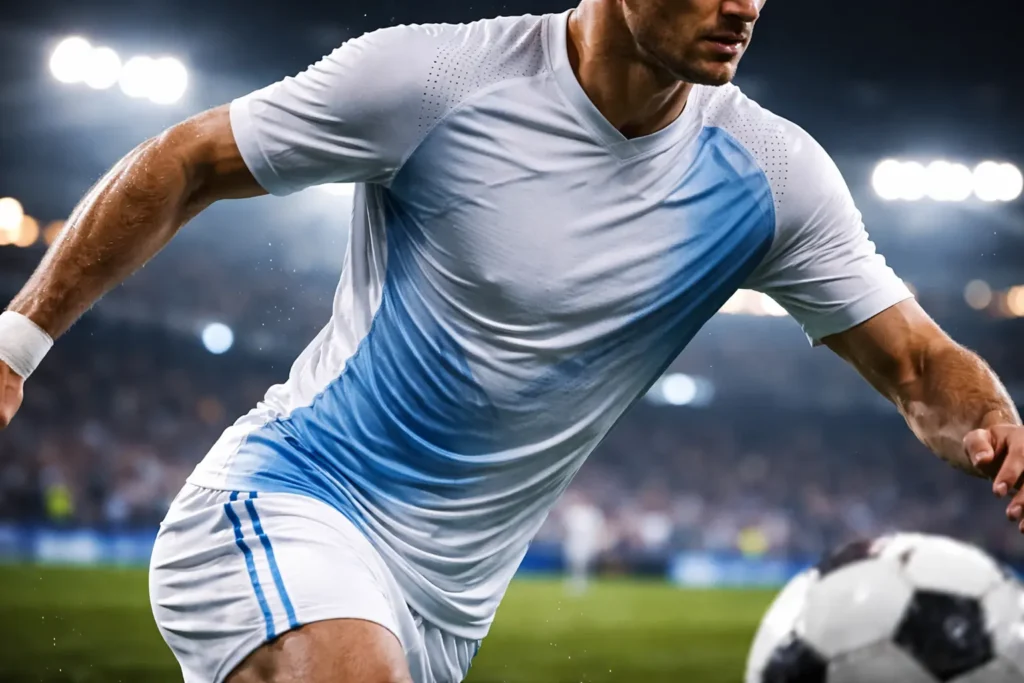
Å forstå den kjemiske sammensetningen til moderne ytelsespolymerer er det første trinnet i produksjonsprosessen. Tradisjonell bomull, med sine høye hydrofile egenskaper, holder på svetten, legger opp til 40% mer vekt på plagget i løpet av en 90-minutters kamp. Moderne produksjon bruker utelukkende mikro-konstruert polyester (KJÆLEDYR) og elastanblandinger. Disse syntetiske garnene er ekstrudert til multifilamentstrukturer som skaper mikroskopiske kanaler. Gjennom kapillærvirkning, disse kanalene trekker fuktighet bort fra epidermis til den ytre overflaten av stoffet, hvor det fordamper raskt. Denne kontinuerlige fuktighetsdampoverføringshastigheten (MVTR) er avgjørende for å opprettholde idrettsutøverens kjernekroppstemperatur. Det er en vitenskapelig dokumentert virkelighet innen den profesjonelle sportsbransjen som spesialiserte seg tilpassede fotballdrakter gir bedre ytelse spesielt fordi disse proprietære fukttransporterende strukturene forhindrer termisk utmattelse under høyintensiv kardiovaskulær anstrengelse. Dessuten, de reduserte friksjonskoeffisientene til disse syntetiske mikrofibrene minimerer hudslitasje drastisk.
Materialparametere: GSM, Spandex-blandinger, og strekkstyrke
Utover basispolymerkjemien, den fysiske arkitektoniske konstruksjonen av stoffet bestemmer dens ultimate feltytelse. Produsenter må nøye kalibrere GSM (gram per kvadratmeter). Et standard replikasett kan bruke en 150-160 GSM stoff, prioriterer holdbarhet for hverdagsbruk. derimot, autentiske kampdagsett er konstruert til et utrolig lys 110-130 GSM. For å oppnå denne vektreduksjonen uten å gå på akkord med strekkfastheten, stoffet må strikkes med avanserte interlock- eller jacquardmaskiner.
Elastane may be incorporated into selected football jersey fabrics when additional stretch and recovery are required. derimot, the appropriate fiber composition depends on the knitting structure, plagg passform, intended use, and target price point. Buyers should evaluate stretch and recovery performance through fabric testing rather than relying on a fixed elastane percentage as a universal specification.
Å anerkjenne disse tekniske forskjellene er helt avgjørende for regionale distributører og engros produsenter av fotballdrakter opererer i forskjellige klimaer, hvor balansen mellom ekstrem lett pusteevne og strukturell integritet dikterer produktets markedssuksess.
How to Select and Test Football Jersey Fabrics Before Production
Fabric selection should be based on the intended use of the football jersey rather than GSM alone. A lightweight fabric may be suitable for match-day apparel, while a team training shirt or fan replica may require a different balance of weight, opasitet, tøye ut, og holdbarhet.
B2B buyers should compare the following fabric characteristics before approving a material:
Fabric Weight and Opacity
GSM indicates the mass of a fabric per square meter, but it does not independently determine garment quality. Buyers should check whether the fabric remains sufficiently opaque when stretched, whether the color appears consistent under different lighting conditions, and whether the finished garment feels appropriate for its intended use.
Stretch and Recovery
For jerseys designed for active movement, evaluate how the fabric stretches horizontally and vertically and whether it returns to its original dimensions after repeated extension. Elastane may be included when additional stretch and recovery are required, but the ideal fiber composition depends on the fabric construction and garment design.
Moisture Management and Air Permeability
Moisture management and air permeability are related but different properties. Moisture-wicking performance concerns the movement of liquid moisture across or through a textile, while air permeability measures how easily air passes through it. Buyers should request relevant test results rather than treating one property as proof of the other.
Colorfastness and Dimensional Stability
Fabric and printed panels should be checked for color transfer, shade variation, shrinkage, and distortion after appropriate washing or conditioning tests. These checks are particularly important for team orders involving multiple sizes and repeat production batches.
A Practical Fabric Evaluation Checklist
| Test Area | What Buyers Should Check | Hvorfor det betyr noe |
|---|---|---|
| Fabric Weight | GSM consistency across rolls | Helps maintain consistent garment specifications |
| Opasitet | Transparency under stretching | Supports suitable coverage during movement |
| Stretch Recovery | Fabric returns after extension | Helps maintain fit and shape |
| Luftpermeabilitet | Airflow through the fabric | Supports ventilation requirements |
| Fuktighetshåndtering | Liquid moisture spreading and drying behavior | Helps assess fabric suitability for active use |
| Colorfastness | Resistance to washing-related color change | Helps preserve the appearance of the jersey |
For larger orders, buyers should approve the actual fabric swatch and retain a reference sample. This creates a clear benchmark for bulk production and future repeat orders.
Spillerversjon vs. Vifteversjon: Viktige konstruksjonsforskjeller
Anatomien til en autentisk kampdagskjorte
Den fysiske geometrien og skjæreprosessen til plagget presenterer enda et lag av produksjonskompleksitet. Bransjen skiller strengt mellom 'spillerversjon’ (autentisk) og 'Fan-versjon’ (replika) kutt. Autentiske kampskjorter er konstruert ved hjelp av en dynamikk, 3D atletisk snitt.
This involves a closer athletic fit and carefully shaped panels designed to follow the body’s contours and reduce excess fabric. The construction should support freedom of movement while maintaining a secure and comfortable fit during football activities. Any specific aerodynamic performance benefit should be supported by appropriate testing rather than assumed from garment fit alone.
Ermhullene er forhøyede, and the chest dimensions are tapered. For profesjonelle klubber, akademier, and semi-pro leagues seeking a closer, movement-oriented fit, abandoning generic boxy templates and sourcing custom football shirts that fit precisely to their athletes’ distinkte biometriske profiler har blitt en ikke-omsettelig anskaffelsesstandard i moderne fotball. Replika-versjonen, omvendt, bruker en straight, avslappet geometri designet for å imøtekomme et bredere utvalg av kroppsformer, prioriterer uformell komfort fremfor høyhastighets aerodynamikk.
Antropometrisk skalering på tvers av demografi
Når vi går dypere inn i antropometrisk skalering på tvers av ulike demografier, graderingen av disse mønstrene blir en intrikat matematisk øvelse. Å skalere et mønster er ikke bare et spørsmål om å krympe eller forstørre dimensjonene universelt. Barne- og ungdomskroppsgeometrier krever helt andre matematiske proporsjoner sammenlignet med fullt utviklede voksne. Skulderhellingen, fall fra bryst til midje, og ermhullsomkrets må beregnes på nytt for hver aldersgruppe for å sikre bevegelsesfrihet. En utbredt produksjonsutfordring mange merker møter ligger i å navigere i den komplekse overgangen mellom ungdomsfotballdrakter vs voksensnitts, ettersom unnlatelse av å justere den strukturelle graderingen fører til restriktive utringninger eller uforholdsmessig lange kantlinjer som hindrer en ung idrettsutøvers biomekanikk på banen. Avanserte mønstermakere bruker digital CAD-programvare for å gradere disse spesifikke dimensjonsovergangene perfekt, sikre optimal ytelse på hvert akademinivå.
Football Jersey Sample Development and Pre-Production Approval
A successful bulk manufacturing project should begin with a clearly documented sample approval process. Even when a buyer has supplied complete artwork and technical specifications, a physical sample is necessary to confirm how the design, stoff, passe, and construction work together.
The sample development process should include the following stages:
Stage 1: Artwork and Technical Specification Review
Before sample production, the buyer and manufacturer should confirm the jersey design, color references, sponsorlogoer, club crest dimensions, spillernavn, tall, printing positions, and size requirements. Artwork files should be checked for resolution, color mode, and production compatibility.
Stage 2: Fabric and Color Confirmation
The selected fabric should be checked against the agreed material specification, GSM range, tekstur, and stretch requirements. Printed color swatches or fabric panels should be reviewed under consistent lighting before the full garment sample is approved.
Stage 3: Fit and Measurement Review
The sample should be measured against the approved size chart. Buyers should check chest width, kroppslengde, skulderbredde, ermelengde, armhole construction, and neckline dimensions. If the order includes adult and youth sizes, each size range should be reviewed separately.
Stage 4: Construction and Branding Inspection
Inspect the stitching, sømmer, hems, etiketter, printed graphics, merker, and heat-applied elements. Pay particular attention to logo alignment, edge finishing, and whether decorative components remain securely attached during normal handling.
Stage 5: Written Pre-Production Approval
Once the sample meets the agreed requirements, both parties should retain an approved reference sample or documented approval record. Any subsequent changes to fabric, artwork, measurements, or construction should be confirmed before bulk production begins.
Pre-Production Sample Approval Checklist
| Inspection Item | Approval Requirement |
|---|---|
| Artwork | Correct logos, sponsor graphics, navn, og tall |
| Stoff | Agreed composition, vekt, tekstur, og farge |
| Mål | Dimensions match the approved size chart |
| Konstruksjon | Consistent stitching, sømmer, hems, and finishing |
| Merkevarebygging | Correct placement, utseende, and attachment |
| Packaging | Approved labels, folding, and packing requirements |
A signed-off sample is an important production reference. It helps reduce misunderstandings between the buyer and factory and provides a practical benchmark for bulk quality inspections.
Avansert pusteevne: Laserkuttet ventilasjon & Mesh soner
Termoregulering på banen
De termoregulatoriske kravene som stilles til menneskekroppen under en profesjonell kamp er ekstreme. En midtbanespiller kan dekke over 11 kilometer, genererer enorm metabolsk varme. For å bekjempe dette, elitefotballskjorter integrerer avanserte kroppskarterte ventilasjonssystemer. Ved å analysere termiske bildedata, ingeniører identifiserer høyvarmesoner - hovedsakelig armhulene, midten av brystet, og den nedre korsryggen. Fabrikkene bruker deretter spesialiserte jacquard-strikketeknikker for å sømløst overføre stoffet fra en solid interlock-struktur til en mesh med åpent hull i nøyaktig samme kontinuerlige stoffpanel.. Forstå denne termodynamiske vitenskapen, ved siden av å vite nøyaktig hvordan størrelse for hver aldersgruppe, sørger for at plagget fungerer som en aktiv kjølemekanisme i stedet for en termisk felle, drastisk utvide en spillers toppytelsesvindu. Denne sømløse overgangen eliminerer behovet for store innvendige sømmer som kan forårsake gnagsår, opprettholde et perfekt glatt interiør.
Engineering laserkuttede perforeringer
Presisjonen som kreves for å utføre ytterligere avansert ventilasjon, bringer oss til laserkuttede perforeringer. I avanserte spillerversjoner, fabrikker bruker datastyrte CO2-lasere for å brenne mikroskopiske hull inn i sidepanelene. Laseren kutter ikke bare stoffet, men kauteriserer samtidig de syntetiske kantene, forhindrer at materialet frynses under den enorme påkjenningen av en fyrstikk.
Laser-cut perforations can create localized ventilation openings and may reduce material in selected areas. Their practical contribution depends on hole size, plassering, fabric construction, and the garment’s overall design. Buyers should evaluate the finished garment for airflow, edge quality, and fabric stability.
Integrering av disse hyperavanserte aerodynamiske og termoregulatoriske funksjonene krever en sofistikert produksjonspartner utstyrt med toppmoderne automatiserte maskiner. For å diskutere integrering av disse elitespesifikasjonene i din neste kommersielle bestilling, eller for å be om en detaljert teknisk konsultasjon, vi oppfordrer deg til kontakt oss direkte for å snakke med vårt produksjonsingeniørteam. Vårt anlegg bygger bro mellom innovativ tekstilvitenskap og skalerbar engrosproduksjon, sikre at hver søm tjener et funksjonelt formål.
Teknisk spesifikasjon: Spillerversjon vs. Vifteversjon
For å fullt ut forstå produksjonskravene, B2B-kjøpere må forstå de nøyaktige fysiske og kjemiske forskjellene mellom de to primære lagene av fotballklær.
| Spesifikasjonsparameter | Spillerversjon (Autentisk match) | Vifteversjon (Replica Stadium) |
| GSM stoff | 110 – 130 GSM (Ultralett) | 150 – 160 GSM (Standard vekt) |
| Materialblanding | 88-92% Polyester / 8-12% Elastan | 100% Polyester (Minimal strekk) |
| Tilpass geometri | 3D Ergonomisk atletisk snitt (Avsmalnet) | Standard rett snitt (Avslappet) |
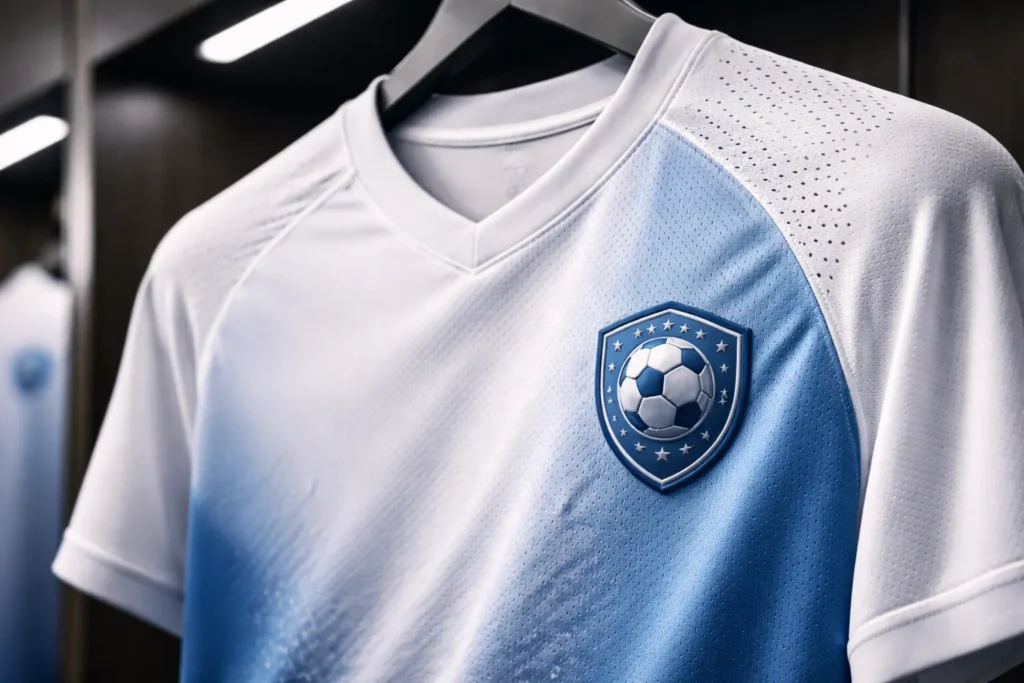
| Club Crest/logo | Varmepresset 3D Silikon/TPU | Direkte broderi eller vevd lapp |
| Ventilasjonsteknologi | Laserkuttede hull & kartlagt jacquard mesh | Standard enhetlig stoffkonstruksjon |
| Hemline profil | Buet drop-tail kant (for å stikke inn) | Rett fald |
Avanserte merkevareteknologier innen sportsklær
Skiftet til varmepåførte 3D-silikonkammer
Historisk sett, fotballklubber viste sin identitet gjennom sterkt broderte emblemer. Mens tradisjonell, disse tykke lappene gir unødvendig vekt og skaper stive områder på brystet. Verre, de slipende støttetrådene inne i skjorten forårsaker alvorlig friksjon mot huden, fører til det beryktede problemet med gnaging av brystvorten under langvarig atletisk anstrengelse. Moderne produksjon har løst dette via varmepåført 3D silikon og termoplastisk polyuretan (TPU) merker.
Disse avanserte toppene er produsert ved hjelp av sprøytestøping, skape svært detaljerte, flerteksturert, og metallisk finish som er umulig å oppnå med nål og tråd. Under plaggmontering, industrielle varmepresser binder silikonet direkte til polyesteren ved presise temperaturer (typisk 150°C til 160°C for 12-15 sekunder). Dette resulterer i en fullstendig flush, friksjonsfritt interiør. For idrettsutøveren, det sparer kritiske gram vekt; for den kommersielle kjøperen, det gir en slank, futuristisk, og høykvalitets estetikk som krever en høyere utsalgspris.
Tradisjonelt direkte broderi og vevde merker
Til tross for den atletiske overlegenheten til silikonkammene, direkte broderi og vevde merker med høy tetthet er fortsatt mye brukt i produksjonen av vifteversjoner. Logikken her er forankret i forbrukeratferd og livssyklus holdbarhet. Replikasett utsettes for ubarmhjertige sykluser i standard husholdningsvaskemaskiner og høyvarme tørketromler, forhold som til slutt kan bryte ned termiske lim. Kraftig broderi sikrer at klubbemblemet overlever år med streng vask uten å flasse. For en grossist kjøper, balansere inventaret mellom høyteknologiske spillerversjoner og holdbare, kostnadseffektive broderte vifteversjoner er nøkkelen til å maksimere markedspenetrasjonen.
How to Inspect Football Jersey Logos, Badges, and Printing Quality
Branding is one of the most visible elements of a custom football jersey. Club crests, sponsor graphics, spillernavn, and numbers must remain consistent with the approved design across the entire production batch.
Different branding methods require different inspection criteria. Buyers should not apply the same acceptance standard to sublimation graphics, heat-applied badges, broderi, and woven patches.
Sublimation Printing Inspection
Check whether the printed design matches the approved artwork and color references. Inspect gradients, fine lines, sponsorlogoer, and panel alignment. Look for visible banding, blurred edges, uneven color areas, or unwanted marks.
Silicone and TPU Badge Inspection
Check the badge dimensions, thickness, surface finish, posisjonering, and edge bonding. Gently inspect the perimeter for lifting or incomplete adhesion. The appropriate bonding settings depend on the badge material, fabric construction, and heat-press equipment, so buyers should approve the actual production result rather than relying on one universal temperature or pressing time.
Embroidery and Woven Patch Inspection
Inspect stitch density, edge finishing, thread consistency, patch alignment, and backing comfort. The badge should be securely attached without excessive puckering or loose threads.
Names, Numbers, and Sponsor Graphics
For personalized team orders, compare the printed or applied names and numbers against the final roster. Check spelling, font style, størrelse, posisjon, and alignment. A small artwork error can affect multiple garments if it is not identified before production.
Branding Quality Inspection Checklist
| Component | Key Inspection Points |
|---|---|
| Sublimation Graphics | Color accuracy, sharpness, alignment, and print defects |
| Silikon / TPU Badges | Position, edge bonding, thickness, and surface finish |
| Embroidery | Stitch consistency, loose threads, and backing finish |
| Woven Patches | Artwork clarity, dimensions, and attachment |
| Names and Numbers | Spelling, font, størrelse, and placement |
| Sponsor Logos | Artwork accuracy and consistent positioning |
For massebestillinger, buyers should define the acceptable appearance and attachment standards before production. A documented approval sample makes it easier for the factory’s quality-control team to inspect every batch consistently.
The Physics of Dye-Sublimation Printing
Blekkpenetrering med høy temperatur
Når du produserer levende, flerfargede sett med komplekse gradienter eller sponsorlogoer, tradisjonell silketrykk er foreldet. Silketrykt plastisolblekk sitter på toppen av stoffet, blokkerer pusteevnen og til slutt sprekker under stress. Førsteklasses atletisk klær er helt avhengig av fargesublimasjonsutskrift.
Denne prosessen involverer utskrift av grafikken på spesialisert overføringspapir ved bruk av disperse fargestoffer. Papiret og det blanke hvite polyesterstoffet mates deretter gjennom en industriell roterende kalender-kalenderpresse ved temperaturer over 200°C (392°F). Under denne ekstreme varmen og trykket, det faste fargestoffet blir umiddelbart til en gass (sublimering) og gjennomsyrer de åpne porene i polyesterfibrene. Når stoffet avkjøles, porene lukkes, fanger pigmentet permanent inne i garnet.
Oppnå absolutt fargefasthet
Because disperse dyes are transferred into polyester fibers during sublimation, the process can produce durable graphics without creating the same surface film associated with some other printing methods. derimot, color performance still depends on ink quality, transfer conditions, fabric composition, and aftercare. Buyers should assess colorfastness through appropriate washing and exposure tests and should not assume that printed garments are completely immune to fading or wear.
Sublimation printing generally preserves the fabric’s original structure more effectively than methods that create a continuous surface coating. Likevel, the finished garment’s breathability and moisture-management performance depend on the underlying fabric construction and should be evaluated separately.
B2B-anskaffelsesteam må sikre at deres produksjonspartnere bruker høy kvalitet, miljøvennlig sublimeringsblekk (slik som EPSON eller Kiian) for å oppnå de dypeste sortene og de mest levende neonfargene som kreves av moderne klubbmerke.

Overholdelse, Bærekraft, og industriforskriften
Global tekstilsikkerhet: OEKO-TEX Standard 100
Textile products entering markets such as the European Union and North America must meet the applicable chemical safety and product compliance requirements. OEKO-TEX STANDARD 100 is a voluntary product certification that tests textiles and their components for harmful substances. It can provide useful supporting evidence for buyers, merkevarer, and retailers, but it should not be presented as a universal mandatory import certificate.
Buyers should check the certificate number, validity, certificate holder, product description, and certified article scope. They should also confirm whether the actual fabric, utskriftsprosess, tilbehør, and finished garment are covered by the relevant certification.
Denne uavhengige testingen garanterer at hver enkelt komponent i plagget – fra polyestergarn og sublimasjonsfargestoffer til sytråder og silikonkammene – har blitt grundig testet for skadelige stoffer.
Fasilitetene må bevise det absolutte fraværet av kreftfremkallende azofargestoffer, tungmetaller, formaldehyd, og skadelige ftalater. Unnlatelse av å verifisere en produsents OEKO-TEX-overholdelse kan føre til at hele engrosforsendelser blir beslaglagt av tollmyndighetene, resulterer i katastrofale økonomiske tap og merkevareskade.
Push for resirkulert polyester (rPET) og GRS-sertifisering
Drevet av globale mandater fra store styringsorganer som FIFA og IOC, sportsklærindustrien gjennomgår en massiv dreining mot bærekraft. Produksjonen av virgin polyester er sterkt avhengig av petroleumsutvinning.
Resirkulert polyester (rPET) can be produced from eligible recycled feedstocks, including certain post-consumer PET materials. The source of recycled content should be verified through appropriate supplier documentation and chain-of-custody records. It should not automatically be described as ocean-recovered plastic unless the specific material origin can be demonstrated.
Recycled polyester can be engineered for sportswear applications, but its performance depends on the feedstock, recycling process, yarn quality, knitting structure, and finishing treatments. Buyers should compare recycled and virgin polyester fabrics using the same relevant performance tests rather than assuming that both materials perform identically.
When making verified recycled-content claims, brands should obtain appropriate transaction documentation and traceability evidence for the materials used. Den globale resirkulerte standarden (GRS) provides a framework for verifying recycled content and tracking materials through the supply chain, subject to its certification and claim requirements.This certification tracks the entire supply chain, sørge for verifisert sporbarhet av resirkulerte materialer og sikre at etisk arbeidspraksis ble opprettholdt under produksjonen.
Produksjonstidslinjer og kvalitetssikringsprotokoller
Administrere ledetider i forsyningskjeden
For B2B-distributører, koordinering av levering av drakter før starten av en ny sportssesong er avgjørende. Å forstå fabrikkens ledetider forhindrer kostbare flaskehalser i forsyningskjeden. Standard produksjonssyklus begynner med prøvetakingsfasen, som vanligvis krever 7 til 14 dager. Under dette vinduet, fabrikken ingeniører CAD-mønstrene, tester sublimeringsfargekodene på fysiske fargeprøver, og produserer en finale “Toppen av produksjonen” (TOPP) prøve for godkjenning.
Når den er godkjent, Bulkproduksjonen starter. For standard engrosbestillinger fra 1,000 til 10,000 enheter, skjæringen, sublimering, sying, og trykke tidslinje spenner 30 til 45 dager. Kjøpere må strategisk innregne ytterligere maritime frakttider (typisk 25-35 dager til EU/USA-havner) og potensiell overbelastning på fabrikken før store globale turneringer som verdensmesterskapet eller EM.
Football Jersey Manufacturing Costs, Lead Times, and Reorder Planning
The cost of a professional football jersey is influenced by more than fabric consumption and sewing labor. Customization requirements, order quantity, emballasje, quality-control procedures, and shipping arrangements can all affect the final landed cost.
For distributors, klubber, and sportswear brands, evaluating the complete order cost is more useful than comparing the factory unit price alone.
What Affects the Manufacturing Cost?
- Fabric and Material: Fiber composition, stoffvekt, knitting structure, and special performance features influence material costs.
- Tilpasning: Sublimation artwork, silicone badges, broderi, woven patches, navn, and numbers may require different processes and additional labor.
- bestillings antall: Larger orders may distribute setup and development costs across more units, subject to the factory’s minimum order requirements and production efficiency.
- Packaging: Individual bags, size labels, hangtags, customized cartons, and retail-ready packaging can affect the total quotation.
- Inspection and Testing: Additional fabric tests, sample revisions, or third-party inspections should be included in the project budget when required.
- Logistics: Freight, insurance, customs duties, brokerage, and destination delivery contribute to the final landed cost.
How to Calculate the Landed Cost
A practical comparison should include all major expenses associated with bringing the finished jerseys to the buyer’s destination.
Landed Cost = Product Cost + Sampling and Development + Packaging + Freight + Insurance + Import Duties and Taxes + Customs and Local Delivery Charges
The exact calculation depends on the agreed Incoterms, destination country, shipping method, and applicable import rules. Buyers should confirm which costs are included in the supplier’s quotation and which remain their responsibility.
How to Plan Production and Delivery
A realistic production schedule should distinguish between sample development, sample revisions, bulk manufacturing, final inspection, og transport. The timeline should also account for artwork approval, size-list confirmation, material availability, and public holidays.
Instead of relying on a general lead-time estimate, buyers should request a written production schedule with clear milestones:
- Artwork and specification confirmation
- Fabric and color approval
- Sample production and revisions
- Pre-production sample sign-off
- Bulk cutting, printing, and sewing
- Final inspection and packing
- Shipment booking and dispatch
Keeping Reorders Consistent
For repeat orders, buyers should retain the approved sample, artwork files, fabric specifications, color references, size charts, label details, and packaging requirements. These records help the manufacturer compare new production batches with the original order.
Before confirming a reorder, buyers should also check whether the original fabric, dye lot, trimmer, and production methods are still available. If any specification has changed, the difference should be reviewed and approved before manufacturing.
Good reorder management helps reduce avoidable variation and makes long-term teamwear sourcing more predictable.
Fire-punkts stoffinspeksjonssystemet
Eksklusive fabrikker implementerer det internasjonalt anerkjente firepunktssystemet for stoffkvalitetskontroll før et enkelt panel kuttes. Ruller med polyester mates gjennom opplyste inspeksjonsmaskiner der teknikere straffer stoffet for defekter som haker, manglende garn, fargeflekker, eller fargevariasjoner. Hvis et kast samler seg mer enn 40 straffepoeng pr 100 kvadrat meter, det avvises fullstendig. Ettermontering, plagg gjennomgår strenge nåledeteksjonsprotokoller og sømstyrketesting for å sikre at de tåler den fysiske aggresjonen fra konkurrerende fotball. Å samarbeide med en produsent som åpent deler disse QA-rapportene er den ultimate sikringen for investeringen din.
Bulk Football Jersey Quality Control: From Fabric Inspection to Final Packing
Quality control should cover the entire manufacturing process rather than relying only on a final visual inspection. For wholesale football jersey orders, defects identified after shipment can lead to replacement costs, delayed deliveries, and additional communication between buyers and suppliers.
A structured inspection plan should include several checkpoints.
1. Incoming Fabric Inspection
Before cutting begins, inspect fabric rolls for holes, snags, stains, shade variation, uneven knitting, and inconsistent weight. Fabric lots should be checked against the approved material specification and reference swatches.
2. Cutting and Panel Inspection
Check panel dimensions, cutting accuracy, stoffretning, and matching components. For patterned or sublimated jerseys, confirm that graphics align correctly across adjoining panels.
3. Sewing and Assembly Inspection
Inspect seam consistency, stitch density, neckline construction, sleeve attachment, hems, and loose threads. Pay attention to stress areas such as underarms and side seams, where poor construction may become visible during wear.
4. Finished Garment Inspection
Compare finished garments with the approved sample and measurement chart. Check garment dimensions, utskriftskvalitet, plassering av logo, color consistency, labeling, and overall appearance.
5. Packing and Shipment Inspection
Confirm that size labels, product labels, quantities, folding methods, and carton markings match the purchase order. For personalized team orders, check that each name and number corresponds to the correct size and quantity.
Recommended Quality Control Checkpoints
| Produksjonsstadiet | Inspection Focus | Required Record |
|---|---|---|
| Fabric Receiving | Vekt, defects, shade, and material specifications | Fabric inspection report |
| Panel Cutting | Dimensions, panel matching, and cutting accuracy | Cutting inspection record |
| Sying | Sømmer, stitches, hems, og konstruksjon | In-process inspection report |
| Etterbehandling | Logos, printing, measurements, og utseende | Finished garment checklist |
| Pakking | Labels, størrelser, quantities, and carton details | Packing list and final inspection record |
Buyers should agree on the inspection method, sampling level, defect classification, and acceptance criteria before production. For larger orders, an independent pre-shipment inspection may also be considered when required by the purchase agreement.
A documented quality-control process gives both the manufacturer and buyer a clearer basis for evaluating the finished order.

Frequently Asked Questions About Professional Football Jersey Manufacturing
1. What fabric is commonly used for professional football jerseys?
Polyester-based fabrics are widely used in football jersey manufacturing because they can be engineered for lightweight construction, fuktighetshåndtering, color printing, and easy-care performance. Some designs incorporate elastane to provide additional stretch and recovery. The best fabric depends on the intended use, passe, klima, and buyer’s technical requirements.
2. What is the difference between player version and fan version football jerseys?
Player version jerseys generally feature a closer athletic fit and may incorporate lightweight fabrics, engineered mesh panels, and heat-applied branding. Fan version jerseys typically use a more relaxed fit designed for everyday comfort. Exact differences vary by manufacturer and product specification, so buyers should compare approved samples rather than rely on product labels alone.
3. How do manufacturers check football jersey quality before bulk production?
A professional quality-control process may include fabric inspection, measurement checks, cutting accuracy, stitching inspection, print and badge verification, finished garment inspection, and packing checks. Buyers should agree on inspection criteria and retain an approved pre-production sample as a reference for bulk manufacturing.
4. Is sublimation printing suitable for custom football jerseys?
Dye-sublimation is widely used for polyester football jerseys, particularly when designs include gradients, multiple colors, sponsor graphics, and detailed patterns. The dye is transferred into the polyester fibers rather than forming a conventional surface layer. Final color performance depends on the fabric, inks, transfer conditions, and care practices, so appropriate colorfastness testing is recommended.
5. What should buyers check when sourcing football jerseys from a manufacturer?
Buyers should evaluate the manufacturer’s production capabilities, fabric specifications, tilpasningsalternativer, sample development process, quality-control procedures, certification documents, minimum order requirements, production lead times, and shipping arrangements. A clear technical specification and written sample approval process help reduce misunderstandings before bulk production.
Referanser:
- “Termodynamiske egenskaper til mikrokonstruert polyester i elitesportsklær.” Dr. Alistair Vance, Tekstilinstitutt for biomekanikk, Journal of Athletic Apparel Science.
- “Aerodynamisk dragreduksjon i 3D ergonomiske fotballdrakter.” Dr. Elena Rostova, European Institute of Sports Technology, International Journal of Sports Physics.
- “Fysikken til disperse fargestoffer i høytemperatursublimering.” Dr. Kenji Sato, Tokyo Polymer Research Center, Digital Textile Engineering Quarterly.
- “Hudfriksjon og slitasjeminimering via TPU Heat-Press-teknologier.” Dr. Sarah Jenkins, Global Dermatology in Sports Initiative, Journal of Sports Medicine.
- “Livssyklusanalyse av rPET (Resirkulert polyetylentereftalat) i kommersielle sportsklær.” Dr. Marcus Thorne, Institutt for bærekraftige tekstiler, Green Manufacturing Review.
- “Antropometrisk skalering og mønstergradering for atletisk klær.” Dr. Chloe Dubois, Paris Academy of Fashion Technology, Apparel Engineering Journal.
- “OEKO-TEX Standard 100: Samsvar og global forsyningskjedepåvirkning.” Regulatory Board for International OEKO-TEX Association, Tekstilsamsvar årlig.
- “Transmisjonshastigheter for fuktighetsdamp (MVTR) i Jacquard Knit Structures.” Dr. Wei Chen, Advanced Material Sciences Laboratory, Polymer Performance Journal.
Ekspertinnsikt: Strategisk anskaffelse av profesjonelle fotballdrakter
Kjerneinnkjøpslogikk (Hvorfor & Hva): Innkjøp av kommersielle fotballdrakter går langt utover grunnleggende klipp-og-sy-operasjoner; det krever å bygge bro mellom atletisk biomekanikk og tekstilfysikk. Den grunnleggende produksjonsbeslutningen er avhengig av å konstruere et stoff som balanserer en ultralav GSM (vekt) med høy overføringshastighet for fuktighetsdamp (MVTR). Ved å spesifisere mikrokonstruert polyester med en 8-12% elastan blanding, B2B-kjøpere sikrer plagg som gir aerodynamisk fireveis stretch mens de aktivt kjøler ned atleten gjennom kapillær fuktighetsstyring.
Strategiske alternativer & Tekniske hensyn
-
Spiller vs. Fan arkitektur (Alternativ)
Den geometriske distinksjonen: Grossistkjøpere må eksplisitt segmentere beholdningen sin. Spillerversjoner krever en 3D ergonomisk avsmalning og laserkuttede perforeringer for å eliminere aerodynamisk motstand. Omvendt, Vifteversjoner krever en avslappet, rett geometri for å imøtekomme ulike kroppsformer, kombinert med kraftig direkte broderi for maksimal holdbarhet ved husvask. -
Silikon 3D Crests vs. gnagsår (Hensyn)
Atletisk risikoreduksjon: Tradisjonelle broderte lapper skaper et stivt friksjonspunkt på brystet, fører til alvorlig hudslitasje under intense 90-minutters kamper. Førsteklasses kildespesifikasjoner krever varmepåførte 3D TPU- eller silikonemblemer for elitesett. Disse binder seg helt i flukt med polyestermatrisen for å eliminere indre friksjon helt og samtidig barberer kritiske gram av den totale vekten. -
Kjemisk sikkerhet & OEKO-TEX (Overholdelse)
Navigere Global Customs: Å bruke høytemperaturfargesublimering krever absolutt kjemisk sikkerhet. B2B-anskaffelseskontrakter må kreve OEKO-TEX Standard 100 sertifisering for å vitenskapelig bevise fraværet av kreftfremkallende azofargestoffer og tungmetaller, sikre jevn fortolling i strengt regulerte europeiske og nordamerikanske markeder.
Final Takeaway: Building a Reliable Football Jersey Manufacturing Partnership
Professional football jersey manufacturing combines textile selection, pattern engineering, ventilation design, branding technology, kvalitetskontroll, and supply chain coordination. Each element contributes to the finished garment, but no single technical feature can guarantee overall product quality.
For klubber, distributors, and sportswear brands, successful sourcing begins with clear product specifications and a qualified manufacturing partner. Buyers should evaluate fabric performance, passe, customization methods, sample accuracy, inspection procedures, and delivery arrangements before approving a bulk order.
A well-managed production process also requires documented sample approval, consistent quality standards, and reliable communication between the buyer and manufacturer. These practices help reduce production uncertainty and support more consistent results across repeat orders.
Whether developing player-inspired match jerseys, fan replicas, treningssett, or fully customized teamwear, working with an experienced football jersey manufacturer can help turn design concepts into commercially practical products.
YSTAR Wear supports custom sportswear development and OEM/ODM manufacturing for buyers looking for personalized football jerseys, teamwear, and related apparel solutions. Contact the team to discuss fabric options, customization requirements, sample development, and bulk production planning.