Quick Overview: Professional Football Jersey Manufacturing
The intersection of sports science and textile engineering has fundamentally transformed athletic apparel. The manufacturing of a professional football jersey is no longer a simple cut-and-sew operation; it is a highly sophisticated discipline requiring a profound understanding of thermodynamics, aerodynamiikka, and polymer chemistry. For decades, players competed in heavy, moisture-absorbing fabrics that restricted movement and increased fatigue. Tänään, the global sportswear market demands ultra-lightweight, hydrophobic materials engineered to enhance athletic output. Procurement officers, klubien johtajat, and sportswear brands face an increasingly complex supply chain when sourcing these specialized garments. Identifying a factory with the technological infrastructure to execute high-density sublimation, laser-cut ventilation, and ergonomic 3D tailoring is paramount. This complexity has driven a significant shift in B2B sourcing strategies, leading to a massive rise in demand for technologically advanced jalkapallopaidan tukkuvalmistajat capable of meeting stringent international performance standards.
How to Evaluate a Professional Football Jersey Manufacturer
Choosing a professional football jersey manufacturer involves more than comparing product photos or requesting the lowest quotation. Klubeille, jakelijat, sportswear brands, ja omien merkkien ostajat, the manufacturer’s production capabilities directly affect product consistency, customization flexibility, and delivery reliability.
Before placing a bulk order, buyers should evaluate several important areas:
1. Production Equipment and In-House Capabilities
Ask whether the manufacturer handles key processes internally or relies on multiple subcontractors. Relevant capabilities may include fabric inspection, digital sublimation printing, precision cutting, ompelu, heat pressing, viimeistely, and final garment inspection. A clear understanding of the production workflow helps buyers identify potential quality-control gaps.
2. Experience with Custom Teamwear
A supplier experienced in football apparel should understand different jersey structures, player and fan fits, nuorten mitoitus, sponsor artwork, club crests, numerointi, and personalized names. Buyers should request relevant product samples or production examples to assess whether the factory can handle their specific requirements.
3. Sample Development and Quality Control
A reliable manufacturer should have a defined sample approval process and documented inspection procedures. Buyers should confirm how fabric specifications, garment measurements, print colors, logon sijoitus, ompelemalla, and packaging are checked before shipment.
4. Certification and Documentation
If a project requires textile safety or recycled-content claims, request the relevant certificates and verify their scope, validity, and applicability to the actual product and production site. A certificate should not be treated as automatic proof that every material or component in an order is covered.
5. Communication and Reorder Support
For repeat teamwear programs, the supplier should be able to retain approved artwork, measurement specifications, material details, color references, and production records. These records make future orders easier to compare with the original approved batch.
A practical supplier evaluation should consider production capability, sample accuracy, quality documentation, viestintää, and delivery performance together. The lowest initial quotation is not necessarily the most cost-effective choice if it creates additional inspection, rework, or replacement costs.
The Evolution of High-Performance Football Kit Fabrics
From Heavy Cotton to Micro-Engineered Polyester
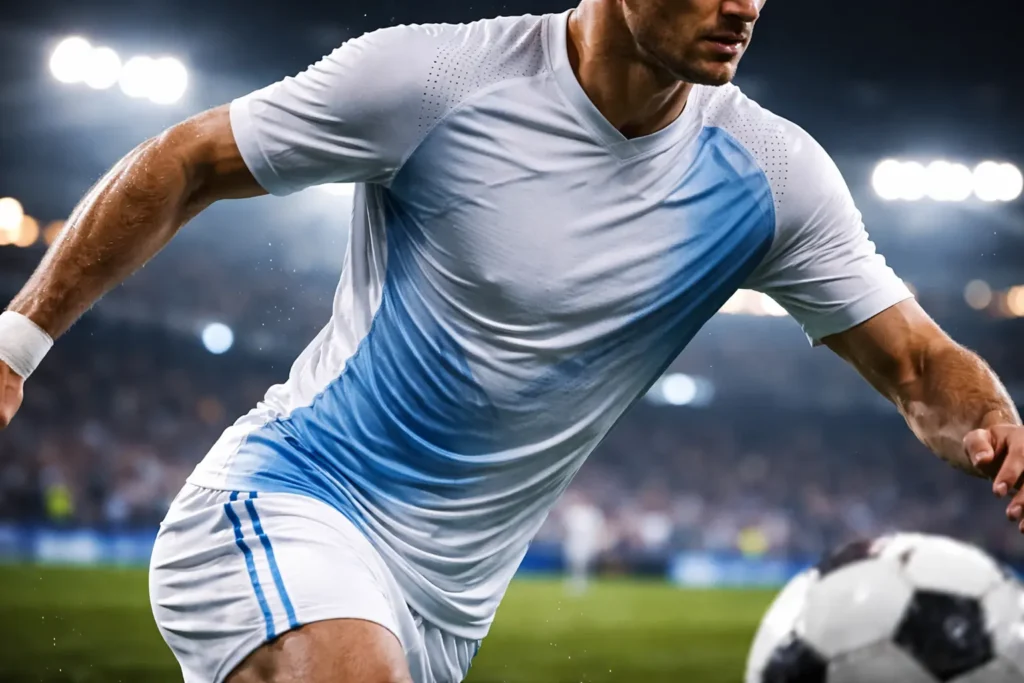
Understanding the chemical composition of modern performance polymers is the first step in the manufacturing process. Traditional cotton, with its high hydrophilic properties, retains sweat, adding up to 40% more weight to the garment during a 90-minute match. Modern production exclusively utilizes micro-engineered polyester (PET) and elastane blends. These synthetic yarns are extruded into multifilament structures that create microscopic channels. Through capillary action, these channels draw moisture away from the epidermis to the outer surface of the fabric, where it evaporates rapidly. This continuous moisture vapor transmission rate (MVTR) is essential for maintaining the athlete’s core body temperature. It is a scientifically documented reality within the professional sports industry that specialized custom football jerseys offer better performance specifically because these proprietary moisture-wicking structures prevent thermal exhaustion during high-intensity cardiovascular exertion. Lisäksi, the reduced friction coefficients of these synthetic microfibers drastically minimize skin abrasions.
Material Parameters: GSM, Spandex Blends, and Tensile Strength
Beyond the base polymer chemistry, the physical architectural construction of the fabric determines its ultimate field performance. Manufacturers must carefully calibrate the GSM (Grams per Square Meter). A standard replica kit may utilize a 150-160 GSM fabric, prioritizing durability for everyday wear. kuitenkin, authentic match day kits are engineered to an incredibly light 110-130 GSM. To achieve this weight reduction without compromising tensile strength, the fabric must be knitted using advanced interlock or jacquard machines.
Elastane may be incorporated into selected football jersey fabrics when additional stretch and recovery are required. kuitenkin, the appropriate fiber composition depends on the knitting structure, garment fit, intended use, and target price point. Buyers should evaluate stretch and recovery performance through fabric testing rather than relying on a fixed elastane percentage as a universal specification.
Recognizing these technical distinctions is absolutely critical for regional distributors and jalkapallopaidan tukkuvalmistajat operating in diverse climates, where the balance between extreme lightweight breathability and structural integrity dictates the product’s market success.
How to Select and Test Football Jersey Fabrics Before Production
Fabric selection should be based on the intended use of the football jersey rather than GSM alone. A lightweight fabric may be suitable for match-day apparel, while a team training shirt or fan replica may require a different balance of weight, opasiteetti, venyttää, ja kestävyys.
B2B buyers should compare the following fabric characteristics before approving a material:
Fabric Weight and Opacity
GSM indicates the mass of a fabric per square meter, but it does not independently determine garment quality. Buyers should check whether the fabric remains sufficiently opaque when stretched, whether the color appears consistent under different lighting conditions, and whether the finished garment feels appropriate for its intended use.
Stretch and Recovery
For jerseys designed for active movement, evaluate how the fabric stretches horizontally and vertically and whether it returns to its original dimensions after repeated extension. Elastane may be included when additional stretch and recovery are required, but the ideal fiber composition depends on the fabric construction and garment design.
Moisture Management and Air Permeability
Moisture management and air permeability are related but different properties. Moisture-wicking performance concerns the movement of liquid moisture across or through a textile, while air permeability measures how easily air passes through it. Buyers should request relevant test results rather than treating one property as proof of the other.
Colorfastness and Dimensional Stability
Fabric and printed panels should be checked for color transfer, shade variation, shrinkage, and distortion after appropriate washing or conditioning tests. These checks are particularly important for team orders involving multiple sizes and repeat production batches.
A Practical Fabric Evaluation Checklist
| Testialue | What Buyers Should Check | Miksi sillä on merkitystä |
|---|---|---|
| Kankaan paino | GSM consistency across rolls | Helps maintain consistent garment specifications |
| Peittävyys | Transparency under stretching | Supports suitable coverage during movement |
| Stretch Recovery | Fabric returns after extension | Helps maintain fit and shape |
| Air Permeability | Airflow through the fabric | Supports ventilation requirements |
| Kosteudenhallinta | Liquid moisture spreading and drying behavior | Helps assess fabric suitability for active use |
| Värinkesto | Resistance to washing-related color change | Helps preserve the appearance of the jersey |
For larger orders, buyers should approve the actual fabric swatch and retain a reference sample. This creates a clear benchmark for bulk production and future repeat orders.
Player Version vs. Fani versio: Key Construction Differences
The Anatomy of an Authentic Match Day Shirt
The physical geometry and cutting process of the garment present another layer of manufacturing complexity. The industry strictly differentiates between ‘Player Version’ (authentic) and ‘Fan Version’ (replica) leikkaus. Authentic match day shirts are constructed using a dynamic, 3D athletic cut.
This involves a closer athletic fit and carefully shaped panels designed to follow the body’s contours and reduce excess fabric. The construction should support freedom of movement while maintaining a secure and comfortable fit during football activities. Any specific aerodynamic performance benefit should be supported by appropriate testing rather than assumed from garment fit alone.
The armholes are elevated, and the chest dimensions are tapered. For professional clubs, akatemiat, and semi-pro leagues seeking a closer, movement-oriented fit, luopumalla yleisistä boxy-malleista ja hankinnasta mukautetut jalkapallopaidat, jotka sopivat precisely to their athletes’ distinct biometric profiles has become a non-negotiable procurement standard in modern football. The replica version, päinvastoin, utilizes a straight, relaxed geometry designed to accommodate a wider variety of body shapes, prioritizing casual comfort over high-speed aerodynamics.
Anthropometric Scaling Across Demographics
As we delve deeper into anthropometric scaling across different demographics, the grading of these patterns becomes an intricate mathematical exercise. Scaling a pattern is not simply a matter of universally shrinking or enlarging the dimensions. Pediatric and adolescent body geometries require entirely different mathematical proportions compared to fully developed adults. Olkapään kaltevuus, rinnasta vyötärölle laskeva, and armhole circumference must be recalculated for each age bracket to ensure freedom of movement. A prevalent manufacturing challenge encountered by many brands lies in navigating the complex transition between youth football jerseys vs adult cuts, as failing to adjust the structural grading leads to restrictive necklines or disproportionately long hemlines that hinder a young athlete’s biomechanics on the pitch. Advanced pattern makers utilize digital CAD software to perfectly grade these specific dimensional transitions, ensuring optimal performance at every academy level.
Football Jersey Sample Development and Pre-Production Approval
A successful bulk manufacturing project should begin with a clearly documented sample approval process. Even when a buyer has supplied complete artwork and technical specifications, a physical sample is necessary to confirm how the design, kangas, sovi, and construction work together.
The sample development process should include the following stages:
Stage 1: Artwork and Technical Specification Review
Before sample production, the buyer and manufacturer should confirm the jersey design, color references, sponsor logos, club crest dimensions, pelaajien nimet, numeroita, printing positions, and size requirements. Artwork files should be checked for resolution, color mode, and production compatibility.
Stage 2: Fabric and Color Confirmation
The selected fabric should be checked against the agreed material specification, GSM range, rakenne, and stretch requirements. Printed color swatches or fabric panels should be reviewed under consistent lighting before the full garment sample is approved.
Stage 3: Fit and Measurement Review
The sample should be measured against the approved size chart. Buyers should check chest width, kehon pituus, hartioiden leveys, sleeve length, armhole construction, and neckline dimensions. If the order includes adult and youth sizes, each size range should be reviewed separately.
Stage 4: Construction and Branding Inspection
Inspect the stitching, seams, hems, tarrat, printed graphics, merkit, and heat-applied elements. Pay particular attention to logo alignment, edge finishing, and whether decorative components remain securely attached during normal handling.
Stage 5: Written Pre-Production Approval
Once the sample meets the agreed requirements, both parties should retain an approved reference sample or documented approval record. Any subsequent changes to fabric, taideteos, measurements, or construction should be confirmed before bulk production begins.
Pre-Production Sample Approval Checklist
| Inspection Item | Approval Requirement |
|---|---|
| Taideteos | Correct logos, sponsorigrafiikka, nimet, ja numerot |
| Kangas | Agreed composition, paino, rakenne, ja väri |
| Measurements | Dimensions match the approved size chart |
| Construction | Consistent stitching, seams, hems, ja viimeistely |
| Brändäys | Correct placement, ulkomuoto, and attachment |
| Pakkaus | Approved labels, folding, and packing requirements |
A signed-off sample is an important production reference. It helps reduce misunderstandings between the buyer and factory and provides a practical benchmark for bulk quality inspections.
Advanced Breathability: Laser-cut Ventilation & Mesh Zones
Thermoregulation on the Pitch
The thermoregulatory demands placed on the human body during a professional match are extreme. A midfielder can cover over 11 kilometriä, generating immense metabolic heat. Tätä vastaan taistelemaan, elite football shirts integrate advanced body-mapped ventilation systems. By analyzing thermal imaging data, engineers identify high-heat zones—predominantly the underarms, the center of the chest, and the lower lumbar region. Factories then deploy specialized jacquard knitting techniques to seamlessly transition the fabric from a solid interlock structure into an open-hole mesh within the exact same continuous panel of fabric. Understanding this thermodynamic science, alongside knowing exactly kuinka mitoittaa jokaiselle ikäryhmälle, ensures that the garment acts as an active cooling mechanism rather than a thermal trap, drastically extending a player’s peak performance window. This seamless transition eliminates the need for bulky internal seams that could cause chafing, maintaining a perfectly smooth interior.
Engineering Laser-Cut Perforations
The precision required to execute further advanced ventilation brings us to laser-cut perforations. In high-end player versions, factories use computer-guided CO2 lasers to burn microscopic holes into the lateral panels. The laser not only cuts the fabric but simultaneously cauterizes the synthetic edges, preventing the material from fraying under the immense stress of a match.
Laser-cut perforations can create localized ventilation openings and may reduce material in selected areas. Their practical contribution depends on hole size, placement, fabric construction, and the garment’s overall design. Buyers should evaluate the finished garment for airflow, edge quality, and fabric stability.
Integrating these hyper-advanced aerodynamic and thermoregulatory features requires a sophisticated manufacturing partner equipped with state-of-the-art automated machinery. To discuss integrating these elite specifications into your next commercial order, or to request a detailed technical consultation, we encourage you to contact us directly to speak with our production engineering team. Our facility bridges the gap between innovative textile science and scalable wholesale manufacturing, ensuring every stitch serves a functional purpose.
Technical Specification: Player Version vs. Fani versio
To fully grasp the manufacturing requirements, B2B buyers must understand the exact physical and chemical differences between the two primary tiers of football apparel.
| Specification Parameter | Playerin versio (Authentic Match) | Fani versio (Replica Stadium) |
| Fabric GSM | 110 – 130 GSM (Ultra-lightweight) | 150 – 160 GSM (Standard weight) |
| Material Blend | 88-92% Polyesteri / 8-12% Elastaani | 100% Polyesteri (Minimal stretch) |
| Fit Geometry | 3D Ergonomic Athletic Cut (Kapenevat) | Standard Straight Cut (Relaxed) |
| Club Crest/Logo | Heat-pressed 3D Silicone/TPU | Direct Embroidery or Woven Patch |
| Ventilation Tech | Laser-cut holes & mapped jacquard mesh | Standard unified fabric construction |
| Hemline Profile | Curved drop-tail hem (for tucking in) | Straight hem |
Advanced Branding Technologies in Sportswear
The Shift to Heat-Applied 3D Silicone Crests
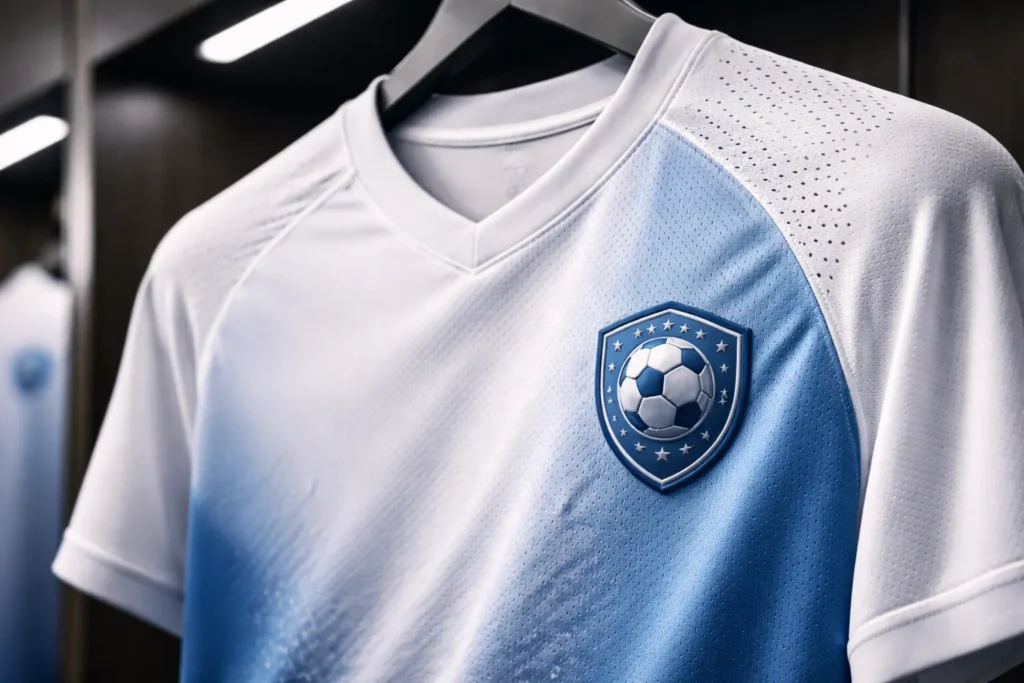
Historically, football clubs displayed their identity through heavily embroidered crests. While traditional, these thick patches add unnecessary weight and create rigid areas on the chest. Huonompi, the abrasive backing threads inside the shirt cause severe friction against the skin, leading to the infamous issue of nipple chafing during prolonged athletic exertion. Modern manufacturing has solved this via heat-applied 3D silicone and Thermoplastic Polyurethane (TPU) merkit.
These advanced crests are manufactured using injection molding, creating highly detailed, multi-textured, and metallic finishes that are impossible to achieve with needle and thread. During garment assembly, industrial heat presses bond the silicone directly to the polyester at precise temperatures (typically 150°C to 160°C for 12-15 seconds). This results in a completely flush, frictionless interior. For the athlete, it saves critical grams of weight; for the commercial buyer, it delivers a sleek, futuristic, and highly premium aesthetic that commands a higher retail price point.
Traditional Direct Embroidery and Woven Badges
Despite the athletic superiority of silicone crests, direct embroidery and high-density woven badges remain heavily utilized in the production of fan versions. The logic here is grounded in consumer behavior and lifecycle durability. Replica kits are subjected to relentless cycles in standard domestic washing machines and high-heat tumble dryers, conditions that can eventually degrade thermal adhesives. Heavy-duty embroidery ensures the club crest survives years of rigorous washing without peeling. For a wholesale buyer, balancing the inventory between high-tech player versions and durable, cost-effective embroidered fan versions is the key to maximizing market penetration.
How to Inspect Football Jersey Logos, Tunnusmerkit, and Printing Quality
Branding is one of the most visible elements of a custom football jersey. Club crests, sponsorigrafiikka, pelaajien nimet, and numbers must remain consistent with the approved design across the entire production batch.
Different branding methods require different inspection criteria. Buyers should not apply the same acceptance standard to sublimation graphics, heat-applied badges, kirjonta, and woven patches.
Sublimation Printing Inspection
Check whether the printed design matches the approved artwork and color references. Inspect gradients, fine lines, sponsor logos, and panel alignment. Look for visible banding, blurred edges, uneven color areas, or unwanted marks.
Silicone and TPU Badge Inspection
Check the badge dimensions, thickness, surface finish, positioning, and edge bonding. Gently inspect the perimeter for lifting or incomplete adhesion. The appropriate bonding settings depend on the badge material, fabric construction, and heat-press equipment, so buyers should approve the actual production result rather than relying on one universal temperature or pressing time.
Embroidery and Woven Patch Inspection
Inspect stitch density, edge finishing, thread consistency, patch alignment, and backing comfort. The badge should be securely attached without excessive puckering or loose threads.
Nimet, Numerot, and Sponsor Graphics
For personalized team orders, compare the printed or applied names and numbers against the final roster. Check spelling, font style, koko, position, and alignment. A small artwork error can affect multiple garments if it is not identified before production.
Branding Quality Inspection Checklist
| Component | Key Inspection Points |
|---|---|
| Sublimation Graphics | Color accuracy, sharpness, alignment, and print defects |
| Silikoni / TPU Badges | Position, edge bonding, thickness, and surface finish |
| Kirjonta | Stitch consistency, loose threads, and backing finish |
| Woven Patches | Artwork clarity, dimensions, and attachment |
| Names and Numbers | Spelling, font, koko, and placement |
| Sponsor Logos | Artwork accuracy and consistent positioning |
For bulk orders, buyers should define the acceptable appearance and attachment standards before production. A documented approval sample makes it easier for the factory’s quality-control team to inspect every batch consistently.
The Physics of Dye-Sublimation Printing
High-Temperature Ink Penetration
When manufacturing vibrant, multi-colored kits with complex gradients or sponsor logos, traditional screen printing is obsolete. Screen printed plastisol inks sit on top of the fabric, blocking breathability and eventually cracking under stress. Premium athletic apparel relies entirely on dye-sublimation printing.
This process involves printing the graphic onto specialized transfer paper using disperse dyes. The paper and the blank white polyester fabric are then fed through an industrial rotary calendar calendar press at temperatures exceeding 200°C (392°F). Under this extreme heat and pressure, the solid dye instantly turns into a gas (sublimaatio) and permeates the open pores of the polyester fibers. As the fabric cools, the pores close, trapping the pigment permanently inside the yarn.
Achieving Absolute Color Fastness
Because disperse dyes are transferred into polyester fibers during sublimation, the process can produce durable graphics without creating the same surface film associated with some other printing methods. kuitenkin, color performance still depends on ink quality, transfer conditions, kankaan koostumus, and aftercare. Buyers should assess colorfastness through appropriate washing and exposure tests and should not assume that printed garments are completely immune to fading or wear.
Sublimation printing generally preserves the fabric’s original structure more effectively than methods that create a continuous surface coating. tästä huolimatta, the finished garment’s breathability and moisture-management performance depend on the underlying fabric construction and should be evaluated separately.
B2B procurement teams must ensure their manufacturing partners utilize high-grade, eco-friendly sublimation inks (such as EPSON or Kiian) to achieve the deepest blacks and most vibrant neon colors required by modern club branding.

Vaatimustenmukaisuus, Kestävyys, and Industry Regulations
Global Textile Safety: ÖKO-TEX standardi 100
Textile products entering markets such as the European Union and North America must meet the applicable chemical safety and product compliance requirements. OEKO-TEX STANDARD 100 is a voluntary product certification that tests textiles and their components for harmful substances. It can provide useful supporting evidence for buyers, brands, ja jälleenmyyjät, but it should not be presented as a universal mandatory import certificate.
Buyers should check the certificate number, validity, certificate holder, product description, and certified article scope. They should also confirm whether the actual fabric, tulostusprosessi, Lisätarvikkeet, and finished garment are covered by the relevant certification.
This independent testing guarantees that every single component of the garment—from the polyester yarns and sublimation dyes to the sewing threads and silicone crests—has been rigorously tested for harmful substances.
Facilities must prove the absolute absence of carcinogenic azo colorants, raskasmetallit, formaldehydi, and harmful phthalates. Failing to verify a manufacturer’s OEKO-TEX compliance can result in entire wholesale shipments being impounded by customs authorities, resulting in catastrophic financial losses and brand damage.
The Push for Recycled Polyester (rPET) and GRS Certification
Driven by global mandates from major governing bodies like FIFA and the IOC, the sportswear industry is undergoing a massive pivot towards sustainability. The production of virgin polyester relies heavily on petroleum extraction.
Kierrätetty polyesteri (rPET) can be produced from eligible recycled feedstocks, including certain post-consumer PET materials. The source of recycled content should be verified through appropriate supplier documentation and chain-of-custody records. It should not automatically be described as ocean-recovered plastic unless the specific material origin can be demonstrated.
Recycled polyester can be engineered for sportswear applications, but its performance depends on the feedstock, recycling process, yarn quality, knitting structure, and finishing treatments. Buyers should compare recycled and virgin polyester fabrics using the same relevant performance tests rather than assuming that both materials perform identically.
When making verified recycled-content claims, brands should obtain appropriate transaction documentation and traceability evidence for the materials used. Maailmanlaajuinen kierrätysstandardi (GRS) provides a framework for verifying recycled content and tracking materials through the supply chain, subject to its certification and claim requirements.This certification tracks the entire supply chain, providing verified traceability of the recycled materials and ensuring ethical labor practices were maintained during production.
Production Timelines and Quality Assurance Protocols
Managing Supply Chain Lead Times
For B2B distributors, coordinating the delivery of kits prior to the start of a new sporting season is critical. Understanding factory lead times prevents costly supply chain bottlenecks. The standard manufacturing cycle begins with the Sampling Phase, which typically requires 7 to 14 päivää. During this window, the factory engineers the CAD patterns, tests the sublimation color codes on physical swatches, and produces a final “Top of Production” (TOP) sample for approval.
Once approved, Bulk Production commences. For standard wholesale orders ranging from 1,000 to 10,000 yksiköitä, the cutting, sublimating, ompelu, and pressing timeline spans 30 to 45 päivää. Buyers must strategically factor in additional maritime shipping times (tyypillisesti 25-35 päivää EU/USA satamiin) and potential factory congestion prior to major global tournaments like the World Cup or European Championships.
Football Jersey Manufacturing Costs, Lead Times, and Reorder Planning
The cost of a professional football jersey is influenced by more than fabric consumption and sewing labor. Customization requirements, order quantity, pakkaus, quality-control procedures, and shipping arrangements can all affect the final landed cost.
For distributors, klubeja, and sportswear brands, evaluating the complete order cost is more useful than comparing the factory unit price alone.
What Affects the Manufacturing Cost?
- Fabric and Material: Fiber composition, kankaan paino, knitting structure, and special performance features influence material costs.
- Räätälöinti: Sublimation artwork, silikoniset merkit, kirjonta, kudotut laastarit, nimet, and numbers may require different processes and additional labor.
- Tilausmäärä: Larger orders may distribute setup and development costs across more units, subject to the factory’s minimum order requirements and production efficiency.
- Pakkaus: Individual bags, kokoiset etiketit, hangtagit, customized cartons, and retail-ready packaging can affect the total quotation.
- Inspection and Testing: Additional fabric tests, sample revisions, or third-party inspections should be included in the project budget when required.
- Logistics: Freight, insurance, customs duties, brokerage, and destination delivery contribute to the final landed cost.
How to Calculate the Landed Cost
A practical comparison should include all major expenses associated with bringing the finished jerseys to the buyer’s destination.
Landed Cost = Product Cost + Sampling and Development + Pakkaus + Freight + Insurance + Import Duties and Taxes + Customs and Local Delivery Charges
The exact calculation depends on the agreed Incoterms, destination country, shipping method, and applicable import rules. Buyers should confirm which costs are included in the supplier’s quotation and which remain their responsibility.
How to Plan Production and Delivery
A realistic production schedule should distinguish between sample development, sample revisions, bulk manufacturing, final inspection, ja kuljetus. The timeline should also account for artwork approval, size-list confirmation, material availability, and public holidays.
Instead of relying on a general lead-time estimate, buyers should request a written production schedule with clear milestones:
- Artwork and specification confirmation
- Fabric and color approval
- Sample production and revisions
- Pre-production sample sign-off
- Bulk cutting, painatus, and sewing
- Final inspection and packing
- Shipment booking and dispatch
Keeping Reorders Consistent
For repeat orders, buyers should retain the approved sample, artwork files, fabric specifications, color references, size charts, etiketin tiedot, and packaging requirements. These records help the manufacturer compare new production batches with the original order.
Before confirming a reorder, buyers should also check whether the original fabric, dye lot, trimmaa, and production methods are still available. If any specification has changed, the difference should be reviewed and approved before manufacturing.
Good reorder management helps reduce avoidable variation and makes long-term teamwear sourcing more predictable.
The Four-Point Fabric Inspection System
High-end factories implement the internationally recognized Four-Point System for fabric quality control before a single panel is cut. Rolls of polyester are fed through illuminated inspection machines where technicians penalize the fabric for defects such as snags, missing yarns, dye spots, or color variations. If a roll accumulates more than 40 penalty points per 100 square yards, it is rejected entirely. Post-assembly, garments undergo strict needle-detection protocols and seam-strength testing to ensure they can withstand the physical aggression of competitive football. Partnering with a manufacturer who transparently shares these QA reports is the ultimate safeguard for your investment.
Bulk Football Jersey Quality Control: From Fabric Inspection to Final Packing
Quality control should cover the entire manufacturing process rather than relying only on a final visual inspection. For wholesale football jersey orders, defects identified after shipment can lead to replacement costs, delayed deliveries, and additional communication between buyers and suppliers.
A structured inspection plan should include several checkpoints.
1. Incoming Fabric Inspection
Before cutting begins, inspect fabric rolls for holes, snags, stains, shade variation, uneven knitting, and inconsistent weight. Fabric lots should be checked against the approved material specification and reference swatches.
2. Cutting and Panel Inspection
Check panel dimensions, leikkaustarkkuus, fabric direction, and matching components. For patterned or sublimated jerseys, confirm that graphics align correctly across adjoining panels.
3. Sewing and Assembly Inspection
Inspect seam consistency, stitch density, neckline construction, sleeve attachment, hems, and loose threads. Pay attention to stress areas such as underarms and side seams, where poor construction may become visible during wear.
4. Finished Garment Inspection
Compare finished garments with the approved sample and measurement chart. Check garment dimensions, tulostuslaatu, logon sijoitus, värin yhtenäisyys, labeling, and overall appearance.
5. Packing and Shipment Inspection
Confirm that size labels, product labels, quantities, folding methods, and carton markings match the purchase order. For personalized team orders, check that each name and number corresponds to the correct size and quantity.
Recommended Quality Control Checkpoints
| Production Stage | Inspection Focus | Required Record |
|---|---|---|
| Fabric Receiving | Paino, defects, shade, and material specifications | Fabric inspection report |
| Panel Cutting | Dimensions, panel matching, and cutting accuracy | Cutting inspection record |
| Ompelu | Saumat, stitches, hems, ja rakentaminen | In-process inspection report |
| Finishing | Logot, painatus, measurements, ja ulkonäkö | Finished garment checklist |
| Pakkaus | Labels, koot, quantities, and carton details | Packing list and final inspection record |
Buyers should agree on the inspection method, sampling level, defect classification, and acceptance criteria before production. For larger orders, an independent pre-shipment inspection may also be considered when required by the purchase agreement.
A documented quality-control process gives both the manufacturer and buyer a clearer basis for evaluating the finished order.

Frequently Asked Questions About Professional Football Jersey Manufacturing
1. What fabric is commonly used for professional football jerseys?
Polyester-based fabrics are widely used in football jersey manufacturing because they can be engineered for lightweight construction, kosteuden hallinta, color printing, and easy-care performance. Some designs incorporate elastane to provide additional stretch and recovery. The best fabric depends on the intended use, sovi, ilmasto, and buyer’s technical requirements.
2. What is the difference between player version and fan version football jerseys?
Player version jerseys generally feature a closer athletic fit and may incorporate lightweight fabrics, engineered mesh panels, and heat-applied branding. Fan version jerseys typically use a more relaxed fit designed for everyday comfort. Exact differences vary by manufacturer and product specification, so buyers should compare approved samples rather than rely on product labels alone.
3. How do manufacturers check football jersey quality before bulk production?
A professional quality-control process may include fabric inspection, measurement checks, leikkaustarkkuus, stitching inspection, print and badge verification, finished garment inspection, and packing checks. Buyers should agree on inspection criteria and retain an approved pre-production sample as a reference for bulk manufacturing.
4. Is sublimation printing suitable for custom football jerseys?
Dye-sublimation is widely used for polyester football jerseys, particularly when designs include gradients, multiple colors, sponsorigrafiikka, and detailed patterns. The dye is transferred into the polyester fibers rather than forming a conventional surface layer. Final color performance depends on the fabric, inks, transfer conditions, and care practices, so appropriate colorfastness testing is recommended.
5. What should buyers check when sourcing football jerseys from a manufacturer?
Buyers should evaluate the manufacturer’s production capabilities, fabric specifications, mukautusvaihtoehdot, sample development process, quality-control procedures, certification documents, minimum order requirements, production lead times, and shipping arrangements. A clear technical specification and written sample approval process help reduce misunderstandings before bulk production.
Viitteet:
- “Thermodynamic Properties of Micro-Engineered Polyester in Elite Sportswear.” Dr. Alistair Vance, Textile Institute of Biomechanics, Journal of Athletic Apparel Science.
- “Aerodynamic Drag Reduction in 3D Ergonomic Football Kits.” Dr. Elena Rostova, European Institute of Sports Technology, International Journal of Sports Physics.
- “The Physics of Disperse Dyes in High-Temperature Sublimation.” Dr. Kenji Sato, Tokyo Polymer Research Center, Digital Textile Engineering Quarterly.
- “Skin Friction and Abrasion Minimization via TPU Heat-Press Technologies.” Dr. Sarah Jenkins, Global Dermatology in Sports Initiative, Journal of Sports Medicine.
- “Lifecycle Analysis of rPET (Recycled Polyethylene Terephthalate) in Commercial Sportswear.” Dr. Marcus Thorne, Institute for Sustainable Textiles, Green Manufacturing Review.
- “Anthropometric Scaling and Pattern Grading for Athletic Apparel.” Dr. Chloe Dubois, Paris Academy of Fashion Technology, Apparel Engineering Journal.
- “ÖKO-TEX standardi 100: Compliance and Global Supply Chain Impact.” Regulatory Board of the International OEKO-TEX Association, Textile Compliance Annual.
- “Moisture Vapor Transmission Rates (MVTR) in Jacquard Knit Structures.” Dr. Wei Chen, Advanced Material Sciences Laboratory, Polymer Performance Journal.
Asiantuntijan näkemyksiä: Strategic Procurement of Professional Football Jerseys
Core Procurement Logic (Why & Mitä): Sourcing commercial football jerseys goes far beyond basic cut-and-sew operations; it requires bridging the gap between athletic biomechanics and textile physics. The fundamental manufacturing decision relies on engineering a fabric that balances an ultra-low GSM (paino) with a high Moisture Vapor Transmission Rate (MVTR). By specifying micro-engineered polyester with an 8-12% elastane blend, B2B buyers secure garments that provide aerodynamic four-way stretch while actively cooling the athlete through capillary moisture management.
Strategic Options & Technical Considerations
-
Player vs. Fan Architecture (Vaihtoehto)
The Geometric Distinction: Wholesale buyers must explicitly segment their inventory. Player versions require a 3D ergonomic taper and laser-cut perforations to eliminate aerodynamic drag. Päinvastoin, Fan versions require a relaxed, straight geometry to accommodate diverse body shapes, paired with heavy-duty direct embroidery for maximum domestic laundering durability. -
Silicone 3D Crests vs. Hankaavaa (Harkinta)
Athletic Risk Mitigation: Traditional embroidered patches create a rigid friction point on the chest, leading to severe skin abrasion during intense 90-minute matches. Premium sourcing specifications mandate heat-applied 3D TPU or Silicone crests for elite kits. These bond completely flush with the polyester matrix to eliminate interior friction entirely while shaving critical grams off the overall weight. -
Chemical Safety & ÖKO-TEX (Vaatimustenmukaisuus)
Navigating Global Customs: Utilizing high-temperature dye-sublimation requires absolute chemical safety. B2B procurement contracts must demand OEKO-TEX Standard 100 certification to scientifically prove the absence of carcinogenic azo dyes and heavy metals, ensuring smooth customs clearance into strictly regulated European and North American markets.
Final Takeaway: Building a Reliable Football Jersey Manufacturing Partnership
Professional football jersey manufacturing combines textile selection, pattern engineering, ventilation design, branding technology, laadunvalvonta, and supply chain coordination. Each element contributes to the finished garment, but no single technical feature can guarantee overall product quality.
Klubeille, jakelijat, and sportswear brands, successful sourcing begins with clear product specifications and a qualified manufacturing partner. Buyers should evaluate fabric performance, sovi, customization methods, sample accuracy, inspection procedures, and delivery arrangements before approving a bulk order.
A well-managed production process also requires documented sample approval, consistent quality standards, and reliable communication between the buyer and manufacturer. These practices help reduce production uncertainty and support more consistent results across repeat orders.
Whether developing player-inspired match jerseys, fan replicas, training kits, or fully customized teamwear, working with an experienced football jersey manufacturer can help turn design concepts into commercially practical products.
YSTAR Wear supports custom sportswear development and OEM/ODM manufacturing for buyers looking for personalized football jerseys, teamwear, and related apparel solutions. Contact the team to discuss fabric options, customization requirements, mallikehitys, and bulk production planning.