Fotball uniformer are not just shirts and shorts; they are part of the game’s identity, regulation, synlighet, opptreden, and commercial presentation. When two football teams step onto the field, their kits must help players recognize teammates instantly, help referees judge fouls clearly, help fans follow the match, and help broadcasters show the game without visual confusion.
Different uniforms also protect the team’s brand. A club’s home kit may carry its traditional colors, while the away kit solves color clashes against opponents. A goalkeeper kit must be visually different because the goalkeeper has a unique role. For klubber, skoler, akademier, tournament organizers, and distributors, choosing Fotball uniformer is therefore a practical decision involving color planning, fabric performance, printing durability, dimensjonering, competition rules, and long-term reorder support.
Modern football kits must also perform under real match pressure. Players sweat, sprint, slide, tøye ut, collide, and wash uniforms repeatedly throughout the season. The best team kits should be breathable, lett, hurtigtørkende, colorfast, tear-resistant, and comfortable across different climates and age groups.
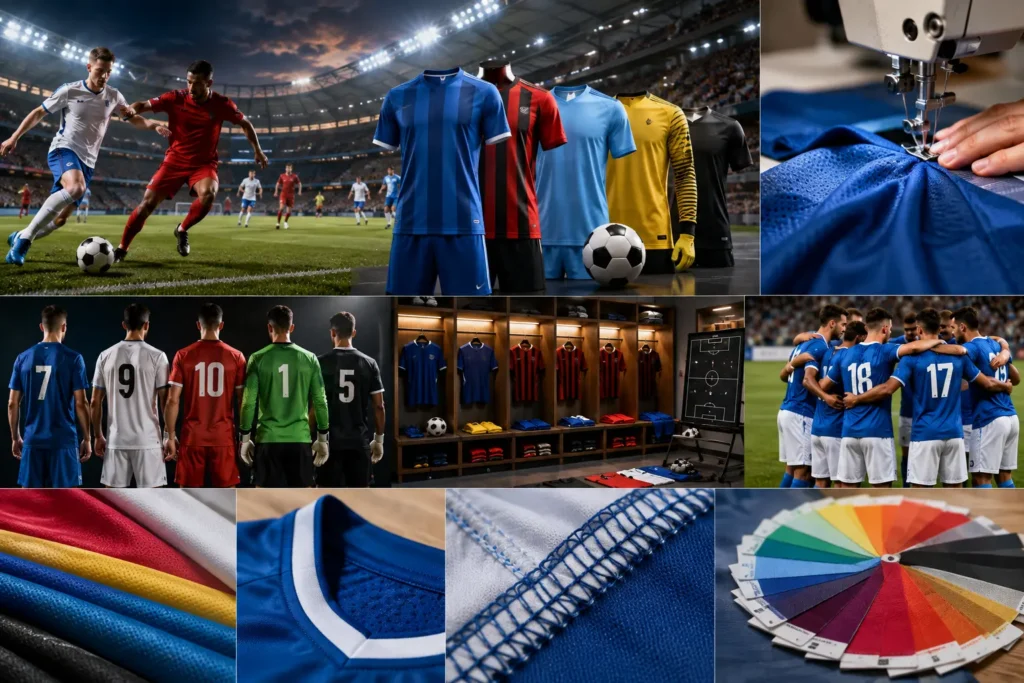
Rask svar: Why Do Football Teams Wear Different Soccer Uniforms?
The Simple Explanation
Football teams wear different Soccer Uniforms to prevent color confusion, help referees make decisions, improve player recognition, support fan identity, satisfy competition requirements, and represent club culture. If both teams wore similar colors, players could pass to the wrong teammate, referees could misread contact, goalkeepers could be confused with outfield players, and fans could struggle to follow the game from a distance.
The Practical Match Reason
On a fast field, players make decisions in seconds. A clear kit color helps a midfielder recognize a teammate before passing. A clear number helps referees record fouls, substitutions, and goals. A clear goalkeeper kit helps everyone understand who can legally handle the ball inside the penalty area. This is why home, away, third, goalkeeper, and training kits all serve different functions.
| Uniform Purpose | Hvorfor det betyr noe | Example |
|---|---|---|
| Team identification | Separates two teams visually | Home vs away colors |
| Referee clarity | Helps judge fouls and possession | Contrasting shirts and socks |
| Player communication | Supports fast passing decisions | Clear teammate recognition |
| Fan identity | Builds loyalty and club culture | Club colors and crest |
| Sponsorship | Displays commercial partners | Chest sponsor logo |
| Broadcast clarity | Improves viewing experience | Strong color contrast |
Hjem, Away, and Third Kits: The Main Types of Soccer Uniforms
Home Soccer Uniforms
The home kit usually represents the club’s strongest identity. It often uses traditional colors, the club crest, official sponsor logo, and a design that fans recognize immediately. For profesjonelle klubber, the home kit can become part of a team’s long-term culture. For schools and youth academies, it creates belonging and pride.
Away Soccer Uniforms
The away kit is designed to contrast with opponents when the home kit creates a color clash. If two teams both use red, blå, hvit, or dark colors, the away kit allows one team to switch to a clearly different look. A good away uniform is not random; it should still reflect the team’s style while solving match visibility.
Third and Training Soccer Uniforms
A third kit gives teams an extra option for tournaments, away matches, international events, and games where both home and away colors may conflict. Training kits are usually simpler, more economical, and designed for repeated washing. Clubs comparing custom football jerseys vs standard football jerseys should decide whether the team needs a unique identity, sponsor placement, full-color graphics, or a budget-friendly standard kit for practice use.
| Kit Type | Main Use | Design Priority |
|---|---|---|
| Home kit | Regular home matches | Tradition and identity |
| Away kit | Color clash prevention | Strong contrast |
| Third kit | Extra match option | Flexibility and branding |
| Goalkeeper kit | Distinguish goalkeeper | High visibility |
| Training kit | Daily practice | Durability and comfort |
| Youth kit | School and academy teams | Passe, sikkerhet, rimelighet |
Why Goalkeepers Wear Different Soccer Uniforms
Role Recognition
Goalkeepers wear different uniforms because their role is different from outfield players. Inside the penalty area, the goalkeeper can handle the ball under specific rules. For referees, teammates, opponents, and spectators, the goalkeeper must be visually clear. This is why goalkeeper Soccer Uniforms usually use colors that contrast with both teams and match officials.
Performance and Protection
Goalkeepers dive, slide, tøye ut, and contact the ground more often than other players. Their kits may use long sleeves, stronger fabric, padded zones, or brighter colors. Youth goalkeepers may need extra comfort and coverage, while professional goalkeepers may prioritize lightweight stretch, grip support, and high visibility under stadium lighting.
| Goalkeeper Uniform Feature | Practical Reason | Kjøpermerknad |
|---|---|---|
| Contrasting color | Easy identification | Must differ from both teams |
| Long sleeves | More coverage | Useful for diving |
| Padded zones | Impact support | Optional for youth teams |
| Durable fabric | Ground contact resistance | Check abrasion strength |
| Bright colors | Visibility | Good for match recognition |
Color Clash Prevention and Match Regulations
Why Similar Colors Create Problems
Similar colors can create problems for players, referees, fans, and broadcasters. A red-and-dark-orange match may look different up close but confusing from the stands. Dark navy and black may appear too similar under night lighting. White numbers on a light background may become unreadable from distance. Even socks can matter because referees may need to identify tackles, touches, and challenges quickly.
Competition Rules and Referee Decisions
Many competitions require teams to register uniform colors before a season or tournament. Match officials may ask a team to change shirts, shorts, sokker, or goalkeeper colors if there is a visual clash. For buyers, the safest strategy is to prepare one dark kit, one light kit, and one clearly different goalkeeper kit. This reduces the chance of last-minute match problems.
| Color Issue | Match Risk | Uniform Solution |
|---|---|---|
| Similar shirt colors | Passing confusion | Use away kit |
| Similar socks | Difficult tackle identification | Change socks |
| Similar goalkeeper color | Referee confusion | Use alternate goalkeeper kit |
| Dark vs dark kits | Poor broadcast contrast | Use light kit |
| Pattern-heavy kit | Number visibility issue | Keep number zone clear |
Soccer Uniforms as Team Identity and Brand Recognition
Club Colors, Crest, and Culture
A team’s uniform is often the first thing fans remember. Club colors may represent a city, school, national identity, sponsor relationship, or long sporting history. The crest creates emotional recognition. Player names and numbers create personal identity. For youth players, wearing the same uniform can build discipline and team pride.
Commercial Value and Fan Connection
Professional and semi-professional teams use uniforms as commercial assets. Sponsor logos, sleeve patches, tournament badges, and team merchandise all depend on accurate decoration and durable printing. The cultural value of football shirts is also strong; many supporters wear them as symbols of loyalty. Teams can better understand this identity value by studying the global language of football jerseys, including how culture, teknologi, rituals, and team colors shape modern kit design.
| Branding Element | Function | Buyer Consideration |
|---|---|---|
| Club colors | Identitet | Keep consistent across seasons |
| Crest/logo | Recognition | Use high-resolution artwork |
| Player number | Match identification | Must remain readable |
| Player name | Personalisering | Check font and placement |
| Sponsor logo | Commercial value | Use durable print method |
| Sleeve patch | League or tournament identity | Confirm regulation size |
Materials Used in Modern Soccer Uniforms
Polyester as the Main Fabric
Most modern Soccer Uniforms use polyester because it is lightweight, varig, hurtigtørkende, and compatible with sublimation printing. Polyester also supports vibrant colors, repeat washing, and all-over designs. For hot climates, lightweight polyester mesh can improve airflow. For colder conditions, teams may choose slightly heavier fabrics or layer uniforms with approved base garments.
Pusteevne, Strekke, and Durability
Fabric performance matters because football is a high-sweat, high-movement sport. Moisture-wicking fabric moves sweat away from the skin. Breathable mesh supports cooling. Stretch construction improves mobility. Strong stitching helps protect seams during tackles, pulls, and repeated washing. Teams that need better seam strength can review the best stitching method for high-tensile football jerseys before confirming match kits for intense play.
| Fabric Parameter | Common Direction | Hvorfor det betyr noe |
|---|---|---|
| Fabric weight | Lightweight to midweight polyester | Balances comfort and durability |
| Moisture wicking | Fast sweat movement | Keeps players drier |
| Air permeability | Breathable mesh zones | Supports cooling |
| Colorfastness | Washing and sunlight resistance | Prevents fading |
| Tensile strength | Fabric and seam durability | Reduces tearing |
| Pilling resistance | Surface quality retention | Maintains professional appearance |
| Strekkgjenoppretting | Formbevaring | Improves fit after movement |
| Utskriftsholdbarhet | Sublimation or transfer quality | Protects logos and numbers |
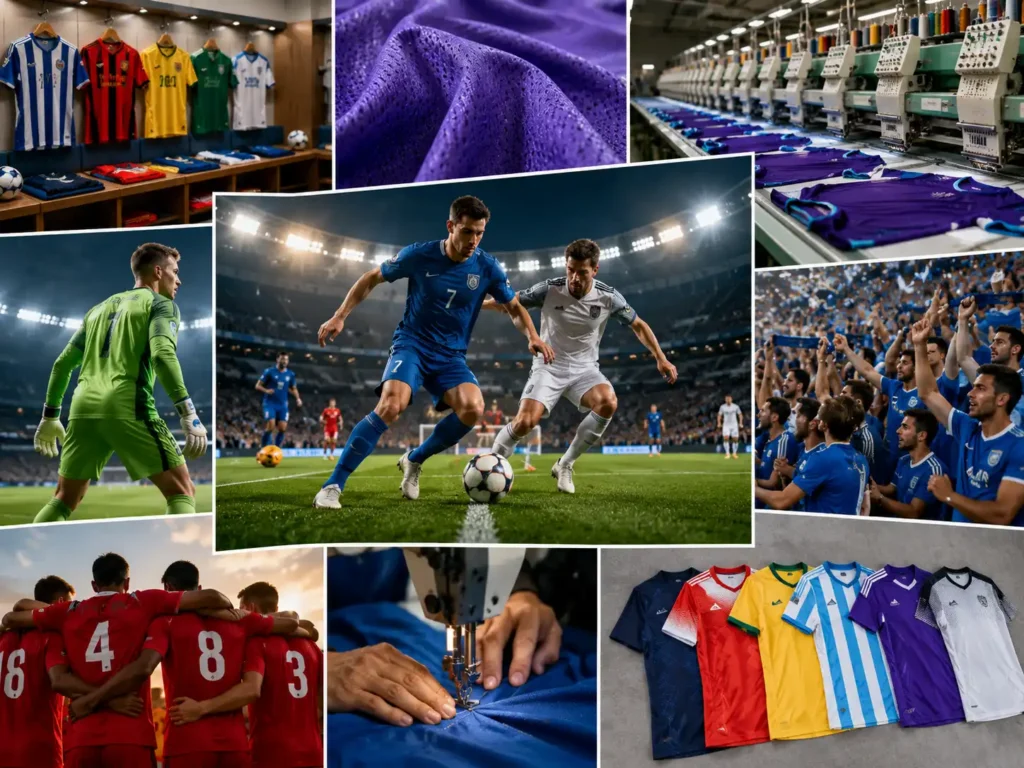
Soccer Uniforms for Different Levels of Play
Professional Clubs and Academies
Professional clubs need premium fabrics, exact fit, sponsorsynlighet, multiple kit options, and regulation compliance. Academies need consistent branding across age groups, easy reorders, comfortable sizing, and durable construction. Both groups should consider long-term design archives so replacement jerseys match previous batches.
Skoler, Amateur Teams, and Tournaments
School teams need comfort, rimelighet, durable seams, trygt passform, lesbare tall, og lettstelt. Amateur teams need cost-effective customization, reliable sizing, and quick production. Tournament teams need bulk ordering, fast turnaround, backup sets, and strong color contrast. A team buying only the exact roster quantity often faces problems when a player joins late, changes size, or damages a jersey.
| Team Type | Main Need | Recommended Soccer Uniform Strategy |
|---|---|---|
| Professional club | Performance and branding | Premium custom kits |
| School team | Durability and budget | Standard custom uniforms |
| Youth academy | Comfort and safety | Pustende, lightweight kits |
| Amateur league | Affordability | Wholesale Soccer Uniforms |
| Tournament team | Fast delivery | Sublimated bulk kits |
| Training squad | High washing frequency | Durable practice uniforms |
Tilpassede fotballdrakter: Printing, Sublimering, and Decoration
Sublimation is widely used for custom Soccer Uniforms because it prints the design into polyester fabric. It is suitable for full-color graphics, club patterns, navn, tall, sponsorlogoer, and complex color gradients. The design remains lightweight because heavy surface layers are not added to the garment.
Heat transfer printing works well for names, tall, and logos, especially for smaller batches or replacement pieces. Embroidery creates a premium crest appearance but may add weight and cost. Screen printing can be cost-effective for simple graphics and larger quantities. The best decoration method depends on design complexity, mengde, budsjett, stofftype, and durability expectations.
| Decoration Method | Beste bruk | Advantage | Limitation |
|---|---|---|---|
| Sublimering | Full custom kits | Lightweight and durable design | Best on polyester |
| Heat transfer | Names, tall, logoer | Flexible for small orders | May peel if poor quality |
| Embroidery | Crests and badges | Premium appearance | Adds weight |
| Silketrykk | Simple bulk graphics | Cost-effective | Less ideal for complex designs |
How Many Soccer Uniforms Does a Team Need?
Most teams should prepare at least home kits, away kits, and goalkeeper kits. Training kits are recommended when the team practices frequently. Teams should also order extra uniforms for substitutes, new players, size exchanges, lost items, and damaged garments. For ungdomslag, extra sizing is especially important because players grow quickly during the season.
For clubs and distributors, long-term reorder planning matters. If the original manufacturer cannot reproduce the same color, stoff, collar, number font, or print placement, the team may end up with mismatched kits. A reliable custom Soccer Uniforms manufacturer should keep artwork files, sizing records, color references, and production details to support future reorders.
| Team Size | Basic Match Kits | Recommended Extra Quantity | Grunn |
|---|---|---|---|
| 11-player squad | 14–18 sets | 2–4 extra | Substitutes and replacements |
| Youth team | 16–22 sets | 3–5 extra | Growth and size changes |
| Academy program | 50+ sets | Size-based stock | Multi-team planning |
| Tournament team | Full roster + backups | 5–10% extra | Damage and lost items |
| Club program | Hjem, away, training sets | Seasonal reorder plan | Consistent branding |
Regulations Buyers Should Consider Before Ordering Soccer Uniforms
Before ordering uniforms, teams should check competition rules for color contrast, number visibility, sponsor placement, crest use, sleeve patches, goalkeeper color, and equipment safety. Numbers should be readable from distance. Busy patterns should not cover the number zone. Sponsor logos should meet size and placement requirements. Uniforms should not include unsafe accessories or loose parts.
Youth and school teams may also require comfortable fabrics, trygt passform, modest design, og enkel vask. Tournament organizers may require color approval before match day. For B2B buyers, confirming rules early prevents emergency kit changes, delayed participation, or extra production costs.
| Regulation Area | Hvorfor det betyr noe | Buyer Action |
|---|---|---|
| Color contrast | Avoid match confusion | Prepare home and away kits |
| Number visibility | Referee and broadcast clarity | Use clear fonts |
| Sponsor placement | Competition approval | Confirm league rules |
| Crest and logo | Brand identity | Use legal artwork |
| Fabric safety | Player comfort | Choose breathable materials |
| Goalkeeper color | Role identification | Use clearly different color |
Common Mistakes When Buying Soccer Uniforms
The first mistake is choosing design before checking competition rules. A beautiful kit may still be rejected if the number is hard to read, the colors clash, or sponsor placement is not allowed. The second mistake is ordering only one color. This creates problems in away matches and tournaments. The third mistake is ignoring fabric quality, which can make players feel hot, tung, or uncomfortable.
The fourth mistake is using low-quality printing. Numbers may peel, logos may crack, and sponsor branding may look unprofessional. The fifth mistake is not planning reorders, causing new players to wear mismatched uniforms. The sixth mistake is choosing the lowest price only, which can create poor stitching, wrong sizing, color fading, delayed delivery, and weak after-sales support.
How to Choose a Reliable Soccer Uniforms Manufacturer
A reliable manufacturer should support home, away, goalkeeper, opplæring, ungdom, and bulk team uniforms. Buyers should ask what fabrics are available, whether custom patterns are supported, what printing methods are offered, what the MOQ is, whether samples are available, how long production takes, and whether the supplier can help check logos, spillernavn, tall, and sponsor placement.
Supplier capability should include fabric options, mønster design, sublimasjonsutskrift, heat transfer, broderi, size grading, sample support, bulk production, kvalitets inspeksjon, emballasje, and reorder support. Lag, klubber, distributors, and academies can submit team size, club colors, logo files, spillernavn, tall, fabric preference, goalkeeper color, mengde, deadline, and budget through the Soccer Uniforms customization support page for project planning.
| Supplier Check | Good Signal | Risk Signal |
|---|---|---|
| Fabric options | Breathable polyester and mesh choices | One generic fabric only |
| Custom design | Supports club colors and graphics | Template-only design |
| Printing quality | Sublimation and transfer control | Peeling or color fading risk |
| Size chart | Clear adult and youth sizing | Unclear fit |
| Sample support | Trial kit available | Bulk order first |
| Bulk capacity | Handles team and club orders | Unstable delivery |
| Reorder support | Keeps design files | Hard to match later |
| QC process | Checks stitching and color | No inspection process |
If This Is Your Team Need, Choose This Soccer Uniforms Strategy
| If Your Team Needs | Velge | Avoid |
|---|---|---|
| Official matches | Home and away Soccer Uniforms | One-color kit only |
| Better player comfort | Quick-dry polyester mesh | Heavy cotton fabric |
| Full custom design | Sublimated Soccer Uniforms | Low-quality transfers |
| Youth team supply | Varig, affordable uniforms | Adult-only sizing |
| Sponsor visibility | Clear logo placement | Busy patterns behind logos |
| Goalkeeper recognition | Bright goalkeeper kit | Similar team colors |
| Tournament use | Extra backup sets | Exact roster quantity only |
| Club brand identity | Consistent color system | Random seasonal colors |
| Wholesale supply | Stable manufacturer | One-time small workshop |
| Long-term reorder | Supplier that keeps artwork files | No design archive |

Frequently Asked Question
1. Why do football teams wear different Soccer Uniforms?
Football teams wear different Soccer Uniforms to prevent color confusion, help referees make accurate decisions, improve player recognition, support fan identity, and meet competition rules. If both teams wear similar colors, players may pass to the wrong teammate, referees may struggle to identify fouls or possession, and fans or broadcasters may find the match harder to follow. Different uniforms make the game clearer, fairer, and easier to watch.
2. What is the difference between home and away Soccer Uniforms?
Home Soccer Uniforms usually use the team’s main colors and represent club tradition, historie, og identitet. Away Soccer Uniforms use contrasting colors to avoid clashes with opponents during away matches or tournaments. A good team kit plan normally includes one strong home color, one clearly different away color, and a goalkeeper kit that contrasts with both teams. This helps teams stay prepared for different match situations.
3. Why do goalkeepers wear different uniforms?
Goalkeepers wear different uniforms because their role is different from outfield players. The goalkeeper can legally handle the ball inside the penalty area under specific rules, so referees, teammates, opponents, and spectators must be able to identify the goalkeeper immediately. Goalkeeper uniforms often use bright or contrasting colors, lange ermer, stronger fabric, and sometimes padded zones because goalkeepers dive, slide, and contact the ground more often.
4. What fabric is best for Soccer Uniforms?
Lightweight polyester with moisture-wicking and breathable mesh construction is commonly used for Soccer Uniforms because it dries quickly, supports player movement, and works well for sublimation printing. Good soccer fabric should balance comfort, varighet, luftpermeabilitet, fargeekthet, strekkfasthet, pilling resistance, and print quality. Teams should avoid heavy cotton for serious match play because it absorbs sweat, dries slowly, and can feel uncomfortable during intense activity.
5. How should teams choose custom Soccer Uniforms?
Teams should choose custom Soccer Uniforms based on color contrast, fabric comfort, passe, printing durability, league rules, spillertall, sponsor placement, production time, and reorder support. Clubs should prepare logo files, spillernavn, tall, preferred colors, size ranges, goalkeeper kit requirements, and deadline before ordering. A reliable supplier should provide fabric options, size charts, sample support, kvalitets inspeksjon, bulk production capacity, and artwork storage for future reorders.
Referanser
- “Laws of the Game: The Players’ Equipment” — The International Football Association Board — Football Equipment Rules
- “FIFA Equipment Regulations” — Fédération Internationale de Football Association — Football Kit and Equipment Guidance
- “UEFA Equipment Regulations” — Union of European Football Associations — Match Kit Regulations
- “Textiles for Sportswear” — Roshan Shishoo — Woodhead Publishing
- “Performance Apparel: Materialer, Development, and Applications” — Guowen Song — Woodhead Publishing
- “Moisture Management in Textiles” — AATCC Technical Manual — Textile Testing Resource
- “Colorfastness to Washing Testing Standards” — International Organization for Standardization — Textile Colorfastness Standards
- “Team Sports Apparel Manufacturing and Quality Control” — Textile Institute — Sportswear Production Resource