A Football Jersey looks simple until the wrong one arrives. A design may look excellent on a digital mockup but feel hot during a match, stretch across the sponsor logo, fade after repeated washing or fit half the team differently from the approved sample. The reason is that performance apparel is a system: fabric composition, costruzione a maglia, fabric mass, panel placement, adatto, seam location, decoration technology and pattern grading all interact. UN 100% polyester jersey can be lightweight and highly breathable, but another 100% polyester jersey can feel heavier and less ventilated because the knit and fabric weight are different. Buyers therefore need to move beyond the label and evaluate the complete specification. Squadre, academies and sportswear distributors beginning a project can first review the available divise da calcio personalizzate direction to understand how fabric, side panels, printing and style choices can be combined before finalizing their own Football Jersey brief.
The same principle applies when evaluating the factory behind the product. A jersey order is not only a sewing job. Pattern development determines fit, digital printing determines graphic accuracy, cutting controls alignment, sewing influences movement and comfort, and quality inspection determines whether bulk pieces stay close to the approved size chart. For private-label brands or club programs that expect repeat orders, the manufacturer must also be able to reproduce color, tessuto, grading and artwork several months later. That makes development capability and process control more important than simply finding the lowest quote. Buyers comparing production partners should examine the supplier’s sportswear experience, digital printing capability, customization workflow and QC structure through its Football Jersey manufacturer background before treating a quotation as commercially comparable. A slightly cheaper factory can become expensive if inconsistent sizing creates replacements, sponsor graphics need reprinting or a second order no longer matches the original season kit.
Before requesting prices, define the use case. A competitive adult squad may prioritize a lightweight technical body fabric, strategic mesh and a close athletic fit. A youth academy may value easy washing, durability and predictable size grading. A fanwear program may prefer a softer regular fit because the jersey will be worn casually rather than for ninety minutes of continuous movement. A tournament organizer ordering several team designs may care most about color management, name-and-number accuracy and delivery control. These differences affect fabric, printing and construction, so an RFQ that says only “100% polyester Football Jersey, best price” leaves too many variables uncontrolled. A useful inquiry should include quantity, adult or youth size breakdown, target fabric weight, fit direction, loghi, player personalization, packaging and delivery date. When those details are ready, buyers can submit a more precise custom Football Jersey quote instead of comparing prices for products that may have completely different fabrics and specifications.
Sizing deserves special attention because customization makes sizing mistakes expensive. A blank shirt that is too small may be exchanged; a shirt carrying a player’s name, numero, club badge and sponsor has little resale value when it fits the wrong person. The letters S, M and L are not universal garment dimensions. They come from a pattern block, intended wearer, misurazioni del corpo, wearing ease and grading rules. A close player-style medium can be noticeably narrower than a relaxed fan medium, while youth and women’s patterns may use different proportions entirely. The safest workflow is to measure players, identify whether the manufacturer’s chart describes body or garment dimensions, approve a representative size set and only then release personalized production. Teams uncertain about this process should use a detailed guide on how to choose your Football Jersey size rather than collecting only each player’s usual T-shirt size.
The second sizing issue is fit intention. Competitive jerseys normally use controlled ease so excess fabric does not flap or bunch during play, while fan jerseys usually allow more room through the chest and waist. Fashion-driven Football Jerseys may deliberately use an oversized silhouette, but a true oversized pattern is not the same as simply ordering several sizes larger. Extreme size substitution can create excessive body length, dropped armholes, long sleeves and a neck opening that looks wrong. Misura del torace, garment pit-to-pit, lunghezza del corpo, shoulder shape, sleeve fit and fabric stretch should be evaluated together. A team that needs adult, women’s and youth sizes should also confirm whether separate patterns are available rather than forcing every wearer into one unisex block. For a more detailed comparison of player, fan, youth and adult fit logic, the existing Guida alle taglie delle maglie da calcio provides a useful measurement reference before the final size list is locked.
Price should be evaluated last, not first. The lowest cost per jersey may produce the weakest project return if the fabric feels hot, colors shift between lots, graphics fail early or replacement orders cannot match the original kit. For a club, a Football Jersey is also a team-identity asset and sponsor display surface. For a distributor, it is inventory that must fit consistently and survive customer washing. For a school, it may be reused weekly over an entire season. These functions make total project ROI more useful than unit price alone. Buyers should compare material quality, processo di stampa, coerenza dimensionale, customization accuracy, inspection and reorder stability together with the quote. A deeper framework for calculating this trade-off is covered in Football Jersey sourcing ROI, especially when comparing bulk suppliers whose headline prices look similar but whose fabric, QC and service scope are not equivalent.

What Should You Look for When Choosing a Football Jersey?
A practical Football Jersey decision starts with six variables: tessuto, fabric weight, gestione dell'umidità, misurare, fit and decoration. Construction and compliance then determine whether the selected design can survive real production and use.
| Tipologia acquirente | Fabric Direction | Fit Direction | Decoration Direction | Main Priority |
|---|---|---|---|---|
| Competitive Team | Lightweight polyester with ventilation zones | Atletico / controlled ease | Sublimation or lightweight transfers | Movement, heat management, low weight |
| Youth Academy | Durable easy-care polyester | Regular athletic fit | Sublimazione | Durabilità, dimensionamento, lavaggio |
| Fan Merchandise | Comfort-focused polyester | Regolare / rilassato | Sublimazione, badge, transfer or embroidery | Comfort and appearance |
| Wholesale Private Label | Specification-driven | Market-specific | Customer-defined | Coerenza, Controllo qualità, reorder control |
| Tournament Organizer | Balanced performance polyester | Broad team fit | Sublimazione | Multi-design efficiency and delivery |
Which Fabric Is Best for a Football Jersey?
Why Polyester Is the Main Performance Direction
Polyester dominates modern Football Jersey manufacturing because it can be lightweight, dimensionally stable, quick drying and compatible with sublimation printing. Tuttavia, the fiber name alone does not describe performance. Yarn type, struttura a maglia, surface finishing, hole geometry and fabric weight all change airflow, stirata, drape and moisture movement.
Per esempio, current football-uniform directions on the site include approximately 140 GSM double-sided polyester, 144 GSM small-mesh polyester and about 145 GSM polyester-spandex mesh for selected side or underarm panels. Rib structures around approximately 230 GSM are used for components such as collars rather than as the entire match-jersey body.
These figures are useful design references, not universal football standards.
Rete in poliestere
Mesh increases open area and can improve ventilation when it is used appropriately. It is particularly useful on the back, side torso or underarm where heat and moisture accumulation can be high.
But bigger holes are not automatically better. Very open mesh can reduce opacity, snag resistance and graphic uniformity. For sublimated designs, different panel constructions can also reproduce color differently, so the buyer should approve the full garment rather than one isolated fabric swatch.
Polyester-Spandex Blends
Adding elastane or spandex can support a closer fit and greater stretch recovery. This can work well for athletic sleeves, side panels and fitted player jerseys.
The trade-off is that highly elastic fabrics may require tighter heat-control during decoration and closer dimensional QC. A Football Jersey with more stretch may also fit differently even when the flat garment dimensions look similar.
Why Cotton Is Usually Not the First Match-Day Choice
Cotton is comfortable in casual apparel, but it absorbs considerably more moisture than hydrophobic polyester and can become heavier as perspiration accumulates. For retro fanwear, lifestyle jerseys or casual collections, cotton-containing fabrics can still be relevant. For competitive match use, lightweight polyester-based structures are generally the more practical starting direction.
How Much Should Football Jersey Fabric Weigh?
Fabric mass is normally expressed in GSM, or grams per square meter. ASTM D3776/D3776M provides established methods for determining fabric mass per unit area. GSM is useful, but it is not a quality score.
A lightweight fabric can be excellent or poor. A heavier fabric can be durable or unnecessarily hot. Buyers need to interpret GSM together with knit construction, opacità, stretch and intended season.
| Approximate Fabric Direction | Typical Character | Potential Advantage | Rischio dell'acquirente |
|---|---|---|---|
| 120–150 GSM | Light performance direction | Low garment weight, faster drying potential | Opacity, snagging and durability must be checked |
| 150–180 GSM | Balanced match / training direction | Good balance of structure and wear comfort | Actual ventilation still depends on knit |
| 180–220 GSM | Heavier training / fanwear direction | More structure and perceived substance | May feel warmer in hot matches |
| 230 GSM rib / trim direction | Collari, polsini, structural trim | Shape retention | Not normally treated as body-fabric benchmark |
Important: These are sourcing and development directions, not official universal Football Jersey GSM requirements. Competition, brand and end-use specifications should take priority.
Does Lighter Always Mean Better?
NO. Extremely light fabric can become translucent under stadium lighting, distort around heavy badges or snag more easily. For a youth academy that washes uniforms every week, a slightly more substantial fabric can generate better total value than chasing the lowest possible garment weight.
If X → Choose Y:
If hot-weather match performance is the priority → start with lightweight polyester and engineered ventilation.
If weekly academy durability is more important → choose a balanced GSM and confirm wash stability.
If the jersey is fan merchandise → prioritize hand feel, opacity and comfort rather than the lowest fabric weight.
How Should a Football Jersey Manage Sweat and Heat?
Breathability and moisture wicking are related but they are not the same property. Breathability generally refers to the ability of air or vapor to move through a textile system. Wicking describes the transport of liquid moisture through or across the structure.
A jersey can therefore have visible mesh and still manage sweat poorly if moisture transport through the rest of the garment is ineffective. al contrario, a dense-looking knit may move moisture efficiently through capillary action but provide less direct airflow.
Body-Mapped Ventilation
Modern performance construction can use different fabrics in different zones. Side panels and underarms may use open mesh while the front provides greater opacity for sponsor printing. The back can use a lighter structure to improve heat release.
For teams competing in warm or humid climates, evaluate the full jersey under movement rather than choosing fabric by touch in an air-conditioned showroom.
Come dovrebbe adattarsi una maglia da calcio?
Giocatore / Adattamento atletico
A player-style jersey normally follows the torso more closely, with less excess fabric around the chest and waist. Sleeves may also be more fitted. This creates a streamlined appearance and reduces flapping during play.
The risk is that players accustomed to regular T-shirts may underestimate how close the fit is. Do not automatically tell every buyer to “size up.” Compare the actual garment chart and intended fit first.
Regular Team Fit
A regular athletic fit provides moderate ease without becoming baggy. It is often the safest starting point for schools, amateur clubs and academies because it accommodates more body types while still looking like sportswear rather than casual apparel.
Fan / Replica Fit
Fan jerseys usually allow more room for casual movement and layering. They may be worn over a T-shirt or lightweight sweatshirt, so torso ease is more important than aerodynamic appearance.
Oversized Lifestyle Fit
Football-inspired streetwear increasingly uses oversized silhouettes. A true oversized jersey should be patterned with deliberate extra width, shoulder position and body proportion. Simply ordering an XL instead of an M can create the wrong sleeve length and neckline rather than a well-designed oversized fit.
Guida alle taglie delle maglie da calcio: Which Measurements Matter?
Chest is usually the strongest starting measurement, but bulk manufacturing should not rely on one number alone.
| Misurazione | How It Is Used | Perché è importante | Common Mistake |
|---|---|---|---|
| Chest Circumference | Body sizing | Primary upper-body reference | Confusing body chest with garment chest |
| Pit-to-pit | Flat garment measurement | Easy comparison with existing jersey | Comparing directly with body circumference |
| Lunghezza del corpo | Garment proportion | Important for tall / short players | Sizing wider just to gain length |
| Larghezza della spalla | Pattern fit | Affects arm movement and appearance | Ignoring dropped or raglan construction |
| Lunghezza della manica | Mobility and style | Important for youth and long-sleeve jerseys | Assuming size label controls sleeve fit |
| Vita / Orlare | Taper assessment | Important on athletic fits | Choosing by chest only on strongly tapered style |
Body Measurements and Garment Measurements Are Different
If a garment laid flat measures 51 cm from pit to pit, its approximate flat circumference is 102 cm. That does not mean it is automatically intended for a 102 cm body chest. The garment can contain positive ease, zero ease or stretch-based negative ease depending on the design.
This is one reason online size charts often create confusion.
Why There Is No Universal Medium
Pattern blocks, fit philosophy and target markets differ. A European fanwear program, a US youth academy and an Asian slim-fit private-label collection may all define “M” differently.
For B2B production, approve actual finished garment measurements rather than only letter sizes.
How Should Teams Approve Size Before Bulk Production?
A club ordering personalized kits should establish the size set before artwork is released for player-specific production.
- Measure representative players.
- Select trial sizes from the proposed chart.
- Test movement: raise arms, rotate shoulders, run and bend.
- Check chest, length and sleeve fit.
- Approve the garment specification.
- Collect final player names, numbers and sizes.
- Release personalized bulk production.
For large programs, sample at least the important grading points rather than approving only one medium sample and assuming XS through 3XL will grade perfectly.
Authentic vs. Replica Football Jerseys: What Is the Difference?
The words “authentic” and “replica” are commonly used in licensed football merchandising, but they generally describe product positioning rather than a universal manufacturing standard.
| Caratteristica | Giocatore / Direzione autentica | Fan / Direzione della replica | Custom Team Direction |
|---|---|---|---|
| Adatto | Closer athletic silhouette | Regolare / rilassato | Buyer-defined |
| Tessuto | Spesso più leggero / più tecnico | Comfort and durability balance | Specification-dependent |
| Badges | Often lightweight applications | May use heavier decorative options | Multiple options |
| Primary Goal | Match performance | Fan comfort | Team identity and project requirements |
| Sizing Risk | Higher if buyer assumes T-shirt fit | Lower but still product-specific | Controlled through approved size set |
A legitimate replica product is not the same thing as a counterfeit. Unauthorized copying of protected team crests, league logos or brand trademarks creates a separate intellectual-property problem.
How Do Jersey Patterns Affect Comfort and Movement?
Maniche raglan
Raglan construction extends the sleeve pattern toward the neckline and can provide a sporty look with fewer conventional shoulder seams. It can support comfortable shoulder movement, although final mobility still depends on armhole geometry and fabric stretch.
Set-In Sleeves
Set-in sleeves create a more defined shoulder line. They work well for teamwear, fanwear and lifestyle designs where structure is desired.
Pannelli laterali
Side panels allow manufacturers to combine different fabrics and improve body shaping. A polyester-spandex mesh panel can add ventilation and flexibility without changing the entire garment fabric.
Collars and Rib Construction
Crew necks, V-necks, polo-style collars and custom rib combinations affect both appearance and comfort. Rib fabric is normally heavier and more elastic than the body fabric because it must recover around the neck opening.
What Is the Best Printing Method for a Football Jersey?
Stampa a sublimazione
Sublimation is one of the strongest directions for polyester Football Jerseys because the colorant is transferred into a suitable polyester substrate rather than creating a thick surface film. It supports gradients, large graphics, complex patterns, player numbers and multi-color designs without adding a heavy print layer across the entire shirt.
Its limitations include substrate dependence and color-management requirements. Sublimation works best on suitable polyester and lighter base directions; final appearance should be approved on actual fabric.
Trasferimento di calore
Heat-applied names, numeri, sponsor logos and crests are useful when personalization changes from player to player. The film or badge sits on the surface, so adhesive quality, press temperature, pressure and time matter.
Poor settings can cause peeling, screpolature, fabric shine or dye migration.
Serigrafia
Screen printing can be efficient for repeated graphics and large production runs, especially when artwork uses a manageable number of colors. Tuttavia, print layers can change fabric hand and ventilation when large areas are covered.
Embroidery and Woven Badges
Embroidery creates a premium, dimensional appearance and works well for selected club crests or lifestyle garments. On ultra-light matchwear, Tuttavia, heavy embroidery may create stiffness and extra weight.
| Method | Complex Graphics | Added Surface Weight | Small-Batch Personalization | Miglior utilizzo | Rischio principale |
|---|---|---|---|---|---|
| Sublimazione | Eccellente | Molto basso | Eccellente | All-over polyester jersey graphics | Color control and substrate compatibility |
| Trasferimento di calore | Bene | Da basso a medio | Eccellente | Nomi, numeri, sponsor | Peeling, screpolature, dye migration |
| Stampa schermo | Moderare | Depends on coverage | Moderare | Repeated logos and simple artwork | Hand feel and ventilation impact |
| Ricamo | Limited for gradients | Da medio ad alto | Bene | Premium crests and badges | Weight and stiffness |
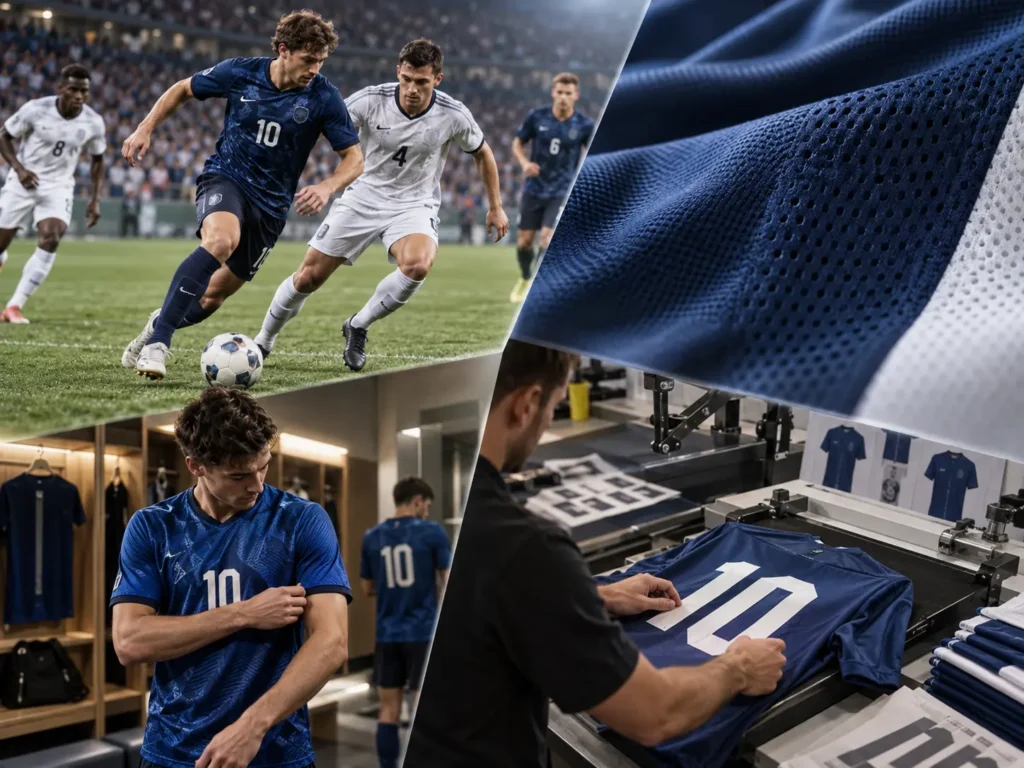
Sublimation vs. Heat Transfer vs. Ricamo: Which Should You Choose?
If X → Choose Y:
If the jersey uses complex all-over graphics → choose sublimation.
If each player needs a different name and number → consider heat transfer or individualized sublimation.
If a premium dimensional crest is required → consider embroidery or a woven / heat-applied badge.
If the priority is the lightest possible match jersey → minimize unnecessarily heavy decoration.
One Football Jersey can combine several technologies. A sublimated body can use a heat-applied sponsor mark and a separate woven crest. The best combination depends on appearance, peso, wash life, quantity and budget.
How to Customize a Football Jersey
Customization extends far beyond adding a logo. A true custom program can control:
- body fabric and mesh zones;
- GSM direction;
- team colors;
- collar and sleeve construction;
- club crest;
- sponsor positioning;
- nomi e numeri dei giocatori;
- manufacturer branding;
- size chart and fit;
- care and brand labels;
- individual or team packaging.
A Safer Custom Development Workflow
- Define end use and target market.
- Select fabric and fit direction.
- Confirm size specification.
- Provide vector artwork and color references.
- Prepare digital mockup.
- Create pre-production sample or strike-off.
- Check fit, colore, graphics and decoration.
- Approve bulk specification.
- Produce and inspect.
- Pack according to team / player list.
How to Avoid Color Problems in Custom Football Jerseys
Pantone Reference Is a Starting Point, Not the Final Result
A Pantone reference helps communicate intended color, but a digital screen, coated paper chip and sublimated polyester are different media. The final fabric appearance depends on printer profile, ink, transfer conditions and material construction.
For important club colors, approve a physical strike-off or actual jersey sample.
Dye Migration
Polyester dye migration can occur when high heat causes disperse dyes in the fabric to migrate into a lighter surface decoration. A white player number on dark red polyester, Per esempio, may become tinted if the transfer system is not designed to block migration.
Use suitable low-bleed or dye-blocking transfer systems and test them on the actual production fabric before bulk approval.
How Durable Should a Football Jersey Be?
There is no single universal performance threshold for every Football Jersey program. A professional club, school uniform supplier and low-cost event jersey may use different specifications. What matters is that test methods and pass criteria are defined before production.
| Area di prova | Relevant Method Direction | Cosa misura | Buyer Risk if Ignored |
|---|---|---|---|
| Fabric Mass | ASTM D3776/D3776M | Mass per unit area | Bulk fabric differs from approved GSM |
| Solidità del colore al lavaggio | ISO 105-C06 | Resistance to laundering-related color change / staining | Fading or color transfer |
| Colorfastness to Rubbing | ISO 105-X12 | Resistance to dry / wet rubbing transfer | Color rubs onto skin or other garments |
| Abrasione | ISO 12947 series where appropriate | Fabric resistance to abrasion | Premature wear or surface change |
| Stabilità dimensionale | Buyer-defined ISO / AATCC procedure | Size change after care cycles | Jersey becomes shorter or narrower |
| Seam Performance | Buyer-defined apparel test | Forza / slippage around seams | Failures during movement |
ISO 105-C06 addresses colorfastness to domestic and commercial laundering, while ISO 105-X12 covers resistance of textile color to rubbing. These methods provide a common language, but buyers still need to define the test condition and desired rating.
Do not accept “wash tested” as a complete specification. Ask which method was used, how many cycles were tested, the detergent and temperature conditions, and what result was considered acceptable.
What Should Buyers Check Before Bulk Production?
A pre-production checklist should confirm:
- fabric composition and construction;
- GSM;
- approved color;
- size chart and finished measurements;
- campione adatto;
- collar and sleeve pattern;
- club crest position;
- sponsor size and location;
- number height and placement;
- player name spelling;
- printing or badge technique;
- brand and care labels;
- individual packaging and carton marks.
Why the Pre-Production Sample Matters
A sample converts abstract specifications into one physical reference. Without it, the factory and buyer may each interpret “athletic fit,” “dark navy,” “large logo” or “light fabric” differently.
Approve the sample in writing and document any changes before bulk cutting begins.
Common Football Jersey Buying Mistakes
Errore 1: Choosing by Appearance Alone
Consequence: The design looks good online but performs poorly in heat or becomes uncomfortable during play.
Errore 2: Assuming GSM Equals Quality
Consequence: A buyer orders the “right” fabric weight but receives poor ventilation, stretch or opacity because knit structure was never specified.
Errore 3: Assuming Every Medium Is the Same
Consequence: Players receive inconsistent fit and customized jerseys become unusable.
Errore 4: Skipping a Size-Set or Fit Sample
Consequence: Grading problems are discovered only after hundreds of pieces are finished.
Errore 5: Choosing the Wrong Decoration Method
Consequence: Graphics become heavy, buccia, crack or reduce ventilation.
Errore 6: Ignoring Dye Migration
Consequence: White or light names and sponsor marks become discolored on darker polyester.
Errore 7: Using Protected Logos Without Authorization
Consequence: The order can create trademark, licensing or customs risk. Club professionistici, leagues and sportswear trademarks should not be reproduced without appropriate rights.
Errore 8: Ordering Exactly the Current Player Count
Consequence: A new player, damaged jersey or incorrect size creates an urgent reorder that may not match the original fabric or color batch.
How Many Football Jerseys Should a Team Order?
A twenty-two-player squad should not automatically order only twenty-two shirts. Consider home and away kits, goalkeepers, substitutes, staff requirements, size changes, new players and replacement stock.
The right contingency depends on the program. A one-day amateur tournament may need only a small buffer, while a school or academy running a full season benefits from replacement inventory.
For repeat programs, keep the approved artwork, Pantone references, fabric specification, size chart and garment measurements on file. Reordering from records is much safer than trying to reproduce the kit from a photograph six months later.
Come scegliere un produttore di maglie da calcio
A strong supplier should control more than sewing. Per abbigliamento da squadra personalizzato, evaluate:
- approvvigionamento di tessuti;
- pattern making;
- sublimation and digital printing;
- cutting accuracy;
- size grading;
- sviluppo del campione;
- color management;
- custom labels and packaging;
- QC procedures;
- repeat-order data management.
Factory vs. Trading Supplier
A factory can offer direct process control, but a trading supplier can sometimes offer wider sourcing flexibility. Neither structure is automatically superior. The deciding question is whether the supplier can meet your specification, document quality and solve problems quickly.
What Should You Ask Before Ordering?
- What body fabrics and GSM options are currently available?
- Can you provide separate youth, women’s and adult patterns?
- Which printing methods are in-house?
- What is the size tolerance?
- How is color approved?
- Can you provide size-set samples?
- How are personalized names and numbers checked?
- What testing can be arranged?
- How are repeat orders controlled?
- What is the real lead time after sample approval?
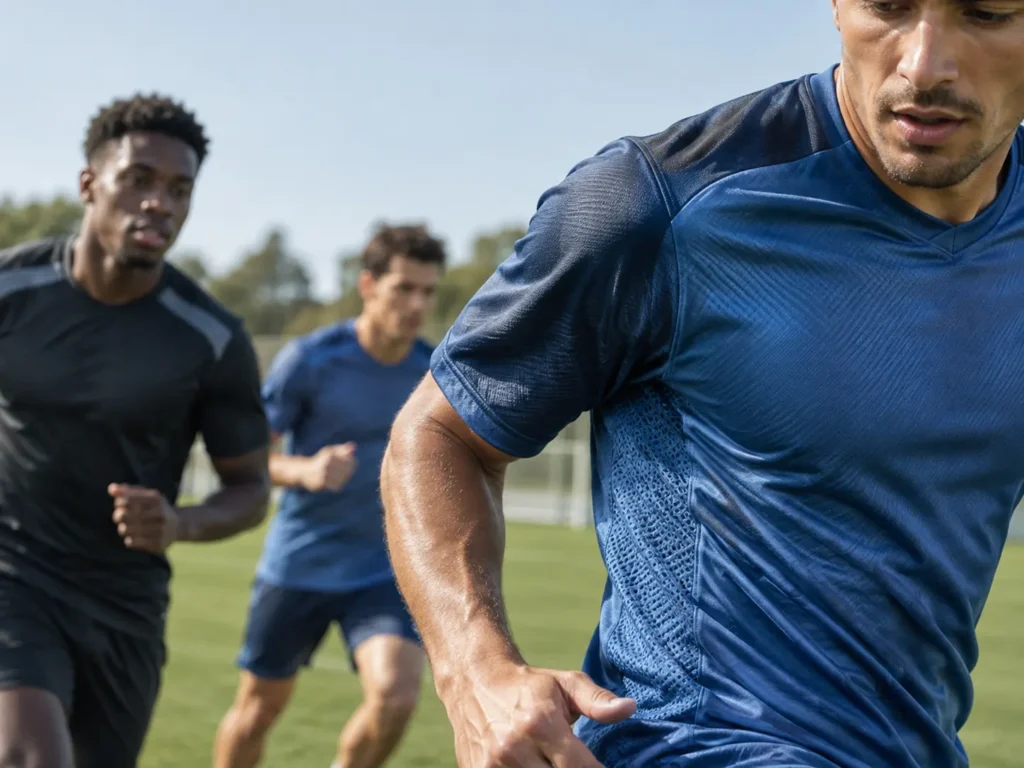
What Information Should You Send for a Custom Football Jersey Quote?
| Informazione | Example | Why the Manufacturer Needs It |
|---|---|---|
| Quantity | 150 maglie | Determines production and pricing direction |
| Users | Adult club / accademia giovanile | Changes size grading and fit |
| Tessuto | Lightweight polyester mesh | Controls comfort and price |
| GSM Direction | ca. 140–150 GSM | Clarifies desired weight |
| Adatto | Regular athletic | Guides pattern development |
| Artwork | AI / PDF / SVG files | Required for accurate graphics |
| Personalizzazione | Club logo, nomi, numeri, sponsor | Determines decoration workflow |
| Confezione | Individual polybag by player | Changes packing labor |
| Mercato | US / Unione Europea / UK / Medio Oriente | Changes labeling and compliance |
| Delivery Date | Before tournament date | Determines schedule feasibility |
Football Jersey Compliance and Labeling Requirements
United States Textile Labeling
Most textile products sold in the United States are subject to FTC textile labeling requirements. Labels generally need to disclose fiber content, country of origin and the identity of the manufacturer or another responsible business. Apparel is also subject to care-label requirements so consumers receive appropriate cleaning instructions.
For private-label buyers, confirm these details before the main label, neck label and care label are printed.
European Union Textile Fiber Labeling
Regulation (Unione Europea) NO 1007/2011 governs textile fibre names and related fiber-composition labeling and marking in the European Union. Only recognized fiber names should be used for declared composition, and products described as 100% or pure must meet the regulation’s requirements for that claim.
Do not assume a US label can automatically be reused for EU distribution without review.
REACH and Chemical Restrictions
Football Jerseys sold into the EU may also be affected by REACH Annex XVII restrictions applicable to textiles. Examples include restrictions on certain azo colorants capable of releasing specified aromatic amines, and restrictions on nonylphenol ethoxylates in textile articles expected to be washed in water.
The importer should confirm applicable chemical requirements for the exact product, dyeing and finishing system rather than simply asking the supplier whether it is “REACH certified.”
Intellectual Property
Custom factories should manufacture logos and crests only when the customer owns them or has authorization to reproduce them. A local amateur team creating its own crest is fundamentally different from an unauthorized order using the trademarks of a professional club or global sports brand.
Industry Trends Shaping Football Jerseys
Lighter Technical Fabrics
Performance collections continue to push toward lower weight without sacrificing opacity, durability and printing quality.
Body-Mapped Ventilation
Instead of making the whole jersey from one mesh, designers increasingly place ventilation where the athlete benefits from it most.
Poliestere riciclato
rPET is increasingly requested by brands and clubs, but sustainability claims should be supported by appropriate material documentation or certification. “Recycled” does not automatically mean lower total environmental impact in every context.
All-Over Sublimation
Sublimation enables smaller teams and private labels to create complex artwork without using multiple heavy surface print layers.
Smaller Customized Production Runs
Digital workflows make personalized names, numbers and team designs more economical at lower quantities than traditional mass-printing models.
Better Sizing Data
Private-label brands are paying more attention to body measurements, target-market grading and customer return data instead of copying generic size charts.
Raccomandazione: Choose the Jersey by Use, Not Appearance Alone
A strong Football Jersey decision begins with the user. Competitive players need mobility, ventilation and low unnecessary weight. Academies need durability, stable sizing and easy care. Fans need comfort. Retailers need consistent fit and repeatable inventory. Teams need accurate customization.
Once that purpose is defined, specify the fabric, GSM, adatto, tabella delle taglie, modello, decoration and QC requirements. Approve the physical sample rather than relying exclusively on a digital rendering. Test critical fabric and color performance where the project justifies it. Finalmente, confirm labeling and chemical requirements for the destination market before bulk production.
Soft CTA:
Preparing a custom team or wholesale Football Jersey project? Send your quantity, size breakdown, target fabric and GSM, fit direction, artwork, colori, club logos, nomi e numeri dei giocatori, packaging requirements and required delivery date. A complete brief allows the supplier to recommend a more realistic fabric, construction and customization route before sampling begins.
Football Jersey Decision Intelligence: How Fabric, Fit and Customization Work Together
This section turns the article into a practical decision framework. A Football Jersey should not be treated as separate choices of “fabric,” “size” and “printing.” Each decision changes the others. A tighter fit changes stretch requirements. A lighter body fabric changes which badges are suitable. A dark polyester can affect transfer selection. A fanwear pattern changes the size chart and expected drape.
Material Fit by Product Direction
Legend:
●●● = Primary
●●○ = Strong Option
●○○ = Depends on Workflow
— = Usually Not First Choice
This table is an application-fit prompt, not statistical data. The symbols do not represent probabilities, percentages, laboratory scores or guaranteed performance. Final suitability depends on fabric construction, GSM, adatto, clima, decoration method, washing requirements, target price and buyer specifications.
| Direzione del prodotto | Competitive Match | Formazione | Youth Academy | Fan Merchandise | Wholesale Private Label | Main Consideration |
|---|---|---|---|---|---|---|
| 140–150 GSM Polyester Body | ●●● | ●●● | ●●○ | ●●○ | ●●● | Opacity, lavorare a maglia, airflow and durability |
| Polyester Mesh Panels | ●●● | ●●● | ●●○ | ●○○ | ●●○ | Ventilazione, snag resistance and color matching |
| Polyester-Spandex Panels | ●●● | ●●○ | ●●○ | ●○○ | ●●○ | Stretch recovery and decoration heat control |
| Heavier Polyester Direction | ●○○ | ●●○ | ●●○ | ●●● | ●●● | Comfort, structure and climate |
| Rib Collar / Cuff Fabric | ●●○ | ●●○ | ●●○ | ●●● | ●●● | Recupero, appearance and collar construction |
Current Product Direction Entry
For buyers developing coordinated club apparel beyond the match shirt, the site also includes a custom teamwear entry point for broader sportswear programs. Use it as a product-direction reference; the exact fabric, fit and customization capability should still be confirmed for the current project.
How Should Fabric and Fit Be Matched?
A close athletic fit needs either sufficient mechanical knit stretch, elastane-assisted stretch or a pattern engineered so movement is not restricted. A relaxed fan fit does not need the same level of elasticity and can prioritize hand feel and structure instead.
If the pattern is very close and the fabric has little recovery, shoulder and chest restriction becomes more likely. If the fabric is highly elastic but the pattern is too loose, the performance benefit may be wasted.
Why Is the Cheapest Jersey Often Not the Lowest-Cost Jersey?
Unit cost is only one part of a team program. Add replacement costs, sizing errors, print failures, color inconsistency, delayed deliveries and difficult reorders. A jersey that costs slightly more but survives a season and can be reordered accurately may create a stronger total ROI.
Opzione: What Should a Competitive Team Prioritize?
Start with breathable polyester construction, controlled garment weight, an athletic pattern and lightweight decoration. Add mesh or stretch zones where they support actual movement and heat management. Avoid adding heavy embroidery or oversized transfers only because they look premium in a catalog.
Opzione: What Should a School or Academy Prioritize?
Durability and size stability often matter more than the absolute lowest garment weight. A regular athletic fit can reduce sizing risk across mixed body types. Sublimation is useful where teams require repeated washing and complex graphics.
Opzione: What Should a Fanwear Brand Prioritize?
Comfort, garment proportions, hand feel and branding become more important than match-level weight reduction. A regular or deliberately oversized pattern can work better than copying a professional player silhouette.
Considerazione: Customization Creates Financial Lock-In
Once names, numbers and logos are applied, an incorrectly sized jersey is difficult to reassign or resell. That means sizing should be approved before personalization, not after.
Considerazione: Regulations Are Market-Specific
US, EU and other destination markets do not use identical textile labeling rules. Chemical restrictions, children’s product rules and customs requirements can also differ. Buyers should identify destination markets during development so the correct labels and compliance documents are prepared before bulk production.
Considerazione: Sustainability Claims Need Evidence
Poliestere riciclato, lower-impact dyes and responsible manufacturing can be meaningful product directions, but buyers should request supporting documentation rather than relying on vague “eco-friendly” language. Traceable fiber claims and recognized certification systems are more useful than unsupported environmental promises.
What Is the Future of Custom Football Jerseys?
The market is moving toward smaller personalized runs, faster digital artwork workflows, better fit data, lightweight badge technology, recycled fiber options and more precise QC records. Per gli acquirenti B2B, this means the competitive advantage is shifting from “who can make a jersey” to “who can reproduce the right jersey consistently across seasons, dimensioni, teams and repeat orders.”
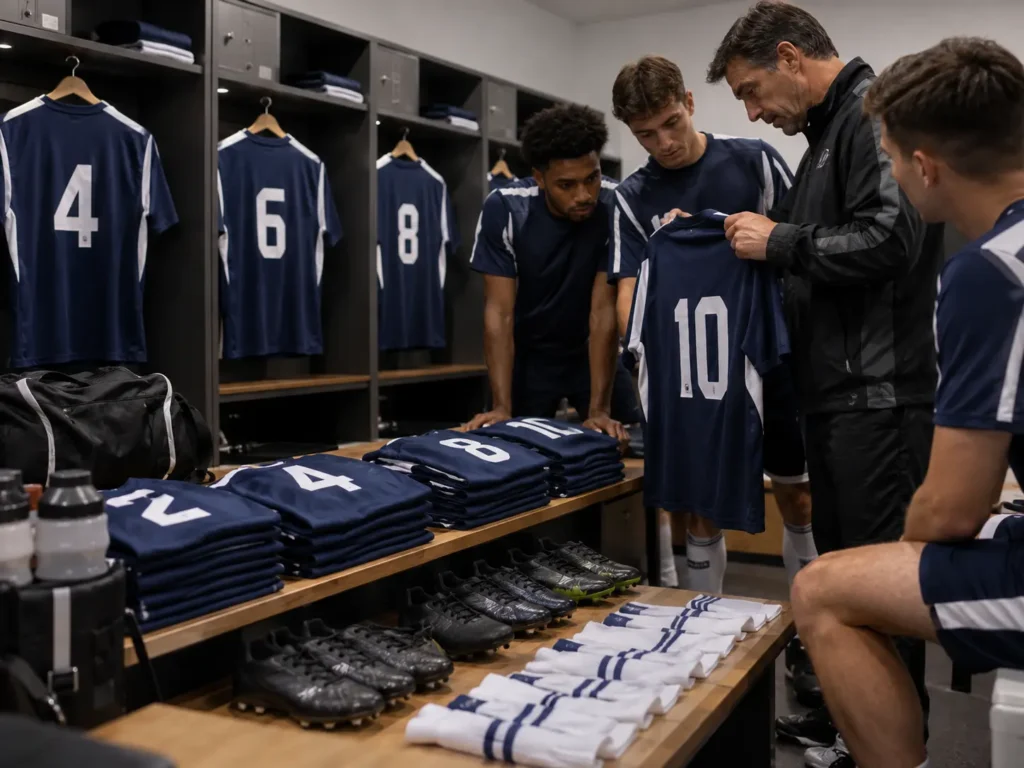
Domande frequenti sulle maglie da calcio
1. What is the best material for a Football Jersey?
Polyester-based knitted fabrics are the most common starting point for performance Football Jerseys because they can be lightweight, asciugatura rapida, dimensionally stable and compatible with sublimation printing. Tuttavia, “100% polyester” does not automatically mean the fabric is breathable or high quality. Yarn, struttura a maglia, GSM, mesh construction and finishing all influence comfort. Competitive teams may prefer lightweight polyester with strategically placed mesh, while fanwear may use a slightly heavier and softer structure. Polyester-spandex blends can also be useful where additional stretch and a close athletic fit are required.
2. What GSM is best for a Football Jersey?
There is no universal best GSM. Lightweight performance jerseys often fall broadly around the 120–150 GSM direction, while approximately 150–180 GSM can provide a balanced structure for match or training use. Heavier fabrics may be useful for fanwear, training apparel or cooler conditions. Current published football-uniform material examples on the site include body fabrics around 140–150 GSM and selected mesh panels around 145 GSM. GSM should always be evaluated together with opacity, flusso d'aria, stirata, durability and climate rather than used as a standalone quality grade.
3. How should a Football Jersey fit?
A match jersey should allow unrestricted shoulder and torso movement without excessive loose fabric. Player-style jerseys normally fit closer through the chest, sleeves and waist, while fan or replica styles generally provide more ease for casual wear and layering. The correct size should be selected from actual chest and garment measurements rather than the S/M/L label alone. When ordering custom team jerseys, approve representative size samples and perform movement checks before assigning personalized player names and numbers. Gioventù, women’s and adult garments may also need separate pattern blocks rather than one universal unisex chart.
4. Is sublimation better than heat transfer for Football Jerseys?
Sublimation is usually the stronger option for full-color, all-over designs on suitable polyester because the graphics add very little surface weight and can include gradients, numbers and complex patterns. Heat transfer is particularly useful for individual player names, numeri, sponsors or badges that change from jersey to jersey. Neither method is universally better. The decision depends on fabric, quantità, artwork, weight target, wash expectations and personalization workflow. Dark polyester also requires attention to possible dye migration when light-colored heat-applied graphics are used.
5. What should I check before ordering custom Football Jerseys in bulk?
Confirm the fabric composition and GSM, struttura a maglia, tabella delle taglie, fit direction, adult and youth grading, collar and sleeve pattern, artwork, colori, logo positions, player-name spelling, dimensioni dei numeri, printing or badge method, etichette per la cura, packaging and delivery date. Approve a physical pre-production sample and, for larger programs, a size set before bulk manufacturing. Buyers should also define measurable QC requirements such as garment dimensions, colorfastness and fabric weight, and verify destination-market labeling and chemical restrictions before production. Finalmente, keep approved specifications and artwork for future repeat orders.
Riferimenti
- Textile Fiber Rule, 16 CFR Part 303. Autore: Commissione federale per il commercio. Institution: U.S. Commissione federale per il commercio. Fonte: Clothing and Textile Regulatory Guidance.
- Care Labeling of Textile Wearing Apparel and Certain Piece Goods, 16 CFR Part 423. Autore: Commissione federale per il commercio. Institution: U.S. Commissione federale per il commercio. Fonte: Care Labeling Rule.
- Regulation (Unione Europea) NO 1007/2011 on Textile Fibre Names and Related Labelling and Marking of Fibre Composition. Autore: European Parliament and Council of the European Union. Institution: European Union. Fonte: Official Journal of the European Union.
- REACH Annex XVII, Entry 43: Azocolourants and Azodyes. Autore: Agenzia europea per le sostanze chimiche. Institution: ECHA. Fonte: REACH Restrictions Database.
- REACH Annex XVII, Entry 46a: Nonylphenol Ethoxylates in Textile Articles. Autore: Agenzia europea per le sostanze chimiche. Institution: ECHA. Fonte: REACH Annex XVII Conditions of Restriction.
- ASTM D3776/D3776M-20(2025), Standard Test Methods for Mass Per Unit Area (Peso) of Fabric. Autore: ASTM Committee D13 on Textiles. Institution: ASTM Internazionale. Fonte: ASTM Book of Standards.
- ISO 105-C06:2010, Textiles — Tests for Colour Fastness — Colour Fastness to Domestic and Commercial Laundering. Autore: ISO Technical Committee 38. Institution: Organizzazione internazionale per la standardizzazione. Fonte: ISO Textile Standards.
- ISO 105-X12:2016, Textiles — Tests for Colour Fastness — Colour Fastness to Rubbing. Autore: ISO Technical Committee 38. Institution: Organizzazione internazionale per la standardizzazione. Fonte: ISO Textile Standards.