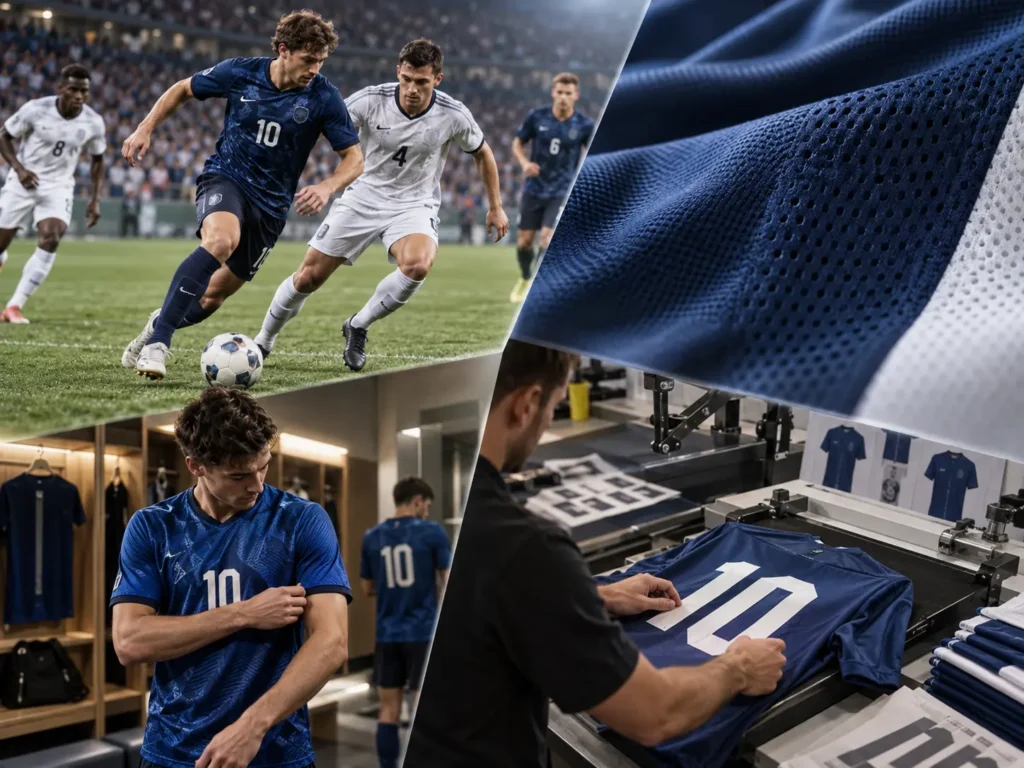
Breathnaíonn Geansaí Peile simplí go dtí go dtagann an ceann mícheart. D’fhéadfadh cuma iontach a bheith ar dhearadh ar bhréagadh digiteach ach go mothaíonn sé te le linn cluiche, síneadh trasna lógó an urraitheora, céimnithe tar éis níocháin arís agus arís eile nó cuir leath na foirne in oiriúint don sampla ceadaithe. Is é an chúis go bhfuil éadaí feidhmíochta córas: comhdhéanamh fabraice, tógáil cniotála, mais fabraice, socrúchán painéil, oiriúnach, suíomh seam, idirghníomhaíonn teicneolaíocht maisiúcháin agus grádú patrún. A 100% is féidir le geansaí poileistear a bheith éadrom agus an-breathable, ach ceann eile 100% is féidir le geansaí poileistear a bheith níos troime agus níos lú aerála toisc go bhfuil an meáchan cniotáilte agus fabraic difriúil. Ní mór do cheannaitheoirí, dá bhrí sin, dul thar an lipéad agus an tsonraíocht iomlán a mheas. Foirne, féadfaidh acadaimh agus dáileoirí éadaí spóirt atá ag cur tús le tionscadal athbhreithniú a dhéanamh ar na cinn atá ar fáil ar dtús éide sacair saincheaptha treo a thuiscint conas fabraice, painéil taobh, is féidir roghanna priontála agus stíle a chur le chéile sula gcríochnaítear a n-ordachán féin Football Jersey.
Tá feidhm ag an bprionsabal céanna nuair a bhíonn an mhonarcha taobh thiar den táirge á mheas. Ní hamháin gur post fuála é ordú geansaí. Cinneann forbairt patrún oiriúnach, cinneann priontáil dhigiteach cruinneas grafach, ailíniú rialuithe gearrtha, bíonn tionchar ag fuála ar ghluaiseacht agus ar chompord, agus cinneann cigireacht cáilíochta cibé an bhfanann na mórphíosaí gar don chairt mhéid ceadaithe. Le haghaidh brandaí lipéad príobháideacha nó cláir chlub a bhfuiltear ag súil le horduithe athuair, caithfidh an monaróir a bheith in ann dath a atáirgeadh freisin, fabraic, grádú agus saothar ealaíne roinnt míonna ina dhiaidh sin. Mar sin tá cumas forbartha agus rialú próisis níos tábhachtaí ná an luachan is ísle a aimsiú. Ba cheart do cheannaitheoirí a dhéanann comparáid idir comhpháirtithe léiriúcháin taithí éadaí spóirt an tsoláthraí a scrúdú, cumas priontála digiteach, sreabhadh oibre saincheaptha agus struchtúr QC trína Peile Jersey monaróir cúlra sula ndéileáiltear le luachan mar luach inchomparáide ó thaobh na tráchtála de. Is féidir le monarcha beagán níos saoire éirí costasach má chruthaíonn méid neamhréireach athchur, tá gá le hathphriontáil a dhéanamh ar ghrafaic an urraitheora nó níl an dara hordú ag teacht le bunfheisteas an tséasúir a thuilleadh.
Sula n-iarrtar praghsanna, an cás úsáide a shainiú. Féadfaidh scuad aosach iomaíoch tosaíocht a thabhairt do fabraic comhlacht teicniúil éadrom, mogalra straitéiseach agus oiriúnach dlúth lúthchleasaíochta. Seans go mbeidh luach ag acadamh óige ar níocháin éasca, marthanacht agus grádú méide intuartha. B’fhéidir gur fearr le clár feisteas fean feisteas rialta níos boige mar go gcaitear an geansaí go hócáideach seachas ar feadh nócha nóiméad de ghluaiseacht leanúnach. D'fhéadfadh go mbeadh an cúram is mó ag eagraí comórtais a ordaíonn roinnt dearaí foirne faoi bhainistíocht dathanna, cruinneas ainm agus uimhir agus rialú seachadta. Bíonn tionchar ag na difríochtaí seo ar an bhfabraic, priontáil agus tógáil, mar sin RFQ a deir ach “100% poileistear Football Jersey, praghas is fearr” fágann an iomarca athróg neamhrialaithe. Ba cheart go gcuimseodh fiosrúchán úsáideach cainníocht, miondealú ar mhéid daoine fásta nó óige, meáchan fabraic sprioc, treo oiriúnach, lógónna, pearsantú imreoir, pacáistiú agus dáta seachadta. Nuair a bheidh na sonraí sin réidh, Is féidir le ceannaitheoirí a chur isteach níos cruinne ceanglófar saincheaptha Jersey Football in ionad praghsanna a chur i gcomparáid le haghaidh táirgí a bhféadfadh fabraicí agus sonraíochtaí go hiomlán difriúil a bheith acu.
Tá aird ar leith tuillte ag sizing mar go ndéanann saincheaptha botúin sizing costasach. Is féidir léine bán atá ró-bheag a mhalartú; léine ar a bhfuil ainm imreora, uimhir, Is beag luach athdhíola atá ag suaitheantas club agus urraitheoir nuair a oireann sé don duine mícheart. Tá na litreacha S, Ní toisí uilíocha éadaigh iad M agus L. Tagann siad ó bhloc patrún, caiteoir beartaithe, tomhais coirp, caitheamh gan stró agus rialacha grádaithe. Is féidir le meán dlúth i stíl imreora a bheith níos cúinge go suntasach ná meán lucht leanúna suaimhneach, agus féadfaidh patrúin na hóige agus na mban comhréireanna éagsúla a úsáid go hiomlán. Is é an sreabhadh oibre is sábháilte imreoirí a thomhas, sainaithin an ndéanann cairt an déantóra cur síos ar thoisí an choirp nó an éadaigh, sraith méid ionadaíoch a cheadú agus gan ach táirgeadh pearsantaithe a scaoileadh ansin. Ba chóir d'fhoirne nach bhfuil cinnte faoin bpróiseas seo treoir mhionsonraithe a úsáid ar conas a roghnú do mhéid Jersey Peile seachas gnáthmhéid T-léine gach imreora a bhailiú.
Is é an dara saincheist méide ná rún oiriúnach. Is gnách go n-úsáideann geansaithe iomaíocha éascaíocht rialaithe ionas nach n-imríonn barraíocht fabraice le linn súgartha, agus ceadaíonn geansaithe lucht leanúna de ghnáth níos mó spáis tríd an cófra agus waist. Is féidir le Geansaithe Peile atá dírithe ar fhaisean scáthchruth rómhór a úsáid d’aon ghnó, ach ní hionann fíorphatrún rómhór agus roinnt méideanna níos mó a ordú. Is féidir le hionadú méid mhór a chruthú fad comhlacht iomarcach, armholes thit, sleeves fada agus oscailt muineál a bhreathnaíonn mícheart. Tomhas cófra, pit-go-pit éadaigh, fad coirp, cruth ghualainn, ba chóir feisteas muinchille agus stráice fabraice a mheas le chéile. Foireann a dteastaíonn daoine fásta uathu, ba cheart do mhéideanna na mban agus na hóige a dhearbhú freisin an bhfuil patrúin ar leith ar fáil seachas gach duine a chaitheamh isteach i mbloc unisex amháin. Chun comparáid níos mionsonraithe a dhéanamh ar imreoir, lucht leanúna, loighic oiriúnachta óige agus daoine fásta, na cinn atá ann Treoir Méid Peile Geirsí soláthraíonn sé tagairt tomhais úsáideach sula gcuirtear an liosta méide deiridh faoi ghlas.
Ba chóir praghas a mheas go deireanach, ní ar dtús. Féadfaidh an costas is ísle in aghaidh an gheansaí an tuairisceán tionscadail is laige a tháirgeadh má bhraitheann an fabraic te, aistríonn dathanna idir go leor, teipeann ar na grafaicí go luath nó ní féidir le horduithe athsholáthair teacht leis an bhfearas bunaidh. Le haghaidh club, is sócmhainn aitheantais foirne agus dromchla taispeána urraithe é Geansaí Peile freisin. Le haghaidh dáileoir, is fardal é a chaithfidh a bheith oiriúnach go comhsheasmhach agus maireachtáil ag níocháin na gcustaiméirí. Do scoil, féadfar é a athúsáid go seachtainiúil thar shéasúr iomlán. Déanann na feidhmeanna seo ROI iomlán an tionscadail níos úsáidí ná an praghas aonaid amháin. Ba cheart do cheannaitheoirí cáilíocht an ábhair a chur i gcomparáid, próiseas priontála, comhsheasmhacht méid, cruinneas saincheaptha, iniúchadh agus cobhsaíocht a athordú mar aon leis an luachan. Clúdaítear creat níos doimhne chun an chomhbhabhtáil sin a ríomh Peil Jersey ag foinsiú ROI, go háirithe nuair a dhéantar comparáid idir soláthraithe mórchóir a bhfuil cuma comhchosúil ar na príomhphraghsanna ach a bhfuil a bhfabraic acu, Níl QC agus raon feidhme seirbhíse comhionann.

Cad ba cheart duit a lorg agus geansaí peile á roghnú agat?
Tosaíonn cinneadh praiticiúil Football Jersey le sé athróg: fabraic, meáchan fabraice, bainistíocht taise, méid, oiriúnach agus maisiú. Cinneann tógáil agus comhlíonadh ansin an féidir leis an dearadh roghnaithe maireachtáil i dtáirgeadh agus úsáid fíor.
| Cineál Ceannaitheora | Treo Fabraic | Treo Fit | Treo Maisiú | Príomhthosaíocht |
|---|---|---|---|---|
| Foireann Iomaíoch | poileistear éadrom le criosanna aerála | Lúthchleas Gael / éascaíocht rialaithe | Aistrithe sublimation nó lightweight | Gluaiseacht, bainistíocht teasa, meáchan íseal |
| Acadamh Óige | poileistir durable éasca-chúraim | Oiriúnach lúthchleasaíochta rialta | sublimation | Marthanacht, méide, ag ní |
| Marsantais Fan | poileistir atá dírithe ar chompord | rialta / suaimhneach | sublimation, suaitheantas, aistriú nó bróidnéireacht | Compord agus cuma |
| Lipéad Príobháideach Mórdhíola | Sonraíocht-tiomáinte | Sainiúil don mhargadh | Sainithe do chustaiméirí | Comhsheasmhacht, QC, rialú athordú |
| Eagraí Tournament | Feidhmíocht chothrom poileistear | Foireann leathan oiriúnach | sublimation | Éifeachtúlacht agus seachadadh il-dearadh |
Cén Fabraic is Fearr le haghaidh Geirsí Peile?
Cén fáth a bhfuil poileistir mar phríomhthreoir feidhmíochta
Is mó poileistir déantúsaíochta Jersey Peile nua-aimseartha mar is féidir é a lightweight, cobhsaí tríthoiseach, triomú tapa agus comhoiriúnach le priontáil sublimation. ach, ní dhéanann an t-ainm snáithín amháin cur síos ar fheidhmíocht. Cineál snáth, struchtúr cniotáilte, críochnú dromchla, céimseata poll agus meáchan fabraice go léir athrú airflow, síneadh, drape agus gluaiseacht taise.
Mar shampla, I measc na dtreoracha reatha peile-éide ar an suíomh tá thart ar 140 poileistear GSM dhá thaobh, 144 GSM poileistear mogall beag agus thart 145 Mogalra poileistear-spandex GSM do phainéil taobh nó underarm roghnaithe. Struchtúir rib timpeall 230 Úsáidtear GSM le haghaidh comhpháirteanna mar choiléar seachas mar chorp an gheansaí meaitseála ar fad.
Is tagairtí dearaidh úsáideacha iad na figiúirí seo, ní caighdeáin uilíocha peile.
Mogalra poileistir
Méadaíonn mogalra limistéar oscailte agus féadann sé aeráil a fheabhsú nuair a úsáidtear é go cuí. Tá sé úsáideach go háirithe ar chúl, taobh torso nó underarm áit ar féidir carnadh teasa agus taise a bheith ard.
Ach níl poill níos mó go huathoibríoch níos fearr. Is féidir le mogalra an-oscailte teimhneacht a laghdú, friotaíocht snag agus aonfhoirmeacht grafach. Le haghaidh dearaí sublimated, is féidir le tógálacha painéil éagsúla dath a atáirgeadh go difriúil freisin, mar sin ba cheart don cheannaitheoir an éadaí iomlán a cheadú seachas swatch fabraice scoite amháin.
Comhcheangail poileistir-Spandex
Má chuirtear leaisteáin nó spandex leis is féidir tacú le feistiú níos dlúithe agus téarnamh stráice níos fearr. Is féidir leis seo oibriú go maith le haghaidh sleeves lúthchleasaíochta, painéil taobh agus geansaithe imreoirí feistithe.
Is é an comhbhabhtáil ná go bhféadfadh rialú teasa níos déine a bheith ag teastáil ó fabraicí an-leaisteach le linn maisiúcháin agus QC tríthoiseach níos dlúithe. Is féidir go n-oirfeadh Geansaí Peile le níos mó stráice ar bhealach difriúil freisin fiú nuair a bhíonn cuma comhchosúil ar thoisí an éadaigh árasán.
Cén Fáth nach De ghnáth cadás é an Chéad Rogha Lá Meaitseála
Tá cadás compordach i éadaí ócáideach, ach súnn sé i bhfad níos mó taise ná poileistear hidreafóbach agus féadann sé éirí níos troime de réir mar a charnann perspiration. Le haghaidh feisteas retro, geansaithe stíl mhaireachtála nó bailiúcháin ócáideacha, is féidir fabraicí ina bhfuil cadás a bheith ábhartha fós. Le haghaidh úsáide iomaíochta, is gnách gurb iad struchtúir éadroma poileistear an treo tosaigh níos praiticiúla.
Cé Mhéad Ba Chóir do Pheil Fabraic Geirsí Meáchain?
De ghnáth cuirtear mais fabraice in iúl i GSM, nó gram in aghaidh an mhéadair chearnaigh. Soláthraíonn ASTM D3776/D3776M modhanna seanbhunaithe chun mais fabraice in aghaidh an aonaid achair a chinneadh. Tá GSM úsáideach, ach ní scór cáilíochta é.
Is féidir le fabraic éadroma a bheith sármhaith nó bocht. Is féidir le fabraic níos troime a bheith durable nó gan ghá te. Ní mór do cheannaitheoirí GSM a léirmhíniú mar aon le tógáil cniotáilte, teimhneacht, stráice agus séasúr beartaithe.
| Treo Fabraic Neas | Carachtar tipiciúla | Buntáiste Féideartha | Riosca Ceannaitheora |
|---|---|---|---|
| 120–150 GSM | Treo feidhmíochta éadrom | Meáchan éadaigh íseal, poitéinseal triomú níos tapúla | Teimhneacht, ní mór snagging agus marthanacht a sheiceáil |
| 150–180 GSM | Cluiche cothrom / treo traenála | Cothromaíocht mhaith de struchtúr agus compord a chaitheamh | Braitheann aeráil iarbhír fós ar chniotáil |
| 180–220 GSM | Traenáil níos troime / treo fanwear | Níos mó struchtúr agus substaint a bhraitear | B'fhéidir go mbraitheann tú níos teo i gcluichí te |
| 230 GSM rib / treo Baile Átha Troim | Coiléir, cuacha, Baile Átha Troim struchtúrach | Coinneáil cruth | Ní dhéileáiltear leo de ghnáth mar thagarmharc fabraice coirp |
Tábhachtach: Is treoracha foinsithe agus forbartha iad seo, ní ceanglais GSM Peile Geansaí uilíoch uilíoch. Comórtas, ba cheart tosaíocht a thabhairt do shonraíochtaí branda agus úsáide deiridh.
An Ciallaíonn Níos Gile i gcónaí Níos Fearr?
Níl. Is féidir le fabraic thar a bheith éadrom a bheith tréshoilseach faoi soilsiú staidiam, saobhadh thart ar shuaitheantais throma nó snag níos éasca. D’acadamh óige a níonn éide gach seachtain, is féidir le fabraic beagán níos substaintiúla luach iomlán níos fearr a ghiniúint ná an meáchan éadaigh is ísle is féidir a bhaint amach.
Má tá X → Roghnaigh Y:
Más é feidhmíocht cluiche te-aimsire an tosaíocht → cuir tús le poileistear éadrom agus aeráil innealtóireachta.
Má tá marthanacht seachtainiúil acadaimh níos tábhachtaí → roghnaigh GSM cothrom agus deimhnigh cobhsaíocht níocháin.
Más marsantas lucht leanúna é an geansaí → tabhair tosaíocht do mhothú láimhe, teimhneacht agus compord seachas an meáchan fabraice is ísle.
Cén chaoi ar chóir do gheirsí peile allais agus teas a bhainistiú?
Tá baint ag breathability agus wicking taise ach ní hionann iad agus an mhaoin chéanna. Tagraíonn breathability go ginearálta do chumas an aeir nó an ghaile bogadh trí chóras teicstíle. Déanann Wicking cur síos ar iompar taise leachtach tríd an struchtúr nó trasna.
Mar sin is féidir le mogall sofheicthe a bheith ag geansaí agus is féidir leis an allais a bhainistiú go dona mura bhfuil iompar taise tríd an gcuid eile den bhall éadaigh neamhéifeachtach. Os a choinne sin, d'fhéadfadh go n-aistríonn cuma dhian an taise go héifeachtach trí ghníomhú ribeach ach ní fhéadfaidh sé sruth aeir níos lú a sholáthar.
Aeráil Mapála Coirp
Is féidir le tógáil feidhmíochta nua-aimseartha fabraicí éagsúla a úsáid i gcriosanna éagsúla. Is féidir le painéil taoibh agus underarms úsáid a bhaint as mogalra oscailte agus soláthraíonn an tosaigh teimhneacht níos mó le haghaidh priontála urraitheoirí. Is féidir leis an gcúl struchtúr níos éadroime a úsáid chun scaoileadh teasa a fheabhsú.
D'fhoirne atá san iomaíocht in aeráidí te nó tais, luacháil an geansaí iomlán agus é á ghluaiseacht seachas fabraic a roghnú trí theagmháil i seomra taispeána aer-oiriúnaithe.
Conas a d'oirfeadh Geansaí Peile?
Imreoir / Fit Lúthchleasa
Is gnách go leanann geansaí ar stíl imreora an torso níos dlúithe, le fabraic níos lú de bhreis ar fud an cófra agus waist. D'fhéadfadh sleeves a bheith níos feistithe freisin. Cruthaíonn sé seo cuma sruthlínithe agus laghdaíonn sé flapping le linn súgartha.
Tá an baol ann go bhféadfadh imreoirí atá i dtaithí ar T-léinte rialta gannmheas a dhéanamh ar chomh gar agus atá an feisteas. Ná inis do gach ceannaitheoir go huathoibríoch "méid suas." Déan comparáid idir an chairt éadaigh iarbhír agus an feistiú atá beartaithe ar dtús.
Feisteas Foirne Rialta
Soláthraíonn oiriúnach lúthchleasaíochta rialta éascaíocht measartha gan a bheith baggy. Is minic gurb é an pointe tosaigh is sábháilte do scoileanna, clubanna amaitéaracha agus acadaimh toisc go bhfreastalaíonn sé ar níos mó cineálacha coirp agus é fós cosúil le héadaí spóirt seachas éadaí ócáideacha.
Fan / Macasamhail Fit
De ghnáth ligeann geansaithe lucht leanúna níos mó spáis le haghaidh gluaiseacht ócáideach agus leagan. Is féidir iad a chaitheamh thar T-léine nó sweatshirt éadrom, mar sin tá éascaíocht torso níos tábhachtaí ná cuma aerdinimiciúil.
Fit Stíl Mhaireachtála rómhór
Úsáideann éadaí sráide atá spreagtha ag an bpeil níos mó scáthchruthanna rómhóra. Ba chóir geansaí fíor-mhór a phatrún le leithead breise d'aon ghnó, seasamh ghualainn agus comhréir coirp. Is féidir an fad muinchille mícheart agus an muince mícheart a chruthú seachas feistiú dea-dheartha rómhór a ordú ach XL a ordú.
Treoir Méid Peile Geirsí: Cé na Tomhais is Tábht?
De ghnáth is é cófra an tomhas tosaigh is láidre, ach níor cheart go mbeadh an mórchóir déantúsaíochta ag brath ar uimhir amháin amháin.
| Tomhas | Conas a Úsáidtear é | Cén Fáth a bhfuil Tábhacht ag baint leis | Botún Coiteann |
|---|---|---|---|
| Imlíne cófra | Méid an choirp | Tagairt phríomhchorp uachtair | Cófra coirp mearbhall le cófra éadaigh |
| Pit-go-Pit | Tomhas éadaigh cothrom | Comparáid éasca leis an geansaí atá ann cheana féin | Comparáid dhíreach a dhéanamh le imlíne an choirp |
| Fad Coirp | Comhréir éadaigh | Tábhachtach le haghaidh ard / imreoirí gearr | Sizing níos leithne ach fad a fháil |
| Leithead Gualainn | Patrún oiriúnach | Bíonn tionchar aige ar ghluaiseacht agus ar chuma na lámh | Neamhaird a thabhairt ar thógáil báite nó raglan |
| fad muinchille | Soghluaisteacht agus stíl | Tábhachtach don óige agus geansaithe fad-sleeve | Ag glacadh leis an lipéad méid rialaíonn sleeve oiriúnach |
| Waist / Hem | Measúnú taper | Tábhachtach ar oireann lúthchleasaíochta | Roghnú le cófra ach amháin ar stíl barrchaolaithe go láidir |
Tá Tomhais Coirp agus Tomhais Éadaigh Éagsúla
Má leagtar ball éadaigh bearta cothrom 51 cm ó chlais go poll, is é a imlíne chomhréidh 102 cm. Ní chiallaíonn sé sin go bhfuil sé beartaithe go huathoibríoch a 102 cófra comhlacht cm. Is féidir le héascaíocht dearfach a bheith sa bhall éadaigh, gan stró náid nó éascaíocht dhiúltach stráice-bhunaithe ag brath ar an dearadh.
Sin cúis amháin a chruthaíonn cairteacha méide ar líne mearbhall go minic.
Cén Fáth nach bhfuil Meán Uilíoch ann
Bloic patrún, fealsúnacht oiriúnachta agus margaí sprice difriúil. Clár fean éadaí Eorpacha, féadfaidh acadamh óige SAM agus bailiúchán lipéad príobháideach caol-oiriúnach na hÁise “M” a shainiú ar bhealach difriúil.
Le haghaidh táirgeadh B2B, tomhais iarbhír éadaí críochnaithe a cheadú seachas méideanna litreacha amháin.
Conas ar Chóir d'Fhoirne Méid a Fhaomhadh roimh Tháirgeadh Bulc?
Ba cheart do chlub a ordaíonn feisteáin phearsantaithe an méid atá leagtha síos a bhunú sula scaoiltear saothar ealaíne le haghaidh táirgeadh sainiúil don imreoir.
- Déan imreoirí ionadaíocha a thomhas.
- Roghnaigh méideanna trialach ón gcairt atá beartaithe.
- Gluaiseacht tástála: airm a ardú, guaillí rothlú, rith agus lúb.
- Seiceáil cófra, fad agus sleeve oiriúnach.
- An tsonraíocht éadaigh a cheadú.
- Bailigh ainmneacha na n-imreoirí deiridh, uimhreacha agus méideanna.
- Scaoileadh táirgeadh mórchóir phearsantaithe.
Le haghaidh cláir mhóra, na pointí grádaithe tábhachtacha ar a laghad a shampla seachas sampla meánach amháin a cheadú agus glacadh leis go mbeidh XS trí 3XL grádaithe go foirfe.
Barántúla vs. Macasamhail Geansaithe Peile: Cad é an Difríocht?
Úsáidtear na focail “barántúla” agus “macasamhail” go coitianta i margaíocht peile ceadúnaithe, ach cuireann siad síos go ginearálta ar shuíomh táirgí seachas ar chaighdeán déantúsaíochta uilíoch.
| Gné | Imreoir / Treo Barántúil | Fan / Treo macasamhail | Treo Foirne Saincheaptha |
|---|---|---|---|
| Fit | Scáthchruth lúthchleasaíochta níos dlúithe | rialta / suaimhneach | Ceannaitheora-sainithe |
| Fabraic | Go minic níos éadroime / níos teicniúla | Comhardú chompord agus marthanacht | Sonraíocht-spleách |
| Suaitheantais | Go minic iarratais éadroma | Is féidir roghanna maisiúcháin níos troime a úsáid | Roghanna iomadúla |
| Bunsprioc | Feidhmíocht mheaitseáil | Compord lucht leanúna | Féiniúlacht foirne agus riachtanais tionscadail |
| Riosca Sizing | Níos airde má ghlacann ceannaitheoir leis go bhfuil T-léine oiriúnach | Níos ísle ach fós sainiúil don táirge | Rialaithe trí thacar méideanna ceadaithe |
Ní hionann táirge macasamhail dlisteanach agus táirge góchumtha. Cóipeáil neamhúdaraithe ar shuaitheantais foirne faoi chosaint, cruthaíonn lógónna léige nó trádmharcanna branda fadhb ar leith maidir le maoin intleachtúil.
Conas a Dhéanann Patrúin Geirsí Tionchar ar Chompord agus ar Ghluaiseacht?
Sleeves Raglan
Síneann tógáil Raglan an patrún muinchille i dtreo an neckline agus féadann sé cuma spórtúil a sholáthar le níos lú seams ghualainn traidisiúnta. Is féidir leis tacú le gluaiseacht ghualainn compordach, cé go mbraitheann soghluaisteacht deiridh fós ar chéimseata armhole agus stráice fabraice.
Sleeves Set-I
Cruthaíonn sleeves socraithe líne ghualainn níos sainithe. Oibríonn siad go maith le haghaidh éadaí foirne, feisteas agus dearaí stíl mhaireachtála áit a bhfuil struchtúr inmhianaithe.
Painéil Taobh
Ligeann painéil taobh do mhonaróirí fabraicí éagsúla a chomhcheangal agus múnlú comhlacht a fheabhsú. Is féidir le painéal mogalra poileistear-spandex aeráil agus solúbthacht a chur leis gan an fabraic éadaigh iomlán a athrú.
Coiléir agus Tógáil Rib
Muince criú, V-mhuineál, Bíonn tionchar ag coiléar polo-stíl agus comhcheangail rib saincheaptha ar chuma agus ar chompord araon. De ghnáth bíonn fabraic rib níos troime agus níos leaisteach ná an fabraic choirp mar go gcaithfidh sé téarnamh timpeall oscailt an mhuiníl.
Cad é an Modh Priontála is Fearr le haghaidh Geirsí Peile?
Priontáil sublimation
Tá sublimation ar cheann de na treoracha is láidre do Gheansaithe Peile poileistear toisc go n-aistrítear an dathán isteach i bhfoshraith poileistear oiriúnach seachas scannán tiubh dromchla a chruthú. Tacaíonn sé le grádáin, grafaicí mór, patrúin casta, líon na n-imreoirí agus dearaí il-datha gan ciseal priontála trom a chur leis ar fud an léine ar fad.
Áirítear lena theorainneacha spleáchas tsubstráit agus ceanglais maidir le bainistiú datha. Is fearr a oibríonn sublimation ar threoracha oiriúnacha bonn poileistear agus níos éadroime; ba cheart cuma deiridh a cheadú ar fhabraic iarbhír.
Aistriú Teas
Ainmneacha teas-fheidhmithe, uimhreacha, bíonn lógónna agus suaitheantais urraitheoirí úsáideach nuair a athraíonn pearsantú ó imreoir go himreoir. Suíonn an scannán nó suaitheantas ar an dromchla, mar sin cáilíocht ghreamaitheacha, teocht brúigh, brú agus ábhar ama.
Is féidir le droch-shuímh a bheith ina chúis le feannadh, scoilteadh, shine fabraice nó imirce dath.
Priontáil Scáileáin
Is féidir le priontáil scáileáin a bheith éifeachtach le haghaidh grafaicí arís agus arís eile agus ritheann táirgeachta mór, go háirithe nuair a úsáideann saothar ealaíne líon inláimhsithe dathanna. ach, is féidir le sraitheanna priontála lámh fabraice agus aeráil a athrú nuair a chlúdaítear limistéir mhóra.
Bróidnéireacht agus Suaitheantais Uigí
Cruthaíonn bróidnéireacht préimh, cuma tríthoiseach agus oibríonn sé go maith le haghaidh suaitheantais chlub roghnaithe nó baill éadaigh stíl mhaireachtála. Ar fheisteas cluiche ultra-éadrom, ach, féadfaidh bróidnéireacht trom stiffness agus meáchan breise a chruthú.
| Modh | Grafaicí Coimpléasc | Meáchan Dromchla breise | Pearsanú Baisc Bheaga | Úsáid is Fearr | Príomhriosca |
|---|---|---|---|---|---|
| sublimation | Ar fheabhas | An-Íseal | Ar fheabhas | Grafaicí geansaí poileistear uileghabhálach | Rialú dath agus comhoiriúnacht tsubstráit |
| Aistriú Teas | Maith | Íseal go Meánach | Ar fheabhas | Ainmneacha, uimhreacha, urraitheoirí | Peeling, scoilteadh, imirce lí |
| Priontáil Scáileáin | Measartha | Ag brath ar chlúdach | Measartha | Lógónna arís agus arís eile agus saothar ealaíne simplí | Mothú láimhe agus tionchar aerála |
| Bróidnéireacht | Teoranta do ghrádáin | Meánach go hArd | Maith | Suaitheantais agus suaitheantais préimhe | Meáchan agus stiffness |
Sublimation vs. Aistriú Teas vs. Bróidnéireacht: Cé acu ar cheart duit a roghnú?
Má tá X → Roghnaigh Y:
Má úsáideann an geansaí grafaicí casta ar fad → roghnaigh sublimation.
Má tá ainm agus uimhir eile ag teastáil ó gach imreoir → smaoinigh ar aistriú teasa nó sublimation aonair.
Má theastaíonn suaitheantas ardtoiseach → → smaoinigh ar bróidnéireacht nó ar fhite / suaitheantas teas-fheidhmithe.
Más é an tosaíocht an geansaí meaitseála is éadroime → íoslaghdaigh maisiúchán trom gan ghá.
Is féidir le Geansaí Peile amháin roinnt teicneolaíochtaí a chomhcheangal. Is féidir le comhlacht sublimated marc urraíochta teas-fheidhmithe agus suaitheantas fite ar leith a úsáid. Braitheann an meascán is fearr ar chuma, meáchan, beatha nigh, cainníocht agus buiséad.
Conas Geirsí Peile a Shaincheapadh
Síneann saincheaptha i bhfad níos faide ná lógó a chur leis. Is féidir le fíorchlár saincheaptha a rialú:
- fabraic comhlacht agus criosanna mogalra;
- Treoir GSM;
- dathanna foirne;
- tógáil collar agus muinchille;
- suaitheantas an chlub;
- suíomh urraitheoir;
- ainmneacha imreoirí agus uimhreacha;
- brandáil monaróir;
- chairt méid agus oiriúnach;
- cúram agus lipéid branda;
- pacáistiú aonair nó foirne.
Sreabhadh Oibre Forbartha Saincheaptha Níos Sábháilte
- Sainmhínigh úsáid deiridh agus spriocmhargadh.
- Roghnaigh fabraic agus treo oiriúnach.
- Deimhnigh sonraíocht méide.
- Cuir saothar ealaíne veicteora agus tagairtí datha ar fáil.
- Ullmhaigh mockup digiteach.
- Cruthaigh sampla réamhléiriúcháin nó bain den chlár.
- Seiceáil oiriúnach, dath, grafaicí agus maisiú.
- Sonrú mórchóir a cheadú.
- Tháirgeadh agus iniúchadh.
- Pacáil de réir na foirne / liosta imreoirí.
Conas Fadhbanna Datha a Sheachaint i nGeansaithe Peile Saincheaptha
Is Pointe Tosaigh é Tagairt Pantone, Ní hé an Toradh Deiridh
Cuidíonn tagairt Pantone leis an dath atá beartaithe a chur in iúl, ach scáileán digiteach, is meáin éagsúla iad sliseanna páipéir brataithe agus poileistear sublimated. Braitheann an chuma fabraice deiridh ar phróifíl printéir, dúch, coinníollacha aistrithe agus tógáil ábhar.
Le haghaidh dathanna club tábhachtacha, bhaint fisiciúil nó sampla geansaí iarbhír a cheadú.
Imirce ruaime
Is féidir le himirce lí poileistir tarlú nuair a bhíonn teas ard ina chúis le ruaimeanna scaipthe sa fabraice a aistriú isteach i maisiú dromchla níos éadroime. Uimhir imreoir bán ar poileistear dorcha dearg, mar shampla, d’fhéadfadh go n-éireoidh siad as mura bhfuil an córas aistrithe deartha chun an imirce a bhac.
Bain úsáid as córais aistrithe oiriúnacha íseal-fuilte nó blocála ruaime agus déan tástáil orthu ar an bhfabraic táirgthe iarbhír sula gceadaítear an mórchóir.
Cé chomh Buan Ba chóir Geansaí Peile A bheith?
Níl aon tairseach feidhmíochta uilíoch aonair ann do gach clár Peile Jersey. Club gairmiúil, Féadfaidh soláthraí éide scoile agus geansaí imeachta ar chostas íseal sonraíochtaí éagsúla a úsáid. Is é an rud is tábhachtaí ná go sainítear modhanna tástála agus critéir pas roimh tháirgeadh.
| Réimse Tástála | Treo Modh Ábhartha | Cad a Thomhas sé | Riosca Ceannaitheora má Neamhairdítear é |
|---|---|---|---|
| Aifreann Fabraic | ASTM D3776/D3776M | Aifreann in aghaidh an limistéir aonaid | Tá fabraic mórchóir difriúil ó GSM ceadaithe |
| Dath fastness a Níochán | ISO 105-C06 | Friotaíocht in aghaidh athrú datha a bhaineann le sciúradh / staining | Fading nó aistriú dath |
| Dath-fastness a Chuimil | ISO 105-X12 | Friotaíocht a thriomú / aistriú rubbing fliuch | Cuimil dath ar chraiceann nó ar bhaill éadaigh eile |
| Scríobadh | ISO 12947 sraith nuair is cuí | Friotaíocht fabraice abrasion | Caitheamh roimh am nó athrú dromchla |
| Cobhsaíocht Toiseach | ISO sainithe ag ceannaitheoir / Nós imeachta AATCC | Athrú méide tar éis timthriallta cúraim | Éiríonn Jersey níos giorra nó níos cúinge |
| Feidhmíocht Seam | Tástáil éadaí sainithe ag ceannaitheoir | Neart / sciorradh timpeall seams | Teipeanna le linn gluaiseachta |
Tugann ISO 105-C06 aghaidh ar luas tapa datha do sciúradh intíre agus tráchtála, agus clúdaíonn ISO 105-X12 friotaíocht datha teicstíle in aghaidh an chuimil. Soláthraíonn na modhanna seo teanga choiteann, ach ní mór do cheannaitheoirí fós an coinníoll tástála agus an rátáil atá ag teastáil a shainiú.
Ná glac le “tástáil níocháin” mar shonraíocht iomlán. Fiafraigh cén modh a úsáideadh, cé mhéad timthriall a tástáladh, na coinníollacha glantach agus teocht, agus cén toradh a measadh a bheith inghlactha.
Cad ar cheart do Cheannaitheoirí a Seiceáil roimh Tháirgeadh Bulc?
Ba cheart go ndeimhneodh seicliosta réamhléiriúcháin:
- comhdhéanamh agus tógáil fabraice;
- GSM;
- dath ceadaithe;
- chairt méide agus tomhais chríochnaithe;
- sampla oiriúnach;
- patrún collar agus muinchille;
- suíomh suaitheantas an chlub;
- méid agus suíomh an urraitheora;
- airde uimhreacha agus socrúchán;
- litriú ainm imreoir;
- teicníc priontála nó suaitheantais;
- lipéid branda agus cúraim;
- pacáistiú aonair agus marcanna cartán.
Cén Fáth a bhfuil na Samplaí Réamh-Táirgthe Déanta
Tiontaíonn sampla sonraíochtaí teibí go tagairt fhisiciúil amháin. Sin é, féadfaidh an mhonarcha agus an ceannaitheoir “fit lúthchleasa,” “cabhlach dorcha,” “lógó mór” nó “fabraic éadrom” ar bhealach difriúil.
Ceadaigh an sampla i scríbhinn agus déan aon athruithe a dhoiciméadú sula dtosaíonn an bulcghearradh.
Botúin Cheannach Coitianta Geirsí Peile
botún 1: Roghnú de réir Dealramh Aonair
Iarmhairt: Breathnaíonn an dearadh go maith ar líne ach ní fheidhmíonn sé go dona sa teas nó éiríonn sé míchompordach le linn súgartha.
botún 2: Ag glacadh leis gur Comhionann GSM Cáilíochta
Iarmhairt: Ordaíonn ceannaitheoir an meáchan fabraice “ceart” ach faigheann sé droch-aeráil, stráice nó teimhneacht toisc nár sonraíodh struchtúr cniotáilte riamh.
botún 3: Ag glacadh leis go bhfuil Gach Meán mar an gcéanna
Iarmhairt: Faigheann imreoirí oiriúnacht neamh-chomhsheasmhach agus ní féidir geansaithe saincheaptha a úsáid.
botún 4: Gan bacadh le Sampla Méid-Tacar nó Feisteas
Iarmhairt: Ní aimsítear fadhbanna grádaithe ach amháin tar éis na céadta píosa a chríochnú.
botún 5: Roghnú an Modh Maisiúcháin Mícheart
Iarmhairt: Éiríonn grafaicí trom, craiceann, crack nó aeráil a laghdú.
botún 6: Neamhaird a thabhairt ar Imirce ruaime
Iarmhairt: Éiríonn ainmneacha bána nó éadroma agus marcanna urraíochta mí-dhaite ar poileistear níos dorcha.
botún 7: Ag Úsáid Lógónna Cosanta Gan Údarú
Iarmhairt: Is féidir leis an ordú trádmharc a chruthú, riosca ceadúnaithe nó custaim. Clubanna gairmiúla, leagues and sportswear trademarks should not be reproduced without appropriate rights.
botún 8: Ordering Exactly the Current Player Count
Iarmhairt: A new player, damaged jersey or incorrect size creates an urgent reorder that may not match the original fabric or color batch.
How Many Football Jerseys Should a Team Order?
A twenty-two-player squad should not automatically order only twenty-two shirts. Consider home and away kits, goalkeepers, substitutes, staff requirements, size changes, new players and replacement stock.
The right contingency depends on the program. A one-day amateur tournament may need only a small buffer, while a school or academy running a full season benefits from replacement inventory.
For repeat programs, keep the approved artwork, Pantone references, fabric specification, size chart and garment measurements on file. Tá sé i bhfad níos sábháilte athordú ó thaifid ná iarracht a dhéanamh an trealamh ó ghrianghraf a atáirgeadh sé mhí ina dhiaidh sin.
Conas Monaróir Geirsí Peile a Roghnú
Ba cheart go ndéanfadh soláthróir láidir níos mó ná fuála a rialú. Le haghaidh éadaí foirne saincheaptha, luacháil:
- foinsiú fabraice;
- patrún a dhéanamh;
- sublimation agus priontáil dhigiteach;
- cruinneas gearrtha;
- grádú méide;
- forbairt samplach;
- bainistíocht datha;
- lipéid saincheaptha agus pacáistiú;
- Nósanna imeachta QC;
- bainistiú sonraí athordaithe.
Monarcha vs. Soláthraí Trádála
Is féidir le monarcha rialú próiseas díreach a thairiscint, ach uaireanta féadann soláthraí trádála solúbthacht foinsithe níos leithne a thairiscint. Níl ceachtar den dá struchtúr níos fearr go huathoibríoch. Is í an cheist cinntitheach ná an féidir leis an soláthraí do shonraíocht a chomhlíonadh, cáilíocht a dhoiciméadú agus fadhbanna a réiteach go tapa.
Cad ba chóir duit a iarraidh roimh ordú?
- Cad iad na fabraicí comhlacht agus na roghanna GSM atá ar fáil faoi láthair?
- An féidir leat a chur ar fáil óige ar leith, patrúin mná agus daoine fásta?
- Cé na modhanna priontála atá intí?
- Cad é an lamháltas méid?
- Conas a cheadaítear dath?
- An féidir leat samplaí de réir méide a sholáthar?
- Conas a dhéantar ainmneacha agus uimhreacha pearsantaithe a sheiceáil?
- Cén tástáil is féidir a shocrú?
- Conas a rialaítear orduithe athuair?
- Cad é an t-am luaidhe fíor tar éis ceadú sampla?

Cén tEolas Ba Chóir duit a Sheoladh Le hAghaidh Geansaí Peile Saincheaptha?
| Eolas | Sampla | Cén fáth a dteastaíonn sé ón Monaróir |
|---|---|---|
| Cainníocht | 150 geansaithe | Cinneann an treoir táirgeachta agus praghsála |
| Úsáideoirí | Club do dhaoine fásta / acadamh óige | Athraíonn grádú méid agus oiriúnach |
| Fabraic | Mogalra poileistear éadrom | Rialaíonn compord agus praghas |
| Treo GSM | Thart. 140–150 GSM | Soiléiríonn meáchan inmhianaithe |
| Fit | Lúthchleas Gael rialta | Treoraíonn forbairt patrún |
| Saothar ealaíne | AI / PDF / Comhaid SVG | Ag teastáil le haghaidh grafaicí cruinn |
| Saincheapadh | lógó an chlub, ainmneacha, uimhreacha, urraitheoirí | Cinneann sreabhadh oibre maisiúcháin |
| Pacáistiú | Polybag aonair ag imreoir | Athruithe pacála saothair |
| Margadh | U.S / AE / RA / Meán-Oirthear | Athruithe ar lipéadú agus ar chomhlíonadh |
| Dáta Seachadta | Roimh dháta an chomórtais | Cinneann indéantacht sceidil |
Peile Geirsí Comhlíonta agus Riachtanais Lipéadaithe
Lipéadú Teicstíle na Stát Aontaithe
Tá an chuid is mó de na táirgí teicstíle a dhíoltar sna Stáit Aontaithe faoi réir ceanglais lipéadaithe teicstíle FTC. Go ginearálta ní mór do lipéid ábhar snáithín a nochtadh, tír thionscnaimh agus céannacht an mhonaróra nó gnóthas freagrach eile. Tá éadaí faoi réir ceanglais lipéad cúraim freisin ionas go bhfaigheann tomhaltóirí treoracha glantacháin cuí.
Do cheannaitheoirí lipéad príobháideach, deimhnigh na sonraí seo roimh an bpríomhlipéad, clóitear lipéad muineál agus lipéad cúraim.
Lipéadú Snáithín Teicstíle an Aontais Eorpaigh
Rialachán (AE) Níl 1007/2011 rialaítear ainmneacha snáithíní teicstíle agus lipéadú agus marcáil chomhpháirteach snáithíní gaolmhara san Aontas Eorpach. Only recognized fiber names should be used for declared composition, and products described as 100% or pure must meet the regulation’s requirements for that claim.
Do not assume a US label can automatically be reused for EU distribution without review.
REACH and Chemical Restrictions
Football Jerseys sold into the EU may also be affected by REACH Annex XVII restrictions applicable to textiles. Examples include restrictions on certain azo colorants capable of releasing specified aromatic amines, and restrictions on nonylphenol ethoxylates in textile articles expected to be washed in water.
The importer should confirm applicable chemical requirements for the exact product, dyeing and finishing system rather than simply asking the supplier whether it is “REACH certified.”
Intellectual Property
Níor cheart do mhonarchana custaim lógónna agus suaitheantais a mhonarú ach amháin nuair is leis an gcustaiméir iad nó nuair a bhíonn údarú aige iad a atáirgeadh. Tá difríocht bhunúsach idir foireann amaitéarach áitiúil a chruthaíonn a suaitheantas féin agus ordú neamhúdaraithe a úsáideann trádmharcanna club gairmiúil nó branda spóirt domhanda..
Treochtaí Tionscail ag Múnlú Geansaithe Peile
Fabraicí Teicniúla Níos Gile
Leanann bailiúcháin feidhmíochta ag brú i dtreo meáchain níos ísle gan íobairt a dhéanamh ar theimhneacht, marthanacht agus cáilíocht priontála.
Aeráil Mapála Coirp
In ionad an geansaí iomlán a dhéanamh ó mhogalra amháin, cuireann dearthóirí aeráil níos mó agus níos mó san áit a mbaineann an lúthchleasaí an tairbhe is mó as.
poileistir athchúrsáilte
Tá níos mó éileamh ag brandaí agus clubanna ar rPET, ach ba cheart go mbeadh doiciméadú ábhartha iomchuí nó deimhniú ábhartha mar thaca le héilimh inbhuanaitheachta. Ní chiallaíonn “athchúrsáilte” go huathoibríoch tionchar iomlán níos ísle ar an gcomhshaol i ngach comhthéacs.
Uile-Thar Sublimation
Cuireann sublimation ar chumas foirne níos lú agus lipéid phríobháideacha saothar ealaíne casta a chruthú gan úsáid a bhaint as sraitheanna priontála dromchla trom iolracha.
Ritheann Táirgeadh Saincheaptha Níos Lú
Déanann sreabhadh oibre digiteach ainmneacha pearsantaithe, uimhreacha agus dearaí foirne níos eacnamaí ag cainníochtaí níos ísle ná samhlacha traidisiúnta maisphriontála.
Sonraí Méid Níos Fearr
Tá brandaí lipéad príobháideacha ag tabhairt aird níos mó ar thomhais choirp, grádú spriocmhargaidh agus sonraí tuairisceáin custaiméirí in ionad cairteacha cineálach méide a chóipeáil.
Moladh: Roghnaigh an Geirsí de réir Úsáide, Gan Dealramh Aonair
Tosaíonn cinneadh láidir Football Jersey leis an úsáideoir. Teastaíonn soghluaisteacht ó imreoirí iomaíocha, aerála agus meáchan íseal gan ghá. Teastaíonn marthanacht ó acadaimh, sizing cobhsaí agus cúram éasca. Ní mór do lucht leanúna compord. Teastaíonn fardal comhsheasmhach oiriúnach agus in-athdhéanta ó mhiondíoltóirí. Teastaíonn saincheaptha cruinn ó fhoirne.
Nuair atá an cuspóir sin sainithe, sonraigh an fhabraic, GSM, oiriúnach, chairt méid, patrún, maisiúcháin agus riachtanais QC. An sampla fisiceach a cheadú seachas a bheith ag brath go heisiach ar rindreáil dhigiteach. Déan feidhmíocht chriticiúil fabraice agus dath a thástáil nuair a thugann an tionscadal údar leis. Ar deireadh, ceanglais lipéadaithe agus cheimiceacha a dheimhniú don mhargadh cinn scríbe roimh an mórtáirgeadh.
CTA bog:
Foireann saincheaptha nó tionscadal mórdhíola Jersey Peile a ullmhú? Seol do chainníocht, miondealú méid, fabraic sprice agus GSM, treo oiriúnach, saothar ealaíne, dathanna, lógónna clubanna, ainmneacha imreoirí agus uimhreacha, riachtanais phacáistithe agus dáta seachadta riachtanach. Ligeann mionteagasc iomlán don soláthraí fabraic níos réadúla a mholadh, bealach tógála agus saincheaptha sula dtosaíonn an sampláil.
Peil Geirsí Cinnidh Faisnéise: Conas Fabraic, Feidhmíonn Feistiú agus Saincheapadh le chéile
Athraíonn an chuid seo an t-alt ina chreat cinnidh phraiticiúil. Níor cheart caitheamh le Geansaí Peile mar roghanna ar leith “fabraic,” “méid” agus “priontáil.” Athraíonn gach cinneadh na cinn eile. Athraíonn oiriúnach níos déine riachtanais stráice. Athraíonn fabraic coirp níos éadroime na suaitheantais atá oiriúnach. Is féidir le poileistear dorcha difear a dhéanamh ar roghnú aistrithe. Athraíonn patrún fanwear an chairt méide agus an drape ionchais.
Feistiú Ábhar de réir Treo an Táirge
Finscéal:
●●● = Bunscoil
●●○ = Rogha Láidir
●○○ = Ag brath ar Shreabhadh Oibre
— = Ní Chéad Rogha de ghnáth
Is leid feidhmchláir é an tábla seo, ní sonraí staidrimh. Ní ionann na siombailí agus dóchúlachtaí, céatadáin, laboratory scores or guaranteed performance. Final suitability depends on fabric construction, GSM, oiriúnach, aeráid, modh maisiúcháin, washing requirements, target price and buyer specifications.
| Product Direction | Competitive Match | Traenáil | Acadamh Óige | Marsantais Fan | Lipéad Príobháideach Mórdhíola | Main Consideration |
|---|---|---|---|---|---|---|
| 140–150 GSM Polyester Body | ●●● | ●●● | ●●○ | ●●○ | ●●● | Teimhneacht, cniotáil, airflow and durability |
| Polyester Mesh Panels | ●●● | ●●● | ●●○ | ●○○ | ●●○ | Aeráil, snag resistance and color matching |
| Polyester-Spandex Panels | ●●● | ●●○ | ●●○ | ●○○ | ●●○ | Stretch recovery and decoration heat control |
| Heavier Polyester Direction | ●○○ | ●●○ | ●●○ | ●●● | ●●● | Compord, structure and climate |
| Rib Collar / Cuff Fabric | ●●○ | ●●○ | ●●○ | ●●● | ●●● | Aisghabháil, appearance and collar construction |
Current Product Direction Entry
For buyers developing coordinated club apparel beyond the match shirt, the site also includes a custom teamwear entry point for broader sportswear programs. Use it as a product-direction reference; the exact fabric, ba cheart cumas oiriúnachta agus saincheaptha a dhearbhú fós don tionscadal reatha.
Conas is cóir Fabraic agus Feistiú a Chomhoiriúnú?
Teastaíonn go leor stráice cniotála meicniúil le haghaidh aclaíochta dlúth lúthchleasaíochta, stráice le cúnamh leaisteáin nó patrún a ndearnadh innealtóireacht air ionas nach gcuirtear srian ar ghluaiseacht. Ní bhíonn an leibhéal céanna leaisteachais ag teastáil ó fheisteas lucht leanúna suaimhneach agus féadann sé mothú láimhe agus struchtúr a chur in ord tosaíochta ina ionad.
Má tá an patrún an-dlúth agus níl mórán aisghabháil ag an bhfabraic, is dóichí go dtiocfaidh srianadh ghualainn agus cófra. Má tá an fabraic an-leaisteach ach tá an patrún ró-scaoilte, féadfar leas na feidhmíochta a chur amú.
Cén Fáth nach bhfuil an Geansaí is Saoire go minic ar an nGeirsí ar Chostas is ísle?
Níl sa chostas aonaid ach cuid amháin de chlár foirne. Cuir costais athsholáthair leis, earráidí méide, teipeanna priontála, neamhréireacht dath, moill ar sheachadadh agus athorduithe deacra. D'fhéadfadh geansaí a chosnaíonn beagán níos mó ach a mhaireann séasúr agus ar féidir é a athordú go cruinn ROI iomlán níos láidre a chruthú.
Rogha: Cad is cóir d'Fhoireann Iomaíoch Tosaíocht a thabhairt?
Tosaigh le tógáil poileistear breathable, meáchan éadaigh rialaithe, patrún lúthchleasaíochta agus maisiú éadrom. Cuir criosanna mogalra nó stráice leis ina dtacaíonn siad le gluaiseacht iarbhír agus le bainistíocht teasa. Seachain bróidnéireacht throm nó aistrithe ró-mhór a chur leis ach toisc go bhféachann siad den scoth i gcatalóg.
Rogha: Cad ar Chóir Tosaíocht a thabhairt do Scoil nó d'Acadamh?
Is minic go mbíonn tábhacht níos mó ag marthanacht agus cobhsaíocht mhéid ná an meáchan éadaigh iomlán is ísle. Is féidir le folláine rialta lúthchleasaíochta an riosca méide a laghdú ar fud na gcineálacha coirp measctha. Tá sublimation úsáideach nuair a éilíonn foirne níocháin arís agus arís eile agus grafaicí casta.
Rogha: Cad Ar cheart Tosaíocht a thabhairt do Bhranda Fanwear?
Compord, comhréireanna éadaigh, éiríonn mothú láimhe agus brandáil níos tábhachtaí ná laghdú meáchain ar leibhéal an chluiche. Is féidir le patrún rialta nó ró-mhór d'aon ghnó oibriú níos fearr ná scáthchruth imreoir gairmiúil a chóipeáil.
Comaoin: Cruthaíonn Saincheapadh Glasáil Isteach Airgeadais
Uair ainmneacha, cuirtear uimhreacha agus lógónna i bhfeidhm, tá sé deacair geansaí mícheart a athshannadh nó a athdhíol. Ciallaíonn sé sin gur cheart an méid a cheadú roimh phearsantú, ní tar éis.
Comaoin: Tá Rialacháin Sonrach don Mhargadh
U.S, Ní úsáideann margaí AE agus margaí cinn scríbe eile rialacha comhionanna maidir le lipéadú teicstíle. Srianta ceimiceacha, d’fhéadfadh rialacha táirgí leanaí agus ceanglais chustaim a bheith difriúil freisin. Ba cheart do cheannaitheoirí margaí cinn scríbe a shainaithint le linn na forbartha ionas go n-ullmhaítear na lipéid chearta agus na doiciméid chomhlíonta roimh an mórtáirgeacht.
Comaoin: Fianaise de dhíth ar Éilimh Inbhuanaitheachta
poileistear athchúrsáilte, is féidir le ruaimeanna ísealtionchair agus déantúsaíocht fhreagrach a bheith ina dtreoracha táirge bríocha, ach ba cheart do cheannaitheoirí doiciméid tacaíochta a iarraidh seachas a bheith ag brath ar theanga doiléir atá “cairdiúil don chomhshaol”.. Tá éilimh inrianaithe snáithíní agus córais deimhnithe aitheanta níos úsáidí ná gealltanais comhshaoil nach dtacaítear leo.
Cad é Todhchaí Geansaithe Peile an Chustaim?
Tá an margadh ag bogadh i dtreo rití pearsantaithe níos lú, sreabhadh oibre ealaíne digiteach níos tapúla, sonraí oiriúnacha níos fearr, teicneolaíocht suaitheantas éadrom, roghanna snáithíní athchúrsáilte agus taifid QC níos cruinne. Do cheannaitheoirí B2B, ciallaíonn sé seo go bhfuil an buntáiste iomaíoch ag aistriú ó “cé atá in ann geansaí a dhéanamh” go “cé atá in ann an geansaí ceart a atáirgeadh go comhsheasmhach thar séasúir, méideanna, foirne agus orduithe athuair.”
Ceisteanna Coitianta Maidir le Geansaithe Peile
1. Cad é an t-ábhar is fearr le haghaidh Jersey Peile?
Is iad fabraicí cniotáilte poileistir-bhunaithe an pointe tosaigh is coitianta le haghaidh feidhmíochta Geansaithe Peile mar is féidir leo a bheith éadrom, triomú tapa, tríthoiseach cobhsaí agus ag luí le priontáil sublimation. ach, Ní chiallaíonn "100% poileistear" go huathoibríoch go bhfuil an fabraic breathable nó ardchaighdeáin. Snáth, struchtúr cniotáilte, GSM, tógáil mogalra agus ag críochnú gach compord tionchar. B'fhéidir gur fearr le foirne iomaíocha poileistear éadrom le mogalra atá suite go straitéiseach, agus is féidir go n-úsáidfeadh fean-éadaí struchtúr beagán níos troime agus níos boige. Is féidir le meascáin poileistir-spandex a bheith úsáideach freisin nuair a bhíonn gá le stráice breise agus dlúth-oiriúnach lúthchleasaíochta.
2. Cén GSM is fearr le haghaidh Geirsí Peile?
Níl aon GSM is fearr uilíoch. Is minic go dtiteann geansaithe feidhmíochta éadroma thart ar an treo 120–150 GSM, agus is féidir le timpeall 150-180 GSM struchtúr cothrom a sholáthar le haghaidh úsáide meaitseála nó oiliúna. D'fhéadfadh fabraicí níos troime a bheith úsáideach le haghaidh fanwear, éadaí oiliúna nó coinníollacha níos fuaire. I measc na samplaí atá foilsithe faoi láthair d’ábhar aonfhoirmeach peile ar an suíomh tá fabraicí coirp timpeall 140–150 GSM agus painéil mhogalra roghnaithe timpeall 145 GSM. Ba cheart GSM a mheas i gcónaí mar aon le teimhneacht, sruth aeir, síneadh, marthanacht agus aeráid seachas a úsáid mar ghrád cáilíochta neamhspleách.
3. Cén chaoi ar cheart Geansaí Peile a bheith oiriúnach?
Ba chóir go gceadódh geansaí meaitseála gluaiseacht ghualainn agus torso gan srian gan fabraic ró-scaoilte. Is gnách go n-oireann geansaithe ar stíl imreora níos gaire don chliabhrach, sleeves agus waist, agus go ginearálta cuireann stíleanna lucht leanúna nó macasamhail níos éasca le caitheamh ócáideach agus leagan amach. Ba cheart an méid ceart a roghnú ó thoisí iarbhír cófra agus éadaigh seachas an lipéad S/M/L amháin. Nuair a ordú geansaithe foirne saincheaptha, samplaí ionadaíocha méide a cheadú agus seiceálacha gluaiseachta a dhéanamh sula sanntar ainmneacha agus uimhreacha pearsanta imreoirí. Óige, d’fhéadfadh go mbeadh bloic phatrúin ar leith ag teastáil ó bhaill éadaigh na mban agus na ndaoine fásta seachas cairt uilíoch unisex amháin.
4. An bhfuil sublimation níos fearr ná aistriú teasa do Gheansaithe Peile?
De ghnáth is é sublimation an rogha níos láidre le haghaidh dath iomlán, dearaí uileghabhálacha ar poileistear oiriúnach mar is beag meáchan dromchla a chuireann na grafaicí agus is féidir grádáin a áireamh, uimhreacha agus patrúin casta. Tá aistriú teasa úsáideach go háirithe d’ainmneacha imreoirí aonair, uimhreacha, urraitheoirí nó suaitheantais a athraíonn ó gheansaí go geansaí. Níl ceachtar den dá mhodh níos fearr go huilíoch. Braitheann an cinneadh ar fhabraic, chainníocht, saothar ealaíne, sprioc meáchain, ionchais nigh agus sreabhadh oibre pearsanaithe. Éilíonn poileistear dorcha aird freisin ar imirce ruaime a d'fhéadfadh a bheith ann nuair a úsáidtear grafaicí éadrom-daite teasa-fheidhmithe.
5. Cad ba cheart dom a sheiceáil sula n-ordóidh mé Geansaithe Peile saincheaptha ar an mórchóir?
Deimhnigh comhdhéanamh na fabraice agus GSM, struchtúr cniotáilte, chairt méid, treo oiriúnach, grádú daoine fásta agus óige, patrún collar agus muinchille, saothar ealaíne, dathanna, suímh lógó, litriú ainm imreoir, méideanna uimhreacha, modh priontála nó suaitheantais, lipéid cúraim, pacáistiú agus dáta seachadta. Sampla réamhléiriúcháin fisiciúil a cheadú agus, le haghaidh cláir níos mó, sraith méide roimh an mórchóir déantúsaíochta. Ba cheart do cheannaitheoirí ceanglais QC intomhaiste a shainiú freisin amhail toisí éadaigh, colorfastness agus meáchan fabraice, agus lipéadú ceann scríbe-mhargaidh agus srianta ceimiceacha a fhíorú roimh tháirgeadh. Ar deireadh, sonraíochtaí ceadaithe agus saothar ealaíne a choinneáil le haghaidh athorduithe sa todhchaí.
Tagairtí
- Riail Snáithín Teicstíle, 16 Cuid CFR 303. Údar: An Coimisiún Cónaidhme Trádála. Institiúid: U.S. An Coimisiún Cónaidhme Trádála. Foinse: Treoir Rialála Éadaí agus Teicstíle.
- Lipéadú Cúraim ar Éadaí Caitheamh Teicstíle agus Earraí Píosa Áirithe, 16 Cuid CFR 423. Údar: An Coimisiún Cónaidhme Trádála. Institiúid: U.S. An Coimisiún Cónaidhme Trádála. Foinse: Riail Lipéadaithe Cúraim.
- Rialachán (AE) Níl 1007/2011 ar Ainmneacha Snáithíní Teicstíle agus Lipéadú Gaolmhar agus Marcáil Comhdhéanamh Snáithín. Údar: Parlaimint na hEorpa agus Comhairle an Aontais Eorpaigh. Institiúid: Aontas Eorpach. Foinse: Iris Oifigiúil an Aontais Eorpaigh.
- REACH Iarscríbhinn XVII, Iontráil 43: Azocolourants agus Azadayes. Údar: An Ghníomhaireacht Eorpach Ceimiceán. Institiúid: ECHA. Foinse: Bunachar Sonraí Srianta REACH.
- REACH Iarscríbhinn XVII, Iontráil 46a: Ethoxylates Nonylphenol in Airteagail Teicstíle. Údar: An Ghníomhaireacht Eorpach Ceimiceán. Institiúid: ECHA. Foinse: REACH Iarscríbhinn XVII Coinníollacha Srianta.
- ASTM D3776/D3776M-20(2025), Modhanna Tástála Caighdeánacha don Aifreann In aghaidh an Aonaid Achar (Meáchan) as Fabraic. Údar: Coiste ASTM D13 ar Theicstílí. Institiúid: ASTM Idirnáisiúnta. Foinse: Leabhar Caighdeáin ASTM.
- ISO 105-C06:2010, Teicstílí - Tástálacha Gasta Datha - Gasta Datha go Sciúradh Intíre agus Tráchtála. Údar: Coiste Teicniúil ISO 38. Institiúid: An Eagraíocht Idirnáisiúnta um Chaighdeánú. Foinse: Caighdeáin Teicstíle ISO.
- ISO 105-X12:2016, Teicstílí - Tástálacha le haghaidh Gasta Datha - Gasta Datha Chuimil. Údar: Coiste Teicniúil ISO 38. Institiúid: An Eagraíocht Idirnáisiúnta um Chaighdeánú. Foinse: Caighdeáin Teicstíle ISO.