The Fit Paradox: Tight Shoulders, Baggy Waist—And the 3 Numbers That Fix It
“Why does my Soccer Jersey feel like it’s strangling my shoulders when I sprint… but somehow still looks baggy in the waist?” the fullback asked, tugging at the seams.
The kit manager didn’t blink. “Because you picked a size like you pick a playlist—based on vibes. Jerseys don’t care about vibes.”
The player frowned. “So what do I measure?”
“Three numbers. Get those right and the rest gets easier.”
That’s the truth most buyers learn the hard way: an ill-fitting Soccer Jersey isn’t just annoying—it changes how you move, how you breathe, and how confident you feel. If you’re serious about performance, fit is equipment-level important, not a fashion detail. This sizing guide is written using YSTAR’s real-world production and fit-testing logic as the reference standard—start from the brand ecosystem here: YSTAR.
Why a Soccer Jersey Size Chart Fails Without the Right Three Measurements
Most size charts look “complete” but still cause mistakes because they over-focus on generic sizes (S/M/L) and under-focus on what actually determines fit under motion. Sportswear research and applied ergonomics consistently point to the same pattern: athletes perceive a garment as “wrong” when it disrupts breathing mechanics, shoulder rotation, or fabric stability during repeated movement.
That’s why the most common complaints in adult kits are not “I chose the wrong colour.” They’re:
- Neckline feels restrictive during high tempo
- Shoulder seams bite during arm drive
- Jersey rides up during sprints or contact
- Excess fabric flaps and creates drag/distraction
When a jersey is sized correctly, it should feel quiet—you stop thinking about it. If you want a sizing recommendation based on your playing level, climate, and use frequency (training vs match), the fastest route is direct help: contact YSTAR.
The 3 Key Dimensions That Decide Soccer Jersey Fit
These three measurements solve the majority of adult sizing errors. They also translate cleanly across different fabrics and cuts.
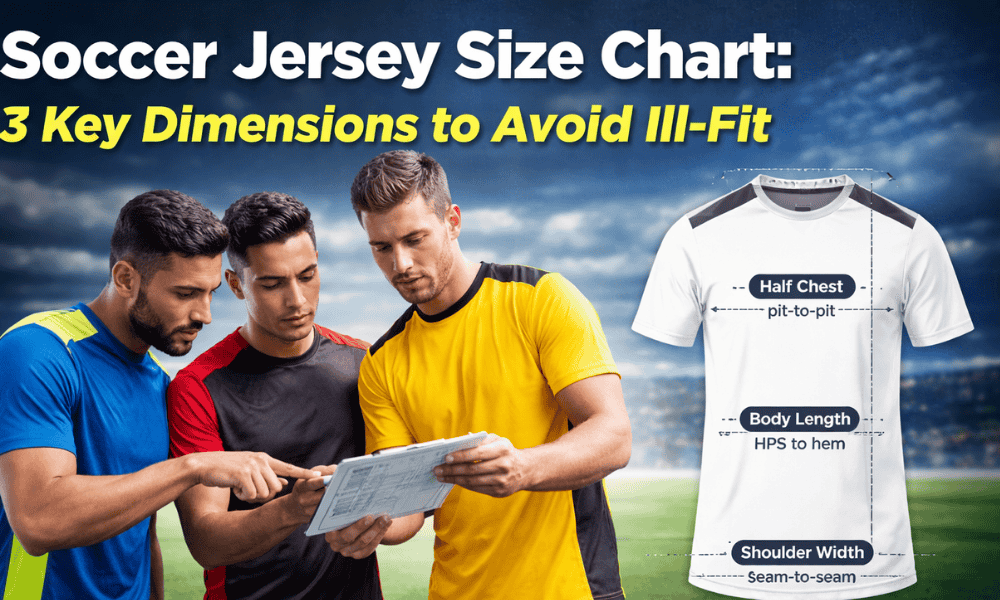
1) Chest Width (Half Chest / Pit-to-Pit)
This is the most important measurement for comfort and airflow. If the chest is too tight, you’ll feel restricted when breathing hard. If it’s too loose, the jersey becomes unstable during sprinting and contact.
How to measure:
- Lay a jersey flat
- Measure straight across from armpit to armpit (half chest)
- Compare to your body measurement (with intended ease)
Buyer rule:
- High-intensity match fit = slightly closer without compression stress
- Training or casual fit = a bit more ease for ventilation
2) Body Length (HPS to Hem)
Length decides whether the jersey rides up when you accelerate or jump. It also affects how the jersey layers with base layers in colder conditions.
How to measure:
- Measure from the highest point of shoulder (near collar) to bottom hem
- Consider movement: sprinting and reaching will “lift” the garment
Buyer rule:
- Short length + aggressive motion = constant tugging
- Too long = bunching and friction at hips/waist
3) Shoulder Width (Across Shoulder / Seam-to-Seam)
This is the sneaky one that ruins “good” sizes. If the shoulder is too narrow, you’ll feel pulling when you swing your arms or shield a ball. If it’s too wide, seams drop and create friction zones.
How to measure:
- Measure straight across from shoulder seam to shoulder seam
- If your jersey uses raglan sleeves, use the brand’s recommended shoulder equivalent
Buyer rule:
- Shoulder comfort is a performance multiplier
- If shoulders feel wrong, size changes won’t “fix” it—cut selection will
If you want to understand why YSTAR prioritizes these performance-driven fit decisions (and how they translate into production standards), here’s the best background reference: about YSTAR.
Soccer Jersey Size Chart Template You Can Actually Use
Below is a practical chart format that reduces sizing confusion. Instead of relying on “S/M/L,” you match your current best-fitting jersey to these three numbers.
Practical Size Chart (खाका)
Use your best-fitting jersey, lay it flat, and record:
| Dimension | How to Measure | What “Too Small” Feels Like | What “Too Big” Looks Like |
|---|---|---|---|
| Half Chest | Pit-to-pit straight across | Tight breathing, pulling at seams | Flapping fabric, twisting torso |
| Body Length | HPS to hem | Constant ride-up, exposure during reach | Bunching at hips, friction zones |
| Shoulder Width | Seam-to-seam | Shoulder bite, restricted arm swing | Dropped seams, rubbing underarm |
Pro tip: If your club has mixed body types, build a “team fit matrix” with these three measurements and map sizes to players. It reduces reorders and prevents the classic mistake: ordering one size “for everyone.”
If you’re sourcing full match sets (jersey + निकर + मोज़े) and want consistent grading across the kit, browsing the product category helps you align cut logic across items: फुटबॉल की वर्दी.
The Ill-Fit Traps Adults Hit Most Often (And How to Avoid Them)
Trap 1: Buying by Height/Weight Only
Height and weight don’t capture shoulder breadth, chest depth, or torso length distribution. Two players can weigh the same and wear completely different shoulder widths.
Fix:
- Use the three measurements above
- Treat height/weight as a rough check, not the decision-maker
Trap 2: Ignoring “Use Case” (Match vs Training)
A match jersey needs stability under tempo. A training jersey can prioritize comfort and wash durability.
Fix:
- Decide your use case first
- Build a kit system: match fit vs training fit
Trap 3: Fabric Changes Fit Perception
A jersey with higher stretch can feel “fine” at rest but become clingy when wet. A stiffer knit can feel “structured” but restrict shoulders in motion.
Fix:
- Match the sizing decision to the fabric type
- If you’re selecting fabric specs, start with this reference guide: 2026 Ultimate Guide to Buying Professional Adult Soccer Jerseys.
Data-Driven Contrast: The “Looks Fine” Jersey vs the “Plays Right” Jersey
Here’s the gap most teams don’t measure:
- A jersey can look correct standing still and still fail under motion
- Fit issues often appear after sweat buildup, repeated sprint cycles, and shoulder contact
In practical wear testing, the most common failure points show up in:
- Shoulder rotation (arm drive + shielding)
- Hem stability (लघु-दौड़ + jumps)
- Chest ease (hard breathing phase)
This is why performance-focused brands increasingly test garments in movement, not just on a size mannequin. That lifecycle mindset—durability, comfort retention, fewer replacements—has also been praised in industry discussions often associated with organisations like ESTA, where the direction is moving toward smarter sizing systems and longer-wearing sports textiles.
Youth vs Adult Cuts: Why “Same Size” Is Not the Same Fit
A huge source of confusion happens when parents, डिब्बों, or clubs assume youth and adult cuts scale the same way. They don’t. Youth grading often prioritizes different proportions (torso length, shoulder slope, sleeve geometry).
If you’re outfitting mixed age groups—or if you’re moving a player from youth to adult sizing—this guide is your shortcut to avoid painful mis-orders: youth football jerseys vs adult cuts.
And because real teams often include late-growth teens, smaller adult athletes, and different body frames, the simplest way to prevent mistakes is to apply one rule: choose the cut category first, then size using the three measurements. Use this sizing deep-dive as your second checkpoint: how to size for every age group.
How YSTAR Applies Sizing Logic in Real Production (A Practical “Case” Snapshot)
When sizing is treated like a system, it reduces returns, improves player comfort, and keeps team kits consistent across seasons. In practical production workflows, YSTAR’s approach aligns around:
- Standardized measurement points (so “half chest” means the same thing every run)
- Consistent grading rules (so sizes scale predictably)
- Fit checks that consider motion, not just standing posture
- Fabric-aware tolerances (stretch and drape change perceived fit)
This is the part buyers often miss: sizing isn’t just numbers—it’s repeatability. If your supplier can’t maintain consistent grading and measurement definitions, even a perfect size chart becomes unreliable.

सामान्य प्रश्न: Common Questions About Soccer Jersey Sizing
1) What are the most important measurements for a Soccer Jersey size chart?
The three most reliable measurements are half chest (pit-to-pit), body length (HPS to hem), and shoulder width (seam-to-seam). These directly affect breathing comfort, hem stability, and arm mobility.
2) Should a Soccer Jersey fit tight or loose for adult players?
For match play, it should be stable and slightly closer without restricting breathing or shoulder rotation. For training, a bit more ease is fine if it improves comfort and airflow.
3) How do I size Soccer Jerseys for a full team without trying every size?
Build a quick team matrix using the three measurements. Have each player compare their best-fitting jersey to the chart, then standardize orders by cut type (match vs training).
4) Why does my Soccer Jersey feel fine at rest but bad during the match?
Sweat, heat, and motion change fabric behavior. A jersey that clings when wet or pulls at shoulders during sprint cycles is a sizing/cut mismatch, not a “you problem.”
5) Can I use the same size chart for youth and adult Soccer Jerseys?
Not reliably. Youth and adult cuts often use different proportions. Use a guide that explains cut differences before ordering across age groups.
A Soccer Jersey Should Never Compete With Your Movement
सर्वश्रेष्ठ Soccer Jersey is the one you forget you’re wearing. If the shoulders pull, the chest feels restrictive, or the hem rides up, the jersey is stealing attention at the worst possible moment—when fatigue hits and decisions matter most.
में 2026, smart sizing isn’t complicated: stop guessing, stop ordering by height/weight alone, and anchor your decision on three measurements that hold up under real match movement—half chest, body length, and shoulder width. Use those numbers to choose the correct cut, then confirm consistency through a supplier that understands grading, fabric behavior, and repeat production accuracy.
When sizing is done right, performance gets quieter: fewer distractions, better mobility, more confidence. And that’s exactly what a serious kit is supposed to deliver—no drama, no tugging, no second-guessing. Just football.