Quick Overview: Professional Football Jersey Manufacturing
The intersection of sports science and textile engineering has fundamentally transformed athletic apparel. The manufacturing of a professional football jersey is no longer a simple cut-and-sew operation; it is a highly sophisticated discipline requiring a profound understanding of thermodynamics, aerodinámica, and polymer chemistry. For decades, players competed in heavy, moisture-absorbing fabrics that restricted movement and increased fatigue. Hoy, the global sportswear market demands ultra-lightweight, hydrophobic materials engineered to enhance athletic output. Procurement officers, club directors, and sportswear brands face an increasingly complex supply chain when sourcing these specialized garments. Identifying a factory with the technological infrastructure to execute high-density sublimation, laser-cut ventilation, and ergonomic 3D tailoring is paramount. This complexity has driven a significant shift in B2B sourcing strategies, leading to a massive rise in demand for technologically advanced wholesale football jersey manufacturers capable of meeting stringent international performance standards.
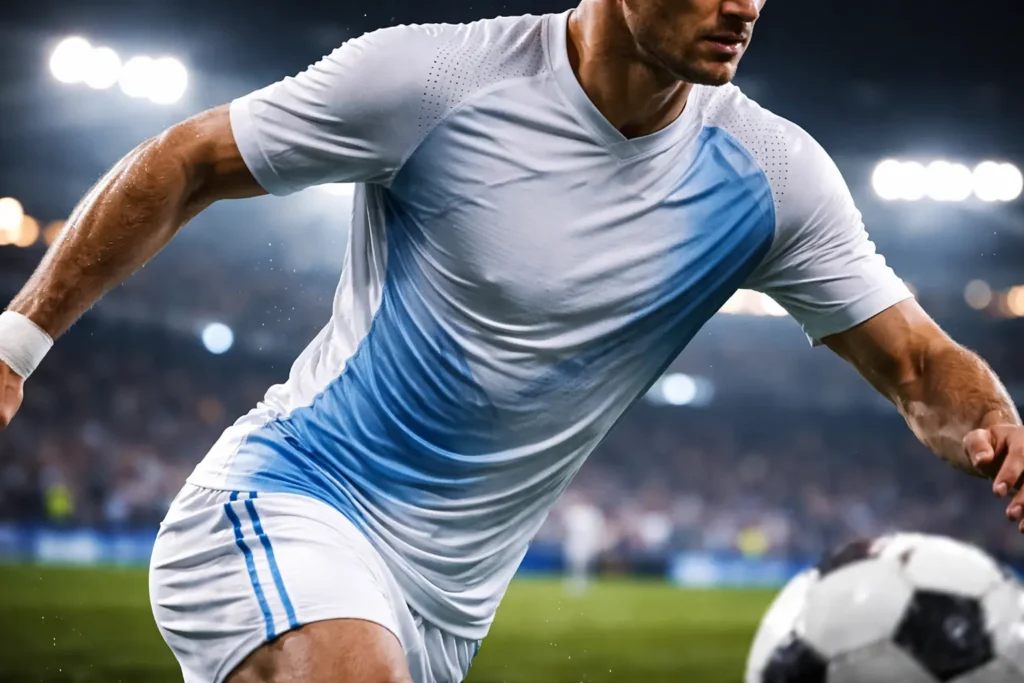
The Evolution of High-Performance Football Kit Fabrics
From Heavy Cotton to Micro-Engineered Polyester
Understanding the chemical composition of modern performance polymers is the first step in the manufacturing process. Traditional cotton, with its high hydrophilic properties, retains sweat, adding up to 40% more weight to the garment during a 90-minute match. Modern production exclusively utilizes micro-engineered polyester (PET) and elastane blends. These synthetic yarns are extruded into multifilament structures that create microscopic channels. Through capillary action, these channels draw moisture away from the epidermis to the outer surface of the fabric, where it evaporates rapidly. This continuous moisture vapor transmission rate (MVTR) is essential for maintaining the athlete’s core body temperature. It is a scientifically documented reality within the professional sports industry that specialized custom football jerseys offer better performance specifically because these proprietary moisture-wicking structures prevent thermal exhaustion during high-intensity cardiovascular exertion. Además, the reduced friction coefficients of these synthetic microfibers drastically minimize skin abrasions.
Material Parameters: GSM, Spandex Blends, and Tensile Strength
Beyond the base polymer chemistry, the physical architectural construction of the fabric determines its ultimate field performance. Manufacturers must carefully calibrate the GSM (Grams per Square Meter). A standard replica kit may utilize a 150-160 GSM fabric, prioritizing durability for everyday wear. Sin embargo, authentic match day kits are engineered to an incredibly light 110-130 GSM. To achieve this weight reduction without compromising tensile strength, the fabric must be knitted using advanced interlock or jacquard machines. Además, the inclusion of 8% a 12% high-grade spandex provides crucial four-way stretch, allowing the garment to recover its shape instantly after aggressive pulling by opponents. Recognizing these technical distinctions is absolutely critical for regional distributors and wholesale football jersey manufacturers operating in diverse climates, where the balance between extreme lightweight breathability and structural integrity dictates the product’s market success.
Player Version vs. Fan Version: Key Construction Differences
The Anatomy of an Authentic Match Day Shirt
The physical geometry and cutting process of the garment present another layer of manufacturing complexity. The industry strictly differentiates between ‘Player Version’ (authentic) and ‘Fan Version’ (replica) cuts. Authentic match day shirts are constructed using a dynamic, 3D athletic cut. This involves complex curved paneling that contours tightly to the athlete’s torso, specifically designed to eliminate excess fabric that could create aerodynamic drag or be easily grabbed by defenders. The armholes are elevated, and the chest dimensions are tapered. For professional clubs, academies, and semi-pro leagues seeking competitive aerodynamic advantages, abandoning generic boxy templates and sourcing custom football shirts that fit precisely to their athletes’ distinct biometric profiles has become a non-negotiable procurement standard in modern football. The replica version, conversely, utilizes a straight, relaxed geometry designed to accommodate a wider variety of body shapes, prioritizing casual comfort over high-speed aerodynamics.
Anthropometric Scaling Across Demographics
As we delve deeper into anthropometric scaling across different demographics, the grading of these patterns becomes an intricate mathematical exercise. Scaling a pattern is not simply a matter of universally shrinking or enlarging the dimensions. Pediatric and adolescent body geometries require entirely different mathematical proportions compared to fully developed adults. The shoulder slope, chest-to-waist drop, and armhole circumference must be recalculated for each age bracket to ensure freedom of movement. A prevalent manufacturing challenge encountered by many brands lies in navigating the complex transition between youth football jerseys vs adult cuts, as failing to adjust the structural grading leads to restrictive necklines or disproportionately long hemlines that hinder a young athlete’s biomechanics on the pitch. Advanced pattern makers utilize digital CAD software to perfectly grade these specific dimensional transitions, ensuring optimal performance at every academy level.
Advanced Breathability: Laser-cut Ventilation & Mesh Zones
Thermoregulation on the Pitch
The thermoregulatory demands placed on the human body during a professional match are extreme. A midfielder can cover over 11 kilómetros, generating immense metabolic heat. To combat this, elite football shirts integrate advanced body-mapped ventilation systems. By analyzing thermal imaging data, engineers identify high-heat zones—predominantly the underarms, the center of the chest, and the lower lumbar region. Factories then deploy specialized jacquard knitting techniques to seamlessly transition the fabric from a solid interlock structure into an open-hole mesh within the exact same continuous panel of fabric. Understanding this thermodynamic science, alongside knowing exactly how to size for every age group, ensures that the garment acts as an active cooling mechanism rather than a thermal trap, drastically extending a player’s peak performance window. This seamless transition eliminates the need for bulky internal seams that could cause chafing, maintaining a perfectly smooth interior.
Engineering Laser-Cut Perforations
The precision required to execute further advanced ventilation brings us to laser-cut perforations. In high-end player versions, factories use computer-guided CO2 lasers to burn microscopic holes into the lateral panels. The laser not only cuts the fabric but simultaneously cauterizes the synthetic edges, preventing the material from fraying under the immense stress of a match. This high-tech modification shaves crucial grams off the total weight of the kit. Integrating these hyper-advanced aerodynamic and thermoregulatory features requires a sophisticated manufacturing partner equipped with state-of-the-art automated machinery. To discuss integrating these elite specifications into your next commercial order, or to request a detailed technical consultation, we encourage you to contact us directly to speak with our production engineering team. Our facility bridges the gap between innovative textile science and scalable wholesale manufacturing, ensuring every stitch serves a functional purpose.
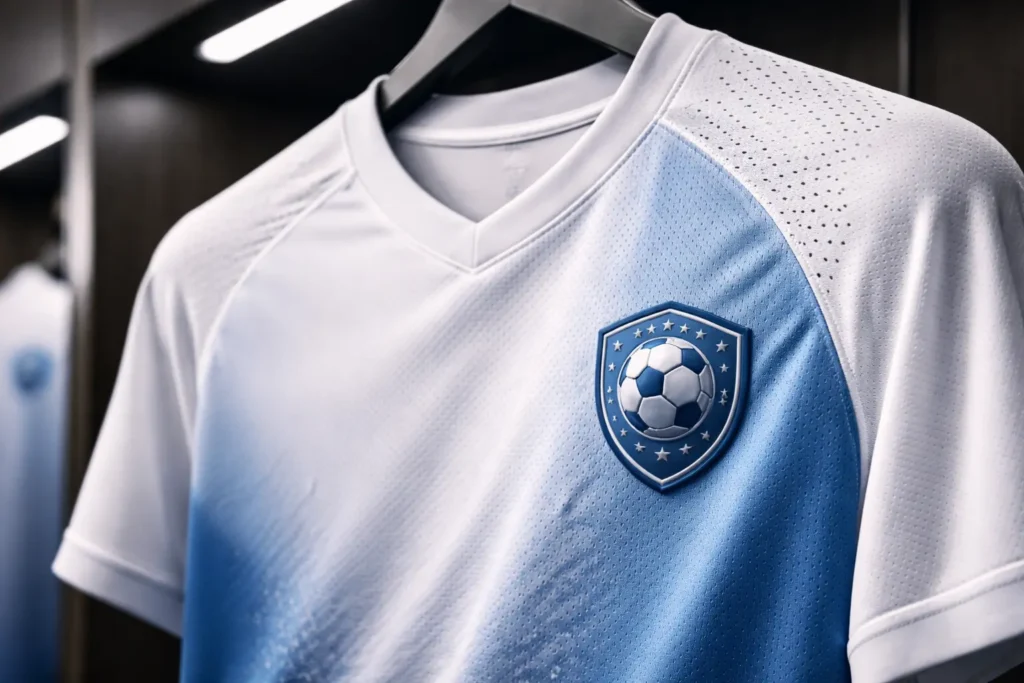
Technical Specification: Player Version vs. Fan Version
To fully grasp the manufacturing requirements, B2B buyers must understand the exact physical and chemical differences between the two primary tiers of football apparel.
| Specification Parameter | Player Version (Authentic Match) | Fan Version (Replica Stadium) |
| Fabric GSM | 110 – 130 GSM (Ultra-lightweight) | 150 – 160 GSM (Standard weight) |
| Material Blend | 88-92% Poliéster / 8-12% Elastane | 100% Poliéster (Minimal stretch) |
| Fit Geometry | 3D Ergonomic Athletic Cut (Tapered) | Standard Straight Cut (Relaxed) |
| Club Crest/Logo | Heat-pressed 3D Silicone/TPU | Direct Embroidery or Woven Patch |
| Ventilation Tech | Laser-cut holes & mapped jacquard mesh | Standard unified fabric construction |
| Hemline Profile | Curved drop-tail hem (for tucking in) | Straight hem |
Advanced Branding Technologies in Sportswear
The Shift to Heat-Applied 3D Silicone Crests
Historically, football clubs displayed their identity through heavily embroidered crests. While traditional, these thick patches add unnecessary weight and create rigid areas on the chest. Peor, the abrasive backing threads inside the shirt cause severe friction against the skin, leading to the infamous issue of nipple chafing during prolonged athletic exertion. Modern manufacturing has solved this via heat-applied 3D silicone and Thermoplastic Polyurethane (TPU) badges.
These advanced crests are manufactured using injection molding, creating highly detailed, multi-textured, and metallic finishes that are impossible to achieve with needle and thread. During garment assembly, industrial heat presses bond the silicone directly to the polyester at precise temperatures (typically 150°C to 160°C for 12-15 seconds). This results in a completely flush, frictionless interior. For the athlete, it saves critical grams of weight; for the commercial buyer, it delivers a sleek, futuristic, and highly premium aesthetic that commands a higher retail price point.
Traditional Direct Embroidery and Woven Badges
Despite the athletic superiority of silicone crests, direct embroidery and high-density woven badges remain heavily utilized in the production of fan versions. The logic here is grounded in consumer behavior and lifecycle durability. Replica kits are subjected to relentless cycles in standard domestic washing machines and high-heat tumble dryers, conditions that can eventually degrade thermal adhesives. Heavy-duty embroidery ensures the club crest survives years of rigorous washing without peeling. For a wholesale buyer, balancing the inventory between high-tech player versions and durable, cost-effective embroidered fan versions is the key to maximizing market penetration.
The Physics of Dye-Sublimation Printing
High-Temperature Ink Penetration
When manufacturing vibrant, multi-colored kits with complex gradients or sponsor logos, traditional screen printing is obsolete. Screen printed plastisol inks sit on top of the fabric, blocking breathability and eventually cracking under stress. Premium athletic apparel relies entirely on dye-sublimation printing.
This process involves printing the graphic onto specialized transfer paper using disperse dyes. The paper and the blank white polyester fabric are then fed through an industrial rotary calendar calendar press at temperatures exceeding 200°C (392°F). Under this extreme heat and pressure, the solid dye instantly turns into a gas (sublimación) and permeates the open pores of the polyester fibers. As the fabric cools, the pores close, trapping the pigment permanently inside the yarn.
Achieving Absolute Color Fastness
Because the dye becomes a structural part of the fabric itself, sublimation printing guarantees absolute color fastness. The garment will never crack, peel, or fade, regardless of how much UV exposure or heavy laundering it endures. Además, because the ink does not block the microscopic gaps between the threads, the fabric retains 100% of its moisture-wicking capillary action. B2B procurement teams must ensure their manufacturing partners utilize high-grade, eco-friendly sublimation inks (such as EPSON or Kiian) to achieve the deepest blacks and most vibrant neon colors required by modern club branding.

Compliance, Sostenibilidad, and Industry Regulations
Global Textile Safety: OEKO-TEX Standard 100
Importing textiles into major markets such as the European Union and North America requires strict adherence to international safety regulations. A reputable manufacturing facility must operate under the OEKO-TEX Standard 100 certification framework. This independent testing guarantees that every single component of the garment—from the polyester yarns and sublimation dyes to the sewing threads and silicone crests—has been rigorously tested for harmful substances.
Facilities must prove the absolute absence of carcinogenic azo colorants, metales pesados, formaldehyde, and harmful phthalates. Failing to verify a manufacturer’s OEKO-TEX compliance can result in entire wholesale shipments being impounded by customs authorities, resulting in catastrophic financial losses and brand damage.
The Push for Recycled Polyester (rPET) and GRS Certification
Driven by global mandates from major governing bodies like FIFA and the IOC, the sportswear industry is undergoing a massive pivot towards sustainability. The production of virgin polyester relies heavily on petroleum extraction. Hoy, cutting-edge factories process rPET (recycled Polyethylene Terephthalate), which is derived from post-consumer plastic water bottles retrieved from oceans and landfills.
The plastic is sterilized, melted, and extruded into high-performance athletic yarns that perform identically to virgin polyester. For a B2B brand to legally market their kits as “sostenible,” the manufacturing facility must hold a Global Recycled Standard (GRS) Certificación. This certification tracks the entire supply chain, providing verified traceability of the recycled materials and ensuring ethical labor practices were maintained during production.
Production Timelines and Quality Assurance Protocols
Managing Supply Chain Lead Times
For B2B distributors, coordinating the delivery of kits prior to the start of a new sporting season is critical. Understanding factory lead times prevents costly supply chain bottlenecks. The standard manufacturing cycle begins with the Sampling Phase, which typically requires 7 a 14 días. During this window, the factory engineers the CAD patterns, tests the sublimation color codes on physical swatches, and produces a final “Top of Production” (TOP) sample for approval.
Once approved, Bulk Production commences. For standard wholesale orders ranging from 1,000 a 10,000 units, the cutting, sublimating, de coser, and pressing timeline spans 30 a 45 días. Buyers must strategically factor in additional maritime shipping times (typically 25-35 days to EU/US ports) and potential factory congestion prior to major global tournaments like the World Cup or European Championships.
The Four-Point Fabric Inspection System
High-end factories implement the internationally recognized Four-Point System for fabric quality control before a single panel is cut. Rolls of polyester are fed through illuminated inspection machines where technicians penalize the fabric for defects such as snags, missing yarns, dye spots, or color variations. If a roll accumulates more than 40 penalty points per 100 square yards, it is rejected entirely. Post-assembly, garments undergo strict needle-detection protocols and seam-strength testing to ensure they can withstand the physical aggression of competitive football. Partnering with a manufacturer who transparently shares these QA reports is the ultimate safeguard for your investment.

Preguntas más frecuentes
1. What is the best fabric for manufacturing professional football jerseys?
The optimal fabric for professional football jerseys is a micro-engineered polyester blend incorporating 8% a 12% elastano (spandex). This specific composition provides a four-way stretch necessary for dynamic athletic movement while ensuring a high Moisture Vapor Transmission Rate (MVTR). Authentic match-day shirts typically use an ultra-lightweight 110-130 GSM fabric with body-mapped jacquard mesh zones for maximum thermoregulation, whereas training or fan versions use a heavier 150-160 GSM material for enhanced durability.
2. How do manufacturers apply 3D silicone crests to football shirts?
Manufacturers apply 3D silicone and Thermoplastic Polyurethane (TPU) crests using industrial heat-press technology rather than traditional stitching. The silicone badge is positioned on the polyester fabric and subjected to exact temperatures—usually between 150°C and 160°C—for 12 a 15 seconds under high pressure. This thermal bonding process permanently fuses the crest to the shirt, eliminating internal abrasive threads that cause skin chafing and significantly reducing the overall weight of the garment.
3. What is the difference between a player version and a replica fan jersey?
The primary differences between a player version and a replica fan jersey lie in the anatomical fit and material weight. Player versions feature a 3D ergonomic, tapered athletic cut designed to reduce aerodynamic drag, alongside laser-cut ventilation holes and lightweight heat-pressed logos. Fan versions utilize a relaxed, straight-cut geometry to accommodate various body shapes and employ heavier, more durable fabrics (alrededor 160 GSM) with directly embroidered club crests to withstand frequent domestic machine washing.
4. How does dye-sublimation printing work on polyester football kits?
Dye-sublimation printing on polyester football kits involves transferring designs from specialized paper onto the fabric using extreme heat (exceeding 200°C) and pressure. During this rotary calendar process, the solid disperse dyes instantly vaporize into a gas and penetrate the open pores of the polyester microfibers. As the fabric cools, the dye is permanently trapped inside the yarn, resulting in absolute color fastness that will never crack, peel, or block the fabric’s moisture-wicking capabilities.
5. What are the OEKO-TEX Standard 100 requirements for sportswear?
El estándar OEKO-TEX 100 is a globally recognized, independent testing certification that ensures textiles are free from harmful substances. For sportswear manufacturing, this means every component of the football kit—including the polyester yarns, sublimation inks, hilos de coser, and silicone patches—must be rigorously tested and proven free from carcinogenic azo colorants, metales pesados, formaldehyde, and toxic phthalates, ensuring the garments are completely safe for prolonged skin contact.
References:
- “Thermodynamic Properties of Micro-Engineered Polyester in Elite Sportswear.” Dr. Alistair Vance, Textile Institute of Biomechanics, Journal of Athletic Apparel Science.
- “Aerodynamic Drag Reduction in 3D Ergonomic Football Kits.” Dr. Elena Rostova, European Institute of Sports Technology, International Journal of Sports Physics.
- “The Physics of Disperse Dyes in High-Temperature Sublimation.” Dr. Kenji Sato, Tokyo Polymer Research Center, Digital Textile Engineering Quarterly.
- “Skin Friction and Abrasion Minimization via TPU Heat-Press Technologies.” Dr. Sarah Jenkins, Global Dermatology in Sports Initiative, Journal of Sports Medicine.
- “Lifecycle Analysis of rPET (Recycled Polyethylene Terephthalate) in Commercial Sportswear.” Dr. Marcus Thorne, Institute for Sustainable Textiles, Green Manufacturing Review.
- “Anthropometric Scaling and Pattern Grading for Athletic Apparel.” Dr. Chloe Dubois, Paris Academy of Fashion Technology, Apparel Engineering Journal.
- “OEKO-TEX Standard 100: Compliance and Global Supply Chain Impact.” Regulatory Board of the International OEKO-TEX Association, Textile Compliance Annual.
- “Moisture Vapor Transmission Rates (MVTR) in Jacquard Knit Structures.” Dr. Wei Chen, Advanced Material Sciences Laboratory, Polymer Performance Journal.
Expert Insights: Strategic Procurement of Professional Football Jerseys
Core Procurement Logic (Why & Qué): Sourcing commercial football jerseys goes far beyond basic cut-and-sew operations; it requires bridging the gap between athletic biomechanics and textile physics. The fundamental manufacturing decision relies on engineering a fabric that balances an ultra-low GSM (peso) with a high Moisture Vapor Transmission Rate (MVTR). By specifying micro-engineered polyester with an 8-12% elastane blend, B2B buyers secure garments that provide aerodynamic four-way stretch while actively cooling the athlete through capillary moisture management.
Strategic Options & Technical Considerations
-
Player vs. Fan Architecture (Option)
The Geometric Distinction: Wholesale buyers must explicitly segment their inventory. Player versions require a 3D ergonomic taper and laser-cut perforations to eliminate aerodynamic drag. En cambio, Fan versions require a relaxed, straight geometry to accommodate diverse body shapes, paired with heavy-duty direct embroidery for maximum domestic laundering durability. -
Silicone 3D Crests vs. Excoriación (Consideration)
Athletic Risk Mitigation: Traditional embroidered patches create a rigid friction point on the chest, leading to severe skin abrasion during intense 90-minute matches. Premium sourcing specifications mandate heat-applied 3D TPU or Silicone crests for elite kits. These bond completely flush with the polyester matrix to eliminate interior friction entirely while shaving critical grams off the overall weight. -
Chemical Safety & OEKO-TEX (Compliance)
Navigating Global Customs: Utilizing high-temperature dye-sublimation requires absolute chemical safety. B2B procurement contracts must demand OEKO-TEX Standard 100 certification to scientifically prove the absence of carcinogenic azo dyes and heavy metals, ensuring smooth customs clearance into strictly regulated European and North American markets.