Die weltweite Beschaffung professioneller Sportbekleidung hat sich zu einer hochspezialisierten technischen Disziplin entwickelt. Für B2B-Käufer, Clubdirektoren, und Sportbekleidungsmarkenmanager, Sourcing-Elite Fußballtrikots beinhaltet die Navigation durch eine komplexe Matrix der Polymerwissenschaft, dimensionale Anthropometrie, und internationale Handelscompliance. Moderne Sportler benötigen Kleidungsstücke, die die Wärmeregulierung aktiv steuern und den Luftwiderstand minimieren, Verlagerung des Fertigungsschwerpunkts von einfachen Schnitt- und Nähvorgängen hin zur fortschrittlichen Textiltechnik.
Um wettbewerbsfähige Margen aufrechtzuerhalten und gleichzeitig die technische Leistung zu gewährleisten, Beschaffungsteams müssen sich auf spezialisierte Einrichtungen im Ausland konzentrieren. Das Verständnis der Betriebsprotokolle in diesen Fabriken – von der Rohstoffextrusion bis zur Exportlogistik – ist für die Sicherung von Prämien von grundlegender Bedeutung Fußballuniformen die den strengen Standards professioneller Ligen entsprechen. Diese Analyse beschreibt die kritischen technischen Parameter und Lieferkettenstrategien, die von Top-Einkäufern bei der Beschaffung von leistungsstarker Sportbekleidung verwendet werden.
How to Verify a Football Kit Manufacturer in China Before Placing an Order
Choosing a football kit manufacturer in China involves more than comparing quotations and reviewing product photos. International buyers should verify the supplier’s actual production capabilities, quality management procedures, customization experience, and export coordination before committing to a bulk order.
A supplier may describe itself as a direct manufacturer, but buyers should understand which production processes are performed in-house and which are handled by external partners.
1. Verify the Company’s Business and Manufacturing Background
Start by checking the company’s registered business information, operating history, business scope, and factory address. Request a company profile and confirm that the business information is consistent across its quotation, contract, website, and commercial documents.
2. Request Evidence of Production Capabilities
Ask for current factory photos, production videos, and a live video walkthrough when an on-site visit is not possible. Buyers should look for relevant processes such as fabric inspection, Musterherstellung, cutting, Drucken, Nähen, Abschluss, and final quality inspection.
Not every manufacturer performs every process internally. The important point is to understand the actual production arrangement and identify any outsourced operations that may affect quality, Vorlaufzeit, or accountability.
3. Review Relevant Product Experience
A supplier experienced in general apparel production may not automatically have the technical capabilities required for custom football kits. Ask for examples of teamwear projects involving sublimation printing, Spielernamen und -nummern, Größeneinstufung, Sponsorengrafiken, and repeat production.
4. Check Quality Management and Certifications
Request relevant quality-control procedures, inspection records, and certificates where applicable. Verify the certificate holder, issuing organization, validity period, covered facility, and product or process scope. A certificate should never be assumed to cover every product made by a company.
5. Evaluate Communication and Order Management
A reliable supplier should be able to explain sampling arrangements, material specifications, production milestones, inspection requirements, Verpackung, and shipping responsibilities. Clear written communication is especially important when several design versions or size breakdowns are involved.
Questions to Ask a Potential China Football Kit Supplier
- Which production processes are completed at your own facility?
- Which processes are outsourced, and how are external partners controlled?
- Can you provide examples of previous custom football kit projects?
- How do you manage fabric inspection, printing quality, Nähen, and final inspection?
- Can you provide a pre-production sample for approval before bulk manufacturing?
- How do you maintain color, Größe, and artwork consistency for repeat orders?
- What export documents and shipping arrangements can you support?
The goal is not simply to find a supplier that claims to have the largest factory. It is to identify a manufacturing partner whose production arrangement, technical experience, Dokumentation, and communication match the requirements of the specific football kit project.
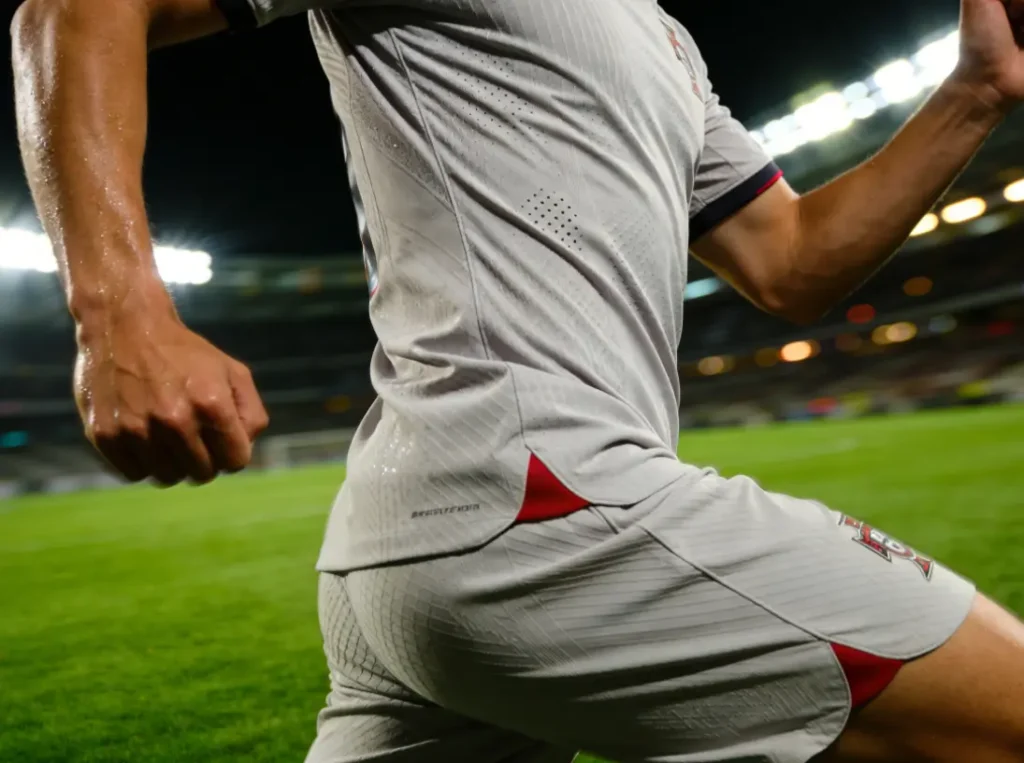
Direkte Materialbeschaffung von High-Tech-Textilfabriken
Die Grundlage jedes Elite-Sportbekleidungsstücks ist seine Grundpolymerchemie. Standardlieferketten für Bekleidung sind oft auf den Stoffhandel auf dem freien Markt angewiesen, Dies führt zu gefährlichen Variablen im Materialgewicht, Dehnungserholung, und Farbstoffabsorption. Professionelle Beschaffungsstrategien erfordern die direkte Beschaffung von High-Tech-Textilfabriken, die in der Lage sind, proprietäre mikrotechnische Garne zu extrudieren.
Die von Advanced ausgewertete primäre Metrik Großhandelshersteller von Fußballtrikots ist die Feuchtigkeitsdampfdurchlässigkeitsrate (MVTR). Während eines 90-minütigen Spiels, Ein Sportler erzeugt erhebliche Stoffwechselwärme.
Football kit fabrics commonly use polyester-based constructions because of their lightweight properties, dimensional stability, and compatibility with sublimation printing. Some designs incorporate elastane or other stretch fibers to provide additional flexibility and recovery. The appropriate fiber composition depends on the garment’s intended use, Stoffkonstruktion, fit requirements, and target price.
Das Mikropolyester verfügt über mikroskopisch kleine Kapillarkanäle, die den Schweiß von der Epidermis ableiten, während das Elastan für den entscheidenden Vier-Wege-Stretch sorgt, Dadurch kann das Kleidungsstück nach mechanischer Belastung sofort seine strukturelle Integrität wiederherstellen.
Außerdem, Strenge Umweltauflagen globaler Leitungsgremien haben den Übergang zu kreislauforientierten Textilwirtschaften beschleunigt. Die Direktbeschaffung ab Werk ermöglicht es Käufern, GRS zu spezifizieren (Globaler Recycling-Standard) zertifiziertes rPET (recyceltes Polyethylenterephthalat).
Factory-direct sourcing may allow buyers to specify recycled polyester fabrics supported by relevant certification and supply chain documentation. Der globale Recycling-Standard (GRS) verifies recycled material content and provides chain-of-custody requirements, alongside additional social, Umwelt, and chemical criteria for processing. Buyers should confirm the recycled content, material performance, and documentation applicable to the actual fabric and finished garment rather than assuming that every recycled polyester product has the same characteristics as virgin polyester.
Der präzise Schnittmusterprozess für ergonomische Passformen
Die physische Geometrie und Musterabstufung des Kleidungsstücks stellen eine weitere entscheidende Ebene der Herstellungskomplexität dar. Die Branche erzwingt eine strikte Trennung zwischen “Spielerversion” (authentischer Spieltag) Und “Fan-Version” (Nachbildung des Stadions) Architekturen. Authentische Match-Trikots werden dynamisch konstruiert, 3D sportliche Schnitte. Dabei handelt es sich um komplexe, geschwungene Verkleidungen, die eng an den Oberkörper des Sportlers angepasst sind, Mit erhöhten Armlöchern und schmal zulaufenden Taillen, um überschüssigen Stoff zu vermeiden, der Luftwiderstand erzeugt.
Für Akademien und Proficlubs, Verzicht auf generische, kastenförmige Vorlagen und Beschaffung individuelle Fußballtrikots, die passen Die genauen biometrischen Profile ihrer Sportler sind ein nicht verhandelbarer Leistungsstandard. Replika-Versionen, umgekehrt, Verwenden Sie eine Gerade, Entspannte Geometrie, die auf unterschiedliche demografische Körperformen zugeschnitten ist, Legt lässigen Komfort über sportliche Hochgeschwindigkeits-Aerodynamik.
Die Skalierung dieser geometrischen Muster über verschiedene Altersgruppen hinweg erfordert eine hochkomplexe mathematische Bewertung. Die Körpergeometrien von Kindern und Jugendlichen weisen im Vergleich zu voll entwickelten Erwachsenen völlig andere strukturelle Proportionen auf. Der Schulterhang, Tropfen von der Brust bis zur Taille, und Kragenumfänge müssen für jede spezifische Altersgruppe separat neu berechnet werden.
Football Kit RFQ Checklist: What Buyers Should Include in a China Sourcing Request
A detailed request for quotation (RFQ) helps Chinese football kit manufacturers understand the project requirements and prepare more accurate quotations. Instead of sending only a reference photo and an estimated quantity, buyers should provide a structured specification sheet covering the product, Anpassung, order breakdown, and delivery expectations.
1. Product and Fabric Specifications
- Product type: match jersey, replica jersey, Trainingsshirt, kurze Hose, or complete football kit.
- Fabric composition and preferred material options.
- Target fabric weight (GSM), if already specified.
- Fabric texture, stretch requirements, and intended usage.
- Preferred color references or approved physical swatches.
2. Design and Customization Requirements
- Front, zurück, and side design artwork.
- Club crest, manufacturer logo, and sponsor graphics.
- Player names and numbers, including the required font and placement.
- Printing method and any special decoration requirements.
- Neck labels, Pflegeetiketten, size labels, and packaging design.
3. Quantity and Size Breakdown
Provide the total order quantity and the number of units required in each size. If the order includes several teams, Altersgruppen, or designs, separate the quantities clearly.
4. Sampling and Quality Requirements
Specify whether a development sample, Passprobe, or pre-production sample is required. Include the measurement chart, acceptable tolerances, inspection requirements, and any testing documentation needed for the project.
5. Delivery and Commercial Information
State the destination country, required delivery date, preferred shipping method, packaging requirements, and requested Incoterm. Buyers should also ask suppliers to identify any separate sample, Kunstwerk, setup, or shipping charges.
Football Kit RFQ Information Table
| RFQ Category | Information to Provide |
|---|---|
| Produkt | Jersey, kurze Hose, training wear, or full kit |
| Stoff | Composition, GSM, Textur, and performance needs |
| Kunstwerk | Design files, Logos, Farben, Namen, und Zahlen |
| Menge | Total units and size-by-size breakdown |
| Probenahme | Sample type, approval process, and required revisions |
| Qualität | Measurement tolerances and inspection criteria |
| Lieferung | Destination, Lieferfrist, and shipping terms |
When multiple factories receive the same RFQ, buyers can compare quotations more accurately. It also becomes easier to identify differences in fabric quality, customization scope, sampling costs, production lead times, and shipping arrangements.
A complete RFQ is one of the simplest ways to reduce misunderstandings before production begins.
Ein weit verbreiteter Herstellungsfehler tritt auf, wenn Fabriken den Übergang dazwischen nicht richtig skalieren Fußballtrikots für Jugendliche im Vergleich zu Schnitten für Erwachsene. Die lineare Skalierung – das einfache Verkleinern eines Musters für Erwachsene um einen festen Prozentsatz – führt zu einschränkenden Ausschnitten oder unverhältnismäßig langen Säumen, die die Biomechanik eines jungen Sportlers beeinträchtigen. Moderne Einrichtungen nutzen digitale CAD-Software, um unabhängige Bewertungsregeln für Sportbekleidung für Kinder festzulegen, Gewährleistung einer optimalen Leistung auf allen Akademieebenen.
Dimensionsskalierung und anthropometrische Daten
Über die Altersdemografie hinaus, Globale Beschaffungsbeauftragte müssen erhebliche anthropometrische Unterschiede in verschiedenen internationalen Märkten berücksichtigen. A “Groß” Größe auf dem asiatischen Markt unterscheidet sich drastisch in Brustumfang und Rumpflänge von a “Groß” auf dem nordamerikanischen oder europäischen Markt.
Verständnis wie man die richtige Größe für jede Altersgruppe findet innerhalb eines bestimmten regionalen Kontexts ist von entscheidender Bedeutung, um katastrophale Großhandelsretourenquoten zu verhindern. Professionelle Fabriken verwenden lokalisierte Sortiertabellen (z.B., US-Standard, EU-Standard, Asiatische Passform). Beim Einleiten einer Großbestellung, Käufer müssen vorschreiben, dass die Fabrik physische Größensätze herstellt (“Passproben”) über den gesamten Größenverlauf. Diese Muster werden an Live-Fit-Modellen im Zielmarkt getestet, bevor mit dem vollautomatischen Schneiden begonnen wird, Sicherstellen, dass die endgültige Massenlieferung perfekt den regionalen Verbrauchererwartungen entspricht.
Football Kit Sample Approval: From Design Mockup to Pre-Production Sample
A digital design mockup is useful for reviewing the overall appearance of a football kit, but it cannot fully demonstrate fabric behavior, garment measurements, Druckqualität, or sewing construction.
Before approving bulk production, buyers should follow a structured sample approval process.
Stage 1: Digital Artwork Approval
Review the front, zurück, and side views of the jersey. Confirm the club crest, Sponsorenlogos, Spielernummern, Namen, Farben, Muster, and placement dimensions.
All artwork changes should be recorded in a clearly identified final version to prevent outdated designs from entering production.
Stage 2: Fabric and Color Confirmation
Review the actual fabric swatch or printed fabric sample. Confirm the agreed composition, GSM, Textur, strecken, color appearance, and printing result.
Für wichtige Vereinsfarben, use an approved physical reference or agreed color measurement procedure rather than relying only on screen images.
Stage 3: Fit and Measurement Approval
Check the sample against the agreed size chart. Measure chest width, Körperlänge, Schulterbreite, Ärmellänge, collar dimensions, and other project-specific points.
For youth and adult ranges, confirm that the relevant grading rules have been reviewed separately.
Stage 4: Construction and Decoration Inspection
Inspect seams, hems, Kragenkonstruktion, Ärmelöffnungen, Etiketten, printed graphics, and any applied decoration. Check that names and numbers are correctly positioned and that the garment is comfortable for its intended use.
Stage 5: Pre-Production Sample Approval
The pre-production sample should represent the agreed materials, Kunstwerk, measurements, construction, and finishing as closely as possible. Buyers should provide written approval before the manufacturer starts bulk production.
Football Kit Sample Approval Checklist
| Inspection Area | Approval Requirement |
|---|---|
| Kunstwerk | Correct logos, Namen, Zahlen, and layout |
| Stoff | Matches the agreed material specification |
| Farbe | Matches the approved color reference |
| Measurements | Meets the agreed size chart and tolerances |
| Construction | Acceptable seams, hems, Kragen, und Abschluss |
| Verpackung | Correct labels, Taschen, and packing instructions |
Buyers should retain an approved reference sample or a complete approval record. If any material, Kunstwerk, or construction detail changes after approval, the manufacturer should communicate the change and obtain authorization before proceeding.
A documented sample approval process creates a clear reference for production inspection and reduces the risk of disputes when the finished football kits are delivered.
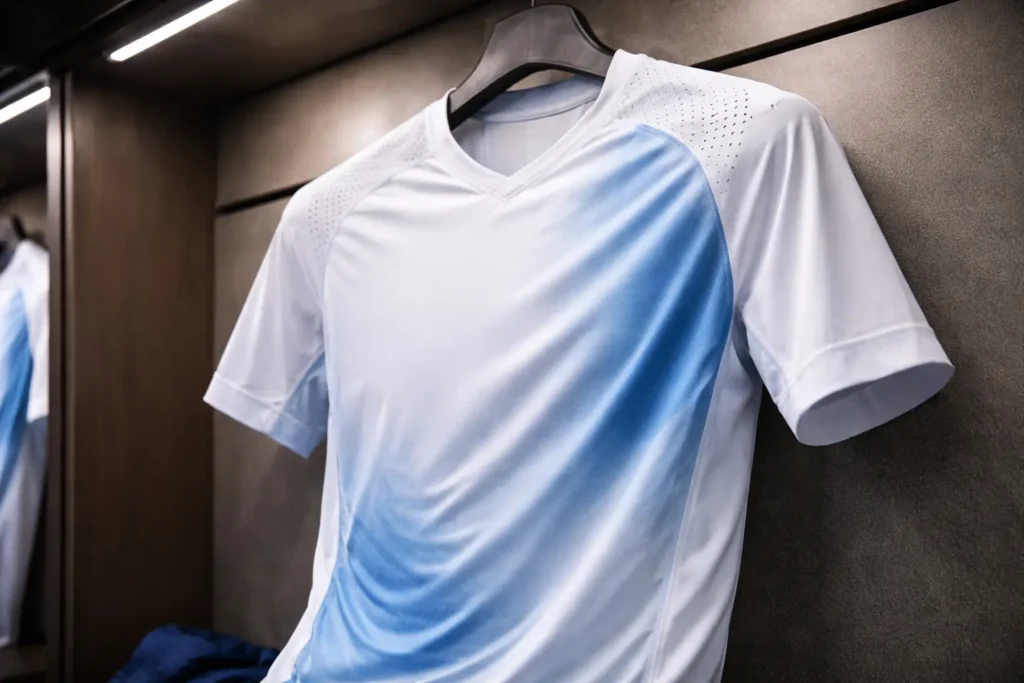
Automatisiertes Farbmanagement für Markenkonsistenz
Die Aufrechterhaltung der absoluten Farbkonsistenz über Tausende von Einheiten hinweg ist einer der technisch anspruchsvollsten Aspekte der Massenproduktion von Sportbekleidung. Moderne Funktionsbekleidung basiert auf dem Thermosublimationsdruck, ein thermodynamischer Prozess, bei dem spezielle Dispersionsfarbstoffe auf Temperaturen über 200 °C erhitzt werden. An dieser Schwelle, Der feste Farbstoff verdampft und dringt dauerhaft in die offenen Poren der Polyester-Mikrofasern ein, garantiert, dass die Farbe nicht verblasst und erhalten bleibt 100% der Atmungsaktivität des Stoffes.
Jedoch, Hitzeschwankungen während des Sublimationskalenderprozesses können zu starken Farbverschiebungen führen. Um dem entgegenzuwirken, Elite-Käufer legen strenge Farbtoleranzen fest Auswahl des perfekten Fußballtrikots Hersteller. Premium-Fabriken nutzen automatisierte Spektrophotometer zur Messung des Delta E (ΔE) Farbabweichung zwischen dem genehmigten digitalen Pantone-Ziel und dem sublimierten Stoff.
In der folgenden Tabelle sind die standardisierten wissenschaftlichen Parameter aufgeführt, die bei professionellen Qualitätskontrollinspektionen durchgesetzt werden:
| Qualitätskontrollparameter | Authentische Match-Spezifikation | Replik / Trainingsspezifikation | Testmethodik |
|---|---|---|---|
| Farbvariation (Delta E) | ΔE < 1.0 (Unmerklich) | ΔE < 2.0 (Akzeptabler Standard) | Spektralphotometer-Analyse |
| Farbechtheit (Waschen) | Grad 4-5 (Keine Blutung) | Grad 4 (Minimales Ausbleichen) | ISO 105-C06-Standard |
| Stoffgewicht (GSM) | 110 – 130 GSM | 150 – 160 GSM | ASTM D3776-Standard |
| Pilling-Resistenz | Grad 4 (Hoher Widerstand) | Grad 3-4 (Mäßiger Widerstand) | ISO 12945-2 (Martindale-Test) |
| Dehnungserholung | > 95% sofortige Genesung | > 90% Erholung | ASTM D3107-Standard |
Bulk Football Kit Quality Control: What to Inspect Before Shipment
Color measurement is only one part of football kit quality control. A bulk order also needs checks for fabric condition, garment measurements, Druckgenauigkeit, sewing construction, Abschluss, and packing.
For overseas buyers, quality control should be organized at several stages rather than postponed until the finished goods are ready to ship.
1. Incoming Fabric Inspection
Before cutting begins, inspect the incoming fabric against the approved specification. Check material identification, color appearance, Stoffgewicht, visible defects, Breite, and consistency between rolls.
2. Cutting and Printing Inspection
During cutting and printing, confirm that panels follow the approved patterns and artwork. Check print alignment, color appearance, logo positioning, Nummernplatzierung, and any visible marks or defects.
3. Sewing and Assembly Inspection
Inspect seam alignment, stitch consistency, Kragenkonstruktion, Ärmelbefestigung, hems, and garment symmetry. Pay particular attention to areas that experience repeated movement and tension during football activities.
4. Finished Garment Inspection
Finished jerseys should be checked against the approved sample and measurement chart. Review the fabric surface, Erscheinungsbild des Drucks, measurements, Etiketten, loose threads, stains, and overall workmanship.
5. Packing and Pre-Shipment Inspection
Confirm that each garment has the correct size, player name, Nummer, Etikett, und Verpackung. Check carton quantities, assortment details, shipping marks, and the final packing list.
Football Kit Quality Control Checkpoints
| Production Stage | Main Inspection Focus | Buyer Action |
|---|---|---|
| Incoming materials | Fabric identity, Gewicht, Farbe, and defects | Confirm against approved specifications |
| Cutting and printing | Panel dimensions and artwork accuracy | Review first production pieces |
| Nähen | Seams, Kragen, hems, und Bau | Check workmanship consistency |
| Finished garments | Measurements, Aussehen, and defects | Compare with approved sample |
| Verpackung | Size assortment, Etiketten, and carton quantities | Verify packing records before shipment |
Define Acceptance Criteria Before Production
Buyers and manufacturers should agree on inspection scope, sampling plans, measurement tolerances, defect classifications, and corrective-action procedures before manufacturing begins.
If an independent inspection is required, the inspection company should receive the approved specifications and acceptance criteria in advance.
A final inspection report is useful only when it clearly identifies the inspected order, sample size, inspection method, findings, and corrective actions. This makes quality decisions more transparent for both the buyer and the manufacturer.
Globale Logistik: Gewährleistung der Sicherheit & Schnelle Lieferung
Die Beschaffung des Materials und die Herstellung der Kleidungsstücke sind nur ein Teil der Lieferkettengleichung; Es ist von größter Bedeutung, sicherzustellen, dass der Bestand pünktlich am Zielhafen ankommt. B2B-Händler müssen die Lieferung von Saisontrikots vor Beginn eines neuen Sportkalenders genau koordinieren. Das Verständnis der Fabrikvorlaufzeiten verhindert äußerst schädliche logistische Engpässe.
China Football Kit Import Costs: Versand, Customs, and Landed Cost
The quoted factory price is not necessarily the final cost of importing football kits from China. International buyers should calculate the total landed cost, including the expenses required to move the finished goods from the manufacturing facility to the agreed destination.
Common Cost Components in a China Football Kit Import Order
- Product cost: The agreed price for jerseys, kurze Hose, Socken, or complete kits.
- Sampling and development: Musterproduktion, artwork preparation, and approved revisions where charged separately.
- Export packing: Individual bags, cartons, Etiketten, and any special packaging requirements.
- Inland transportation: Transportation from the factory to the export port, airport, or consolidation warehouse.
- International freight: Air freight, sea freight, or another agreed transportation method.
- Insurance: Cargo insurance where required by the buyer or agreed shipping arrangement.
- Customs and import charges: Applicable duties, taxes, customs clearance, and destination-related fees.
- Local delivery: Transportation from the destination port or airport to the buyer’s warehouse.
Understand the Shipping Terms Before Confirming the Order
Incoterms define important responsibilities between buyers and sellers, including delivery obligations, cost allocation, and the transfer of risk. Buyers should confirm the exact Incoterm, named place, and applicable version in the sales contract.
Zum Beispiel, under FOB, the seller’s delivery obligations differ from those under CIF or DDP. These terms should not be treated as interchangeable, and the buyer should understand which freight, insurance, customs, and destination costs remain its responsibility.
Documents to Confirm Before Shipment
| Document | Zweck |
|---|---|
| Commercial Invoice | Records the transaction value and seller-buyer details |
| Packing List | Shows carton quantities, product descriptions, and packing details |
| Bill of Lading or Air Waybill | Provides the relevant transport document |
| Ursprungszeugnis | Identifies the declared country of origin when required |
| Test or Compliance Documents | Supports applicable buyer, Markt, or regulatory requirements |
The exact documents depend on the destination country, product classification, Versandart, and buyer’s customs requirements. Buyers should confirm applicable import rules and tariff classification with their customs broker before shipment.
Calculate Landed Cost Per Football Kit
Landed Cost Per Unit = (Produktkosten + Sampling and Development + Export and Freight Costs + Insurance + Import Duties and Taxes + Destination Charges) ÷ Total Sellable Units
This calculation helps distributors and sportswear brands compare suppliers using the cost of receiving the goods, rather than relying only on the factory quotation.
A clear shipping agreement and complete export documentation can reduce avoidable delays and make the total sourcing budget easier to manage.
Ein Standardfertigungszyklus für Großbestellungen (1,000 Zu 10,000 Einheiten) arbeitet auf einer stark strukturierten Zeitachse. Die Probenahmephase erfordert 7 Zu 14 Tage für CAD-Musterentwicklung und Top of Production (SPITZE) Mustergenehmigung. Massenproduktionsspannen 30 Zu 45 Tage, gefolgt von der Seeschifffahrt (typischerweise 25-35 Tage zu EU-/US-Häfen). Professionelle Beschaffungsteams überwachen aktiv mögliche Fabriküberlastungen, insbesondere vor großen globalen Turnieren.
Außerdem, Der Import von Textilien in stark regulierte Märkte erfordert die strikte Einhaltung internationaler Sicherheitsgesetze.
How to Verify OEKO-TEX and GRS Claims When Sourcing Football Kits
Certifications can help buyers evaluate certain aspects of textile safety, recycled material sourcing, and supply chain management. Jedoch, a certificate should never be accepted based on a logo displayed on a supplier’s website alone.
Buyers need to confirm what the certificate covers, which organization issued it, whether it is valid, and whether it applies to the actual facility, Material, or product involved in the order.
OEKO-TEX STANDARD 100
OEKO-TEX STANDARD 100 focuses on testing textile products and their components for harmful substances. Buyers should check the certificate number, certificate holder, validity period, product class, and covered product scope.
A supplier’s certificate for one product category should not automatically be assumed to cover every fabric, Kleidungsstück, accessory, or production facility.
Globaler Recycling-Standard (GRS)
GRS is designed to verify recycled material content and provide chain-of-custody traceability. It also includes additional social, Umwelt, and chemical requirements for processing.
When sourcing recycled polyester football kits, buyers should request relevant certification and transaction documentation that supports the recycled material claim for the supplied goods.
A factory having a valid certification does not automatically prove that every product it manufactures contains certified recycled material.
Certification Verification Checklist
- Confirm the full name of the certification and its applicable standard version.
- Check the certificate holder and the legal entity named on the document.
- Verify the certificate number and validity period through the relevant certification organization or official verification system.
- Review the covered product categories, Materialien, processes, and facility scope.
- For recycled content claims, request documentation that connects the certified material to the actual order.
- Confirm whether the final garment, Stoff, or only an upstream material is covered.
Certification Is Not a Substitute for Import Compliance
Voluntary textile certifications and mandatory legal requirements serve different purposes. OEKO-TEX STANDARD 100 may provide useful evidence of harmful-substance testing, but buyers must still identify and meet the legal requirements applicable to their destination market and product category.
For a professional sourcing project, certification documents should be reviewed together with product specifications, test reports, supplier records, and applicable import regulations.
This approach helps buyers avoid unsupported sustainability claims and make more transparent decisions when sourcing football kits from China.
Renommierte Fabriken arbeiten nach dem OEKO-TEX-Standard 100 Zertifizierungsrahmen. Diese unabhängige Laborprüfung garantiert, dass alle Polyestergarne, Sublimationsfarbstoffe, und Nähgarne sind völlig frei von eingeschränkt krebserregenden Azofarbstoffen und Schwermetallen. Für technische Beratungen zu ISO-Zertifizierungen, GRS-Konformität, oder die Festlegung eines zuverlässigen Produktionszeitplans, Beschaffungsbeauftragte sollten Kontakt direkt an das Supply-Chain-Management-Team der Produktionsstätte, um sicherzustellen, dass alle Zoll- und Compliance-Dokumente vor dem Export überprüft werden.
FAQ
1. Was ist die Standard-MVTR-Anforderung für authentische Spieltrikots??
Die Feuchtigkeitsdampfdurchlässigkeitsrate (MVTR) ist eine entscheidende Leistungskennzahl für authentische Spieltrikots. Professionelle Mikropolyester-Gewebe sind so konzipiert, dass sie eine hohe Kapillarwirkung erzielen, Der Schweiß wird schnell von der Haut an die Außenseite des Stoffes geleitet. Während genaue numerische Standards je nach Testmethode variieren, Die optimale Stoffzusammensetzung nutzt ein 88-92% Polyester und 8-12% Elastanmischung mit hoher Atmungsaktivität 110-130 GSM-Gewicht zur Maximierung der kontinuierlichen Wärmeregulierung während einer 90-minütigen sportlichen Anstrengung.
2. Wie stellen Fabriken bei Großbestellungen eine exakte Farbkonsistenz sicher??
Um absolute Farbkonsistenz bei Tausenden von Kleidungsstücken zu gewährleisten, Premium-Fabriken nutzen neben Hochtemperatur-Farbstoffsublimationstechnologie auch automatisierte Spektrophotometer. Das Spektralfotometer misst das Delta E (ΔE) Abweichungen zwischen dem physischen Stoff und dem genehmigten digitalen Pantone-Code. Professionelle Qualitätskontrollprotokolle lehnen jede Produktionscharge ab, die eine Delta-E-Abweichung von mehr als aufweist 2.0, Gewährleistung einer weltweit einheitlichen Markenidentität.
3. Warum ist beim Import von Sportbekleidung eine OEKO-TEX-Zertifizierung erforderlich??
OEKO-TEX-Standard 100 ist ein unabhängiger, Weltweit anerkanntes Prüfzertifikat, das Textilien auf Schadstofffreiheit nachweist. Dies ist eine zwingende Voraussetzung für den Import von Bekleidung in streng regulierte Märkte wie die Europäische Union und die Vereinigten Staaten. Ohne diese Zertifizierung, die die Abwesenheit krebserregender Azofarbstoffe beweist, Formaldehyd, und Schwermetalle, Internationale Zollbehörden können die gesamte Großhandelssendung beschlagnahmen oder vernichten.
4. Was ist der strukturelle Unterschied zwischen Player-Version und Replikatschnitten??
Der “Spielerversion” verfügt über eine 3D-Ergonomie, Stark konischer, athletischer Schnitt, der speziell entwickelt wurde, um überschüssiges Material zu vermeiden und den Luftwiderstand zu reduzieren. Es verfügt über erhöhte Armlöcher und eine komplexe geschwungene Verkleidung. Der “Replikatversion” (oder Fan-Version) nutzt ein traditionelles, Gerade geschnittene Geometrie für eine entspannte Passform, Es passt sich einer viel breiteren Bevölkerungsgruppe an Körperformen an und legt Wert auf lässigen Komfort gegenüber sportlicher Hochgeschwindigkeits-Aerodynamik.
5. Wie erfolgt die richtige Abstufung der Größe zwischen Jugendlichen und Erwachsenen??
Eine ordnungsgemäße Mustereinstufung zwischen Jugend- und Erwachsenendemografie erfordert eine völlig unabhängige mathematische Skalierung. Lineare Skalierung (einfach ein erwachsenes Muster verkleinern) schlägt fehl, weil die Körpergeometrien von Kindern und Jugendlichen unterschiedliche Schulterneigungen aufweisen, Tropfen von der Brust bis zur Taille, und Halsumfang im Vergleich zu voll entwickelten Erwachsenen. Fortgeschrittene Hersteller nutzen digitale CAD-Software, um für jede Altersgruppe unterschiedliche geometrische Grundlinienmuster zu erstellen, Gewährleistung biomechanischer Bewegungsfreiheit für alle Spieler.
Referenzen:
- “Feuchtigkeitsdampfdurchlässigkeit und Thermoregulierung in Hochleistungs-Mikropolyester.” Zeitschrift für sportliche Textiltechnik.
- “Reduzierung des aerodynamischen Widerstands durch ergonomische 3D-Musterbewertung.” Internationales Institut für Sportbiomechanik.
- “Spektrophotometrische Qualitätskontrolle in Farbsublimationsprozessen.” Zeitschrift für industrielle Farbwissenschaft.
- “Compliance-Protokolle: OEKO-TEX-Standard 100 und globale Zollbestimmungen.” International Textile Compliance Board.
- “Lebenszyklusbewertung von GRS-zertifiziertem rPET in der Massenproduktion von Sportbekleidung.” Global Sustainable Textile Review.
- “Anthropometrische Skalierungsfehler in pädiatrischer Sportbekleidung.” Amerikanische Gesellschaft der Musteringenieure.
- “Lieferkettenlogistik und Produktionsdurchlaufzeiten in asiatischen Textilmärkten.” Global Sourcing Economics Vierteljährlich.
- “ISO 105-C06: Standardtestmethoden für die Farbechtheit gegenüber Haushalts- und Gewerbewäsche.” Internationale Organisation für Normung.