The global procurement of professional athletic apparel has evolved into a highly specialized technical discipline. For B2B buyers, дырэктараў клубаў, and sportswear brand managers, sourcing elite футбольныя камплекты involves navigating a complex matrix of polymer science, dimensional anthropometry, and international trade compliance. Modern athletes require garments that actively manage thermoregulation and minimize aerodynamic drag, shifting the manufacturing focus from simple cut-and-sew operations to advanced textile engineering.
To maintain competitive margins while guaranteeing technical performance, procurement teams must look toward specialized overseas facilities. Understanding the operational protocols within these factories—from raw material extrusion to export logistics—is fundamental for securing premium футбольная форма that meet the rigorous standards of professional leagues. This analysis outlines the critical technical parameters and supply chain strategies utilized by top-tier buyers when sourcing performance athletic wear.
How to Verify a Football Kit Manufacturer in China Before Placing an Order
Choosing a football kit manufacturer in China involves more than comparing quotations and reviewing product photos. International buyers should verify the supplier’s actual production capabilities, quality management procedures, customization experience, and export coordination before committing to a bulk order.
A supplier may describe itself as a direct manufacturer, but buyers should understand which production processes are performed in-house and which are handled by external partners.
1. Verify the Company’s Business and Manufacturing Background
Start by checking the company’s registered business information, operating history, business scope, and factory address. Request a company profile and confirm that the business information is consistent across its quotation, contract, website, and commercial documents.
2. Request Evidence of Production Capabilities
Ask for current factory photos, production videos, and a live video walkthrough when an on-site visit is not possible. Buyers should look for relevant processes such as fabric inspection, pattern making, cutting, друк, шыццё, аздабленне, and final quality inspection.
Not every manufacturer performs every process internally. The important point is to understand the actual production arrangement and identify any outsourced operations that may affect quality, час выканання, or accountability.
3. Review Relevant Product Experience
A supplier experienced in general apparel production may not automatically have the technical capabilities required for custom football kits. Ask for examples of teamwear projects involving sublimation printing, імёны і нумары гульцоў, size grading, sponsor graphics, and repeat production.
4. Check Quality Management and Certifications
Request relevant quality-control procedures, inspection records, and certificates where applicable. Verify the certificate holder, issuing organization, validity period, covered facility, and product or process scope. A certificate should never be assumed to cover every product made by a company.
5. Evaluate Communication and Order Management
A reliable supplier should be able to explain sampling arrangements, material specifications, production milestones, inspection requirements, ўпакоўка, and shipping responsibilities. Clear written communication is especially important when several design versions or size breakdowns are involved.
Questions to Ask a Potential China Football Kit Supplier
- Which production processes are completed at your own facility?
- Which processes are outsourced, and how are external partners controlled?
- Can you provide examples of previous custom football kit projects?
- How do you manage fabric inspection, printing quality, шыццё, and final inspection?
- Can you provide a pre-production sample for approval before bulk manufacturing?
- How do you maintain color, праклейвання, and artwork consistency for repeat orders?
- What export documents and shipping arrangements can you support?
The goal is not simply to find a supplier that claims to have the largest factory. It is to identify a manufacturing partner whose production arrangement, technical experience, documentation, and communication match the requirements of the specific football kit project.
Direct Material Sourcing from High-Tech Textile Mills
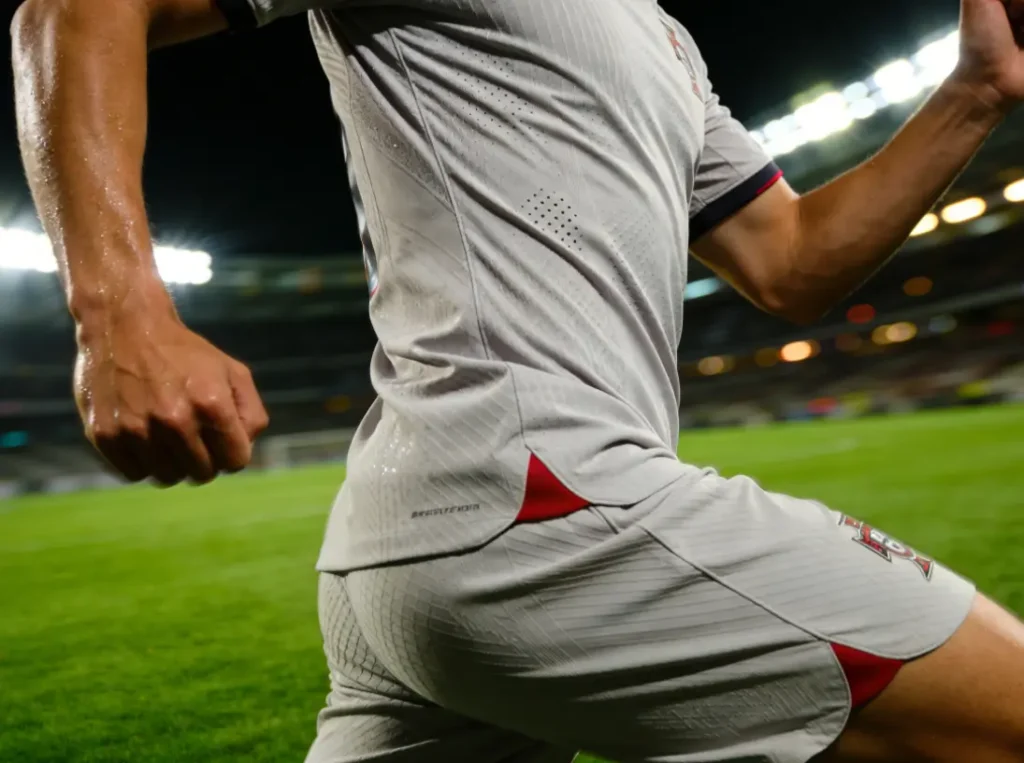
The foundation of any elite athletic garment is its base polymer chemistry. Standard apparel supply chains often rely on open-market fabric trading, which introduces dangerous variables in material weight, stretch recovery, and dye absorption. Professional procurement strategies mandate direct sourcing from high-tech textile mills capable of extruding proprietary micro-engineered yarns.
The primary metric evaluated by advanced аптовыя вытворцы футбольнай формы is the Moisture Vapor Transmission Rate (МВТР). During a 90-minute match, an athlete generates significant metabolic heat.
Football kit fabrics commonly use polyester-based constructions because of their lightweight properties, dimensional stability, and compatibility with sublimation printing. Some designs incorporate elastane or other stretch fibers to provide additional flexibility and recovery. The appropriate fiber composition depends on the garment’s intended use, fabric construction, fit requirements, and target price.
The micro-polyester features microscopic capillary channels that draw sweat away from the epidermis, while the elastane provides crucial four-way stretch, allowing the garment to recover its structural integrity immediately after mechanical stress.
Акрамя таго, strict environmental mandates from global governing bodies have accelerated the transition toward circular textile economies. Factory-direct sourcing allows buyers to specify GRS (Глабальны стандарт другаснай сыравіны) сертыфікаваны rPET (перапрацаваны поліэтылентэрэфталат).
Factory-direct sourcing may allow buyers to specify recycled polyester fabrics supported by relevant certification and supply chain documentation. Глабальны стандарт другаснай сыравіны (GRS) verifies recycled material content and provides chain-of-custody requirements, alongside additional social, экалагічны, and chemical criteria for processing. Buyers should confirm the recycled content, material performance, and documentation applicable to the actual fabric and finished garment rather than assuming that every recycled polyester product has the same characteristics as virgin polyester.
The Precision Pattern-Making Process for Ergonomic Fits
The physical geometry and pattern grading of the garment present another critical layer of manufacturing complexity. The industry enforces a strict bifurcation between “Версія прайгравальніка” (authentic match-day) і “Фанацкая версія” (replica stadium) architectures. Authentic match shirts are constructed utilizing dynamic, 3D athletic cuts. This involves complex curved paneling tailored tightly to the athlete’s torso, featuring elevated armholes and tapered waistlines to eliminate excess fabric that generates aerodynamic drag.
For academies and professional clubs, адмова ад агульных квадратных шаблонаў і пошуку крыніц індывідуальныя футбольныя кашулі, якія падыходзяць the exact biometric profiles of their athletes is a non-negotiable performance standard. Replica versions, наадварот, utilize a straight, relaxed geometry designed to accommodate diverse demographic body shapes, prioritizing casual comfort over high-speed athletic aerodynamics.
Scaling these geometric patterns across different age groups requires highly intricate mathematical grading. Pediatric and adolescent body geometries possess entirely different structural proportions compared to fully developed adults. Плечавы нахіл, апусканне ад грудзей да пояса, and collar circumferences must be recalculated independently for each specific age bracket.
Football Kit RFQ Checklist: What Buyers Should Include in a China Sourcing Request
A detailed request for quotation (RFQ) helps Chinese football kit manufacturers understand the project requirements and prepare more accurate quotations. Instead of sending only a reference photo and an estimated quantity, buyers should provide a structured specification sheet covering the product, налада, order breakdown, and delivery expectations.
1. Product and Fabric Specifications
- Product type: match jersey, replica jersey, трэніровачная кашуля, шорты, or complete football kit.
- Fabric composition and preferred material options.
- Target fabric weight (GSM), if already specified.
- Fabric texture, stretch requirements, and intended usage.
- Preferred color references or approved physical swatches.
2. Design and Customization Requirements
- Front, назад, and side design artwork.
- Club crest, manufacturer logo, and sponsor graphics.
- Player names and numbers, including the required font and placement.
- Printing method and any special decoration requirements.
- Neck labels, care labels, этыкеткі памеру, and packaging design.
3. Quantity and Size Breakdown
Provide the total order quantity and the number of units required in each size. If the order includes several teams, age groups, or designs, separate the quantities clearly.
4. Sampling and Quality Requirements
Specify whether a development sample, fit sample, or pre-production sample is required. Include the measurement chart, acceptable tolerances, inspection requirements, and any testing documentation needed for the project.
5. Delivery and Commercial Information
State the destination country, required delivery date, preferred shipping method, патрабаванні да ўпакоўкі, and requested Incoterm. Buyers should also ask suppliers to identify any separate sample, artwork, setup, or shipping charges.
Football Kit RFQ Information Table
| RFQ Category | Information to Provide |
|---|---|
| Прадукт | Джэрсі, шорты, training wear, or full kit |
| Тканіна | Кампазіцыя, GSM, тэкстура, and performance needs |
| Artwork | Design files, лагатыпы, колеру, імёны, і лічбы |
| Quantity | Total units and size-by-size breakdown |
| Адбор проб | Sample type, approval process, and required revisions |
| Якасць | Measurement tolerances and inspection criteria |
| Дастаўка | Destination, тэрмін пастаўкі, and shipping terms |
When multiple factories receive the same RFQ, buyers can compare quotations more accurately. It also becomes easier to identify differences in fabric quality, customization scope, sampling costs, production lead times, and shipping arrangements.
A complete RFQ is one of the simplest ways to reduce misunderstandings before production begins.
A prevalent manufacturing failure occurs when factories improperly scale the transition between youth football jerseys vs adult cuts. Linear scaling—simply shrinking an adult pattern by a fixed percentage—results in restrictive necklines or disproportionately long hemlines that hinder a young athlete’s biomechanics. Advanced facilities utilize digital CAD software to establish independent grading rules for pediatric athletic wear, ensuring optimal performance across all academy levels.
Dimensional Scaling and Anthropometric Data
Beyond age demographics, global procurement officers must account for significant anthropometric variations across different international markets. А “Large” size in the Asian market differs drastically in chest circumference and torso length from a “Large” in the North American or European markets.
Understanding як падабраць памер для кожнай узроставай групы within a specific regional context is essential to prevent catastrophic wholesale return rates. Professional factories employ localized grading charts (напр., US Standard, EU Standard, Asian Fit). When initiating a bulk order, buyers must mandate that the factory produces physical sizing sets (“fit samples”) across the entire size run. These samples are tested on live fit models in the target market before full-scale automated cutting begins, ensuring the final bulk delivery perfectly matches regional consumer expectations.
Football Kit Sample Approval: From Design Mockup to Pre-Production Sample
A digital design mockup is useful for reviewing the overall appearance of a football kit, but it cannot fully demonstrate fabric behavior, garment measurements, якасць друку, or sewing construction.
Before approving bulk production, buyers should follow a structured sample approval process.
Stage 1: Digital Artwork Approval
Review the front, назад, and side views of the jersey. Confirm the club crest, лагатыпы спонсараў, нумары гульцоў, імёны, колеру, шаблоны, and placement dimensions.
All artwork changes should be recorded in a clearly identified final version to prevent outdated designs from entering production.
Stage 2: Fabric and Color Confirmation
Review the actual fabric swatch or printed fabric sample. Confirm the agreed composition, GSM, тэкстура, расцягвацца, color appearance, and printing result.
For important club colors, use an approved physical reference or agreed color measurement procedure rather than relying only on screen images.
Stage 3: Fit and Measurement Approval
Check the sample against the agreed size chart. Measure chest width, даўжыня цела, шырыня плячэй, sleeve length, collar dimensions, and other project-specific points.
For youth and adult ranges, confirm that the relevant grading rules have been reviewed separately.
Stage 4: Construction and Decoration Inspection
Inspect seams, hems, канструкцыя хамута, sleeve openings, этыкеткі, printed graphics, and any applied decoration. Check that names and numbers are correctly positioned and that the garment is comfortable for its intended use.
Stage 5: Pre-Production Sample Approval
The pre-production sample should represent the agreed materials, artwork, measurements, construction, and finishing as closely as possible. Buyers should provide written approval before the manufacturer starts bulk production.
Football Kit Sample Approval Checklist
| Inspection Area | Approval Requirement |
|---|---|
| Artwork | Correct logos, імёны, лічбы, and layout |
| Тканіна | Matches the agreed material specification |
| Колер | Matches the approved color reference |
| Вымярэнні | Meets the agreed size chart and tolerances |
| Будаўніцтва | Acceptable seams, hems, collar, and finishing |
| Packaging | Correct labels, сумкі, and packing instructions |
Buyers should retain an approved reference sample or a complete approval record. If any material, artwork, or construction detail changes after approval, the manufacturer should communicate the change and obtain authorization before proceeding.
A documented sample approval process creates a clear reference for production inspection and reduces the risk of disputes when the finished football kits are delivered.
Automated Color Management for Brand Consistency
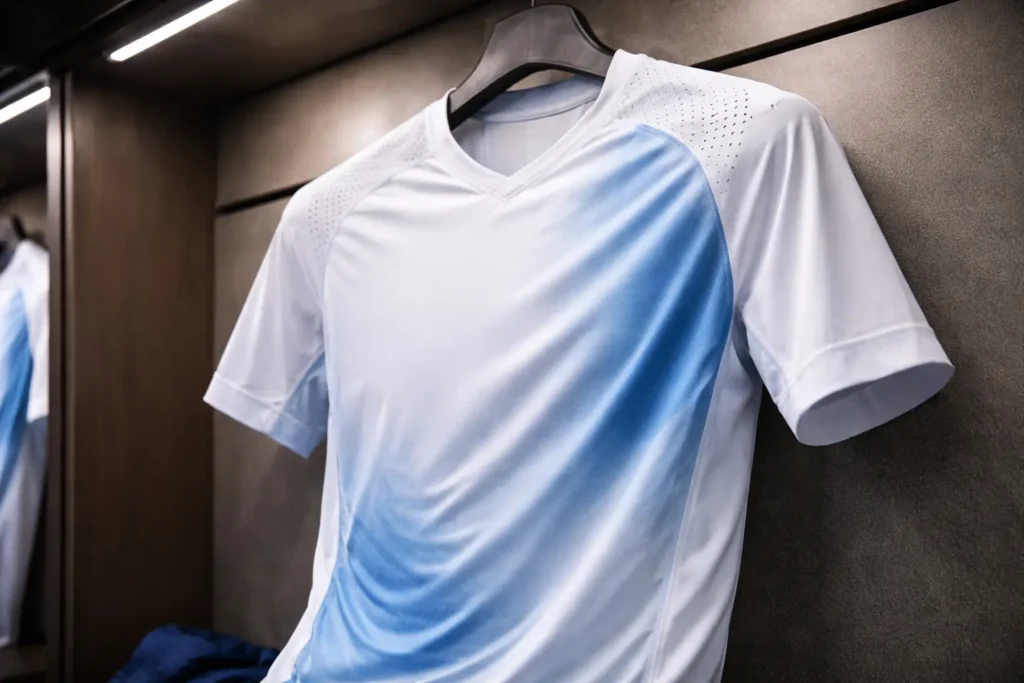
Maintaining absolute color consistency across thousands of units is one of the most technically demanding aspects of bulk sportswear production. Modern performance apparel relies on dye-sublimation printing, a thermodynamic process where specialized disperse dyes are heated to temperatures exceeding 200°C. At this threshold, the solid dye vaporizes and permanently permeates the open pores of the polyester microfibers, guaranteeing zero color fading and maintaining 100% of the fabric’s breathability.
Аднак, heat fluctuations during the sublimation calendar process can cause severe color shifting. Для барацьбы з гэтым, elite buyers establish strict color tolerances when selecting the perfect football jersey вытворца. Premium factories utilize automated spectrophotometers to measure the Delta E (ΔE) color variance between the approved digital Pantone target and the sublimated fabric.
The following table outlines the standardized scientific parameters enforced during professional quality control inspections:
| Quality Control Parameter | Authentic Match Specification | Replica / Training Specification | Testing Methodology |
|---|---|---|---|
| Color Variance (Delta E) | ΔE < 1.0 (Imperceptible) | ΔE < 2.0 (Acceptable standard) | Spectrophotometer Analysis |
| Устойлівасць колеру (Мыццё) | Grade 4-5 (No bleeding) | Grade 4 (Minimal fading) | ISO 105-C06 Standard |
| Вага тканіны (GSM) | 110 – 130 GSM | 150 – 160 GSM | ASTM D3776 Standard |
| Pilling Resistance | Grade 4 (High resistance) | Grade 3-4 (Moderate resistance) | ISO 12945-2 (Martindale test) |
| Stretch Recovery | > 95% recovery instantly | > 90% recovery | ASTM D3107 Standard |
Bulk Football Kit Quality Control: What to Inspect Before Shipment
Color measurement is only one part of football kit quality control. A bulk order also needs checks for fabric condition, garment measurements, дакладнасць друку, sewing construction, аздабленне, and packing.
For overseas buyers, quality control should be organized at several stages rather than postponed until the finished goods are ready to ship.
1. Incoming Fabric Inspection
Before cutting begins, inspect the incoming fabric against the approved specification. Check material identification, color appearance, вага тканіны, visible defects, width, and consistency between rolls.
2. Cutting and Printing Inspection
During cutting and printing, confirm that panels follow the approved patterns and artwork. Check print alignment, color appearance, logo positioning, number placement, and any visible marks or defects.
3. Sewing and Assembly Inspection
Inspect seam alignment, stitch consistency, канструкцыя хамута, sleeve attachment, hems, and garment symmetry. Pay particular attention to areas that experience repeated movement and tension during football activities.
4. Finished Garment Inspection
Finished jerseys should be checked against the approved sample and measurement chart. Review the fabric surface, print appearance, measurements, этыкеткі, loose threads, stains, and overall workmanship.
5. Packing and Pre-Shipment Inspection
Confirm that each garment has the correct size, player name, number, ярлык, і ўпакоўка. Check carton quantities, assortment details, shipping marks, and the final packing list.
Football Kit Quality Control Checkpoints
| Production Stage | Main Inspection Focus | Дзеянне пакупніка |
|---|---|---|
| Incoming materials | Fabric identity, вага, колер, and defects | Confirm against approved specifications |
| Cutting and printing | Panel dimensions and artwork accuracy | Review first production pieces |
| Шыццё | Seams, collar, hems, і будаўніцтва | Check workmanship consistency |
| Finished garments | Вымярэнні, знешні выгляд, and defects | Compare with approved sample |
| Ўпакоўка | Size assortment, этыкеткі, and carton quantities | Verify packing records before shipment |
Define Acceptance Criteria Before Production
Buyers and manufacturers should agree on inspection scope, sampling plans, measurement tolerances, defect classifications, and corrective-action procedures before manufacturing begins.
If an independent inspection is required, the inspection company should receive the approved specifications and acceptance criteria in advance.
A final inspection report is useful only when it clearly identifies the inspected order, sample size, inspection method, findings, and corrective actions. This makes quality decisions more transparent for both the buyer and the manufacturer.
Global Logistics: Ensuring Safe & Fast Delivery
Procuring the material and manufacturing the garments is only part of the supply chain equation; ensuring the inventory arrives at the destination port on schedule is paramount. B2B distributors must coordinate the delivery of seasonal kits precisely before the start of a new sporting calendar. Understanding factory lead times prevents highly damaging logistical bottlenecks.
China Football Kit Import Costs: Дастаўка, Customs, and Landed Cost
The quoted factory price is not necessarily the final cost of importing football kits from China. International buyers should calculate the total landed cost, including the expenses required to move the finished goods from the manufacturing facility to the agreed destination.
Common Cost Components in a China Football Kit Import Order
- Product cost: The agreed price for jerseys, шорты, шкарпэткі, or complete kits.
- Sampling and development: Узор вытворчасці, artwork preparation, and approved revisions where charged separately.
- Export packing: Individual bags, cartons, этыкеткі, and any special packaging requirements.
- Inland transportation: Transportation from the factory to the export port, airport, or consolidation warehouse.
- International freight: Air freight, sea freight, or another agreed transportation method.
- Insurance: Cargo insurance where required by the buyer or agreed shipping arrangement.
- Customs and import charges: Applicable duties, taxes, customs clearance, and destination-related fees.
- Local delivery: Transportation from the destination port or airport to the buyer’s warehouse.
Understand the Shipping Terms Before Confirming the Order
Incoterms define important responsibilities between buyers and sellers, including delivery obligations, cost allocation, and the transfer of risk. Buyers should confirm the exact Incoterm, named place, and applicable version in the sales contract.
Напрыклад, under FOB, the seller’s delivery obligations differ from those under CIF or DDP. These terms should not be treated as interchangeable, and the buyer should understand which freight, insurance, customs, and destination costs remain its responsibility.
Documents to Confirm Before Shipment
| Document | Прызначэнне |
|---|---|
| Commercial Invoice | Records the transaction value and seller-buyer details |
| Packing List | Shows carton quantities, product descriptions, and packing details |
| Bill of Lading or Air Waybill | Provides the relevant transport document |
| Сертыфікат паходжання | Identifies the declared country of origin when required |
| Test or Compliance Documents | Supports applicable buyer, рынак, or regulatory requirements |
The exact documents depend on the destination country, product classification, shipping method, and buyer’s customs requirements. Buyers should confirm applicable import rules and tariff classification with their customs broker before shipment.
Calculate Landed Cost Per Football Kit
Landed Cost Per Unit = (Кошт прадукту + Sampling and Development + Export and Freight Costs + Insurance + Import Duties and Taxes + Destination Charges) ÷ Total Sellable Units
This calculation helps distributors and sportswear brands compare suppliers using the cost of receiving the goods, rather than relying only on the factory quotation.
A clear shipping agreement and complete export documentation can reduce avoidable delays and make the total sourcing budget easier to manage.
A standard manufacturing cycle for bulk orders (1,000 каб 10,000 адзінак) operates on a highly structured timeline. The Sampling Phase requires 7 каб 14 days for CAD pattern engineering and Top of Production (ТОП) зацвярджэнне ўзору. Bulk production spans 30 каб 45 дзён, followed by maritime shipping transit (звычайна 25-35 дзён да партоў ЕС/ЗША). Professional procurement teams actively monitor potential factory congestion, particularly preceding major global tournaments.
Акрамя таго, importing textiles into highly regulated markets requires stringent adherence to international safety laws.
How to Verify OEKO-TEX and GRS Claims When Sourcing Football Kits
Certifications can help buyers evaluate certain aspects of textile safety, recycled material sourcing, and supply chain management. Аднак, a certificate should never be accepted based on a logo displayed on a supplier’s website alone.
Buyers need to confirm what the certificate covers, which organization issued it, whether it is valid, and whether it applies to the actual facility, матэрыял, or product involved in the order.
OEKO-TEX STANDARD 100
OEKO-TEX STANDARD 100 focuses on testing textile products and their components for harmful substances. Buyers should check the certificate number, certificate holder, validity period, product class, and covered product scope.
A supplier’s certificate for one product category should not automatically be assumed to cover every fabric, адзенне, accessory, or production facility.
Глабальны стандарт другаснай сыравіны (GRS)
GRS is designed to verify recycled material content and provide chain-of-custody traceability. It also includes additional social, экалагічны, and chemical requirements for processing.
When sourcing recycled polyester football kits, buyers should request relevant certification and transaction documentation that supports the recycled material claim for the supplied goods.
A factory having a valid certification does not automatically prove that every product it manufactures contains certified recycled material.
Certification Verification Checklist
- Confirm the full name of the certification and its applicable standard version.
- Check the certificate holder and the legal entity named on the document.
- Verify the certificate number and validity period through the relevant certification organization or official verification system.
- Review the covered product categories, матэрыялаў, processes, and facility scope.
- For recycled content claims, request documentation that connects the certified material to the actual order.
- Confirm whether the final garment, тканіна, or only an upstream material is covered.
Certification Is Not a Substitute for Import Compliance
Voluntary textile certifications and mandatory legal requirements serve different purposes. OEKO-TEX STANDARD 100 may provide useful evidence of harmful-substance testing, but buyers must still identify and meet the legal requirements applicable to their destination market and product category.
For a professional sourcing project, certification documents should be reviewed together with product specifications, test reports, supplier records, and applicable import regulations.
This approach helps buyers avoid unsupported sustainability claims and make more transparent decisions when sourcing football kits from China.
Reputable factories operate under the OEKO-TEX Standard 100 рамкі сертыфікацыі. This independent laboratory testing guarantees that all polyester yarns, sublimation dyes, and sewing threads are entirely free from restricted carcinogenic azo colorants and heavy metals. For technical consultations regarding ISO certifications, GRS compliance, or establishing a reliable production timeline, procurement officers should кантакт the manufacturing facility’s supply chain management team directly to ensure all customs and compliance documentation is verified prior to export.
FAQ
1. What is the standard MVTR requirement for authentic match shirts?
The Moisture Vapor Transmission Rate (МВТР) is a critical performance metric for authentic match shirts. Professional-grade micro-polyester fabrics are engineered to achieve high capillary action, moving sweat from the skin to the fabric’s exterior rapidly. While exact numeric standards vary by testing method, the optimal fabric composition utilizes an 88-92% polyester and 8-12% elastane blend at a highly breathable 110-130 GSM weight to maximize continuous thermal regulation during 90-minute athletic exertion.
2. How do factories ensure exact color consistency in bulk orders?
To guarantee absolute color consistency across thousands of garments, premium factories employ automated spectrophotometers alongside high-temperature dye-sublimation technology. The spectrophotometer measures the Delta E (ΔE) variance between the physical fabric and the approved digital Pantone code. Professional quality control protocols reject any production batch that exhibits a Delta E variance greater than 2.0, ensuring uniform brand identity globally.
3. Why is OEKO-TEX certification necessary when importing sportswear?
Стандарт OEKO-TEX 100 is an independent, globally recognized testing certification that verifies textiles are free from harmful substances. It is a mandatory requirement for importing apparel into strictly regulated markets like the European Union and the United States. Without this certification proving the absence of carcinogenic azo colorants, фармальдэгід, and heavy metals, international customs authorities can impound or destroy the entire wholesale shipment.
4. What is the structural difference between player version and replica cuts?
The “Версія прайгравальніка” features a 3D ergonomic, highly tapered athletic cut specifically engineered to eliminate excess fabric and reduce aerodynamic drag. It incorporates elevated armholes and complex curved paneling. The “Replica Version” (or Fan Version) utilizes a traditional, straight-cut geometry designed for a relaxed fit, accommodating a much wider demographic of body shapes and prioritizing casual comfort over high-speed athletic aerodynamics.
5. How is sizing properly graded between youth and adult demographics?
Proper pattern grading between youth and adult demographics requires completely independent mathematical scaling. Linear scaling (simply shrinking an adult pattern) fails because pediatric and adolescent body geometries have different shoulder slopes, chest-to-waist drops, and neck circumferences compared to fully developed adults. Advanced manufacturers utilize digital CAD software to create distinct geometric baseline patterns for each age bracket, ensuring biomechanical freedom of movement for all players.
Спасылкі:
- “Moisture Vapor Transmission and Thermoregulation in High-Performance Micro-Polyester.” Journal of Athletic Textile Engineering.
- “Aerodynamic Drag Reduction via 3D Ergonomic Pattern Grading.” International Institute of Sports Biomechanics.
- “Spectrophotometric Quality Control in Dye-Sublimation Processes.” Journal of Industrial Color Science.
- “Compliance Protocols: Стандарт OEKO-TEX 100 and Global Customs Regulations.” International Textile Compliance Board.
- “Lifecycle Assessment of GRS Certified rPET in Bulk Sportswear Manufacturing.” Global Sustainable Textile Review.
- “Anthropometric Scaling Errors in Pediatric Athletic Apparel.” American Society of Pattern Engineers.
- “Supply Chain Logistics and Production Lead Times in Asian Textile Markets.” Global Sourcing Economics Quarterly.
- “ISO 105-C06: Standard Test Methods for Color Fastness to Domestic and Commercial Laundering.” International Organization for Standardization.