Approving a football jersey sample is a critical purchasing decision, not simply a final look at the color and design. A sample may appear attractive in photographs yet reveal problems after washing, растяжка, repeated wear, or comparison with the bulk order. For sportswear brands, футбольные клубы, teamwear distributors, and wholesale buyers, the purpose of sample approval is to confirm that the garment meets the agreed specifications and can be reproduced consistently at production scale.
A practical inspection process evaluates the fabric, garment measurements, строительство, печать, decoration, производительность, labeling, упаковка, and supporting documentation. Buyers should also distinguish between a development sample, a pre-production sample, and a bulk-production inspection sample. These stages serve different purposes, and approval at one stage should not automatically authorize changes made at another.
This guide explains how to evaluate a Football Jersey Sample Approval request, which tests deserve attention, how to document defects, and when to approve, revise, or reject a sample. It is designed to help buyers make evidence-based decisions before committing to a large order.
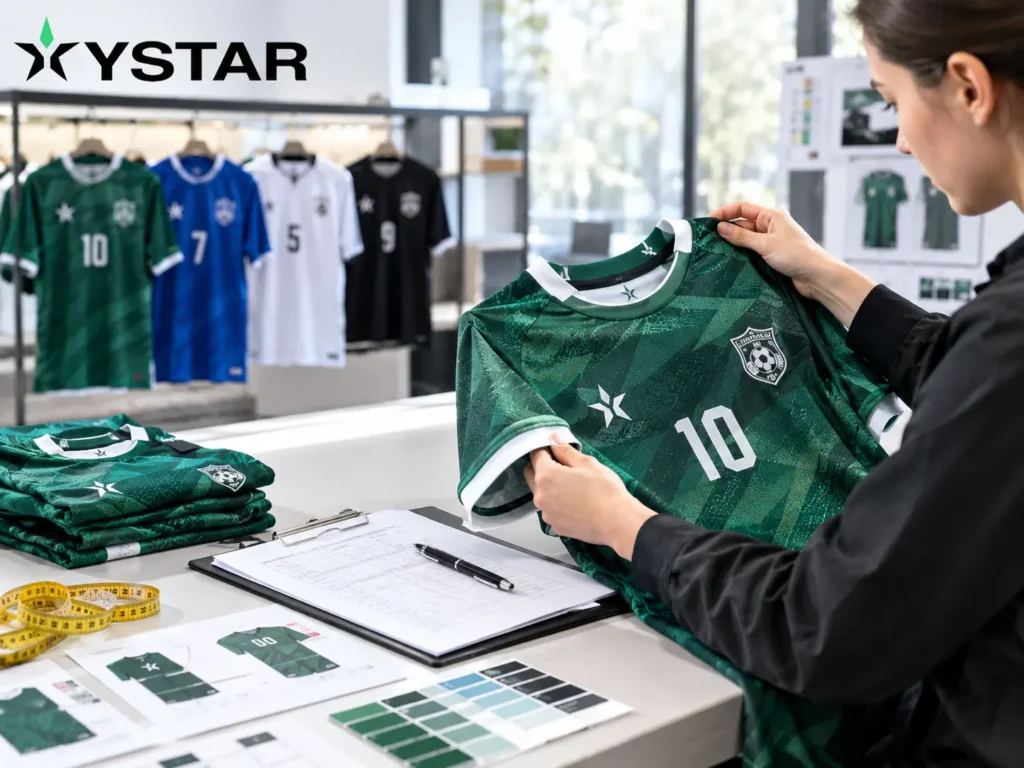
Why Football Jersey Sample Approval Matters Before Bulk Production
How a sample becomes the reference for mass production
A sample establishes a physical reference for the product that the buyer expects to receive. It should represent the agreed fabric, цвет, шаблон, measurements, шитье, размещение логотипа, метод печати, обрезки, and finishing details. When these elements are documented, both the buyer and manufacturer can use the approved sample to resolve questions during production.
Consider a football club ordering 500 jerseys before a tournament. The sample may look correct, but the factory could later substitute a slightly different fabric, reposition the back numbers, or use a different transfer material. Even if each change appears minor in isolation, the combined result may be visibly different from the approved product. Written specifications and a retained reference sample help prevent these avoidable disagreements.
The cost of approving an incomplete sample
Premature approval can lead to reprinting, re-sewing, delayed delivery, additional freight, customer complaints, and unsold inventory. The commercial risk becomes more significant when jerseys carry player names, individual numbers, спонсировать произведение искусства, or tournament-specific details that cannot easily be reused.
Before approval, buyers should identify the product’s intended use, количество заказа, срок поставки, target market, and required performance level. These factors determine whether visual inspection is sufficient or whether additional wear trials and laboratory testing are justified.
Buyers sourcing coordinated team apparel can also review the range of футбольная форма to understand how jerseys fit into a broader uniform program that may include shorts, тренировочные топы, and coordinated teamwear. The final sample specification should clearly identify which garments and accessories are included in the order.
Check the Football Jersey Sample Against the Approved Specification
Verify the technical pack and artwork revision
Start by comparing the physical sample with the latest approved technical pack, произведение искусства, Таблица размеров, purchase order, and written production instructions. Check the style number, revision date, ссылки на цвета, fabric composition, trim details, logo dimensions, player-number layout, and label information.
Version control is especially important when a buyer requests several revisions. A sample made from an outdated artwork file may have the wrong sponsor logo or number proportions even when the sewing quality is excellent. Record the version used for approval and remove obsolete files from the active production workflow.
Confirm that the sample uses the specified materials
Ask the manufacturer to confirm whether the sample uses the same fabric, yarn, dyeing or printing process, обрезки, and decoration materials intended for bulk production. If an item is temporarily unavailable and a substitute is proposed, document the difference and obtain written approval before treating the sample as final.
Use a specification comparison table
| Inspection Item | What to Verify | Evidence to Keep |
|---|---|---|
| Ткань | Composition, строительство, масса, цвет | Specification and supplier data |
| Measurements | Грудь, длина тела, рукава, tolerances | Measured sample and approved size chart |
| Artwork | Логотип, имя, число, цвет, alignment | Approved artwork and sample photographs |
| Строительство | Швы, воротник, hems, loose threads | Inspection record and defect photographs |
| Упаковка | Labels, barcodes, сумки, маркировка картона | Packaging specification and sample |
Evaluate Fabric Quality, Масса, Воздухопроницаемость, and Stretch
Check fabric composition and GSM
Fabric weight, usually expressed in grams per square meter (GSM), is one useful indicator of textile construction. Однако, GSM alone does not establish whether a jersey will feel comfortable, быстро сохнуть, resist snagging, or perform well during repeated movement. Fiber type, yarn structure, knitting construction, finishing, and garment design also influence performance.
Polyester is commonly used in performance sportswear because it can support lightweight construction and moisture-management finishes. Elastane may be included when additional stretch is required, while different knit structures can balance airflow, непрозрачность, драпировать, и долговечность. Buyers should assess the actual fabric rather than assume that a particular fiber composition guarantees a specific performance outcome.
For a deeper explanation of this factor, consult the discussion of how fabric weight affects football jersey comfort and performance. The useful purchasing question is not simply whether a fabric is lightweight, but whether its measured properties suit the intended climate, activity, and product positioning.
Assess breathability, управление влажностью, and stretch recovery
Check whether the fabric feels appropriate against the skin and allows sufficient movement during running, ног, and upper-body rotation. A short wear trial can identify irritation, excessive cling, ограниченное движение, or poor drape. For more demanding performance requirements, ask for test results relevant to air permeability, управление влажностью, dimensional stability, or stretch recovery.
Stretch recovery matters because a jersey that deforms after repeated movement may look worn before the end of its expected service life. Opacity is another practical concern: light-colored or highly stretched fabric may reveal more than intended. Inspect the garment under suitable lighting and evaluate the fabric in the actual areas where it will be worn and stretched.
Fabric performance data to request
| Параметр | Unit or Method | Почему это важно | Действия покупателя |
|---|---|---|---|
| Fabric mass | g/m² (GSM) | Helps compare material weight | Compare with the approved specification |
| Fiber composition | Percentage by fiber type | Affects care, feel, and labeling | Request supporting documentation |
| Air permeability | Method-dependent airflow measurement | Helps evaluate airflow through fabric | Compare samples using the same method |
| Dimensional change | Percentage change after conditioning and washing | Indicates shrinkage or growth | Set an agreed acceptance limit |
| Цветостойкость | Test-specific rating or grade | Indicates resistance to color change or transfer | Review the method and test conditions |
| Seam performance | Force or method-specific result | Helps assess construction durability | Test when required by product risk |
Important data note: The table identifies relevant measurable parameters; it does not claim universal performance values. Acceptable GSM, воздухопроницаемость, dimensional change, стойкость цвета, and seam performance depend on the product specification, intended use, test method, and buyer requirements. A result is meaningful only when the method, условия, единицы, and acceptance criteria are known.
Confirm Measurements, Соответствовать, and Size Consistency
Measure the sample at defined points
Use the approved measurement guide to check chest width, длина тела, ширина плеч, Длина Рукава, sleeve opening, and other relevant points. Lay the jersey on a flat surface, smooth it without stretching, and use consistent measuring positions. Record the results instead of relying on visual estimation.
Measurement tolerances should be agreed before sample approval. Do not assume that every supplier, garment size, or measurement point follows the same tolerance. The buyer and manufacturer should document the permitted deviation for each critical measurement and decide how borderline results will be handled.
Test fit under realistic movement
A jersey can match its size chart yet still restrict movement because of the pattern, sleeve construction, collar opening, or fabric behavior. Ask representative wearers to move through basic football actions such as jogging, raising the arms, turning the torso, и растяжка. Look for excessive pulling, uncomfortable seams, unwanted transparency, and fabric that rides up or twists.
For team orders, confirm how the size range is developed. One approved medium-size sample cannot prove that every smaller and larger size will fit correctly. When the order is significant, inspect representative sizes or request a size-set sample before authorizing full production.

Inspect Stitching, Швы, Collar Construction, and Finishing
Look for defects inside and outside the garment
Inspect the neckline, shoulder seams, sleeve attachments, side seams, hems, and any panels joining fabrics of different constructions. Look for skipped stitches, loose threads, open seams, сморщивание, uneven seam allowances, and visible distortion. Turn the jersey inside out because some construction defects are easier to identify on the reverse side.
Check stress points and skin-contact areas
Pay particular attention to areas exposed to repeated movement or friction. The collar should sit evenly, the sleeves should be symmetrical according to the design, and the hem should remain stable without obvious twisting. Check labels and internal seams for rough edges that may irritate the wearer.
Not every loose thread requires rejection, but defects should be classified consistently. A cosmetic issue may be repairable, while an open seam at a critical construction point could affect durability. The acceptance rules should distinguish critical, major, and minor defects and state who has authority to approve corrective action.
Verify Logo, Crest, Player Name, Число, and Printing Quality
Check artwork placement and readability
Compare every logo, гребень, sponsor mark, имя игрока, and number with the approved artwork. Check spelling, шрифт, размер, spacing, alignment, цвет, and position. Measure placement from defined garment reference points where appropriate instead of judging from a photograph alone.
Names and numbers deserve particular attention because errors can make personalized garments unusable. For a team order containing many individual names, approve the personalization data separately and retain the final list used by production. A visually correct sample does not eliminate the risk of data-entry errors across the full order.
Evaluate the decoration method
Сублимация, теплопередача, снимок экрана, and embroidery have different production characteristics. Sublimation can integrate suitable designs into compatible synthetic fabrics, while transfers and screen printing require their own adhesion, гибкость, and wash-durability checks. Embroidery can provide a raised finish but may add weight or stiffness in certain areas.
Inspect the decoration for lifting edges, cracking, bubbling, poor registration, uneven stitching, and color mismatch. If the garment will be stretched substantially during play, examine the decorated areas under controlled movement. The test should reflect the actual materials and process selected for bulk production.
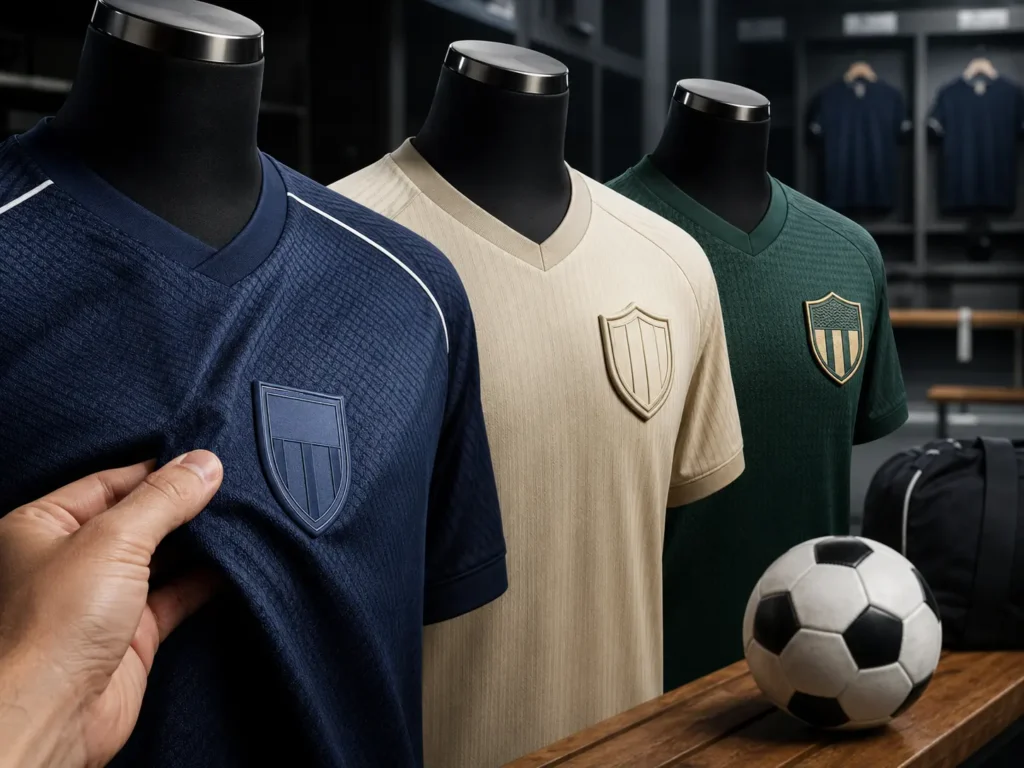
Test Colorfastness, Усадка, and Performance After Washing
Why washing tests matter
A sample that looks perfect when new may change after laundering. Fabric may shrink or grow, colors may transfer, and printing may peel or crack. A controlled wash trial can reveal issues that visual inspection cannot detect. Follow the care instructions intended for the finished product and record the washing conditions so results can be interpreted properly.
Use recognized test methods where appropriate
Depending on the material and sales requirements, relevant methods may include ISO 6330 for domestic washing and drying procedures, ИСО 5077 for dimensional change after washing and drying, ISO 105-C06 for colorfastness to domestic and commercial laundering, and ISO 105-X12 for colorfastness to rubbing. Confirm the current edition, exact scope, specimen preparation, and applicable rating system before specifying a test.
A simple in-house wash trial is useful for preliminary screening but is not equivalent to a controlled laboratory report. If the buyer requires formal evidence, use a competent laboratory and state the acceptance criteria before testing. Compare pre-wash and post-wash measurements, появление, цвет, print condition, and seam integrity.
Record the test rather than relying on impressions
| Test Stage | Record | Decision Use |
|---|---|---|
| Перед стиркой | Measurements, цвет, print condition, photographs | Establishes a baseline |
| During the test | Метод, температура, detergent, cycle, drying process | Supports reproducibility |
| После стирки | Dimensional change, color transfer, peeling, seam damage | Shows whether requirements are met |
| Final review | Pass, fail, corrective action, reviewer | Supports the approval decision |
Review Labels, Инструкции по уходу, Упаковка, and Compliance
Check labeling against the destination market
Labels may need to communicate fiber composition, care instructions, размер, страна происхождения, manufacturer or responsible business details, and other information required by the destination market. Requirements vary by jurisdiction and product category. Buyers should verify the rules that apply to their actual sales channels rather than assume that one label format is sufficient worldwide.
For products sold in the United States, textile labeling obligations may involve applicable Federal Trade Commission requirements, including fiber content, страна происхождения, and responsible business identification where required. Care labeling rules should also be checked for the product concerned. For the European Union, review applicable textile fiber-name and fiber-composition labeling requirements, alongside other relevant product-safety and chemical restrictions.
Assess packaging and chemical-safety documentation
Check the size label, бирка, штрих-код, folding method, individual bag, carton label, and packing list against the purchase order. Packaging errors can cause warehouse receiving problems even when the garment itself is acceptable.
Where the order or destination market requires chemical compliance evidence, request relevant documentation and test reports. Depending on the product and market, requirements may involve restricted substances or applicable rules under frameworks such as the European Union’s REACH regulation. Do not assume that a generic certificate proves compliance with every requirement.
Compare the Approved Sample with the Manufacturer’s Production Capabilities
Confirm that the sample is representative of bulk production
Ask whether the sample was made using the actual production fabric, decoration process, обрезки, sewing equipment, and approved artwork. If it was produced using special materials or manual finishing that will not be available for the main order, the sample may not accurately represent the final product.
Buyers should understand the difference between a development sample and a pre-production sample. A development sample helps establish design direction. A pre-production sample should reflect the agreed materials and production methods closely enough to serve as a meaningful reference for the order. If important details change after approval, the buyer should determine whether another sample or written reapproval is required.
Evaluate supplier communication and corrective action
A capable Football Jersey Manufacturer should be able to explain its material specifications, sample revisions, качественные проверки, and process controls. Buyers should look for clear answers, traceable documentation, and a defined procedure for correcting defects rather than relying only on attractive sample photographs.
For background on supplier capabilities and business processes, buyers can review the manufacturer’s company background and production approach. This should be part of a broader assessment that also considers relevant product evidence, коммуникация, Время выполнения, order requirements, and the ability to maintain consistency across sizes and repeat orders.
Use a Football Jersey Sample Inspection Checklist Before Signing Off
Record each inspection item
A structured Football Jersey Sample Inspection Checklist turns subjective opinions into a documented decision. Use one line for each requirement and record the actual result, the agreed acceptance criterion, the inspection method, and the final status. Where possible, attach photographs, measurement records, and relevant test reports.
| Checkpoint | Pass Criteria | Status to Record |
|---|---|---|
| Спецификация | Matches approved version | Pass / Fail / Pending |
| Ткань | Meets agreed composition and performance requirements | Pass / Fail / Pending |
| Measurements | Within specified tolerances | Pass / Fail / Pending |
| Строительство | No unacceptable defects | Pass / Fail / Pending |
| Decoration | Correct artwork and acceptable durability | Pass / Fail / Pending |
| Стирка | Meets agreed post-wash criteria | Pass / Fail / Pending |
| Labels and packaging | Matches approved destination-market requirements | Pass / Fail / Pending |
| Документация | All required approvals and reports are available | Pass / Fail / Pending |
Classify defects and assign corrective actions
Critical defects may include safety or compliance issues that make the product unacceptable. Major defects can affect usability, соответствовать, появление, or the buyer’s core requirements. Minor defects are generally limited to small imperfections that do not materially affect use or agreed quality. The classification must be defined for the order, since defect severity depends on product requirements and intended use.
For each failure, identify the defect, its location, supporting evidence, responsible party, corrective action, and required reinspection. A revised sample should be checked against the same criteria as the original. Verbal assurances should not replace documented closure of unresolved issues.
Common Football Jersey Sample Approval Mistakes to Avoid
Approving from photographs alone
Photographs can confirm visible design details, but they cannot reliably establish fabric hand feel, exact measurements, прочность шва, устойчивость к стирке, or every color difference. Physical inspection and relevant test evidence are needed when those properties are important to the order.
Ignoring differences between sample and bulk materials
A sample made from one fabric cannot automatically validate a substitute fabric. Differences in construction, масса, dyeing, finishing, or transfer materials can change the garment’s appearance and performance. Reassess the sample whenever a material substitution affects a critical requirement.
Starting production before closing open issues
Do not authorize bulk cutting while critical measurements, произведение искусства, labeling, or required tests remain unresolved. If a minor issue is accepted conditionally, record the agreed correction and who is responsible for verifying it. This prevents an informal exception from becoming an unintended production standard.
Failing to maintain an approval record
Keep the approved sample identification, dated photographs, final technical pack, measurement records, test reports, and written approval together. A retained reference makes later inspection and dispute resolution more objective. It also helps the buyer evaluate repeat orders against the same documented requirements.

Frequently Asked Questions About Football Jersey Sample Approval
1. What should buyers check on a Football Jersey sample before approving it?
Buyers should verify the fabric composition and weight, garment measurements, соответствовать, шитье, collar construction, logo and number placement, color consistency, washing performance, этикетки, и упаковка. They should compare the physical garment with the latest approved specification and record any deviations. If the order requires performance or compliance evidence, the relevant test reports should be reviewed before approval.
2. Should buyers test a Football Jersey sample before placing a bulk order?
Да, testing is advisable when performance, долговечность, or compliance requirements could affect the order. Как минимум, buyers should conduct a structured visual and measurement inspection. Depending on the product, they may also need a wear trial, controlled washing assessment, испытание на устойчивость цвета, dimensional-change testing, or other relevant laboratory evaluations. The test plan should reflect the intended use and the risks associated with the order.
3. How many Football Jersey samples should a buyer approve?
There is no universal number suitable for every order. A simple order may need one representative pre-production sample, while complex designs, multiple fabrics, personalized printing, or a wide size range may require additional samples. Buyers should consider separate colorways, decoration methods, and representative sizes. The important principle is to obtain enough evidence to verify every meaningful product variation before bulk production begins.
4. Can a manufacturer change the fabric or printing method after sample approval?
A manufacturer should not make an unapproved change to a material or process that affects the agreed specifications. Fabric composition, масса, цвет, метод печати, обрезки, and artwork can influence fit, появление, долговечность, and labeling. If a change becomes necessary, the manufacturer should disclose it, explain the potential impact, and obtain written approval. A revised sample or additional testing may be required before production continues.
5. What should buyers do if bulk Football Jerseys do not match the approved sample?
Buyers should compare the delivered garments with the documented specification and retained approved sample, record the differences, and preserve photographs and relevant inspection results. They should then notify the supplier according to the purchase agreement and request a documented corrective-action proposal. Depending on the contract, defect severity, and applicable law, the available remedies may differ. Clear sample records and written acceptance criteria make these discussions more objective.
Ссылки
- Международная организация по стандартизации. ИСО 6330: Textiles — Domestic Washing and Drying Procedures for Textile Testing. ИСО.
- Международная организация по стандартизации. ИСО 5077: Textiles — Determination of Dimensional Change in Washing and Drying. ИСО.
- Международная организация по стандартизации. ИСО 105-С06: Textiles — Tests for Colour Fastness — Colour Fastness to Domestic and Commercial Laundering. ИСО.
- Международная организация по стандартизации. ISO 105-X12: Textiles — Tests for Colour Fastness — Colour Fastness to Rubbing. ИСО.
- Федеральная торговая комиссия. Threading Your Way Through the Labeling Requirements Under the Textile and Wool Acts. United States Federal Trade Commission.
- Федеральная торговая комиссия. Care Labeling of Textile Wearing Apparel and Certain Piece Goods. United States Federal Trade Commission.
- European Parliament and Council. Regulation (Евросоюз) Нет 1007/2011 on Textile Fibre Names and Related Labelling and Marking of the Fibre Composition of Textile Products. Official Journal of the European Union.
- European Parliament and Council. Regulation (EC) Нет 1907/2006 Concerning the Registration, Оценка, Authorisation and Restriction of Chemicals (ДОСТИГАТЬ). Official Journal of the European Union.
How to Choose the Right Next Step After Sample Inspection
Once the sample has been checked, the buyer should decide whether the product is ready for approval, needs a defined revision, or should be rejected. The decision should follow documented evidence rather than pressure to meet a deadline. A sample is ready for approval when critical specifications are met, required tests are acceptable, outstanding issues are closed, and the reference documents are consistent.
For buyers comparing uniform options, the choice of jersey should also reflect the intended team identity, playing conditions, garment construction, and decoration requirements. Понимание why football teams wear different soccer uniforms can help clarify why a single design or material specification may not be suitable for every role, климат, or competition.
Retailers and team managers who need a broader purchasing framework can use a Футбольный трикотаж 2026 buying guide alongside the sample checklist. The two resources serve different purposes: one helps define the purchasing requirements, while the other verifies whether a specific sample meets them.
When the technical requirements, test results, and approval record are complete, the buyer can authorize the next production stage with greater confidence. If a material, произведение искусства, or construction detail remains uncertain, request clarification before the order proceeds. Buyers with project-specific questions can contact the supplier to discuss sample requirements, expected quantities, revisions, and the documentation needed for a clear production handover.
Football Jersey Sample Approval Insights for B2B Buyers
A sound sample-approval decision connects product design, производительность ткани, garment construction, тестирование, согласие, and production control. No single feature proves that a jersey is suitable for bulk production. The buyer needs a consistent set of requirements and enough evidence to confirm that the sample meets them.
How should buyers match inspection depth to product direction?
Different football apparel products place different demands on fabric, строительство, and decoration. The following matrix is a qualitative suitability guide, not statistical data. The symbols do not represent measured probabilities, market shares, or guaranteed performance outcomes. Actual suitability depends on the fabric specification, Процесс производства, wearer needs, and test evidence.
Legend: ●●● = Primary; ●●○ = Strong Option; ●○○ = Depends on Workflow; — = Usually Not First Choice.
| Направление продукта | Key Inspection Priorities | Fabric Performance | Decoration Review | Дополнительные соображения |
|---|---|---|---|---|
| Футболки для матчей | Соответствовать, движение, долговечность, number visibility | ●●● | ●●● | Verify performance requirements and player personalization |
| Training jerseys | Repeated washing, комфорт, строительство | ●●● | ●●○ | Check expected frequency of use and care instructions |
| Fan and retail jerseys | Appearance, постоянство размера, labeling | ●●○ | ●●● | Confirm target price positioning and retail presentation |
| Youth team jerseys | Соответствовать, движение, care, relevant safety requirements | ●●● | ●●○ | Check age-appropriate sizing and applicable market rules |
| Premium customized jerseys | Artwork precision, finish, material consistency | ●●○ | ●●● | Confirm every custom element and revision before production |
What should buyers do when information is incomplete?
If the supplier cannot provide reliable fabric data, test reports, a complete size chart, or a clear statement about sample materials, buyers should not treat the missing information as proof of compliance. Request the missing evidence, define the acceptance criteria, and decide whether additional testing is necessary. Where evidence remains unavailable, record the limitation and avoid making unsupported claims about durability or performance.
Why does the approved sample remain important after production starts?
The approved sample provides a practical comparison point, but it does not replace bulk quality control. Production inspections should still verify workmanship, measurements, decoration, and relevant batch consistency. If the manufacturer changes a material or process, the buyer should evaluate whether the original approval remains valid.
Which purchasing option is most appropriate?
The right option depends on the order’s intended use, required customization, количество, график доставки, and acceptable risk. A basic team order may need a straightforward physical inspection and size verification. A complex personalized order or a product subject to stricter performance or compliance requirements may need a wider test plan and additional documented approvals. Buyers should select the inspection process that matches the actual product rather than applying the same checklist mechanically to every order.
Final buyer recommendation
Approve a football jersey sample only when its critical requirements are verified, its remaining deviations are documented, and the buyer and supplier agree on the production reference. Keep the approved sample identity, final artwork, specifications, measurement results, test records, and written sign-off together. This process supports clearer communication, more consistent production, and better-informed purchasing decisions.
For additional company and product information, use the relevant sections of the supplier’s website to review the available uniform range and establish which specifications should be confirmed for your project. A clear discussion before bulk production is usually more effective than trying to resolve avoidable discrepancies after the jerseys have been manufactured.