Choosing a Football Jersey sounds simple until two shirts marked “Medium” fit completely differently. One may be designed as a close athletic match jersey with a tapered torso and narrow sleeves, while another may be a relaxed fan jersey intended for casual wear. Add differences in regional sizing, youth patterns, women’s cuts, fabric stretch and custom manufacturing, and the size label becomes only a starting point.
For individual shoppers, choosing the wrong size can mean a return. Dla klubu, szkoła, football academy or distributor ordering hundreds of customized garments, the same mistake can create replacement costs, delivery delays and unusable inventory after names and numbers have already been printed. Buyers developing Niestandardowe stroje piłkarskie should therefore treat sizing as part of product development, together with fabric, pattern construction, printing method and target wearer.
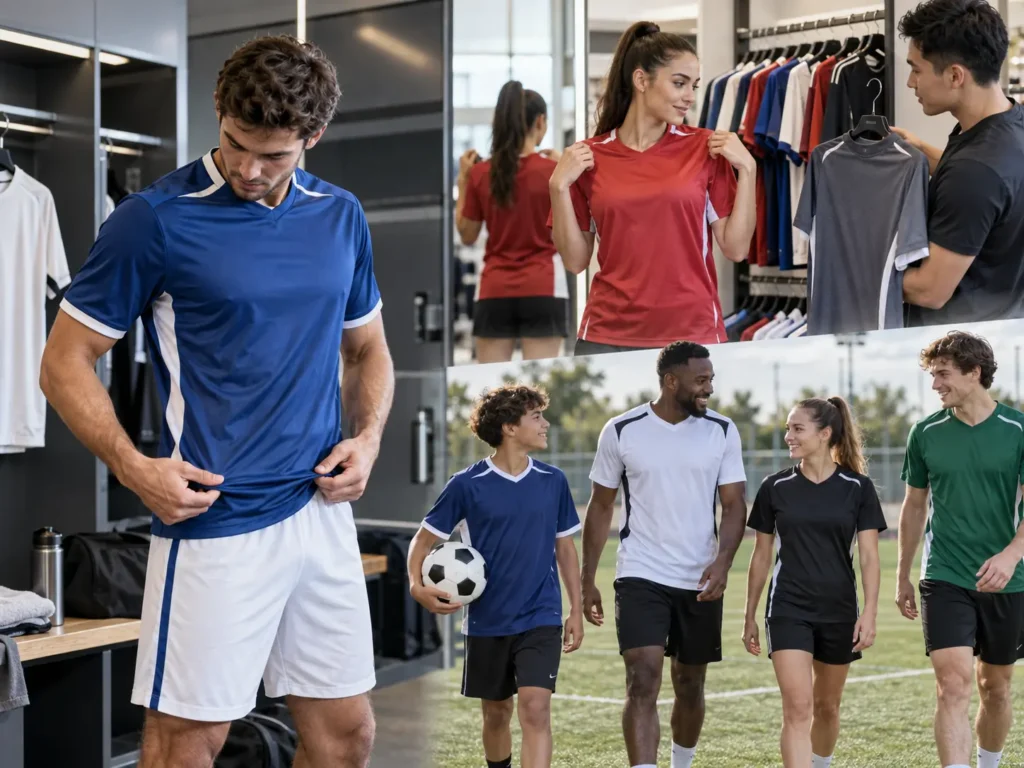
Why Football Jersey Sizing Is a Manufacturing Issue Too
A size chart is created from a pattern block, intended body dimensions, wearing ease and grading rules. The manufacturer then converts those dimensions into a finished garment specification covering chest width, długość ciała, plecy, rękawy, neck opening and other measurement points. If the initial pattern does not match the target market, simply relabeling S, M and L will not solve the fit problem.
This matters for private-label brands because a European fanwear collection, an academy training kit and a South Korean-inspired oversized lifestyle jersey may all require different fit logic even when they use similar fabrics. Sample fitting and size-set approval are therefore as important as graphics.
When evaluating a Football Jersey manufacturer, buyers should ask how patterns are developed, how sizing is graded between sizes, whether youth and women’s blocks are separate, and how finished garment measurements are controlled in bulk production.
Measure Before You Customize
Customization increases the financial cost of sizing mistakes. A plain jersey may be returned or reassigned. A jersey carrying a player name, numer, club badge and sponsor artwork may have little resale value if it does not fit the intended wearer.
The safest bulk-order sequence is to establish the target size chart first, confirm representative samples, fit-test them on real users and only then release personalized names and numbers. For mixed groups, record chest, height and preferred fit rather than collecting only “usual T-shirt size.”
If a team or private-label buyer is uncertain about size grading, fabric behavior or the right fit for the target market, A Football Jersey sizing consultation can be based on intended users, measurement data, style direction and fabric construction before the production size list is finalized.
The Size Chart Is Only Useful When You Know What It Measures
One of the most common sources of confusion is mixing body measurements with garment measurements. A size chart saying “M fits a 96–104 cm chest” normally describes the wearer’s body. A factory specification saying “M half-chest = 52 cm” describes the physical garment laid flat.
These numbers should not be expected to match directly because garments usually contain wearing ease, and stretch fabrics can create a closer fit with less extra circumference.
For a detailed consumer measurement process, the existing Przewodnik po rozmiarach koszulek piłkarskich explains chest, od dołu do dołu, body length and fit checks. The core lesson is that the measurement type must be identified before two charts can be compared.
Mężczyźni, Women and Kids Should Not Be Forced Into One Size Logic
Męskie, women’s and youth jerseys may use different pattern blocks. Women’s patterns can include different bust shaping, waist suppression, shoulder width and body length. Youth charts may use height and chest together because children of the same age can differ substantially in body size.
The same applies to player and fan versions. A player-fit jersey can intentionally sit closer to the torso, while a fan version may provide more room for everyday movement. Neither pattern is incorrect; they are designed around different users.
A more detailed mężczyźni, women and kids Football Jersey size guide is useful when a club or retailer needs several body types and fit categories inside the same program. The practical rule is to combine measurements and fit type rather than relying on a universal letter size.
Football Jersey Fit Is Also Becoming a Fashion Decision
Football jerseys are no longer worn only for matches. They now function as fan merchandise, retro sportswear, odzież uliczna, collector apparel and private-label fashion. That shift affects how buyers define the correct size.
A football academy may want a relatively close match fit with minimal loose fabric. A supporter may want a regular jersey over a T-shirt. A fashion customer may deliberately choose dropped shoulders and extra body width. These are three different pattern decisions, not simply three different sizes.
The current 2026 Trendy w niestandardowych koszulkach piłkarskich also show how fit direction varies by market: heritage fanwear, athletic silhouettes, technical minimalism and oversized lifestyle styling can all exist in the same product category.
The Fastest Way to Choose Your Football Jersey Size
- Measure your chest around the fullest point.
- Measure your height and, when useful, your waist.
- Use the exact brand or manufacturer size chart.
- Confirm whether the chart shows body or garment measurements.
- Identify whether the jersey is player, wentylator, regularny, slim or oversized fit.
- Decide whether you will wear anything underneath.
- Check body length if you are particularly tall or short.
- If between sizes, choose according to the fit you want rather than habit.
Quick rule: If you are between sizes, the smaller size generally creates a closer fit and the larger size creates more ease. Always check the actual product chart because pattern and fabric can change that result.
How to Measure Your Chest Correctly
Chest circumference is usually the best starting measurement for an upper-body sports garment.
- Stand naturally with your arms relaxed.
- Place a flexible measuring tape around the fullest part of the chest.
- Keep the tape horizontal across the back.
- Keep it close to the body without compressing the chest.
- Breathe normally.
- Record the result in centimeters and inches if you shop internationally.
Do not measure over a bulky sweatshirt unless that layer is actually how you intend to wear the jersey.
Waist and Hip Measurements Can Matter on Tapered Jerseys
Chest is not always sufficient. A strongly tapered match jersey can fit correctly through the chest but feel restrictive through the waist.
For waist measurement, place the tape around the natural narrowest point while standing normally. Hip measurement is more important for long or shaped garments and should be taken around the fullest point.
If a product chart places your chest and waist in different sizes, prioritize the measurement identified by the brand for upper-body garments and consider your desired fit. Nike, Na przykład, currently advises shoppers whose chest and waist fall into different suggested sizes to choose the size indicated by the chest measurement.
Body Measurements and Garment Measurements Are Not the Same
| Measurement Type | What It Measures | Example | How to Use It |
|---|---|---|---|
| Body Chest | Your actual chest circumference | 96 cm | Compare with a body-size chart |
| Garment Pit-to-Pit | Flat jersey width from armhole to armhole | 51 cm | Compare with a jersey that already fits well |
| Garment Chest Circumference | Approximate physical garment circumference | O 102 cm from a 51 cm flat width | Shows garment ease relative to body |
| Długość ciała | Your physical torso/height relationship | Wearer-specific | Helps judge regular vs tall sizing |
| Garment Length | Physical jersey length | Example: 72 cm | Compare with a garment you already wear |
How Pit-to-Pit Measurement Works
Lay the Football Jersey flat without stretching it. Measure horizontally from one lower armhole edge to the other.
Approximate Garment Chest Circumference = Pit-to-Pit Width × 2
Na przykład:
51 cm pit-to-pit × 2 = approximately 102 cm garment circumference
That does not mean the jersey is intended only for a 102 cm body chest. Wearing ease, fabric stretch and pattern shape still matter.
Illustrative Body vs Garment Fit Example
| Item | Illustrative Measurement |
|---|---|
| Wearer chest | 96 cm |
| Garment circumference | 102 cm |
| Approximate added circumference | 6 cm |
| Approximate pit-to-pit | 51 cm |
This is an educational fit example, not a universal ease recommendation. A stretch player jersey can use less ease, while a relaxed fan jersey can use more.
Why There Is No Universal S, M, L or XL
Official brand charts demonstrate why a Football Jersey size should not be chosen from the letter alone.
| Rozmiar | adidas Men’s Chest Example | Nike Team Men’s Chest Example | Buyer Meaning |
|---|---|---|---|
| S | 87–92 cm | 88–96cm | Ranges already overlap differently |
| M | 93–100 cm | 96–104cm | A 100 cm chest may fall differently by brand |
| L | 101–108 cm | 104–112cm | “Large” is not one fixed circumference |
| XL | 109–118 cm | 112–124 cm | Difference widens at larger sizes |
These figures are brand examples, not a universal Football Jersey standard. The exact chart for the exact garment should always take priority.
Authentic or Player-Style Football Jersey Fit
Player-style jerseys are generally engineered around performance and a closer athletic silhouette. Depending on the brand and model, they may have:
- more torso taper;
- closer sleeves;
- lighter technical fabric;
- less loose fabric around the waist;
- more body-contoured panels.
A shopper who normally wears a regular-fit medium may find a player-style medium noticeably closer. That does not mean everyone should automatically size up; it means the product chart and garment dimensions deserve more attention.
Replica or Fan Football Jersey Fit
Fan jerseys are commonly designed for everyday comfort rather than the closest possible athletic silhouette.
They may provide:
- more room through the torso;
- easier layering;
- less aggressive waist taper;
- a more familiar casual T-shirt feel.
Brand and season still matter, so “replica” should not be interpreted as universally loose.
Player vs Fan Jersey Fit Comparison
| Czynnik | Odtwarzacz / Authentic Direction | Fan / Replica Direction |
|---|---|---|
| Torso | Closer, more shaped | Usually more relaxed |
| Sleeves | Often more fitted | More casual ease |
| Layering | Less room | Usually easier |
| Performance appearance | Wysoki | Umiarkowany |
| Casual stadium wear | Fit preference dependent | Strong option |
| Sizing risk | Higher when buyer assumes T-shirt fit | Lower but still model-specific |
Slim Fit, Regular Fit and Oversized Football Jerseys
Slim or Athletic Fit
The jersey follows the body more closely with limited loose fabric. This can work well for playing or for buyers who prefer a performance silhouette.
Regular Fit
The garment provides moderate ease without becoming baggy. It is often the easiest direction for clubs, fanwear and casual use.
Oversized Fit
Oversized football fashion uses extra width and often modified shoulder and body proportions. It is not always achieved successfully by buying a jersey three sizes larger.
Simply sizing up can create:
- excessive body length;
- very low shoulder seams;
- overly long sleeves;
- a neckline that feels too large.
A true oversized pattern is usually better than extreme size substitution.
Should You Size Up in a Football Jersey?
Consider the larger size when:
- your measurement falls exactly between two sizes;
- you prefer a relaxed fit;
- you will wear a hoodie or thick base layer underneath;
- the jersey is specifically described as a close player fit;
- you prefer extra room around the waist or shoulders.
Stay close to the measured size when the jersey is already described as regular or relaxed fit and you are wearing it over light clothing.
Should You Size Down?
Sizing down can make sense when you fall between sizes and deliberately want a closer silhouette, or when the product is explicitly designed as a loose fit.
The risk is that the jersey begins to:
- pull across the chest;
- restrict shoulders;
- distort printed numbers;
- ride upward;
- create tension around side seams.
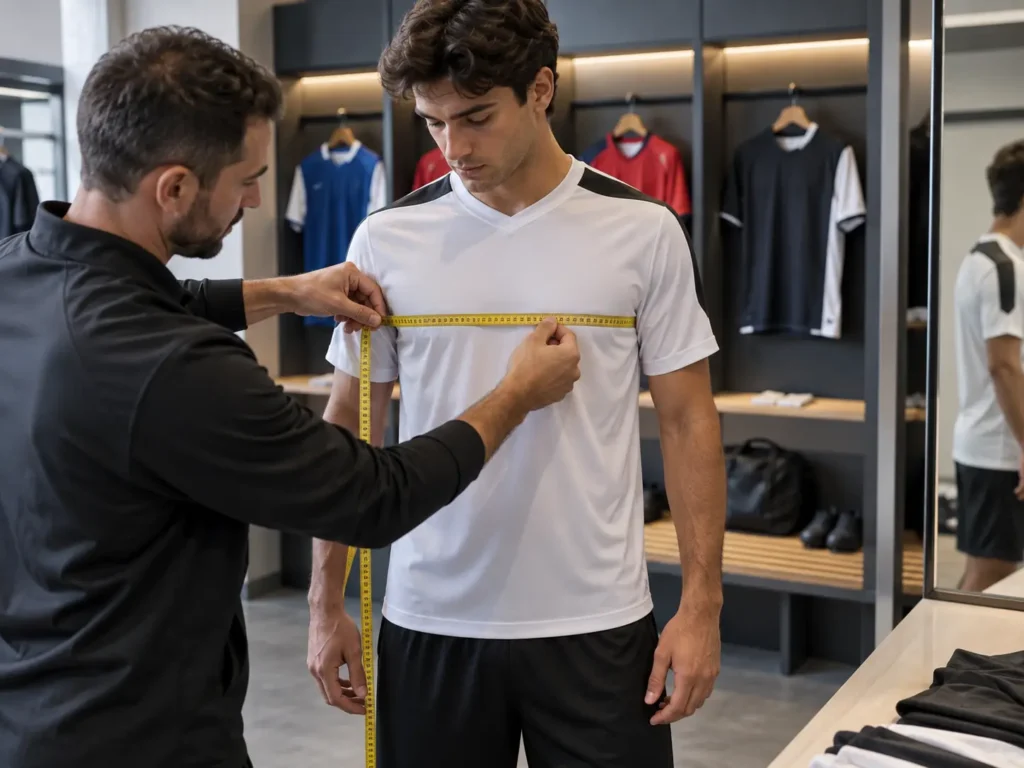
How Should a Football Jersey Actually Fit?
| Fit Area | What to Look For | Warning Sign |
|---|---|---|
| Plecy | Natural alignment unless deliberately dropped | Seams pulled inward or excessively low |
| Klatka piersiowa | Comfortable without constant tension | Horizontal pulling or graphic distortion |
| Sleeves | Free arm movement | Restriction at upper arm or armhole |
| Torso | Fit appropriate to style | Excess bunching or severe compression |
| Długość | Enough coverage during movement | Hem constantly riding up |
Use a Movement Test, Not Just a Mirror
After putting the jersey on:
- Raise both arms overhead.
- Rotate your shoulders.
- Lean forward.
- Sit down.
- Simulate running arm movement.
A jersey that looks good while standing completely still can feel restrictive in play.
Men’s Football Jersey Sizing
For most men’s tops, chest circumference is the strongest first reference. Waist and body length become more important when the jersey is strongly tapered or when the wearer is unusually tall or short.
Na przykład, adidas currently lists men’s shirt chest ranges of 93–100 cm for M and 101–108 cm for L. That does not mean every adidas football jersey has identical finished dimensions; these are body-size chart ranges.
Tall Players and Fans Should Check Length Before Sizing Wider
A tall wearer can have a medium chest but require more body length. Moving from M to XL just to gain length also adds substantial width.
Some brands address this with tall or long options. adidas, Na przykład, identifies Tall/Long men’s sizes for wearers over approximately 189 cm. Nike’s current men’s tall-top guidance also provides additional body length on selected products.
If width fits but length does not → look for Tall/Long sizing before automatically moving several sizes larger.
Women’s Football Jersey Sizing
Women’s-specific jersey patterns may differ from men’s or unisex garments through:
- bust shaping;
- waist shaping;
- szerokość ramienia;
- hip allowance;
- długość ciała.
A women’s M should not automatically be converted from a men’s M by name alone. Use the women’s measurement chart when a women’s-specific pattern is offered.
For unisex jerseys, compare chest and garment dimensions with a top that already fits the wearer well.
Kids Football Jersey Sizing
Age can be a useful category label, but height and chest are more dependable measurements for children.
Two 12-year-olds may differ dramatically in height and body development. A football team using age alone can therefore create several incorrect sizes inside the same squad.
For children:
- Measure current height.
- Measure chest.
- Compare both with the product chart.
- Use age only as a secondary reference.
- Allow reasonable growing room without creating a garment that interferes with play.
How Much Growing Room Should a Kids Jersey Have?
The jersey should provide enough ease for movement and modest growth, but excessive oversizing can create:
- shoulder seams dropping far down the arms;
- sleeves covering too much of the arm;
- a hem that interferes with shorts or movement;
- large graphics sitting incorrectly on the body.
For club and academy orders, sizing should also consider how long the uniform is expected to remain in use.
How to Choose Size for Wearing a Football Jersey Over a Hoodie
Do not simply add two sizes.
A better method is to measure yourself while wearing the intended layer or compare the jersey’s finished measurements with a shirt or jacket combination you already like.
Pay particular attention to:
- chest ease;
- armhole room;
- otwarcie rękawa;
- szerokość ramienia;
- długość ciała.
Playing Fit vs Casual Fit
| Use | Preferred Fit Direction | Main Priority |
|---|---|---|
| Competitive play | Atletyczny / controlled ease | Freedom of movement without excess fabric |
| Szkolenie | Athletic or regular | Comfort and ventilation |
| Stadium fanwear | Regular / zrelaksowany | Comfort and layering |
| Odzież uliczna | Regular to oversized | Style and proportion |
| Collector jersey | Osobiste preferencje | Wearability vs display |
Fabric Construction Can Change How the Same Size Feels
Modern football jerseys commonly use polyester-based knitted fabrics, but “100% polyester” does not describe the full fit behavior.
Fit can change with:
- knit construction;
- waga tkaniny;
- mechanical stretch;
- elastane content;
- panele siatkowe;
- panel orientation;
- finishing process.
Mechanical Stretch vs Elastane Stretch
A knitted polyester structure can stretch because of how loops are constructed even when the fiber composition contains no elastane.
A polyester/spandex fabric gains additional elastic behavior from the spandex component.
Two jerseys labeled 100% polyester can still feel different because knit construction, GSM and pattern shape are different.
Fabric Weight and Fit
Fabric weight is commonly expressed in GSM, or grams per square meter.
GSM does not directly define quality or sizing. It influences structure, drape and perceived weight.
Current published football-uniform fabric options on the site include:
| Published Fabric Direction | Approx. Waga | Published Use / Character |
|---|---|---|
| 100% Podwójna warstwa poliestru | 140 GSM | General football uniform direction |
| 100% Polyester Single-Layer Mesh | 150 GSM | Breathable general-use direction |
| 100% Polyester Rib Knit | 230 GSM | Collars and cuffs |
| 95% Poliester / 5% Spandex Mesh | 145 GSM | Stretch-oriented side-panel direction |
| 100% Podwójna warstwa poliestru | 220 GSM | Heavier fall/winter apparel direction |
| 84% Poliester / 16% Spandex | 240 GSM | Stretch-heavy fall/winter apparel direction |
These are current published material options from the supplier’s sportswear range, not universal football jersey specifications.
Mesh Side Panels Can Change Perceived Fit
A jersey with stretchier side panels may feel more forgiving through the torso than another jersey with the same nominal chest circumference but rigid side panels.
This is why a B2B buyer should approve the final fit using the production fabric, not only a pattern sample sewn from a substitute material.
Does Sublimation Affect Jersey Fit?
Sublimation transfers color into compatible polyester fabric rather than adding a thick printed film to the surface. Because the decoration adds little physical thickness, it generally preserves the base fabric’s drape.
Dla porównania, large heat-transfer graphics or heavy embroidered patches can locally stiffen a garment. This usually has a small effect on overall size but can change feel and drape.
Why a Jersey May Feel Different After Customization
Possible reasons include:
- the original pattern was already very slim;
- a large rigid transfer changes drape;
- heat during decoration affects the fabric or finish;
- the wearer selected the wrong underlying size;
- different production fabrics were used between sample and bulk.
Heat processing should be controlled according to the fabric, transfer and decoration system rather than assuming one temperature is suitable for every jersey.
Does a Football Jersey Shrink After Washing?
Polyester generally has better dimensional stability than many natural fibers under normal care, but no manufacturer should assume zero dimensional change without testing.
Potential influences include:
- excessive heat;
- dryer settings;
- fabric construction;
- fiber blend;
- finishing;
- printing or decoration process.
AATCC TM135 and TM150 provide standardized approaches for evaluating dimensional change in fabrics and garments after home laundering, while ISO 5077 is another recognized framework for measuring dimensional change.
Care Labels Help Protect Fit Over Time
In the United States, the FTC Care Labeling Rule requires covered manufacturers and importers of textile wearing apparel to provide regular care instructions and have a reasonable basis for those instructions.
This matters to sizing because inappropriate washing or drying can affect:
- garment dimensions;
- print appearance;
- kształt kołnierza;
- seam stability;
- fabric surface.
Textile Labeling Requirements Matter for B2B Orders
For the U.S. rynek, most textile products generally require labeling that identifies fiber content, country of origin and the manufacturer or other responsible business, while applicable apparel also needs care information.
For the European Union, Regulation (UE) NIE 1007/2011 establishes rules for textile fibre names and fibre-composition labeling.
Private-label buyers should confirm destination-market requirements before approving final neck labels, care labels and packaging.
Custom Football Jersey Sizing for Teams
Bulk team orders create much more sizing risk than individual purchases.
A stronger process is:
- Select the target fit: odtwarzacz, regular or relaxed.
- Approve the master size chart.
- Produce representative size-set samples.
- Ask players to measure chest and height.
- Record preferred fit where necessary.
- Finalize names, numbers and sizes only after confirmation.
- Keep the approved specification for reorders.
Why Size-Set Samples Are So Important
A size-set sample means producing several garment sizes before mass production so the buyer can verify grading across the range.
It can reveal problems that one medium sample cannot:
- large sizes becoming too short;
- youth sizes grading too aggressively;
- sleeves becoming disproportionate;
- neck openings changing incorrectly;
- women’s shaping not scaling smoothly;
- print positions moving visually between sizes.
How a Manufacturer Builds a Football Jersey Size Chart
Target Body → Desired Ease → Base Pattern → Grading Rules → Size Samples → Fit Approval → Bulk Specification
A consumer usually sees only S, M, L and XL. The factory works with many actual measurements.
A specification can include:
- pół klatki piersiowej;
- długość ciała;
- szerokość ramienia;
- długość rękawa;
- otwarcie rękawa;
- bottom opening;
- neck width;
- front neck drop;
- back neck drop.
What Is Size Grading?
Grading is the controlled process of increasing or decreasing a base pattern to create neighboring sizes.
For an educational example only:
| Illustrative Size | Garment Chest Circumference |
|---|---|
| M | 104 cm |
| L | 108 cm |
This example shows a 4 cm circumference change, but real grade rules vary by pattern and measurement point. Body length, sleeve width and shoulder width do not necessarily increase by exactly the same amount.
Garment Tolerance Affects Bulk Size Consistency
Sewn garments are not manufactured to zero mathematical variation. The tech pack should define measurement tolerances for critical points.
Buyers should ask:
- Which points of measurement are controlled?
- How is each measurement taken?
- Is the garment measured relaxed or stretched?
- What tolerance applies to each point?
- How many pieces are inspected?
There is no single universal tolerance that should be copied into every Football Jersey specification.
How to Measure a Football Jersey You Already Own
If you already have a jersey that fits perfectly, it can be an excellent online-shopping reference.
Lay it flat and measure:
- pit-to-pit width;
- długość ciała;
- shoulder width for set-in sleeves;
- długość rękawa;
- bottom width.
Then compare those dimensions with the seller’s finished garment chart, not with a body-size chart.
International Sizing: Use Centimeters as a Common Reference
S/M/L labels are used internationally, but the actual measurement range can still change by region, pattern or brand.
Centimeters are useful for B2B specification because they:
- reduce regional size-label ambiguity;
- work well in tech packs;
- make factory measurement easier;
- allow direct cross-market comparison.
Consumer-facing charts can show both centimeters and inches while the manufacturer maintains one controlled master measurement system internally.
Illustrative Football Jersey Size Scenarios
| Scenario | Situation | Better Decision Logic |
|---|---|---|
| A | 98 cm chest, regular athletic build | Start with the exact chart around M-range and check intended fit |
| B | 100 cm chest, between ranges, hoodie underneath | Consider the larger option after checking garment width |
| C | Medium chest but very tall torso | Check Tall/Long option before choosing a wider XL |
| D | 12-year-old but 158 cm tall | Use height and chest rather than age label alone |
| mi | Streetwear buyer wants oversized look | Choose an oversized pattern or compare full garment dimensions |
These are decision examples, not universal size recommendations.
10 Common Football Jersey Sizing Mistakes
1. Buying Your Normal T-Shirt Size Without Checking the Chart
Konsekwencja: a player-fit jersey can feel much tighter than expected.
2. Using Age Alone for Kids
Konsekwencja: children of the same age receive significantly different fits.
3. Mixing Body and Garment Measurements
Konsekwencja: the buyer compares a 100 cm body chest with a 100 cm finished jersey circumference and assumes they should fit identically.
4. Ignoring Player vs Fan Fit
Konsekwencja: two jerseys with the same size label feel intentionally different.
5. Sizing Up Excessively for an Oversized Look
Konsekwencja: width, sleeve and body length become disproportionate.
6. Ignoring Body Length
Konsekwencja: tall wearers buy a wider jersey when they really need additional length.
7. Measuring Chest With the Tape Too Tight
Konsekwencja: the recorded body measurement is artificially small.
8. Ordering Bulk Jerseys Without Fit Samples
Konsekwencja: grading issues are discovered after hundreds of garments are customized.
9. Assuming All Polyester Fabrics Fit the Same
Konsekwencja: rozciągać się, drape and comfort differ from the approved sample.
10. Ignoring Care Conditions
Konsekwencja: heat or unsuitable laundering can affect dimensions and decoration over time.
How E-Commerce Stores Can Reduce Football Jersey Size Returns
A strong product page should include:
- body-size chart;
- finished garment measurements where practical;
- measurement diagram;
- fit label such as player, regular or oversized;
- model height and size worn;
- cm and inch measurements;
- authentic/player vs fan explanation;
- layering advice;
- clear between-size guidance.
A model wearing size M provides useful visual context, but model height alone is not a reliable sizing system. Two people of the same height can have very different chest, waist and shoulder dimensions.
What Should B2B Buyers Ask a Football Jersey Manufacturer?
A club, dystrybutor, academy or private-label buyer comparing a **Football Jersey Manufacturer**, **Custom Football Jersey Manufacturer** or **Wholesale Football Jersey Supplier** should ask:
- Is the chart based on body or garment measurements?
- What is the half-chest measurement for each size?
- What are the grade rules?
- Are men’s, damskie, unisex and youth blocks separate?
- What fabric is used for fit samples?
- How much mechanical or elastane stretch does the fabric have?
- What GSM is used?
- What measurement tolerances apply?
- Can size-set samples be approved before bulk production?
- Has dimensional change after laundering been evaluated?
- How are neck, sleeve and body-length measurements controlled?
- Can the size specification be retained for repeat orders?
What Tests Can Support Better Size Consistency?
Useful textile and garment tests can include:
- dimensional change after laundering;
- rozciągliwość tkaniny;
- rekonwalescencja rozciągająca;
- seam performance;
- trwałość koloru;
- appearance after laundering.
ISO 8559-1 provides standardized anthropometric definitions for body measurement, while AATCC TM135 and TM150 provide methods for evaluating dimensional change after laundering at fabric and garment level.
Football Jersey Fit Trends Buyers Should Watch
Closer Player Fits
Performance jerseys continue to use body-conscious silhouettes designed around active movement and lightweight fabrics.
Relaxed Retro Jerseys
Retro football styling has renewed interest in roomier fan silhouettes, heritage collars and traditional proportions.
Oversized Lifestyle Football Shirts
Streetwear-focused markets increasingly treat football shirts as fashion garments, making shoulder and body proportion as important as traditional athletic fit.
Women’s-Specific Patterns
Clubs and private-label brands increasingly need dedicated women’s patterns rather than simply scaling a men’s block downward.
Extended Size Ranges
More inclusive sizing creates additional grading and fit-testing requirements because a pattern must remain proportional across a wider size range.
Jeśli X → Wybierz Y: Football Jersey Size Decision Guide
| If You… | Start With… | Decision Direction |
|---|---|---|
| Want a close athletic fit | Chest measurement | Stay close to measured chart size |
| Are between sizes and prefer comfort | Klatka piersiowa + garment width | Consider the larger size |
| Wear a hoodie underneath | Measurements over intended layer | Allow additional ease |
| Buy player/authentic fit | Klatka piersiowa + talia + product chart | Check taper carefully |
| Buy fan/replica fit | Klatka piersiowa + normal wear preference | Regular chart is usually the starting point |
| Are tall but not broad | Klatka piersiowa + wysokość | Check Long/Tall options |
| Buy for children | Wysokość + klatka piersiowa | Do not use age alone |
| Order for a team | Tabela rozmiarów + size-set samples | Approve grading before customization |
Football Jersey Fit Insight: The Correct Size Is a Measurement Decision, Not a Letter
The best Football Jersey size is determined by the relationship between the wearer’s body, the pattern, the fabric and the intended use. The same “M” label can legitimately describe different physical garments because brands and manufacturers use different pattern blocks, wearing ease and target customers.
What Measurement Matters Most?
Chest circumference is usually the best first measurement for an upper-body Football Jersey. Height becomes important when body length is unusual, waist matters for strongly tapered player fits, and garment measurements are especially useful when shopping online because they can be compared with a jersey that already fits well.
Why Is Body Measurement Different From Finished Garment Measurement?
A body chart describes the person. A garment specification describes the jersey. The difference between them includes wearing ease and fabric behavior. A 100 cm body chest does not automatically require a jersey with a 100 cm finished chest circumference.
Material Fit by Product Direction
The matrix below is an application-fit indicator only. It is not statistical data, a probability model, a performance guarantee or a universal sizing standard. The dots show general suitability based on currently published fabric directions. Actual fit depends on the final pattern, garment construction, rozciągać się, size grading and wearer preference.
Legend
●●● = Primary
●●○ = Strong Option
●○○ = Depends on Workflow
— = Usually Not First Choice
| Current Material / Product Direction | Odtwarzacz / Match Jersey | Regular Fan Jersey | Stretch Panel | Cool-Weather Apparel | Product Page Entry | Fit Consideration |
|---|---|---|---|---|---|---|
| 100% Podwójna warstwa poliestru, 140 GSM | ●●● | ●●● | ●○○ | ●○○ | Stroje piłkarskie | Light general jersey direction; final fit depends on knit structure and pattern ease. |
| 100% Polyester Single-Layer Mesh, 150 GSM | ●●● | ●●● | ●●○ | — | Stroje piłkarskie | Breathable mesh direction suitable for active football uniform applications. |
| 95% Poliester / 5% Spandex Mesh, 145 GSM | ●●● | ●●○ | ●●● | — | Soccer Uniform Side Panels | Stretch-oriented side-panel direction that can change perceived torso fit. |
| 100% Polyester Rib Knit, 230 GSM | ●●○ | ●●○ | ●○○ | ●○○ | Collars & Cuffs | Structural trim direction; neckline and cuff dimensions still require separate grading control. |
| 100% Podwójna warstwa poliestru, 220 GSM | — | ●○○ | ●○○ | ●●● | Fall / Winter Sportswear | Heavier product direction where layering and garment ease need more attention. |
| 84% Poliester / 16% Spandex, 240 GSM | — | ●○○ | ●●● | ●●● | Stretch Fall / Winter Sportswear | Higher-stretch heavier direction; not a direct substitute for lightweight match-jersey fit. |
Opcja: If You Want a Player Fit
Use the exact body chart, check chest and waist, and review finished garment measurements if available. A player jersey should feel controlled and athletic without relying on excessive fabric tension to create the fit.
Opcja: If You Want a Regular Fan Fit
Chest remains the starting point, but allow enough ease for normal movement and light layering. Do not automatically size up if the product is already designed as a relaxed fan jersey.
Opcja: If You Want an Oversized Streetwear Fit
Review garment width, plecy, sleeve length and total body length together. A purpose-built oversized pattern will usually create better proportions than choosing several sizes above your body measurement.
Namysł: Why Should Team Buyers Approve a Size Set?
One approved medium proves only that one size works. It does not confirm that XS, XL, youth and extended sizes have been graded proportionally. Size-set samples allow the buyer to check how chest, długość, sleeve and neck measurements change across the complete range before names and numbers are applied.
Namysł: Does Fabric Stretch Allow Buyers to Ignore Measurements?
NIE. Stretch can make a garment more forgiving, but it should not be used to compensate for an incorrect pattern. Excess tension can change comfort, wygląd, graphics and seam loading. Fabric behavior and garment dimensions should be evaluated together.
How Should International Buyers Manage Size Charts?
Use one controlled measurement standard internally, preferably with centimeters in the technical specification, while showing both centimeters and inches to end users when appropriate. Clearly identify whether each number represents a body measurement or finished garment measurement.
The Complete Football Jersey Size Decision
A reliable sequence is:
Chest → Height → Exact Product Size Chart → Body vs Garment Measurement → Fit Type → Fabric Stretch → Intended Use → Layering → Final Size.
For bulk production, add:
Master Pattern → Size Grading → Size-Set Samples → Fit Approval → Measurement Tolerances → Customization → Bulk Production.
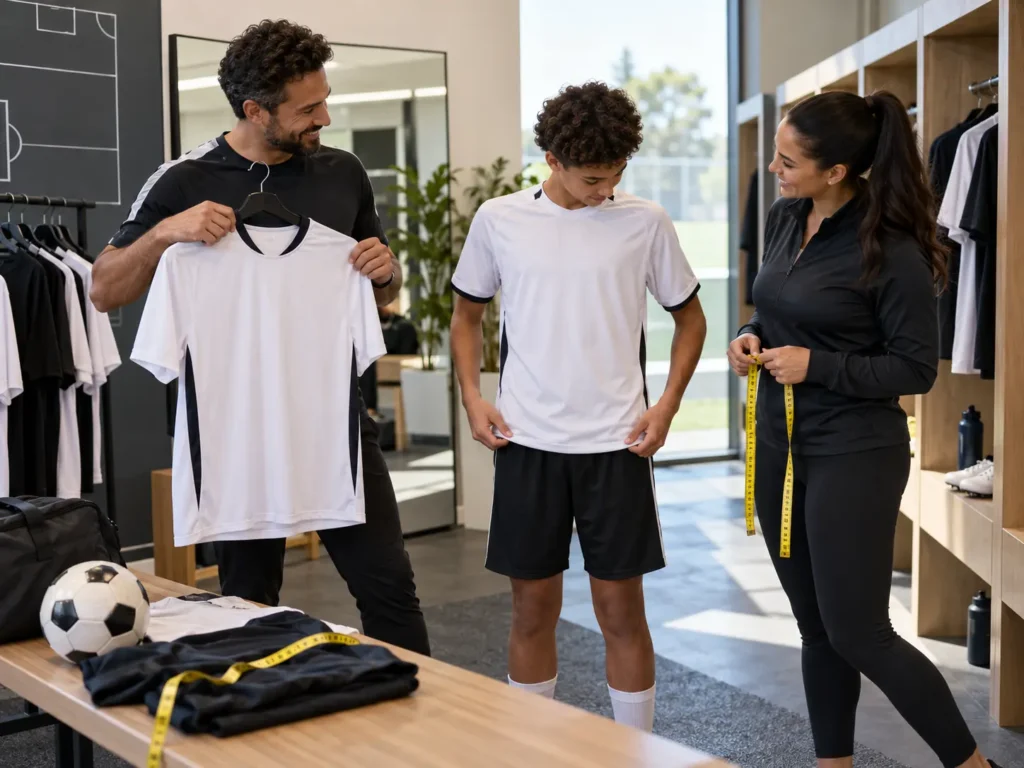
Ostateczne zalecenie: Measure First, Then Choose the Fit
Do not begin with “I always wear Large.”
Begin with your actual chest measurement.
Then check the exact Football Jersey chart, identify whether it is player, fan or oversized fit, review length if you are tall or short, and consider the layer you plan to wear underneath.
For children, use height and chest rather than age alone.
For women’s-specific jerseys, use the women’s chart instead of automatically translating a men’s size.
Na rozkazy zespołowe, approve size-set samples before customization.
The right Football Jersey size is not the label you usually buy. It is the size whose measurements, pattern and fabric behavior match your body and the way you plan to wear the jersey.
Preparing a Custom Football Jersey Order?
Prepare the target market, wearer type, men’s/women’s/youth size range, desired player or fan fit, wybór tkaniny, chest measurements, garment measurement chart and customization requirements before bulk production. A strong supplier should help confirm the fit system before names, numbers and team graphics are permanently applied.
Frequently Asked Questions About Football Jersey Sizing
1. Should I size up when buying a Football Jersey?
You should not automatically size up when buying a Football Jersey. Start by measuring your chest and comparing it with the exact product size chart. Consider the larger size if you fall between two sizes, prefer a relaxed fit, plan to wear a hoodie or thick base layer underneath, or are buying a close player-style jersey and want additional room. If the jersey is already designed as a regular or relaxed fan fit, your measured chart size may provide enough ease. When finished garment measurements are available, comparing pit-to-pit width and body length with a jersey you already own is often more reliable than choosing a larger size from habit.
2. Do authentic football jerseys fit tighter than replica jerseys?
Authentic or player-style football jerseys often use a closer athletic silhouette than replica or fan versions, but the exact difference depends on the brand and model. Player jerseys may have more torso taper, closer sleeves, lightweight technical fabrics and less excess material because they are designed around an on-field appearance. Fan jerseys are commonly shaped for more relaxed everyday wear and easier layering. This does not mean everyone should automatically size up in an authentic jersey or that every replica jersey is loose. Compare the actual body-size chart, finished garment measurements and fit description for the specific Football Jersey before choosing.
3. How do I measure my chest for a Football Jersey?
Stand naturally and wrap a flexible measuring tape around the fullest part of your chest. Keep the tape horizontal across your back and comfortably close to your body without compressing your chest. Breathe normally and record the measurement. Measure over light clothing or over the type of base layer you expect to wear under the Football Jersey. Then compare the result with the exact brand or manufacturer body-size chart. Do not confuse chest circumference with pit-to-pit garment width. Pit-to-pit is measured across a jersey laid flat and is approximately half of the garment’s chest circumference, while your chest measurement describes your body.
4. What Football Jersey size should I buy if I am between sizes?
If you fall between two Football Jersey sizes, choose according to the fit you want and the construction of the jersey. The smaller option generally creates a closer fit, while the larger option provides more ease for casual wear or layering. Check whether the garment is described as player, szczupły, regularny, fan or oversized fit before making the decision. Also compare body length, particularly if you are tall or short. When a finished garment chart is available, compare its pit-to-pit width and length with a jersey you already wear comfortably. The letter size alone is less useful than the physical measurements and intended fit.
5. How should I choose a Football Jersey size for a child?
Choose a child’s Football Jersey size primarily from current height and chest measurements rather than age alone. Children of the same age can differ significantly in height, chest and body proportions, so an age label such as 11–12 years should be treated as a reference rather than the only sizing rule. Compare the child’s height and chest with the product’s youth chart and allow reasonable room for movement and growth. Avoid excessive oversizing because very low shoulders, long sleeves and an overly long hem can interfere with play. For club or academy orders covering an entire season, size-set samples can help families confirm fit before the jerseys are customized.
Referencje
- Men’s Shirts & Tops Size Guide — adidas Product Fit Team — adidas — Official Apparel Size Guide.
- Men’s Tops & Tees Size Chart — Nike Product Fit Team — Nike — Official Size & Fit Guide.
- ISO 8559-1:2017 — Size Designation of Clothes: Anthropometric Definitions for Body Measurement — ISO Technical Committee 133 — International Organization for Standardization — International Standard.
- AATCC TM135-2025 — Dimensional Changes of Fabrics after Home Laundering — AATCC Technical Committee — American Association of Textile Chemists and Colorists — Test Method.
- AATCC TM150-2025 — Dimensional Changes of Garments after Home Laundering — AATCC Technical Committee — American Association of Textile Chemists and Colorists — Test Method.
- ISO 5077:2007 — Textiles: Determination of Dimensional Change in Washing and Drying — ISO Technical Committee 38 — International Organization for Standardization — International Standard.
- Care Labeling of Textile Wearing Apparel and Certain Piece Goods — 16 Część CFR 423 — Federal Trade Commission — United States Federal Trade Commission — Apparel Care Labeling Regulation.
- Regulation (UE) NIE 1007/2011 on Textile Fibre Names and Related Labelling and Marking of Fibre Composition — European Parliament and Council of the European Union — European Union — Official Journal of the European Union.