Buying a football jersey sounds easy until two shirts labeled “Medium” fit like completely different garments. One may have a close athletic body, narrow sleeves, and very little extra room. Another may be cut wider through the chest and waist so a supporter can wear it comfortably over a T-shirt. Add different regional sizing systems, youth sizes, women’s patterns, stretch fabrics, sublimated teamwear, and custom production, and the letter printed on the size label becomes only the beginning of the decision.
For an individual buyer, a sizing mistake may mean an inconvenient return. For a club, academy, school, detailhandelaar, or football apparel buyer ordering 100 of 1,000 stukken, the same mistake becomes a project problem: players receive the wrong fit, names and numbers are already printed, replacement quantities delay the season, and inventory is left in sizes nobody needs.
That is why fit should be confirmed before customization. Buyers comparing aangepaste voetbaluniformen should treat sizing as part of product development rather than the final line on an order sheet. Stof, pattern block, chest allowance, lichaamslengte, sleeve construction, rekken, and player demographics should be discussed before mass production.
Quick Answer: What Football Jersey Size Should You Buy?
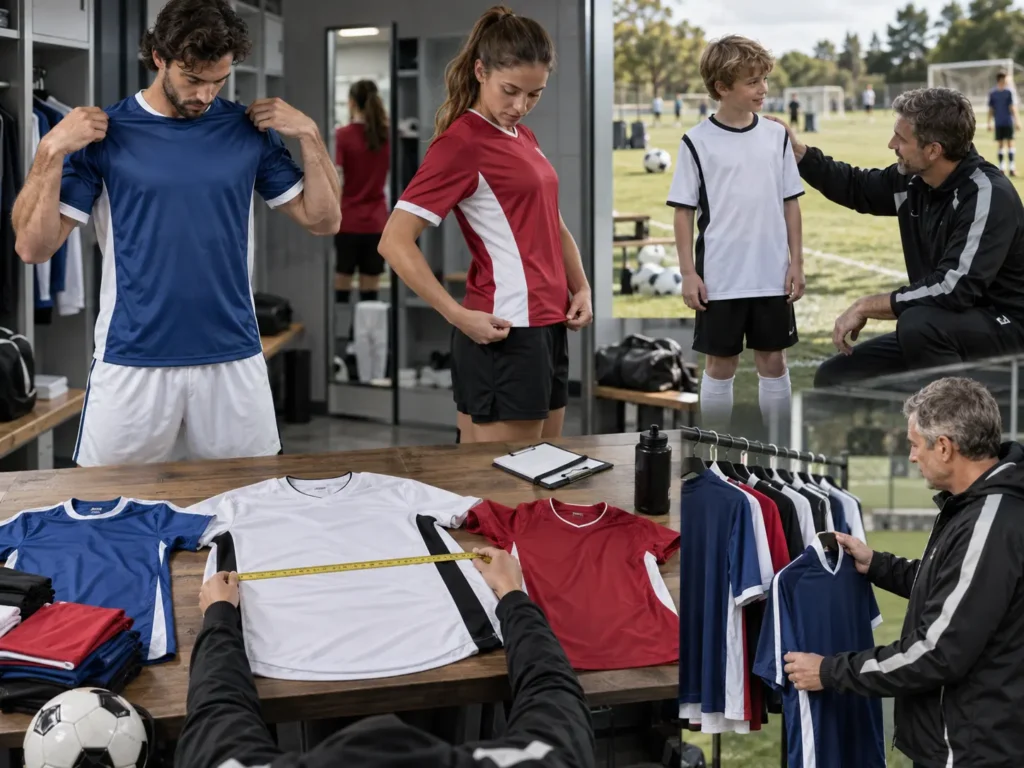
Start with your actual chest measurement, then compare it with the brand or manufacturer’s current body-size chart. If a garment measurement chart is available, compare the jersey’s pit-to-pit width and body length with a shirt you already like wearing. Eindelijk, adjust for the intended fit.
A fan or replica jersey usually allows more room for everyday wear. A player-style or authentic jersey may sit closer to the torso and can feel noticeably smaller even when the printed size is identical. Children should be sized primarily from current body measurements, not age alone. Adults who fall between sizes, prefer a relaxed look, or intend to wear a base layer underneath will usually find the larger option safer.
A more detailed football jersey size guide for men, women and kids is useful when the same order includes several body types or different jersey constructions. The key lesson is simple: compare measurements and fit category together. “Medium” is a label; the physical dimensions determine how the jersey actually feels.
Why Football Jersey Sizes Differ Between Brands
There is no single global rule requiring every football jersey manufacturer to use the same chest width for Small, Medium, Groot, or XL. Apparel sizing systems are built around target populations, pattern blocks, merkpositionering, gender or unisex assumptions, intended ease, and garment construction.
Even when two manufacturers use similar body-size ranges, the finished garments can differ because one applies more wearing ease than the other. A jersey designed for professional-style competition may use a more tapered waist and higher armhole, while supporter merchandise may use a straighter body shape. Stretch mesh panels can also make a relatively close pattern feel less restrictive than a rigid fabric with the same flat measurement.
This is why buyers should compare actual dimensions such as chest width, garment length, shoulder construction, and sleeve opening. A practical soccer jersey size chart measurement guide becomes more useful than relying on letter sizes alone because it turns “I normally wear Large” into dimensions that can be checked before ordering.
How Fit Errors Become a Cost Problem in Team Orders
Sizing is not just a comfort question when jerseys are being customized. Once a player name, nummer, sponsor, kam, or sublimated graphic has been applied, exchanging one garment is harder than returning a plain retail shirt. At team level, even a small error rate creates administrative work, replacement shipping, production interruption, and the risk that the replacement does not arrive before the next match.
A club ordering 200 jerseys with a 5% size-selection error would need to solve 10 individual fit problems. That percentage is only an illustration, not an industry defect rate, but it demonstrates why confirming measurements beforehand has economic value.
This connects sizing directly to ROI van voetbalshirts. The cheapest unit price does not create the lowest total project cost if inaccurate sizing produces remakes, express freight, unusable customized stock, or dissatisfied players. The correct purchasing question is therefore not only “How much is one jersey?” but “How reliably can this size system fit our actual roster?”
Do Football Jerseys Fit Differently Across Countries?
Buyers sourcing internationally often discover that a familiar size label does not always produce a familiar fit. Differences can come from regional body datasets, local sportswear preferences, modetrends, fan-merchandise conventions, and the pattern block used by each manufacturer.
A market that prefers close athletic silhouettes may accept less chest ease than a market where supporter jerseys are commonly worn over casual clothing. Youth sizing can also vary because “age 12” does not represent one universal height, borst, or build. Even within one country, two brands may target different body shapes.
For international sourcing, use measurement tables rather than attempting to convert every product mechanically from “Asian size” to “EU size” or “US size.” The broader discussion of football jerseys across countries is useful because regional style affects more than graphics; silhouette, fit expectations, bouw, and merchandising can change as well.
Manufacturer Experience Matters When Building a Size Range
For a retail customer buying one jersey, choosing between two sizes is personal. For a brand or football club creating its own range, the supplier must develop a size system capable of serving a population rather than one person.
That means deciding the base sample size, grading rules, chest increments, length increments, shoulder changes, sleeve changes, youth proportions, and whether women’s or goalkeeper patterns require separate blocks. The manufacturer should also distinguish body measurements from finished garment measurements. Confusing the two is one of the fastest ways to create an unusable size chart.
Buyers evaluating the sportswear manufacturing experience behind a project should ask how jersey patterns are developed and graded, whether pre-production samples are available, and how different fabrics affect the approved fit. A correct Medium sample is not enough if the grading to 2XL or youth sizes has never been tested.
Confirm the Size System Before Mass Customization
The safest time to solve a fit issue is before artwork and production are locked. Clubs and brands should approve at least one physical sample in the chosen fabric and, for a new size system, preferably review more than one size around the core of the range.
If the roster includes unusually tall, broad, dun, or youth players, those body types should be represented during fitting rather than assuming the same grading works perfectly for everyone. Record any intentional fit choice—such as “relaxed fan fit” or “close player fit”—so future repeat orders use the same reference.
When measurements, intended use, roster size mix, or fit expectations are unclear, buyers can contact a football jersey supplier with chest data, current garment measurements, target quantities, kunstwerk, and usage information before requesting final production. Giving the manufacturer real dimensions produces a much better discussion than simply sending a list such as “20 M, 30 L, 10 XL.”
Player Fit vs Fan Fit: What Is the Practical Difference?
“Player fit,” “authentic fit,” “slim fit,” “fan fit,” and “replica fit” are common commercial descriptions, but the exact definitions vary by brand. They should therefore be treated as fit directions rather than universal engineering standards.
Player or Authentic Fit
A player-oriented jersey generally aims for a cleaner athletic silhouette. Depending on the product, that can mean less excess fabric through the chest and waist, shaped side seams, narrower sleeves, stretchzones, and a hem designed to move with the player.
The advantage is reduced loose material and a closer on-field appearance. The disadvantage for a casual wearer is less tolerance for body-shape variation and layering.
Fan or Replica Fit
Fan-fit jerseys are generally designed to accommodate a wider range of everyday wearers. They may have a straighter torso, more room through the chest and waist, and a less aggressive taper.
This can be more comfortable for match-day supporters, gifts, retail programs, and customers who wear shirts underneath.
| Fit Factor | Player / Authentic Direction | Fan / Replica Direction |
|---|---|---|
| Torso silhouette | Closer and more athletic | More relaxed |
| Waist shape | Often more tapered | Usually straighter |
| Layering room | Beperkt | Usually better |
| On-field movement | Primary consideration | Comfort and versatility prioritized |
| Best buyer | Players or customers wanting a close fit | Fans, casual wearers, gifts, general retail |
| Between sizes | Often safer to evaluate the larger size | Depends more on preferred looseness |
How Should a Football Jersey Actually Fit?
A correctly fitted jersey should allow normal shoulder and arm movement without creating excessive fabric that bunches under the arms, pulls across the chest, or swings heavily around the waist.
Fit is also visual. A player jersey can sit relatively close to the body without stretching graphics or distorting side seams. A relaxed jersey should still follow the shoulder line reasonably well rather than hanging so far beyond the shoulder that the sleeves look structurally oversized.
Borst
The garment should not pull horizontally across the chest during normal breathing or when both arms are raised. Stretch fabric can tolerate a closer fit, but permanent tension should not be used to compensate for selecting the wrong size.
Shoulders
Set-in shoulder seams should generally sit near the natural shoulder point unless the garment intentionally uses raglan sleeves or a dropped-shoulder design.
Body Length
The jersey should remain adequately covered during running, springen, reaching, and shooting. Extremely long jerseys can bunch around shorts; overly short jerseys can ride upward during movement.
Sleeves
Sleeves should allow full arm movement without cutting into the upper arm. Player cuts may sit more closely than fan versions, but the opening should not restrict circulation or movement.
How to Measure Your Body for a Football Jersey
Body measurement should be done over light clothing or directly over a base layer similar to what you plan to wear under the jersey. Keep the tape level and comfortably close without pulling it tightly into the body.
International apparel measurement practice distinguishes clearly defined anthropometric measurements from garment dimensions. This is important because a 100 cm body chest and a jersey measuring 100 cm around the chest would usually not create the same fit as a chart saying “fits chest 100 cm.” Finished garments generally contain an allowance determined by stretch and intended ease.
Measure Chest Circumference
Wrap a flexible tape around the fullest part of the chest, keeping it horizontal around the back. Breathe normally. Do not intentionally expand the chest or tighten the tape.
Measure Body Height
Height is especially useful for youth sizing and for adults whose torso length differs significantly from typical proportions within one chest size.
Measure Waist When the Jersey Is Tapered
A strongly shaped player jersey may fit the chest correctly but feel restrictive around the waist. If a manufacturer supplies waist measurements, use them rather than assuming chest alone guarantees fit.
How to Measure a Football Jersey You Already Own
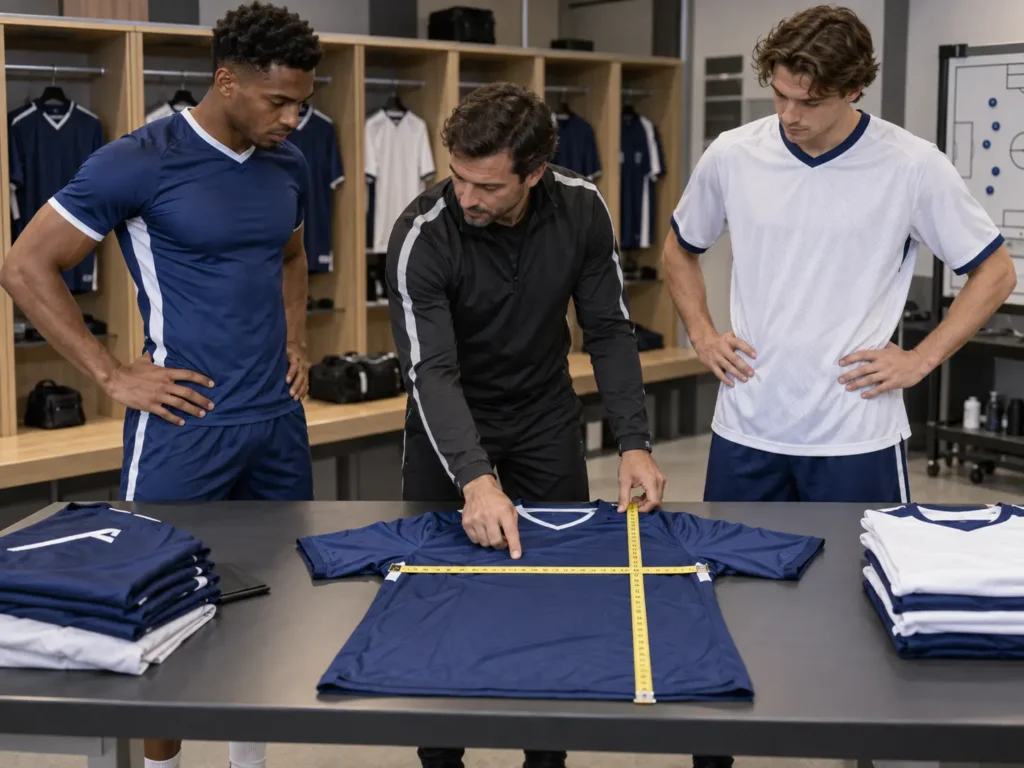
For online ordering, comparing against a jersey that already fits well is often easier than interpreting body measurements alone. Lay the garment flat on a smooth surface without stretching it.
Pit-to-Pit Width
Measure horizontally from the lower edge of one armhole to the other. This is a flat garment width, not a body circumference.
Practical conversion: A jersey measuring 52 cm pit-to-pit has an approximate flat chest circumference of 104 cm when doubled. That does not mean it is designed only for a 104 cm body chest; wearing ease and fabric stretch still need to be considered.
Body Length
Measure from the highest shoulder point near the collar down to the bottom hem. Make sure you know whether the manufacturer measures the front or back when a jersey uses a dropped rear hem.
Schouderbreedte
For traditional set-in sleeves, measure seam to seam across the back. Raglan-sleeve jerseys require a different construction reference because there is no conventional shoulder seam.
Mouwlengte
Measure from the relevant shoulder or raglan reference point to the sleeve edge. This is particularly useful for goalkeeper shirts and long-sleeve teamwear.
Body Size vs Garment Size: Do Not Mix Them Up
This is one of the most common reasons buyers select the wrong size from a chart.
| Chart Type | What the Number Represents | Example Interpretation |
|---|---|---|
| Body measurement chart | Your physical chest, taille, hoogte, enz. | “M fits chest 96–101 cm” means measure your body |
| Garment measurement chart | The actual finished jersey dimensions | “M chest width 52 cm” usually means flat pit-to-pit width |
| Mixed chart | May contain both body and garment values | Read labels carefully before comparing measurements |
If a size chart does not clearly explain which system it uses, ask before ordering. Never assume “chest 52 cm” means the same thing across different websites.
Football Jersey Fabric Weight and Fit
Fabric does not determine size on its own, but it changes how a jersey feels at the same dimensions. Lightweight mesh can drape differently from dense double-knit fabric, while elastane-containing panels can allow greater local stretch.
Typical soccer-uniform production may use lightweight polyester constructions around the 140–150 GSM range for main body areas, stretch mesh panels around a similar weight, and substantially heavier rib or training materials for collars, manchetten, warm-up pieces, or tracksuits.
| Fabric Direction | Example Weight Direction | Likely Fit Consideration |
|---|---|---|
| Light polyester double-knit | Approx. 140 GSM | Light everyday or match jersey body |
| Polyestergaas | Approx. 144–150 GSM | Ventilation and lighter drape |
| Polyester / spandex mesh | Approx. 145 GSM | Useful in stretch or movement zones |
| Polyester rib construction | Approx. 230 GSM | Collars and cuffs where structure is needed |
| Heavier polyester / spandex training fabric | Approx. 240 GSM | Better suited to warm-up or cool-weather garments than a standard match jersey |
These weights are product-development references, not universal rules. Two fabrics with the same GSM can still have different knit structures, rekken, air permeability, handgevoel, and recovery.
Should You Size Up in a Football Jersey?
Sizing up makes sense when the intended use requires additional ease. It should not be an automatic rule for every football shirt.
Consider Sizing Up If…
- You are between two body-size ranges.
- You are choosing a close player or slim fit.
- You prefer a relaxed casual silhouette.
- You plan to wear a T-shirt or thermal base layer underneath.
- Your waist or midsection falls into a larger size than your chest.
- Your existing favorite jersey is wider than the proposed garment measurement.
Stay With the Smaller Option If…
The smaller size can make sense when your measurements clearly sit inside its range, the garment is already a relaxed fan fit, and you prefer a closer silhouette. Do not size down simply because stretch fabric can physically accommodate the body. Constant stretch changes appearance and may distort printed graphics, naden, and logos.
What If You Are Between Two Sizes?
If your chest falls at the upper edge of one size and the lower edge of another, compare more than chest circumference.
Check body length first. A taller wearer may benefit from the larger size even when both widths are acceptable. Then compare waist or hip measurements if the jersey is tapered. Eindelijk, think about usage. Match play usually favors a cleaner fit, while travel, coaching, fan wear, and cold-weather use may benefit from more room.
Between sizes + player fit →The larger size is often the lower-risk starting point because player patterns commonly offer less excess room.
Between sizes + relaxed fan fit →Compare actual garment measurements because the smaller size may already provide sufficient ease.
Football Jersey Sizes for Kids
Children’s sizes should not be chosen from age alone. Two ten-year-old players can have very different height, borstomtrek, schouderbreedte, and growth stage.
Use height and chest measurement together. If a size chart supplies both, prioritize the measurements over the age label. For a child near the upper limit of one size, modest growth room can be sensible, especially when the jersey is intended to last a season.
Echter, deliberately buying several sizes too large creates its own problems. Extra fabric can interfere with movement, sleeves may extend too far, and oversized shoulders can make the uniform look poorly coordinated across a team.
How Much Growth Room Should You Allow?
There is no universal number because growth rate, garment cut, and replacement cycle vary. The safest approach is to select the next size only when current measurements are already near the top of the smaller size range rather than guessing how much a child will grow.
Football Jersey Sizing for Women
A women-specific jersey may use a different pattern block rather than simply making a unisex jersey smaller. Depending on the design, differences can include bust shaping, waist taper, hip allowance, schouderbreedte, sleeve shape, and total length.
Women choosing unisex or men’s jerseys should compare physical measurements instead of converting automatically from a familiar women’s dress size. A unisex Small and a women’s Medium can overlap in some dimensions while differing substantially in waist or body length.
Voor teambestellingen, do not assume that one unisex size range will provide the preferred fit for every squad. If the team wants a women-specific silhouette, request and approve the actual pattern before production.
How to Size a Jersey Over a T-Shirt or Base Layer
Layering changes the effective body dimensions inside the jersey. A thin performance base layer adds little bulk, while a cotton T-shirt, thermal top, or goalkeeper padding can change the required ease more noticeably.
If layering is planned, take body measurements while wearing the intended underlayer or compare the jersey against another garment worn in the same way.
Do not assume that every cold-weather application requires one full size larger. The answer depends on how close the original fit is and how thick the underlayer will be.
Playing Jersey vs Everyday Jersey
The same supporter may prefer two different fits depending on how the jersey will be used.
| Use | Typical Fit Priority | Potential Size Decision |
|---|---|---|
| Competitive match | Movement, low excess fabric, stable fit | Body-fit or player block |
| Opleiding | Movement plus comfort | Regular athletic fit |
| Stadium / fan wear | Comfort and layering | Normale of ontspannen pasvorm |
| Casual streetwear | Personal styling preference | Can intentionally size up for oversized look |
| Goalkeeper use | Movement plus possible protection/base layers | Check sleeve and torso allowance carefully |
Does Custom Name and Number Printing Affect Size Choice?
Printing does not normally change the nominal garment size, but it makes getting the size right more important because customized pieces may be difficult to return or resell.
Large back numbers also make fabric tension more visible. If a jersey is excessively tight, heat-transfer graphics may be repeatedly stretched during wear. Sublimated designs are integrated into the fabric differently, but the garment can still look distorted when worn under excessive tension.
Voor clubjes, size approval should happen before individual player names and numbers are finalized. Ideally, players try on an undecorated size set or approved samples first.
How to Build a Size Breakdown for a Team Order
Do not estimate a roster split from a generic ratio unless no better data exist. Collect measurements or confirmed wearer sizes.
Stap 1: Build a Player List
Record player name, borst, hoogte, preferred fit, and intended size.
Stap 2: Resolve Borderline Sizes
Ask players between two sizes to try physical samples when practical.
Stap 3: Keep Spare Jerseys
Teams expecting roster changes may choose a small number of undecorated or generic-number spares in common sizes.
Stap 4: Freeze the List Before Printing
Late size changes after personalized production begins create unnecessary remakes and schedule risk.
Common Football Jersey Sizing Mistakes
Fout 1: Buying the Same Size You Wear in Every Brand
Size labels are not universally standardized. Check the actual chart.
Fout 2: Confusing Pit-to-Pit With Chest Circumference
Pit-to-pit is a flat width. Body chest is a circumference. They are not the same measurement.
Fout 3: Ignoring Fit Type
A slim player jersey and relaxed fan jersey can feel very different at the same labeled size.
Fout 4: Using Age Alone for Kids
Children of the same age can have very different body dimensions.
Fout 5: Buying Oversized “For Growth”
Excessive growth allowance can make current fit poor for an entire season.
Fout 6: Measuring Over a Heavy Hoodie
Unless that is how the jersey will actually be worn, thick clothing distorts body measurements.
Fout 7: Approving Custom Printing Before Fit
Personalization turns an easy sizing correction into a remake problem.
Fout 8: Assuming Fabric Stretch Fixes the Wrong Size
Stretch improves movement; it should not be used to compensate for permanent over-tension.
Quick Decision Table: If X, Choose Y
| If Your Situation Is… | Consider… | Waarom |
|---|---|---|
| You are between two sizes | Evaluate the larger size first | Reduces risk of chest or waist restriction |
| You want a player-style look | Closer athletic fit | Matches the intended silhouette |
| You want casual supporter wear | Fan / regular fit | Provides more everyday comfort |
| You plan to wear layers underneath | Allow extra ease | Prevents the jersey becoming restrictive |
| You are buying for a child near the top of a size range | Consider the next size | Allows modest growth room |
| You are ordering customized team jerseys | Approve a physical size set first | Reduces remake risk |
| Your favorite jersey already fits perfectly | Compare garment measurements | Provides a practical fit benchmark |
| You are sourcing internationally | Use cm/in measurements, not region labels | Avoids unreliable US/EU/Asia conversions |
What Football Rules Actually Say About Jerseys
Football’s Laws of the Game define required player equipment, but they do not create a global consumer apparel size chart.
Under current IFAB Law 4, a player’s compulsory equipment includes a shirt with sleeves, korte broek, sokken, shin guards, and footwear. The law also contains requirements around colors and permitted equipment. It does not specify that a Medium shirt must equal a particular chest circumference.
That distinction matters for international buyers. Regulatory conformity in match equipment and consumer sizing are separate questions. A legally suitable playing shirt can still be poorly sized for a particular roster if body measurements and garment grading were not handled correctly.
How Apparel Measurement Standards Help Explain Better Sizing
International apparel standards separate anthropometric body measurements from garment size-designation systems. That is exactly the logic buyers should use when evaluating a football jersey.
First establish the person’s measurable dimensions. Then understand which body range the garment is designed to fit. Finally evaluate the finished garment dimensions and intended ease.
This prevents a common mistake: comparing one manufacturer’s finished garment chest directly against another manufacturer’s body chest chart and assuming the numbers should match.
Fit Decision Insight: How to Choose a Football Jersey With Less Guesswork
What Measurement Matters Most?
Chest is usually the most useful starting point for an upper-body sports garment, but it should not be treated as the only measurement. Body length becomes important for taller or shorter wearers, waist matters on tapered player patterns, and height is particularly valuable for youth sizing. When buying online, garment measurements from a jersey that already fits well provide an excellent second reference.
Why Can Two Jerseys With the Same Label Fit Differently?
Because the label describes a size category, not a universal physical dimension. Pattern block, wearing ease, doelmarkt, stof rekt, waist taper, sleeve construction, and intended user can all change the result. A Medium fan jersey and Medium player jersey can therefore be intentionally different products rather than evidence that one is incorrectly sized.
Material Fit by Product Direction
The matrix below is an application-fit guide only. It is not statistical data, probability, a guaranteed performance rating, or a universal sizing formula. Actual suitability depends on knit construction, rekken, pattern engineering, climate, intended use, player preference, afdrukmethode, and the manufacturer’s approved specification.
Legend
●●● = Primary
●●○ = Strong Option
●○○ = Depends on Workflow
— = Usually Not First Choice
| Existing Product Direction | Light Polyester Jersey | Polyester gaas | Polyester / Spandex Mesh | Heavier Knit / Rib | Typical Fit Logic |
|---|---|---|---|---|---|
| Teamvoetbalshirts Product page entry: Voetbaluniformen | ●●● | ●●● | ●●○ | ●○○ | Lightweight polyester and mesh are common starting points for team match jerseys; stretch panels may be used selectively. |
| Aangepaste voetbaluniformen Product page entry: Voetbaluniformen | ●●● | ●●● | ●●● | ●○○ | Fabric selection should follow fit, climate, afdrukken, and movement requirements rather than one universal construction. |
| Aangepaste voetbaluniformen Product page entry: Voetbaluniformen | ●●● | ●●● | ●●○ | ●○○ | A balanced match kit typically prioritizes low weight, vochtregulatie, bewegingsvrijheid, and printing compatibility. |
| Voetbalteamuniformen Product page entry: Voetbaluniformen | ●●● | ●●● | ●●○ | ●○○ | Team sizing requires consistent grading across the full adult or youth range, not only a correct sample size. |
| Training and Warm-Up Apparel | ●○○ | ●○○ | ●●○ | ●●● | Heavier constructions can be appropriate where warmth, structuur, or cool-weather use is more important than match-weight lightness. |
Opties: Which Sizing Method Should You Use?
If you are buying one jersey online →Measure your chest and compare the manufacturer’s current size chart. If possible, also measure the pit-to-pit width and length of a jersey you already like.
If you are ordering for a team →Use a physical size set or sample garments before personalization. A few minutes of fitting can prevent an entire group of customized remakes.
If you are developing a private-label jersey →Approve the base size, intended fit, grading rules, stof, and sample range before production. Treat the size chart as part of product engineering.
If your market spans several countries →Communicate dimensions in centimeters or inches rather than assuming US, EU, Aziatisch, or age labels translate perfectly.
Overweging: What Is the Biggest Sizing Risk?
The biggest risk is not choosing Medium instead of Large. It is making a decision from incomplete information. A customer sees only a size letter, a supplier sees a garment measurement, and a team manager assumes the chart contains body measurements. Everyone thinks they are discussing the same size when they are not.
The safer process is:
Body measurement → intended fit → manufacturer size chart → garment measurement check → sample fitting → customization approval → production.
How Is Football Jersey Sizing Changing?
Modern football apparel is becoming more segmented rather than more standardized. Brands increasingly distinguish performance fits from fan fits, men’s from women’s patterns, adult from youth proportions, and match jerseys from lifestyle products. Stretch panels, engineered mesh, seamless or reduced-seam constructions, and digital pattern development give manufacturers more control over silhouette—but they also make the size label alone less informative.
What Is the Most Reliable Rule?
Use measurements, not assumptions. If body measurements and the size chart disagree with the size you normally buy, trust the current product data. If two dimensions point to different sizes, prioritize the measurement most likely to create restriction and consider the intended fit. For customized bulk orders, use a physical sample whenever possible.
Measure First, Customize Second, Play Comfortably
The perfect Football Jersey fit is not defined by whether you always wear Medium or whether a friend says to size up. It comes from matching real body dimensions to a specific garment, fit category, stof, and use case.
If you want a close player look, start with the manufacturer’s player-fit chart and do not assume it matches a replica shirt. If you prefer casual wear, allow enough ease for comfortable movement. If you are between sizes, compare length and waist as well as chest. If the jersey is for a child, use height and chest instead of age alone. If you are ordering personalized teamwear, solve fit before names and numbers are printed.
Most sizing mistakes become expensive only after someone skips that sequence. A tape measure, an existing jersey, and a five-minute chart comparison are cheaper than remaking an entire customized order.
Planning a Custom Football Jersey Order?
Prepare your target size range, player chest and height data, preferred fit, fabric direction, quantities, kunstwerk, and intended use before finalizing production. A clear sizing brief gives the manufacturer enough information to recommend patterns and samples instead of guessing from S/M/L labels alone.

Frequently Asked Questions About Football Jersey Sizing
1. Should I size up when buying a football jersey?
You should consider sizing up if you are between two sizes, choosing a close player or authentic fit, planning to wear a T-shirt or thermal layer underneath, or if your waist measurement falls into a larger size than your chest. Echter, sizing up is not a universal rule. A relaxed fan-fit jersey may already provide enough ease at your normal size. The safest method is to measure your chest, check the manufacturer’s current size chart, and compare the garment measurements with a football jersey you already like wearing.
2. How do I measure myself for a football jersey?
Start with chest circumference by wrapping a flexible tape around the fullest part of your chest while keeping it level around your back. Measure without pulling the tape tightly. Height is particularly useful for youth sizing, while waist measurement becomes important for strongly tapered player jerseys. If possible, also measure an existing jersey by laying it flat and recording pit-to-pit width and body length. Always confirm whether the supplier’s chart shows body measurements or finished garment measurements before comparing your numbers.
3. What is the difference between player fit and fan fit football jerseys?
A player or authentic-fit football jersey is generally designed around a closer athletic silhouette, often with less excess fabric through the chest and waist. A fan or replica fit usually provides more room for everyday wear and layering. The exact definitions vary between manufacturers, so these terms should not be treated as universal measurements. Someone who wears Medium in a relaxed fan shirt may prefer Large in a close player jersey, but the correct choice should always be based on the actual size chart and garment dimensions.
4. How should I choose a football jersey size for a child?
Use the child’s current height and chest measurement rather than relying only on an age label such as 8–10 or 10–12. Children of the same age can have very different proportions and growth stages. If the child’s measurements are close to the upper limit of one size, the next size can provide reasonable growth room. Avoid buying several sizes too large simply to extend garment life, because excessive width, mouw lengte, and shoulder drop can interfere with movement and make a team uniform look poorly fitted during the current season.
5. Is football jersey sizing the same across all brands and countries?
Nee. Football jersey sizing is not globally standardized to one universal S/M/L measurement system. Manufacturers can use different body-size ranges, pattern blocks, grading rules, fit allowances, stoffen, and regional market assumptions. A Medium from one brand may therefore have different chest width or body length from another. International buyers should compare measurements in centimeters or inches rather than trying to convert size labels mechanically between US, Europese, Aziatisch, or other regional systems. For customized team orders, approving physical samples before production is the safest approach.
Referenties
- ISO 8559-1:2017 — Size Designation of Clothes: Anthropometric Definitions for Body Measurement — ISO/TC 133 — International Organization for Standardization — International Apparel Measurement Standard.
- ISO 8559-2:2025 — Size Designation of Clothes: Primary and Secondary Dimension Indicators — ISO/TC 133 — International Organization for Standardization — Clothing Size Designation Standard.
- ISO 8559-3:2018 — Methodology for the Creation of Body Measurement Tables and Intervals — ISO/TC 133 — International Organization for Standardization — Anthropometric Sizing Standard.
- Wetten van het spel 2026/27 — Law 4: De uitrusting van de spelers — The International Football Association Board — IFAB — Official Football Laws.
- ASTM D3776/D3776M — Standard Test Methods for Mass Per Unit Area (Gewicht) of Fabric — ASTM Committee D13 on Textiles — ASTM International — Textile Test Standard.
- AATCC TM195 — Liquid Moisture Management Properties of Textile Fabrics — AATCC Research Committee — American Association of Textile Chemists and Colorists — Performance Textile Test Method.
- ASTM D4966 — Standard Test Method for Abrasion Resistance of Textile Fabrics — ASTM Committee D13 on Textiles — ASTM International — Textile Durability Test Standard.
- Textile Terms and Definitions — The Textile Institute Editorial Committee — The Textile Institute — Professional Textile Reference.