Velox Overview: Mastering Elite Teamwear Procurement
In the competitive landscape of modern sports apparel, the silhouette of a football player is no longer just a display of team colors; it is a sophisticated interface where historical legacy meets cutting-edge textile science. The evolution of the Ornamentum iaculis has transitioned from heavy, sweat-soaked cotton to ultra-lightweight, digitally engineered skins that act as an extension of the athlete’s body. As we move toward 2026, the industry is witnessing a “Retrofuturist” revolution—where the rugged charm of the 90s is rebuilt using the molecular precision of the 21st century.
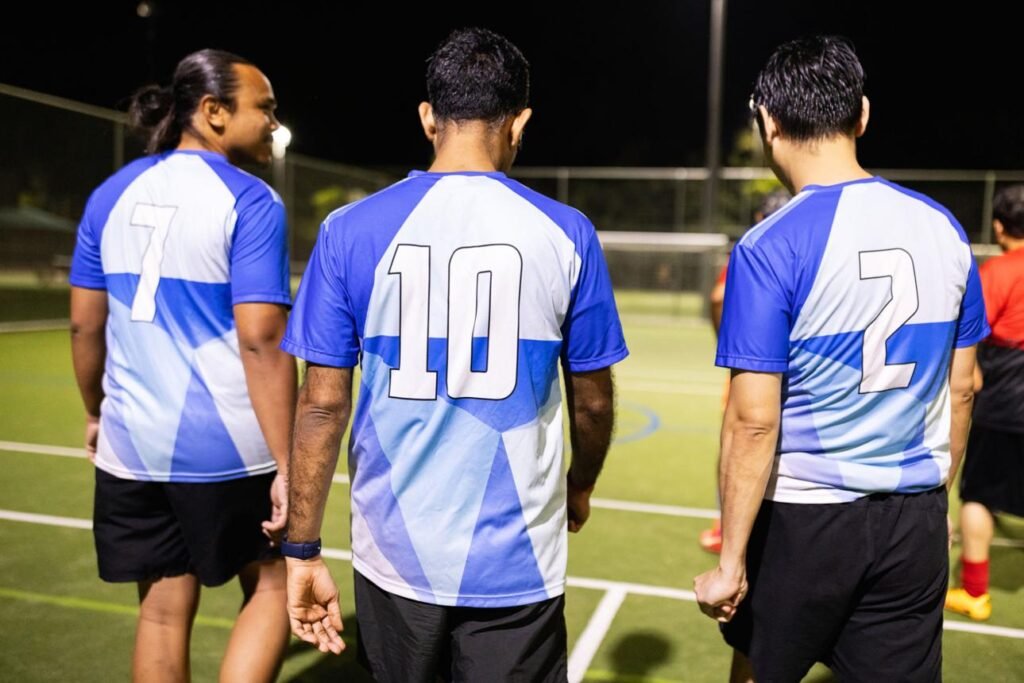
The “Bloke Core” Trend: Reviving Vintage Collar & Texture Designs
The current cultural zeitgeist in football fashion is dominated by “Bloke Core,” a movement that brings 1980s and 90s terrace fashion back to the pitch. This trend has forced Lupum eu Jersey manufacturers to re-examine the physical textures of the past. Vintage kits were characterized by heavy ribs, oversized collars, and intricate Jacquard patterns woven directly into the fabric. hodie, these elements are being revived, but with a high-tech twist.
Modern collars are no longer stiff or restrictive. Using flat-knit technology with a blend of spandex and micro-polyester, manufacturers can create a classic polo-neck aesthetic that retains its shape even during high-intensity duels. Ceterum, the tactile feel of 90s fabric is being mimicked through advanced weaving techniques that allow for subtle depth and shadowing without the historical weight. This duality allows clubs to tap into generational nostalgia while equipping players with professional-grade Morbi vestium scholarium that weigh 40% less than their predecessors.
2026 Forecast: Gradient Patterns and Geometric Sublimation
Looking ahead to the next cycle of global tournaments, the visual language of football is shifting toward geometric complexity. Geometric sublimation is the process of using high-pressure heat to infuse ink directly into the polymer fibers. Secus traditum screen printing, this method ensures that the fabric’s breathability is never compromised. Clubs are increasingly moving away from flat colors in favor of digital gradients that represent motion and energy.
For many decision-makers, the first step in realizing these futuristic visions is to contactus specialized design teams who can translate brand values into complex vector patterns. The 2026 aesthetic will likely feature “kinetic gradients”—patterns that appear to change color or shape as the player moves across the pitch. This is achieved through varying thread densities and specialized yarn cross-sections that reflect light differently depending on the viewing angle.
Customizing Club Identity through Bespoke Sleeve Tapes & Neck Ribs
Mass production is the enemy of identity. To stand out in a crowded market, elite clubs are focusing on bespoke details that cannot be easily replicated. Custom sleeve tapes—often featuring Jacquard webbing with club slogans or coordinates—have become a hallmark of premium kit design. These elements are not just decorative; they provide structural integrity to the garment’s stress points.
To learn more about the engineering behind these specific details, one must look at the integration of different fabric weights. A bespoke kit might use a 140gsm interlock for the main body but switch to a 220gsm heavy rib for the neck and cuffs. This variation creates a garment that looks tailored but performs like a second skin. These small, intricate customizations are what turn a standard jersey into a collector’s item, reinforcing the bond between the badge and the supporter.
Sizing and Fit: Bridging the Generational Gap
The transition from a youth academy to the first team is a pivotal moment in a player’s career, and the kit must reflect this maturity. tamen, sizing remains a persistent challenge for many organizations. The debate of puer eu Jersey nobis adulta secat often boils down to the anatomical difference in muscle distribution. High-performance jerseys for adults typically feature an “athletic fit”—tapered waists and articulated sleeves—to minimize air resistance.
Youth kits, e contrario, require a balance between durability and room for growth. Professional factories are now utilizing 3D body scanning to optimize sizing for every age group, ensuring that a 12-year-old prospect feels as “locked-in” as a veteran striker. This precision in sizing reduces friction and prevents the kit from becoming a hindrance during quick directional changes.
Scientific Comparison: Haereditas vs. Modern Fabric Tech
| Parameter | 1996 Heritage Fabric | 2026 Tech Fabric | Emendatio |
| Grams per Sq. Meter (gsm) | 220 – 250 gsm | 130 – 145 gsm | ~40% Weight Reduction |
| umor Absorption | 35% of dry weight | < 1% of dry weight | Non-absorbent performance |
| Air Permeability | 120 cm³/cm²/s | 450 cm³/cm²/s | 3.75x Breathability |
| Siccatio tempus (from saturated) | 45 – 60 mins | 8 – 12 mins | 5x Faster Drying |
Visual Storytelling: Using Kits to Build Brand Loyalty
A jersey is a club’s most powerful marketing tool. By embedding historical patterns or local architectural motifs into the design, clubs create a narrative that resonates with the local community. haec design trends for custom football jerseys are evolving to include AR-compatible elements and NFC chips that allow fans to “scan” their shirts to unlock exclusive content.
This visual storytelling is the ultimate driver of loyalty. When a fan wears a kit that looks like a masterpiece of streetwear but feels like a professional uniform, the brand equity of the club rises. The “lifestyle crossover” is no longer an afterthought; it is the core of the business model. Footballers are the new influencers, and the pitch is their runway.
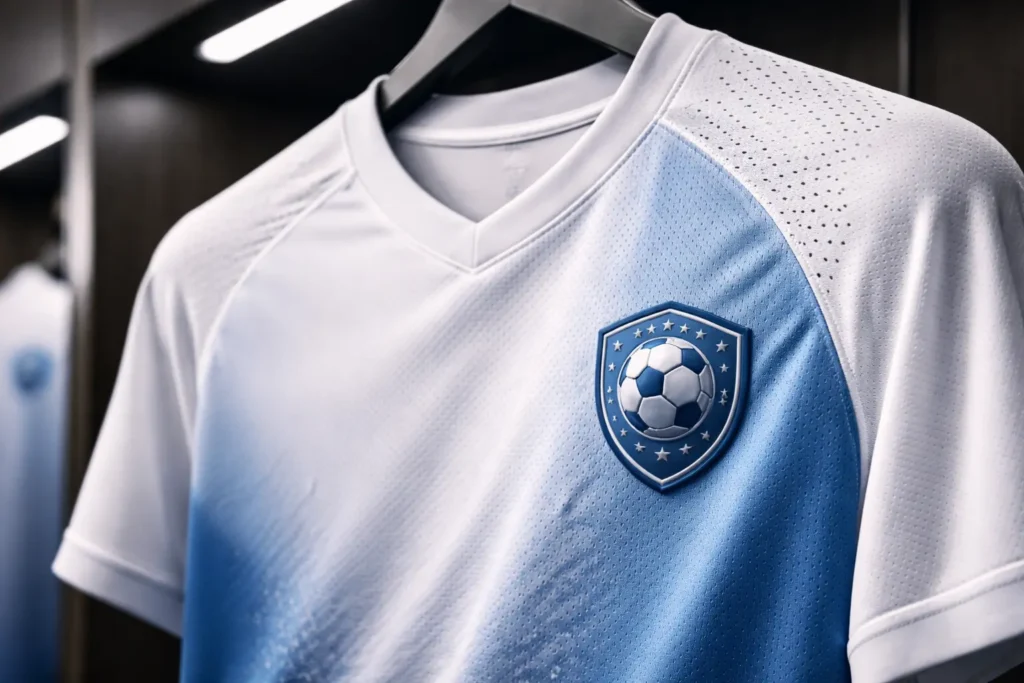
Performance Science: The Mechanics of the Matchday Jersey
Behind the aesthetics lies the brutal reality of physical exertion. During a 90-minute match, a professional player can lose up to 3 liters of sweat. If the jersey absorbs this moisture, the player’s temperature rises, and their cognitive performance drops. The science of moisture-wicking fabrics relies on capillary action—using micro-fibers with “star” or * “cross” cross-sections that pull water away from the skin to the surface of the garment, where it evaporates instantly.
Advanced kits now feature laser-cut ventilation zones in the “heat maps” of the body (typically the underarms and lower back). These are not merely holes; they are precision-engineered apertures that open as the player moves, creating a chimney effect that pulls cool air in and pushes hot air out. This thermal regulation is the difference between a goal in the 90th minute and a missed opportunity due to fatigue.
Industry Standards and Sustainability Regulations
As we look toward the future, the regulatory landscape is tightening around chemical usage and carbon footprints. FIFA and UEFA are increasingly emphasizing sustainability in teamwear procurement.
- Recycled Content: By 2027, most major leagues will mandate at least 80% REDIVIVUS polyester (rPET') in matchday kits.
- Chemical Safety: Fabrics must adhere to OEKO-TEX Standard 100, ensuring no harmful substances like phthalates or Azo dyes are used during sublimation.
- Durability Requirements: Kits must withstand a minimum of 50 industrial wash cycles without losing elasticity or color vibrancy.
Partnering with a factory that meets these global standards is no longer optional; it is a prerequisite for entry into the professional market.
The Aesthetic Paradigm Shift
The future of the kit aesthetics is not about choosing between tech and heritage—it is about the seamless integration of both. By reviving the textures of the past and reinforcing them with the material science of the future, football Kit is entering its most creative era yet. Whether it is through bespoke sleeve tapes or holographic crests, the focus remains on building a visual identity that is as resilient as the athletes who wear it.
FAQ: Strategic Insights for Football Kit Procurement
1. What is the best fabric for professional football kits in 2026?
The industry standard has shifted toward 100% recycled micro-interlock polyester with high spandex content in the ribbing. For elite performance, look for fabrics with a weight between 135-145 gsm and a 3D Jacquard structure to enhance airflow between the skin and the garment.
2. How does sublimation printing affect fabric breathability?
High-quality digital sublimation uses water-based inks that turn into gas and bond with the fiber at a molecular level. Unlike screen printing or vinyl transfers, this process leaves the fabric’s pores open, ensuring that the kit’s moisture-wicking properties are maintained 100% across the entire surface.
3. What are the mandatory FIFA regulations for custom team crests?
FIFA equipment regulations dictate that crests must be positioned on the chest, centered or to the left. They must not exceed an area of 100cm². For 2026, many clubs are switching to 3D heat-applied silicone crests, which offer better tactile detail than traditional embroidery while being lighter.
4. Why should clubs prioritize recycled materials in kit sourcing?
Sustainability is now a core metric for club brand value and ESG compliance. Ceterum, modern recycled polyester (rPET') has evolved to offer identical tensile strength and wicking performance as virgin polyester, meaning there is zero performance penalty for choosing eco-friendly options.
5. How to identify a reliable football Kit manufacturer for wholesale?
A reliable partner should possess GRS (Global Recycled Standard) certificatione, offer transparent lead times (typically 3-5 hebdomades), and have the capability to produce bespoke Jacquard weaves and high-definition sublimation. Always request a 4-point inspection report on mass-produced samples to check for seam strength and color fastness.
References
- “The Physics of Sportswear: Aerodynamics and Fabric Density,” Journal of Sports Engineering and Technology.
- “Moisture Management in Synthetic Fibers: A Superlative Study,” Textile Research Institute.
- “FIFA Equipment Regulations 2024-2027 Edition,” FIFA Official Documentation.
- “The Bloke Core Movement and the Globalization of Terrace Fashion,” European Journal of Fashion Studies.
- “Advancements in Digital Sublimation for Performance Apparel,” International Journal of Digital Printing.
- “Sustainability in the Sports Apparel Industry: From rPET to Circular Economy,” Global Teamwear Review.
- “3D Body Scanning for Professional Athletic Garment Optimization,” Textile Science Quarterly.
- “The Psychology of Brand Loyalty in Football Supporter Culture,” Sports Marketing Quarterly.
Deep Synthesis of Football Kit Engineering
📈 2026 Industry Outlook & Obsequium (Trend): The global sportswear supply chain is rapidly pivoting toward strict Environmental, Social, and Governance (ESG) standards. The new B2B benchmark requires manufacturers to adopt 100% Polyester REDIVIVUS (rPET') fabrics that maintain identical tensile strength to virgin yarns. Clubs failing to secure these sustainable, closed-loop supply chains will face severe friction with eco-conscious Gen-Z fans and potential exclusion from upcoming UEFA and FIFA sustainability mandates.