Choosing the Right Football Jersey Patch Before It Becomes a Branding Problem
A Football Jersey is judged in seconds. Buyers notice the fabric, la vestibilità, the print, and the club crest almost immediately. If the jersey looks sharp but the badge starts lifting after washing, feels too heavy on the chest, or loses logo detail after bulk production, the problem is no longer “just a patch.” It becomes a product quality issue, a brand trust issue, and sometimes a refund issue.
Per i club, accademie, sportswear brands, distributori, and private-label sellers, choosing between TPU, silicone, and woven patches is not only a design decision. It affects production cost, comodità del giocatore, durabilità del lavaggio, retail value, export compliance, and repeat-order stability. A professional Football Jersey manufacturer should help buyers match the logo craft with the real use case instead of simply asking, “Which patch looks nicer?” That question is cute, but it is not enough. Jerseys live in sweat, washing machines, allungamento, tackles, shipping cartons, and picky customer reviews.
This guide compares TPU patches, 3D creste in silicone, and woven patches on Football Jerseys from a buyer’s perspective. It explains how each option performs, where each one fails, and how to select the right badge construction for elite player-issue jerseys, fan-grade shirts, youth teamwear, and wholesale custom Football Jersey orders.
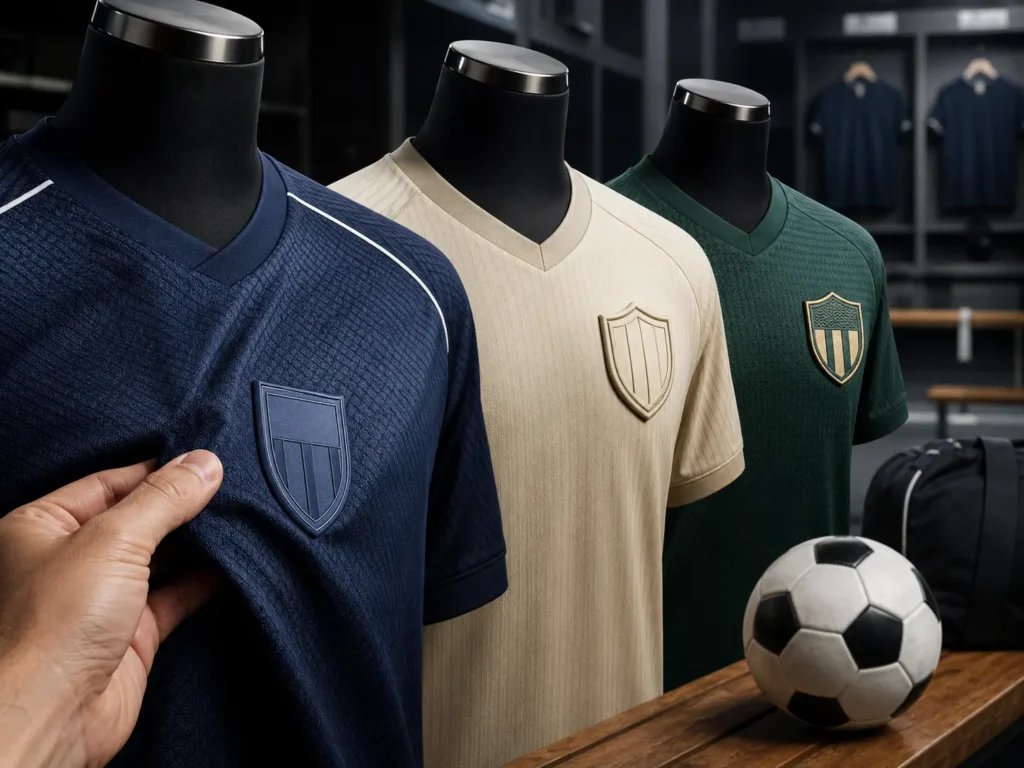
Confronto rapido: TPU vs Silicone vs Woven Patches on Football Jerseys
The fastest way to compare these three patch types is to look at the buyer objective. TPU is usually chosen for modern, leggero, high-definition performance jerseys. Silicone is chosen when the jersey needs a raised 3D crest and premium retail feel. Woven patches are selected for traditional textile identity, classic club styling, and cost-controlled teamwear.
If you are preparing a new order and still comparing jersey grade, logo size, tipo di tessuto, and target price, it is smart to contact a custom football jersey factory before finalizing the badge craft. A patch that works on a heavyweight fan shirt may not work well on a lightweight player-issue shirt. The same logo can behave differently on recycled polyester, mesh knit, jacquard fabric, or highly elastic performance fabric.
| Patch Type | Ideale per | Visual Effect | Feel on Jersey | Rischio principale | Cost Level |
|---|---|---|---|---|---|
| TPU Patch | Player-issue shirts, modern team kits, lightweight Football Jerseys | Sharp, smooth, clean, high-definition | Thin, flessibile, performance-focused | Edge lifting if heat press parameters are poor | Medio |
| Silicone Crest | Premium fan jerseys, limited editions, club merchandise | Raised 3D, soft rubber-like, bold branding | Premium but thicker | Can feel heavy if oversized | Medium–High |
| Woven Patch | Classic club shirts, fan-grade jerseys, wholesale teamwear | Traditional textile badge | Morbido, familiare, less dimensional | Fraying, seam irritation, or reduced logo detail | Low–Medium |
Comparing 3D Silicone Crests vs. High-Definition TPU Patches
What Makes TPU Patches Different on a Football Jersey?
TPU stands for thermoplastic polyurethane. In Football Jersey production, TPU patches are often used when the buyer wants a thin, clean, flessibile, and high-definition crest. TPU can hold sharp logo lines, modern color blocking, metallic effects, layered details, and smooth surfaces. That makes it popular for performance-driven jerseys where the badge needs to look professional without adding too much weight.
TPU patches are usually applied by heat press, which creates a cleaner surface than traditional sewing. This is one reason many brands use TPU for modern player-issue shirts and replica jerseys. When the adhesive layer, temperatura, pressione, dwell time, and fabric compatibility are properly controlled, TPU can deliver a strong balance of appearance and performance.
Buyers comparing Football Jerseys often also source matching training apparel, warm-up pieces, and teamwear bottoms. For programs that include kits and matching bottoms, pantaloncini in rete personalizzati can help create a consistent club collection. This matters for academies, distributori, and sportswear brands that sell full team sets rather than only shirts.
The best use case for TPU is simple: if the jersey must stay lightweight, flessibile, and sharp-looking, TPU is usually a strong choice. If the logo contains small letters, thin outlines, fine geometry, or a modern badge design, TPU usually keeps details clearer than woven patches. For a player issue football jersey, TPU often performs better than a thick silicone crest because it is easier to keep low-profile and comfortable.
What Makes Silicone Crests Different on a Football Jersey?
A silicone crest creates a raised 3D effect with a soft rubber-like surface. It looks premium, feels more dimensional, and gives the badge more physical presence. This is why silicone is often used for premium fan-grade shirts, limited edition jerseys, club merchandise, and private-label sportswear that needs stronger shelf appeal.
Silicone is not automatically “better” than TPU. It is better when the buyer wants depth, touch quality, and a high-end retail impression. Tuttavia, silicone can become too heavy if the crest is oversized or too thick. On a lightweight Football Jersey, a large silicone badge may pull on the fabric, reduce breathability in the chest area, or feel less suitable for elite matchwear.
For buyers planning coordinated custom apparel, Questo custom mesh shorts manufacturing guide is useful because patch selection should not be isolated from the full teamwear program. A premium jersey badge paired with low-quality shorts creates an uneven product experience. The outfit may technically match, but buyers will feel the quality gap immediately.
Silicone is especially powerful for fan retail because fans buy emotion, identità, and perceived value. A raised crest can make the shirt feel more collectible. For clubs and e-commerce sellers, the question is whether the extra cost supports a higher selling price. If the answer is yes, silicone can be worth it. If the project is a price-sensitive bulk teamwear order, TPU or woven may be more practical.
TPU vs Silicone: Which Looks More Professional?
TPU looks more technical, affilato, and performance-oriented. Silicone looks more premium, bold, and dimensional. Neither wins every situation. The right choice depends on the jersey grade, wearer expectation, logo complexity, bilancio, and production volume.
| Buyer Goal | Scelta migliore | Perché funziona | Risk to Watch |
|---|---|---|---|
| Lightweight match jersey | TPU | Thin, flessibile, clean appearance | Poor heat press can cause peeling |
| Premium fan jersey | Silicone | Raised 3D branding and high perceived value | Oversized crests may feel heavy |
| Fine logo details | TPU | Better definition for small text and lines | Requires accurate cutting and molding |
| Bold club crest | Silicone | Stronger touch and visual depth | Needs consistent molding quality |
| Large-volume teamwear | TPU or woven | Better cost control and repeatability | No wash testing before bulk order |
Woven Patches for Football Jerseys: Classic Look, Practical Cost
Why Buyers Still Choose Woven Patches
Woven patches are textile badges made with woven threads. They are often used on classic club jerseys, school team shirts, amateur league kits, fan-grade shirts, retro designs, and cost-sensitive wholesale Football Jersey programs. Woven patches do not have the same 3D depth as silicone, but they offer a traditional football look that many clubs still prefer.
For national teams and clubs, the crest is more than a decoration. It carries memory, identità, region, e lealtà. This is why badge craft matters in global tournaments, where jerseys often become symbols of belonging. The cultural role of football jerseys and national identity shows why buyers should not treat the patch as a disposable accessory. If the crest looks cheap, the whole shirt feels weaker.
Woven patches are useful when the logo has a traditional shape, simple color structure, and classic club style. They can be sewn, heat-backed, or combined with stitching for extra security. Per wholesale Football Jerseys, woven badges can help control cost while still giving the shirt a finished teamwear appearance.
Strengths and Limitations of Woven Patches
The strengths of woven patches are clear: lower cost in many bulk orders, familiar textile texture, good classic appearance, and practical use for fan-grade shirts. They work well for schools, accademie, local clubs, community teams, and retro-style merchandise.
The limitations are also important. Woven patches may struggle with very small text, gradienti, tiny outlines, or complex logo geometry. Edges can fray if the border quality is weak. Sewing can create needle holes, seam irritation, or added weight on lightweight jersey fabric. If the Football Jersey is designed for elite match performance, a bulky sewn woven patch may feel outdated or uncomfortable.
Decision logic is simple: if the logo is traditional and the order is cost-sensitive, woven is practical. If the logo needs fine detail and a modern finish, TPU is safer. If the buyer wants a raised premium retail badge, silicone is stronger.
Durability Testing: Heat Press Adhesion vs. Traditional Embroidery Seams
Why Patch Durability Fails in Real Football Use
Football Jerseys are not worn in gentle conditions. They face sweat, allungamento, contatto, scorrevole, lavaggio, essiccazione, folding, imballaggio, and sometimes very creative laundry habits. A crest that looks perfect in a product photo can fail after a few wash cycles if the patch material, fabric surface, adhesive layer, or application method is wrong.
Common patch failures include edge lifting, surface cracking, adhesive residue, thread fraying, sbiadimento del colore, fabric distortion, logo deformation, and seam irritation. For sourcing managers, these failures are painful because they often appear after shipment, not during the first sample review. That is why serious buyers should approve Football Jersey patches based on physical samples and test results, not photos alone.
Demand for custom teamwear often increases around major tournaments. IL World Cup custom Football Jersey sourcing guide is relevant because tournament-driven orders usually involve tight deadlines, emotional buyers, and high repeat-purchase potential. In that environment, patch failure is not a small defect. It can damage a seller’s reputation quickly.
Heat Press Adhesion for TPU and Silicone Patches
TPU and silicone patches are commonly applied by heat press. The main variables are press temperature, pressione, dwell time, adhesive layer, fabric compatibility, cooling process, and post-press handling. Buyers should avoid using one universal heat press setting for every patch and fabric combination because different materials and adhesives can behave differently.
| Heat Press Factor | What Buyers Should Confirm | Risk If Wrong | Recommended Check |
|---|---|---|---|
| Temperatura | Must match patch material and jersey fabric | Fabric scorching, weak bonding, patch deformation | Test on actual fabric before bulk production |
| Pressure | Even pressure across the full crest | Edge lifting or incomplete adhesion | Inspect edges after cooling and washing |
| Dwell Time | Long enough to activate adhesive | Poor wash durability | Run trial press and wash test |
| Tipo di tessuto | Poliestere, maglia, jacquard, poliestere riciclato, stretch fabric | Adhesive mismatch or fabric distortion | Use the final production fabric for sampling |
| Cooling Process | Bond should stabilize before handling | Early peeling or movement | Follow supplier cooling instructions |
Traditional Embroidery Seams for Woven Patches
Woven patches can be attached by sewing, heat backing, or a combination of both. Sewing gives mechanical security, but it also adds stitch lines, needle holes, and possible irritation. On thicker fan-grade shirts, this may be acceptable. On lightweight player-issue fabric, heavy stitching can distort the surface or reduce comfort.
Heat press application gives a cleaner look and may reduce weight. Sewing gives a traditional appearance and physical reinforcement. Heat press plus stitching can improve security, but it increases labor cost and may not fit every modern jersey design. Buyers should choose based on jersey grade, not habit.
Wash Durability Expectations
Before bulk production, buyers should request wash testing for patch adhesion, color change, surface cracking, edge lifting, fabric distortion, and logo readability. For e-commerce sellers and club stores, the shirt must survive real customer care behavior, not just factory lighting.
| Articolo di prova | Practical Evaluation Target | What Buyers Should Inspect | Perché è importante |
|---|---|---|---|
| 5 cicli di lavaggio | Early failure screening | Edge lifting, bubbling, color bleeding | Finds obvious bonding problems |
| 10 cicli di lavaggio | Basic retail confidence | Crest shape, fabric distortion, adhesive marks | Useful for first sample approval |
| 20 cicli di lavaggio | Fan-grade durability check | Surface cracking, fraying, logo clarity | Reduces customer complaint risk |
| 30+ cicli di lavaggio | Higher durability benchmark | Long-term appearance and bonding stability | Better for premium retail programs |
| Stretch test | Match-use simulation | Patch flexibility and recovery | Important for player-issue shirts |
| Abrasion check | Contact and friction simulation | Surface wear and logo definition | Important for training and youth jerseys |

Selecting the Right Logo Craft for Elite Player-Issue vs. Fan-Grade Shirts
Player-issue Football Jerseys prioritize performance. They need low weight, traspirabilità, recupero dell'allungamento, moisture movement, and reduced irritation. Per questa ragione, TPU is often the safest patch choice for elite player-issue shirts. It can be made thin, affilato, and flexible. Thin silicone may work when the project needs a premium crest, but size and weight must be controlled carefully.
Fan-grade Football Jerseys have a different job. They need to look desirable, feel comfortable, survive washing, and justify the retail price. Fans often judge the crest heavily because it represents identity and club pride. Silicone can create a premium retail effect. Woven can create a classic club feel. TPU can create a clean modern replica look.
Factory-direct sourcing trends are also changing. Buyers are asking for smaller MOQs, faster sampling, better patch options, recycled polyester fabrics, and more customized jersey programs. This trend report on factory direct custom Football Jersey trends supports the same point: buyers no longer want generic team shirts with random badges. They want fabric, adatto, cresta, and production logic aligned.
| Jersey Grade | Best Patch Direction | Motivo | Avoid This Mistake |
|---|---|---|---|
| Elite player-issue jersey | TPU | Leggero, flessibile, high-definition | Oversized heavy silicone crest |
| Premium fan jersey | Silicone | Strong 3D retail value | Cheap molded badge with poor edge quality |
| Retro club shirt | Woven | Classic textile identity | Using woven for tiny detailed logos |
| Wholesale teamwear | TPU or woven | Cost control and repeatability | Approving bulk order without wash testing |
| Youth football jerseys | Soft TPU or soft woven | Comfort and safety | Ignoring chemical safety documents |
| Limited edition kit | Silicone or layered TPU | Premium differentiation | Choosing only by lowest patch price |
Material Parameters Buyers Should Compare Before Ordering
Patch Thickness and Weight
Patch thickness affects flexibility, peso, comfort, and visual depth. TPU can often be made thin and low-profile. Silicone is usually thicker because of its molded 3D structure. Woven patches vary depending on yarn density, border design, backing, and whether stitching is used.
For lightweight match shirts, even a small amount of extra badge weight can affect drape and comfort. For fan-grade shirts, a thicker crest may be acceptable if it increases perceived value. For wholesale teamwear, weight and cost should stay controlled because the buyer may order hundreds or thousands of shirts across many sizes.
Flexibility and Stretch Compatibility
Football Jersey fabric stretches during running, affrontare, lavaggio, and daily wear. If the patch is too stiff, the fabric may pucker, the edge may lift, or the patch may crack over time. This is especially important for elastic polyester and performance mesh fabrics.
The correct test is simple: apply the patch to the actual production fabric, then stretch, wash, inspect, and wear-test it. Testing on a random fabric swatch is better than nothing, but it is not enough for serious production.
Color Accuracy and Logo Detail
TPU is strong for sharp logo lines, small letters, and high-definition effects. Silicone is strong for bold shapes, raised forms, and premium touch. Woven is strong for traditional textile crests but may lose clarity in tiny text, gradienti, and complicated geometry.
If the logo includes fine lines, choose TPU. If the logo needs raised depth, choose silicone. If the logo is classic and simple, choose woven. If the buyer says “we want everything: premio, cheap, magro, 3D, flessibile, no risk,” gently remind them that physics has not resigned yet.
Breathability and Skin Comfort
Patches reduce breathability in the applied area. The larger and thicker the crest, the more noticeable it becomes. This matters for match jerseys, hot-climate teamwear, youth kits, and training shirts.
For player-issue shirts, keep patch size proportional and avoid unnecessary bulk. For fan-grade shirts, visual effect can carry more weight, but comfort still matters. A beautiful crest that feels like armor is not a good retail experience.
Compliance and Safety Considerations for Football Jersey Patches
Competition Equipment Rules
Football Jerseys used in official competitions may need to follow rules on numbers, nomi, team crests, posizionamento dello sponsor, distintivi sulla manica, slogans, and permitted markings. Buyers should confirm competition-specific requirements before production, especially for professional clubs, tornei, accademie, and national-level events.
The emotional value of the crest also matters. In global competitions, jerseys often become public symbols of identity, loyalty, e cultura. This second resource on national identity in football jersey design reinforces why patch quality and placement must be treated seriously. If the badge is wrong, the shirt does not simply look different; it can feel disrespectful to the brand or team story.
Textile Chemical Safety
For export Football Jerseys, especially youth teamwear and skin-contact sportswear, buyers should request chemical safety documents. Relevant concerns may include restricted substances, heavy metals in pigments, phthalates where applicable, skin-contact safety, odor, dye fastness, e lavare la durabilità.
Buyers selling into Europe, America del Nord, and brand-controlled retail channels should be especially careful. The patch material, adhesive layer, ink, backing, and fabric may all be reviewed. A shirt can look perfect and still fail buyer approval if documentation is weak. That is the kind of problem that appears late, costs money, and makes everyone suddenly very interested in paperwork.
Youth Football Jersey Safety
Youth Football Jerseys require extra attention because children’s apparel often faces stricter buyer expectations. Patch edges should be comfortable, bonding should be secure, and materials should be suitable for skin contact. If the crest peels after washing, it becomes both a quality issue and a safety concern.
For youth orders, buyers should prioritize soft hand feel, smooth edges, stable adhesion, wash-tested durability, and documented material safety. TPU and soft woven options can work well. Silicone can also work when it is properly designed, but oversized thick crests should be avoided for young players.
Common Buyer Mistakes When Choosing Football Jersey Patch Craft
Errore 1: Choosing the Patch Only by Appearance
A silicone crest may look excellent in a sample photo, but if it is too heavy for the jersey fabric, it can feel awkward during wear. A woven patch may look traditional, but if the logo has small details, it may lose definition. TPU may look modern, but poor heat press settings can still cause peeling.
Raccomandazione: match the patch to the jersey grade, fabric weight, wearer expectation, and washing requirement. Appearance matters, but it should not be the only decision factor.
Errore 2: Ignoring Fabric Compatibility
Patch adhesion depends on fabric surface, coating, stretch level, thickness, moisture management treatment, and heat sensitivity. A patch that bonds well to one polyester fabric may behave differently on recycled polyester, mesh fabric, jacquard knit, or highly elastic material.
Raccomandazione: always test the final patch on the final jersey fabric before bulk production. No guessing. Guessing is not a sourcing strategy; it is just optimism wearing a safety helmet.
Errore 3: Approving Bulk Production Without Wash Testing
Photos do not prove durability. A crest can look clean on day one and start lifting after washing. For wholesale Football Jerseys, this risk multiplies across many shirts, many buyers, and many reviews.
Raccomandazione: approve bulk production only after checking wash cycles, recupero dell'allungamento, edge bonding, color change, patch shape, and fabric distortion.
Errore 4: Using the Same Patch for Player and Fan Jerseys
Player-issue and fan-grade shirts have different priorities. Player shirts prioritize weight, stirata, traspirabilità, e prestazioni. Fan shirts prioritize identity, retail value, durabilità del lavaggio, e appeal visivo.
Raccomandazione: use different patch structures when necessary. A thin TPU crest can work for player kits, while silicone or woven may be better for fan merchandise depending on brand positioning.
Errore 5: Forgetting Documentation Until the Order Is Finished
Compliance documents should be requested before production, not after shipment. If the buyer needs chemical safety, restricted-substance declarations, wash care guidance, or material traceability, the supplier should know before sampling.
Raccomandazione: confirm documentation requirements in the RFQ stage. It saves time, reduces disputes, and prevents “urgent document panic,” a classic office sport nobody enjoys.
Football Jersey Patch Selection Framework for Buyers
Fare un passo 1: Define the Jersey Grade
Start by defining whether the product is an elite player-issue jersey, replica jersey, fan-grade shirt, training shirt, academy uniform, wholesale teamwear, or limited edition retail kit. The same patch craft should not be forced across all product levels.
Fare un passo 2: Define the Main Buyer Priority
Is the buyer optimizing for lightweight performance, premium 3D branding, traditional club identity, cost efficiency, fast delivery, durabilità del lavaggio, or export compliance? Every priority points to a different patch decision.
Fare un passo 3: Match the Patch Type
| If the Buyer Needs | Scegliere | Motivo |
|---|---|---|
| Lightweight performance | TPU | Thin, flessibile, suitable for modern match jerseys |
| Premium raised branding | Silicone | Strong 3D look and higher retail value |
| Classic club identity | Woven | Traditional textile appearance |
| Cost-effective bulk teamwear | TPU or woven | Better price control and repeatability |
| Fine logo details | TPU | Sharper detail than woven patches |
| Retro jersey collection | Woven | Matches heritage styling |
Fare un passo 4: Request Samples and Testing
Ask for samples made with the actual jersey fabric, actual logo size, actual patch material, and actual production method. Then test wash durability, stirata, adhesion, color stability, edge quality, wearer comfort, and packaging condition.
Fare un passo 5: Lock the Specification
Once the sample is approved, lock patch type, patch thickness, patch size, logo colors, application method, heat press parameters, backing material, wash care label, compliance documents, packaging method, and inspection standards. This reduces inconsistency between sample approval and bulk production.
Raccomandazione finale: Match the Patch to the Shirt, Not the Trend
TPU, silicone, and woven patches can all be excellent choices for Football Jersey production, but only when they are used in the right context. TPU is usually the strongest option for lightweight player-issue shirts and sharp modern logos. Silicone is ideal when the buyer wants a raised 3D crest and premium retail value. Woven patches remain a smart choice for classic designs, fan-grade shirts, scuole, accademie, and cost-controlled wholesale teamwear.
The best buyer decision is not “Which patch is best?” It is “Which patch is best for this jersey grade, this fabric, this logo, this target market, and this selling price?” Before placing a bulk order, prepare the logo file, jersey fabric, gamma di dimensioni, quantità dell'ordine, mercato di riferimento, wash requirements, and compliance expectations. A capable OEM football jersey supplier can then recommend the right patch construction before production mistakes become expensive.

Frequently Asked Questions About Football Jersey Patches
1. Which patch is best for a Football Jersey?
The best patch for a Football Jersey depends on the jersey grade, tipo di tessuto, logo detail, bilancio, and target customer. TPU patches are usually best for lightweight player-issue shirts and modern replica jerseys because they are thin, flessibile, and sharp. Silicone crests are better for premium fan jerseys and limited edition merchandise because they create a raised 3D effect and stronger retail value. Woven patches are practical for classic club shirts, academy uniforms, and wholesale teamwear where traditional textile appearance and cost control are important.
2. Are TPU patches durable on football jerseys?
TPU patches can be durable on football jerseys when the adhesive layer, heat press temperature, pressione, dwell time, and fabric compatibility are properly controlled. They are commonly used for modern performance jerseys because they can stay lightweight while keeping sharp logo details. Tuttavia, TPU patches may lift at the edges if the heat press process is poor or if the patch is applied to an unsuitable fabric surface. Buyers should request samples, prove di lavaggio, stretch testing, and edge inspection before approving bulk production.
3. Are silicone crests good for player-issue football shirts?
Silicone crests can be used on player-issue football shirts, but they must be carefully designed. The crest should be thin, flessibile, and not oversized, otherwise it may feel heavy, reduce breathability, or pull on lightweight jersey fabric. For ultra-light match jerseys, TPU is often safer because it offers a lower-profile and more flexible finish. Silicone is usually stronger for premium fan-grade jerseys, limited edition shirts, and club merchandise where the raised 3D effect supports higher perceived value.
4. Do woven patches last longer than heat press patches?
Woven patches do not automatically last longer than heat press patches. A sewn woven patch can provide mechanical attachment, but it may fray, create seam irritation, or distort lightweight jersey fabric if the construction is poor. Heat press TPU and silicone patches can also perform well when the adhesive, temperatura, pressione, fabric compatibility, and cooling process are controlled. The best way to compare durability is to test the actual patch on the actual Football Jersey fabric through washing, allungamento, and visual inspection before bulk production.
5. How should buyers test football jersey patches before bulk orders?
Buyers should test football jersey patches on the final production fabric using the actual logo size, patch material, and application method. The sample should be checked after multiple wash cycles for edge lifting, surface cracking, color change, fraying, adhesive residue, and fabric distortion. Stretch testing is also important for player-issue and training jerseys because the patch must move with the fabric. For export orders, buyers should also request material safety documents, compliance declarations, and clear wash care instructions before mass production.
Riferimenti
- Leggi del gioco: Legge 4, L'equipaggiamento dei giocatori, The International Football Association Board, Official Laws of the Game.
- Regolamento sulle apparecchiature, Fédération Internationale de Football Association, FIFA Legal and Compliance Resources.
- OEKO-TEX STANDARD 100: Tested for Harmful Substances, Associazione OEKO-TEX, Textile Safety Standard.
- REACH Regulation and Restrictions, Commissione europea, Environment and Chemicals Policy Resources.
- AATCC Standard Test Methods and Procedures, Associazione americana dei chimici e dei coloristi tessili, Textile Testing Standards.
- Textiles: Tests for Colour Fastness, Organizzazione internazionale per la standardizzazione, ISO Textile Testing Standards.
- Lo stato della moda 2025, McKinsey & Company and The Business of Fashion, Global Apparel Industry Report.
- Sports Apparel Market Insights, Statista Research Department, Global Sportswear and Teamwear Market Data.