Résumé rapide
UN Maillot de football is not only a match-day uniform; it is a performance garment, a team identity asset, a sponsor display surface, and a repeat-purchase product that must deliver value beyond the lowest quote. A club may wear it on the pitch. A school may wash it every week. A distributor may sell it in bulk. A sponsor may judge its value through photos, vidéos, social media posts, and tournament exposure. That means Football Jersey sourcing is a total project ROI decision, not just a unit price negotiation.
The cheapest jersey often looks attractive on a spreadsheet, but it can become expensive after the first season if the fabric feels hot, the print peels, the sponsor logo fades, the sizing is inconsistent, or players complain about comfort. A higher-quality Football Jersey may cost more upfront, but if it lasts longer, photographs better, supports clearer sponsor placement, reduces replacement orders, and improves reorder stability, the total project ROI can be stronger.
Before comparing factories, buyers should first define the project purpose. A local football club needs reliable team identity and comfort. A school team needs durability and clear size grading. A tournament organizer needs consistent multi-team delivery. A distributor needs margin, repeatable quality, and fewer complaints. Reviewing Football Jersey and soccer uniforms options can help buyers understand how teamwear categories, customization choices, and sportswear production paths connect before moving into quotation, échantillonnage, et production en vrac.

What Makes a High-Quality Football Jersey?
A high-quality Football Jersey starts with fabric performance. Most modern football jerseys use polyester because it supports lightweight construction, séchage rapide, impression par sublimation, stabilité des couleurs, and repeated washing. Fabric structure may include bird-eye mesh, interlock polyester, jacquard mesh, honeycomb mesh, polyester recyclé, or polyester-spandex blends depending on the target price and performance level.
Fabric weight is one of the most important sourcing parameters. Many lightweight football jerseys fall within the approximate range of 135–180 GSM. A very light jersey may feel cooler, but it can look thin or transparent if the fabric quality is weak. A heavier jersey can feel stronger and more retail-like, but it may trap heat during summer matches. For many teamwear orders, a balanced 140–165 GSM performance polyester is often practical because it combines comfort, printability, et durabilité.
Moisture management is also important. A Football Jersey should move sweat away from the skin, sécher rapidement, and allow airflow. Mesh structures can improve ventilation, especially under the arms, panneaux latéraux, or upper back. Stretch and recovery matter because football requires sprinting, torsion, sauter, and body contact. Colorfastness matters because jerseys are washed repeatedly throughout the season. Seam strength matters because shoulder, side, collier, and sleeve areas must survive movement and pulling.
| Fabric Parameter | Typical Buying Range | Pourquoi c'est important |
| Poids du tissu | 135–180 g/m² | Balances lightness, confort, et durabilité |
| Matériel | 100% polyester or recycled polyester blend | Supports sublimation, séchage rapide, and stable color |
| Respirabilité | Medium to high mesh airflow | Improves player comfort in training and matches |
| Gestion de l'humidité | Wicking finish or performance knit | Reduces sticky feel during play |
| Récupération d'étirement | Moderate mechanical stretch | Supports sprinting and body movement |
| Solidité des couleurs | Grade 3–4 or above preferred | Reduces fading after repeated washing |
| Rétrécissement | Usually controlled under 3–5% | Improves size stability |
| Seam strength | Project-dependent test requirement | Reduces tearing and after-sales complaints |
Price vs. Performance: Why a Cheap Football Jersey Costs More in the Long Run
A low-price Football Jersey can reduce initial purchasing cost, but the hidden cost often appears later. Cheap fabric may feel thin, rough, chaud, or sticky. Low-grade polyester may pill, snag, stretch out, lose shape, or become uncomfortable after repeated washing. Poor moisture management can make players feel heavy and wet during matches, especially in hot climates or tournaments with multiple games in one day.
Printing failure is another major cost. If sponsor logos, Nombres, or team graphics are applied through low-quality heat transfer, they may crack, peel, disparaître, or wrinkle after washing. This directly affects sponsor value. A sponsor logo that looks damaged in match photos reduces the professional image of the club and may weaken renewal value. For teams that rely on sponsorship, poor printing is not only a garment problem; it is a revenue problem.
Cheap jerseys can also increase replacement and reorder cost. If sizing is unstable, players may request exchanges. If the fabric shrinks, teams may need extra pieces. If colors change between batches, late-season reorders may not match the original kit. A well-planned sourcing approach should compare cost per wear, not only unit cost. UN $6 jersey worn 10 times costs $0.60 per wear. UN $10 jersey worn 30 times costs $0.33 per wear. In that scenario, the higher-priced jersey delivers better long-term value.
Large football events also increase order pressure because teams, distributeurs, and fanwear buyers often place urgent or larger orders around major tournaments. UN World Cup Effect Custom Football Jersey sourcing guide can help buyers think beyond the unit price and plan earlier around fabric stock, approbation des œuvres d'art, sponsor demand, fan interest, and delivery deadlines.
| Cost Factor | Cheap Football Jersey Risk | Better Jersey ROI Benefit |
| Fabric durability | Pilling, shape loss, snagging | Longer use cycle |
| Print quality | Peeling, cracking, décoloration | Better sponsor visibility |
| Confort du joueur | Chaleur, sweat retention, rough touch | Better match-day experience |
| Stabilité de la taille | Shrinkage or poor grading | Fewer complaints and replacements |
| Reorder consistency | Different color or fabric | Easier team replenishment |
| Brand value | Looks low-end in photos | Stronger club image |
| Total cost | More replacements | Better long-term value |
Understanding Total Project ROI for Football Jersey Orders
ROI in Football Jersey sourcing is not only resale margin. It includes usage lifespan, sponsor exposure, player satisfaction, fan perception, reorder potential, and lower complaint cost. A distributor may focus on margin, but if the jersey generates returns, slow repeat orders, and customer complaints, the margin becomes weaker. A school may focus on budget, but if shirts shrink or fade after a few washes, the administration spends more time managing replacements. A football club may focus on design, but if the fabric is uncomfortable, players may avoid wearing it outside matches.
Total project ROI should include four levels: product ROI, operational ROI, sponsor ROI, and brand ROI. Product ROI comes from durability and cost per wear. Operational ROI comes from fewer mistakes, clearer packing, and easier size distribution. Sponsor ROI comes from logo visibility and professional appearance. Brand ROI comes from better team identity and more consistent fan-facing photos.
Procurement teams should also compare sample cost, artwork setup, gamme de tailles, MOQ, delivery speed, emballage, shipping, customs documentation, and reorder record keeping. The strongest supplier is not always the lowest quote; it is the one that helps reduce uncertainty across the whole order.
| Buyer Type | ROI Priority | Football Jersey Decision Focus |
| Football club | Team image and comfort | Tissu, ajuster, placement de sponsor |
| School team | Budget and durability | Wash stability, gamme de tailles |
| Sports academy | Reorder consistency | Color control and stock planning |
| Distributor | Margin and complaint reduction | Factory reliability and QC |
| Parrainer | Logo exposure | Print clarity and design placement |
| Tournament organizer | Fast delivery and consistency | Bulk production and packaging |
Volume Discount Structures for Wholesale Football Jersey Orders
Wholesale Football Jersey pricing usually improves when quantity increases because setup cost, artwork preparation, coupe, sublimation layout, sewing preparation, inspection, and packing can be spread across more pieces. Bulk fabric purchasing can also reduce cost. Cependant, volume discounts are not always linear. A jump from 30 à 100 pieces may reduce the unit price noticeably, while a jump from 1,000 à 1,300 pieces may create a smaller percentage change.
Common order tiers include 30–50 pieces for small teams, 100–300 pieces for clubs or academies, 500–1,000 pieces for tournaments or distributors, et 1,000+ pieces for wholesale or private-label programs. Mixed designs can change pricing because each design may require separate artwork setup, printing arrangement, cutting plan, and packing control. Reorders may be more efficient if the supplier keeps artwork files, références de couleurs, tableaux de tailles, et dossiers de production.
Buyers should never sacrifice fabric quality, précision des couleurs, classement par taille, sponsor logo clarity, qualité de sublimation, Inspection CQ, or packaging accuracy only to gain a small discount. A lower unit price is useful only when the final goods are wearable, sellable, and reorderable. For broader sourcing direction, les acheteurs peuvent examiner Tendances des maillots de football personnalisés directement en usine to understand how MOQ, tissu, sublimation, disposition des sponsors, and production control are becoming more important for clubs and distributors.
| Quantité commandée | Typical Buyer Type | Pricing Feature | Key Risk |
| 30–50 pcs | Team or small club | Higher unit cost | Limited discount |
| 100–300 pcs | School, académie, club | Better unit price | Size mix planning needed |
| 500–1,000 pcs | Tournament, distributeur | Stronger bulk discount | QC consistency critical |
| 1,000+ pièces | Wholesale program | Best price potential | Reorder and color control required |
| Mixed designs | Multi-team order | Setup cost may increase | Artwork management risk |
| Repeat order | Club replenishment | Better planning efficiency | Fabric and color must match |
Fabric Quality Parameters That Affect Football Jersey ROI
Fabric GSM affects how the jersey feels, performs, and lasts. A very light 120–135 GSM fabric can be suitable for hot-weather training or budget matchwear, mais cela peut sembler trop mince pour certaines équipes. A balanced 140–165 GSM fabric is often useful for many club and school orders because it is light enough for sport but stable enough for repeated washing. A 160–180 GSM fabric can feel stronger and more premium, but it may be warmer during intense play.
Breathability and moisture-wicking are essential because football players move continuously. A jersey that traps sweat can feel heavy and uncomfortable. Mesh or bird-eye structures improve airflow. Performance polyester can move moisture away from the skin more effectively than basic low-grade fabric. Stretch and recovery are useful for fitted jerseys, but excessive stretch without recovery can make the garment lose shape.
Colorfastness and shrinkage control reduce complaints. Team jerseys are often washed together, sometimes under rougher conditions than ordinary casualwear. If dark colors bleed, white panels become stained. If size changes after washing, the team must manage complaints. Good stitching also matters. Coutures latérales, coutures aux épaules, collar seams, and sleeve openings should be stable enough for match use.
| Paramètre | Low-End Risk | Better Specification Direction |
| GSM | Too thin or transparent | 140–165 GSM for many teamwear needs |
| Structure tricotée | Poor airflow | Bird-eye, engrener, or performance knit |
| Moisture handling | Sticky fabric | Wicking polyester |
| Solidité des couleurs | Fading after washing | Grade 3–4+ target |
| Rétrécissement | Size complaints | Controlled shrinkage |
| Seam quality | Tearing or twisting | Coutures renforcées |
| Collar/rib | Deformation | Stable rib or clean crew neck |
| Print process | Peeling logo | Sublimation for full custom graphics |
Maximizing Sponsorship Value Through High-End Football Jersey Design
Sponsors care about Football Jersey design because the jersey becomes a moving advertising surface. Sponsor logos appear in match photos, vidéos, social media posts, fan content, team announcements, local news, tournament broadcasts, and school events. A clearer, better-designed jersey gives sponsors more value because their logo is easier to recognize and more likely to look professional in real-world images.
Logo placement should be planned before final artwork approval. The front chest is usually the highest-value area. Sleeves can hold secondary sponsors. The back upper area can support sponsor visibility, but it must not conflict with player names and numbers. Shorts can add additional sponsor inventory. For tournaments, training versions and warm-up tops can also extend sponsor exposure.
Color contrast is essential. A dark sponsor logo placed over a dark background may look invisible from distance. A busy pattern behind a sponsor mark may reduce readability. A sponsor logo stretched over a seam may distort. The strongest designs keep sponsor areas clean, high-contrast, and camera-readable. For teams competing in major events or representing local identity, design also carries cultural meaning. The topic of football jerseys and national identity shows why colors, symbols, motifs, and shirt design can carry value far beyond basic uniform function.
| Design Area | Sponsor Value | Chèque de l'acheteur |
| Front chest | Highest visibility | Large readable logo |
| Sleeve | Good secondary exposure | Avoid seam distortion |
| Back upper area | Useful in match photos | Keep player name readable |
| Shorts logo | Extra sponsor inventory | Check print size |
| Color contrast | Improves recognition | Test logo on final artwork |
| Sublimation clarity | Prevents peeling and fading | Use high-resolution files |
| Social media photos | Extends exposure | Design must look good on camera |
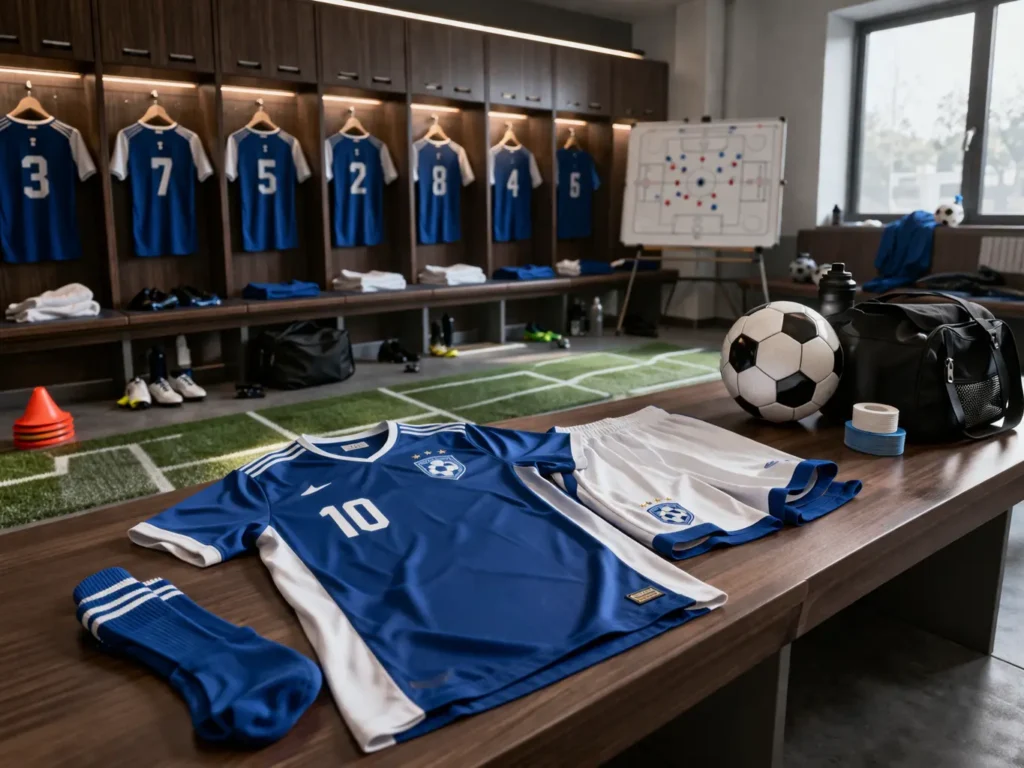
Why Sublimated Football Jersey Graphics Never Peel or Fade
Sublimation printing is one of the strongest methods for full custom Football Jersey graphics. It uses heat and pressure to transfer dye into polyester fibers. The graphic becomes part of the fabric surface instead of sitting on top like a sticker. Because the design is integrated into the polyester, sublimated graphics do not peel like heat-transfer vinyl.
Sublimation is especially useful for full-color teamwear. It can include gradients, motifs géométriques, logos des sponsors, numéros de joueurs, noms, détails des manches, graphiques d'épaule, national-inspired motifs, and background textures without adding heavy print layers. The jersey remains lightweight because the print does not create a thick surface film. This is valuable for matchwear because players need movement, flux d'air, et confort.
Heat transfer can still be useful for simple names, Nombres, and small logos, but it may crack or peel over time if quality is weak. Screen printing can work for simple repeated graphics, but it is less flexible for complex full-body designs. Embroidery or woven patches can look premium for crests, but they add weight and cost. For full custom team kits, sublimation is usually the most efficient and durable choice.
| Print Method | Meilleure utilisation | Force | Risk |
| Sublimation | Full custom Football Jersey | No peeling, poids léger, durable | Works best on polyester |
| Transfert de chaleur | Simple names or logos | Low setup and flexible | Can crack or peel |
| Sérigraphie | Simple repeated graphics | Good for bulk simple designs | Limited for complex designs |
| Broderie | Badge or premium logo | High-end feel | Ajoute du poids et du coût |
| Patch tissé | Club crest | Professional appearance | Sewing quality matters |
Real-World Sourcing Scenarios
A local football club ordering 50–100 sets usually needs moderate budget control, good fabric, custom names and numbers, sponsor logo clarity, and fast delivery. A sublimated Football Jersey with reliable GSM and a clear size chart is often the best direction. The club should approve artwork before bulk production and confirm whether late-season reorders will match the first batch.
A school or academy ordering 200–500 sets needs durability, youth-to-adult sizing, wash performance, et réorganiser la stabilité. Schools often wash jerseys frequently, so fabric stability and colorfastness matter. A distributor ordering 1,000+ jerseys needs strong wholesale price, factory reliability, Inspection CQ, packaging consistency, and repeatable production. A sponsor-focused tournament order needs high visual quality, logo exposure, team color consistency, and fast production.
Design trends also vary across countries and football cultures. Buyers who sell to multiple markets should understand how color, modèle, placement de sponsor, and national style influence purchase decisions. A guide to custom Football Jersey trends by country can help distributors and private-label buyers align designs with regional preferences rather than applying one template everywhere.
| Scenario | Main Buyer Need | Recommended Direction | Risk If Ignored |
| Local club | Budget and identity | Sublimated team jersey | Low-quality sponsor display |
| School team | Durability and sizing | Stable fabric and size grading | Complaints and replacements |
| Academy | Reorder stability | Color and pattern consistency | Mixed team appearance |
| Distributor | Margin and QC | Factory-direct bulk production | Return and complaint cost |
| Tournament | Fast multi-team supply | Artwork management and packing | Delivery confusion |
| Sponsor program | Logo value | Premium design and contrast | Weak brand exposure |
Compliance and Safety Considerations for Football Jersey Buyers
Football Jersey buyers should check fabric composition, dye safety, and restricted substance requirements when selling into regulated markets. Selon le marché cible, buyers may need to consider REACH, OEKO-TEX, CPSIA for children’s apparel, or local textile safety rules. Requirements vary by country and buyer type, so compliance should be discussed before production rather than after shipment.
Labeling is also important. Many markets require care labels, étiquettes de taille, fiber content, country of origin, and washing instructions. Youth teamwear should be reviewed carefully because children’s apparel may have stricter safety expectations. Trims, Étiquettes, drawcords, small parts, and packaging must be suitable for the age group and destination market.
Care instructions help reduce after-sales complaints. If players wash sublimated jerseys at high heat, mix colors carelessly, or use harsh chemicals, the jersey may age faster. Clear labeling and team-level washing guidance improve long-term performance.
| Requirement | Pourquoi c'est important | Buyer Action |
| Fiber content label | Required in many markets | Confirm fabric composition |
| Care label | Reduces washing complaints | Add clear instructions |
| Restricted substances | Safety and import compliance | Ask supplier documents |
| Children’s sizes | Youth safety | Check trim and label rules |
| Solidité des couleurs | Long-term appearance | Request test direction |
| Packaging label | Distribution accuracy | Use size and team coding |
Common Mistakes When Buying Football Jerseys
The first mistake is choosing only the lowest unit price. This can lead to poor comfort, weak fabric, bad printing, more complaints, and early replacement. The second mistake is ignoring fabric GSM. A jersey that is too thin may look cheap, while one that is too heavy may feel hot. The third mistake is poor sponsor logo placement. If the logo is unclear, distorted, or hidden by a busy background, sponsor value decreases.
The fourth mistake is using heat transfer for full custom designs when sublimation would perform better. Heat transfer can work for simple decoration, but full-body graphics may feel heavy or peel if the process is weak. The fifth mistake is not checking size charts. Fit complaints can create replacement cost and delay. The sixth mistake is skipping pre-production mockup approval. Wrong colors, incorrect sponsor size, misspelled names, or layout errors become expensive after bulk production begins.
How to Choose a Reliable Football Jersey Supplier
A reliable Football Jersey supplier should discuss fabric options, GSM, impression par sublimation, tableaux de tailles, youth and adult sizes, names and numbers, logos des sponsors, MOQ, volume discount tiers, OEM/ODM packaging, QC, and delivery time. The supplier should not only ask, “How many pieces?” They should ask about climate, team level, use scenario, oeuvre d'art, besoins des sponsors, target market, and reorder plan.
Supplier capability should include fabric sourcing, pattern making, impression par sublimation, coupe, couture, classement par taille, artwork support, logo placement control, bulk order QC, emballage, labeling, and export experience. Buyers should also check whether the supplier keeps artwork records for repeat orders. Reviewing an experienced Football Jersey manufacturer profile can help buyers evaluate production background, service capability, Contrôle de qualité, and OEM/ODM support before confirming bulk orders.
| Supplier Check | Good Signal | Risk Signal |
| Fabric options | Multiple GSM and mesh choices | One unknown fabric only |
| Sublimation ability | Full custom graphics supported | Outsourced unclear printing |
| Mockup support | Artwork approval before production | No design proof |
| Gamme de tailles | Youth and adult grading | Generic sizing only |
| QC process | Inspection before shipment | No quality record |
| Volume pricing | Clear tiered quotation | Vague discount promise |
| Reorder support | Keeps artwork and color records | No repeat order control |
| Communication | Specific answers | Price-only replies |

If This Is Your Project, Choose This Football Jersey Strategy
The right Football Jersey sourcing strategy depends on total project goals. If the project needs the lowest total cost, choose durable fabric with stable sublimation instead of the cheapest thin jersey. If the team needs full custom graphics, choose a sublimated Football Jersey rather than full-body heat transfer. If sponsor visibility matters, use a high-contrast design layout. Si la commande concerne les écoles, prioritize wash-stable polyester and accurate size grading.
If the team plays in a hot climate, use lightweight breathable mesh. Si l'acheteur est un distributeur, choose volume discount plus QC rather than price-only supply. If the order includes youth teams, confirm safe trims and correct youth sizing. If repeat orders are likely, choose a supplier that keeps artwork records, color files, tableaux de tailles, and production details. Buyers can use the Football Jersey project consultation page to send quantity, gamme de tailles, préférence de tissu, oeuvre d'art, logos des sponsors, délai de livraison, and target budget for sourcing support.
| If Your Project Needs | Choisir | Éviter |
| Lowest total cost | Durable fabric with stable print | Cheapest thin jersey |
| Full custom graphics | Sublimated Football Jersey | Heat transfer full-body design |
| Sponsor visibility | High-contrast design layout | Busy background behind logo |
| Équipes scolaires | Wash-stable polyester | Unknown shrinkage fabric |
| Hot climate | Lightweight breathable mesh | Heavy low-airflow fabric |
| Distributor margin | Volume discount plus QC | Price-only factory |
| Youth teams | Safe trims and accurate sizes | Adult-only grading |
| Repeat orders | Supplier with artwork records | One-time uncontrolled production |
Foire aux questions
1. What fabric is best for a Football Jersey?
Polyester performance fabric is widely used for a Football Jersey because it supports breathability, évacuation de l'humidité, séchage rapide, impression par sublimation, stabilité des couleurs, and repeated washing. Common options include bird-eye mesh, interlock polyester, jacquard mesh, honeycomb mesh, polyester recyclé, and polyester-spandex blends. For many teamwear orders, a 140–165 GSM polyester performance fabric offers a practical balance between comfort, durabilité, and print quality. Hot-weather teams may prefer lighter breathable mesh, while fanwear or retail programs may choose a slightly stronger hand feel.
2. Why are sublimated Football Jerseys better for custom teamwear?
Sublimated Football Jerseys are better for full custom teamwear because sublimation dyes the artwork into polyester fibers instead of placing a thick print layer on top of the fabric. This means the design does not peel like low-quality heat-transfer graphics, and the jersey remains lightweight during play. Sublimation is ideal for full-color team designs, logos des sponsors, noms, Nombres, dégradés, motifs géométriques, détails des manches, and club identity graphics. It is especially useful for clubs, écoles, académies, tournaments, and distributors ordering customized jerseys in bulk.
3. How do wholesale Football Jersey discounts work?
Wholesale Football Jersey discounts usually improve as order quantity increases because setup, artwork preparation, coupe, impression, couture, inspection, and packing costs can be spread across more pieces. A small team order of 30–50 pieces usually has a higher unit cost, while 100–300 pieces may receive better pricing. Orders of 500–1,000 pieces or more can often achieve stronger bulk pricing. Cependant, buyers should not sacrifice fabric quality, sublimation clarity, précision de la taille, visibilité des sponsors, or QC only to reduce the unit price.
4. How can Football Jerseys increase sponsorship value?
Football Jerseys can increase sponsorship value by making sponsor logos visible in matches, photos, vidéos, social media posts, tournament coverage, and fan content. A high-quality jersey design should use clean logo zones, strong contrast, readable placement, and professional artwork balance. The front chest is usually the highest-value area, while sleeves, back panels, shorts, and training tops can create additional sponsor exposure. Sublimated graphics help keep sponsor logos clear and durable because they do not peel like weak surface prints.
5. What should buyers check before ordering Football Jerseys?
Before ordering Football Jerseys, buyers should check fabric GSM, material composition, respirabilité, performance d'évacuation de l'humidité, méthode d'impression, tableau des tailles, youth and adult grading, artwork proof, sponsor logo placement, précision des couleurs, MOQ, volume pricing, sample quality, QC process, emballage, Délai de livraison, et réorganiser le support. For bulk orders, buyers should also confirm whether the supplier can keep artwork records, références de couleurs, tableaux de tailles, and production notes for future replenishment. A pre-production mockup is strongly recommended before bulk production.
Références
- “Textiles — Tests for Colour Fastness” — International Organization for Standardization — ISO Textile Testing Standard
- “Standard Test Methods for Moisture Management Properties of Textile Fabrics” — ASTM International — Textile Performance Testing Resource
- « Norme OEKO-TEX 100 Testing and Certification System” — OEKO-TEX Association — Textile Safety Certification Resource
- “REACH Regulation Guidance for Textiles and Apparel” — European Chemicals Agency — Restricted Substance Compliance Resource
- “Care Labeling Rule for Textile Wearing Apparel” — Federal Trade Commission — Apparel Labeling Reference
- “Children’s Product Safety Guidance for Apparel” — U.S. Consumer Product Safety Commission — Youth Product Safety Resource
- “Sportswear Fabric Performance and Moisture Transport” — Textile Research Journal — Textile Science Publication
- “Global Sportswear Market and Teamwear Development Trends” — Sports & Fitness Industry Association — Industry Market Resource
Strategic Insights: Modern Football Jersey Sourcing and Lifecycle Management
Why Sourcing Strategy Defines ROI: Beyond the initial unit price, the true value of a football jersey lies in its total project ROI. Clubs and distributors often fall into the trap of “lowest quote” procurement, only to face hidden costs such as early garment replacement, sponsor logo degradation, and player dissatisfaction due to poor moisture management. A high-performing jersey acts as an asset that enhances team identity, maximizes sponsor visibility through high-contrast print clarity, and simplifies operational logistics via consistent size grading and repeatable quality.
The Evolution of Sublimation as a Business Tool: Modern teamwear has shifted away from heavy, peeling heat transfers toward integrated sublimation technology. This transition is not merely cosmetic; it represents a functional upgrade that keeps uniforms lightweight during peak intensity matches. By dyeing graphics directly into polyester fibers, teams gain a professional edge—ensuring that sponsor branding remains sharp in high-resolution match photography and social media media coverage, which directly correlates to the jersey’s ability to attract and retain sponsors.
Balancing Performance and Sustainability: Trends in global teamwear production are moving toward recycled polyester and performance blends that do not compromise on durability. Pour les acheteurs, the consideration is no longer just “breathability versus cost,” but rather a 360-degree evaluation of fabric GSM, solidité des couleurs, and shrinkage control. Managing the jersey lifecycle—from the pre-production mockup phase to the long-term reorder archive—is essential for clubs and academies that need to maintain a unified look across multiple seasons without risking color variation or branding inconsistencies.
Navigating Global Procurement Compliance: As sportswear distribution scales, meeting regulatory standards such as OEKO-TEX, REACH, or CPSIA has become a baseline requirement rather than an elective feature. Proactive sourcing involves not just selecting a fabric, but verifying its safety documentation and labeling standards early in the project. By prioritizing factory-direct production paths that emphasize quality control (QC) at every stage—from the yarn level to the final inspection—buyers can mitigate supply chain uncertainty and build a resilient teamwear program that scales with their growth.