How Football Jerseys Differ Across Countries: From Europe to South America
“Coach, why do our jerseys look elite in the tunnel but feel like plastic bags by halftime?”
That question comes up more often than most clubs admit. A kit that works in Northern Europe may feel too heavy in tropical heat. A design that looks emotionally powerful in South America may seem visually overloaded for a club that wants a cleaner, premium European identity. And a jersey that sells well to fans in one market may completely miss the mark in another.
That is why Fotballdrakter should never be chosen as if every country, climate, and football culture wants the same thing. Across Europe and South America, jerseys differ in cut, fabric logic, color language, sponsor balance, fan symbolism, and even how players psychologically respond to the kit on match day. The football shirt has long functioned as both performance gear and a badge of identity, while football itself now reaches billions of fans worldwide, with Latin America among the strongest football fan bases. That combination of identity, commerce, and on-pitch function is exactly why modern clubs need smarter sourcing decisions.
If your goal is to create football jerseys redefining team identity, the real question is not whether one regional style is “better.” The real question is which country-specific design logic best fits your team, your climate, your level of play, and your fan culture.
Why National Style Still Shapes Modern Football Jerseys
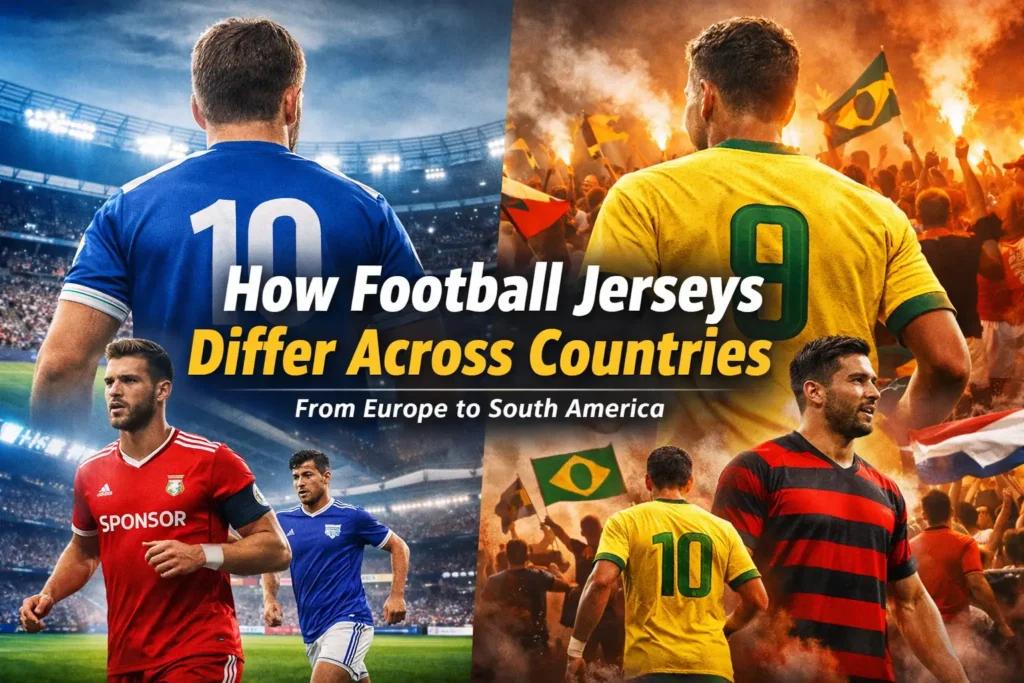
Football shirts may look more global than ever, but their design DNA is still deeply local. In Europe, many clubs prioritize heritage continuity, visual restraint, sponsor readability, and a fit that feels technical and streamlined. In South America, clubs often lean harder into energy, emotional symbolism, vivid contrasts, bolder visual rhythm, and a matchday look that feels alive even before kick-off.
That difference is not random. Research on football shirt evolution shows that jersey colors and visual traditions remain remarkably resilient because they are tied to branding, habit, and identity over long periods of time. In plain English: once supporters emotionally connect a look with a club, changing it carelessly is asking for trouble.
That is also why clubs sourcing fotballdrakter should stop treating jerseys as generic sportswear. A football kit has to do three jobs at once. It must help players perform, help fans identify, and help clubs build a recognizable visual asset season after season.
Europa: Precision, Restraint, and Heritage-Driven Performance
European football jersey culture often rewards discipline in design. That does not mean “boring.” It means controlled. The shirt usually needs to look sharp on television, professional in sponsor photography, and timeless enough that fans still want to wear it casually six months later.
In practical sourcing terms, that often leads to a few recurring preferences:
- slimmer or more structured athletic fits
- cleaner striping or block-color layouts
- sponsor marks that stay legible at distance
- restrained collar and cuff details
- high attention to club-color consistency over multiple seasons
This is exactly why clubs that want long-term brand recognition should study football jerseys that players love, coaches trust, and fans never forget. The best European-style kits usually win because they balance three things at once: spillerkomfort, broadcast clarity, and commercial wearability. A shirt can be emotionally meaningful without looking like the designer lost a fight with eight gradients and a lightning bolt pack.
Another overlooked point is visibility. A peer-reviewed study in the Journal of Sports Sciences found that white football outfits were localized more accurately than green ones in 5.2% of trials, suggesting that kit color can influence visual perception in match conditions. That is not the same as saying “white always wins,” but it does prove that color choice is not purely aesthetic fluff. It has functional consequences.

South America: Emotion, Rhythm, and Matchday Presence
South American football jerseys often communicate something more immediate and visceral. The shirt is not only a uniform. It is atmosphere. It is noise before noise. It is the visual extension of terraces, local pride, and emotional tempo.
That usually shows up in a different design language:
- stronger contrast combinations
- more expressive pattern work
- greater tolerance for bold chest and sleeve visuals
- looser visual energy rather than strict minimalism
- stronger cultural symbolism in color and detailing
The reason this works is simple: football culture in South America is intensely emotional and community-driven. FIFA has noted that Latin America represents one of the world’s largest football fan bases, which helps explain why shirt identity there is often treated as a social statement, not just a technical garment.
That is also why clubs should think carefully about custom football jerseys that players actually want to wear. In many South American-influenced design approaches, players want movement, letthet, airflow, and emotional pride in the same package. If the jersey looks brilliant in launch photos but feels sticky, hot, or restrictive in real play, the design has failed. A good football jersey should raise morale, not body temperature and blood pressure.
A Practical Comparison Table for Buyers
The table below is a practical sourcing framework based on football identity research, visibility studies, sportswear comfort research, FIFA fan-base context, and Ystarwear’s football uniform product logic. These are not rigid rules, but they are highly useful patterns for clubs, skoler, academies, and private-label buyers.
| Factor | Europe-Leaning Preference | South America-Leaning Preference | What Buyers Should Do |
|---|---|---|---|
| Passe | Cleaner, more tailored athletic silhouette | Slightly freer visual movement, comfort-led feel | Match the fit to player expectation, not just trend photos |
| Color Language | Stable heritage colors, disciplined contrast | Bolder contrasts, more expressive visual energy | Protect club identity first, then modernize carefully |
| Fabric Logic | Balanced performance with polished finish | Lightweight feel and heat comfort are often more critical | Prioritize climate before choosing the fabric package |
| Fan Appeal | Off-pitch wearability matters a lot | Emotional intensity and matchday symbolism matter more | Decide whether the shirt is performance-led, merch-led, eller begge deler |
| Sponsor Treatment | Cleaner layout and clearer hierarchy | More tolerance for visual complexity | Avoid clutter; distance readability still matters |
| Design Mood | Premium, controlled, timeless | Dynamic, passionate, high-impact | Align design mood with team culture and local audience |
What Science Says About Fabric, Climate, and Performance
Here is where many clubs make an expensive mistake: they copy a visual style from another country without copying the performance logic behind it.
A jersey built for cooler, less humid conditions will not necessarily perform well in hot and humid football environments. EN 2025 study on football jersey fabrics used in hot and humid weather emphasized that thermophysiological comfort is critical for athlete performance and tested different 100% polyester microfiber constructions such as mini mesh, eyelet, and interlock. That matters because not all “polyester football jerseys” behave the same way once sweat, airflow, and heat build-up enter the chat.
Related sportswear research also shows that moisture management and thermal comfort depend heavily on fiber composition, layer structure, pusteevne, and evaporation resistance. Studies summarized in the sportswear literature found that bi-layer constructions and moisture-transfer-oriented synthetic inner layers can improve comfort in active and summer sportswear applications, while lower resistance to evaporative heat transfer improves breathability. In normal human language: if the fabric cannot move sweat and release heat efficiently, your players are basically wearing a tactical sauna.
That is why buyers looking at professional adult soccer jerseys should evaluate more than price and artwork. They should ask:
- Is the jersey designed for hot, humid, tørke, or mixed conditions?
- Are ventilation zones placed in the chest, tilbake, and underarm where heat accumulates most?
- Is the fabric light enough for match play but stable enough for repeated washing?
- Does the cut support sprinting, rotation, and shoulder movement?
- Will the print finish stay clean after multiple wash cycles?
The Fabric Choices That Usually Make Sense
For clubs influenced by European styling, a smoother double-knit or well-finished performance polyester may make sense because it supports a cleaner silhouette and polished visual presentation.
For clubs influenced by South American match intensity, micro-mesh, eyelet, or strategically ventilated polyester structures often make more sense because airflow and fast sweat dispersion become more urgent.
For hybrid clubs, the sweet spot is often a performance polyester base with mesh panel zoning and moderate stretch, so the jersey looks sharp but still handles heat properly.

The Biggest Buyer Mistakes When Copying Another Country’s Football Jersey Style
This is where the pain usually starts.
A school in a tropical city orders a beautiful European-inspired shirt with a heavy feel, thick collar, and dense print coverage. It looks fantastic in mockups. By minute 60, players are tugging the neckline, sweat is trapped in the torso, and the shirt feels like wet wallpaper. På den andre siden, a club in a cooler market orders a very loud, ultra-light, high-contrast design meant to mimic South American energy, only to discover that fans find it visually chaotic and less wearable off the pitch.
The smarter route is to build a custom soccer jersey for your team around actual use conditions. Most sourcing failures come from one of these five mistakes:
- Choosing by inspiration photo instead of match environment
- Prioritizing fashion trends over player comfort
- Ignoring how color affects readability and on-pitch visibility
- Using one fit standard for every age group and body type
- Treating the jersey as merchandise only, or as performance gear only, instead of both
The best clubs do the opposite. They define the climate, player level, club identity, fan expectations, and budget window first. Then they build the shirt. That sequence saves money, avoids remake headaches, and usually leads to much higher player satisfaction.
Ystarwear Case Analysis: What a Smarter Country-Aware Jersey Strategy Looks Like
A useful way to think about Ystarwear is not just as a seller of shirts, but as a manufacturing framework that already reflects the reality that different teams need different solutions.
According to Ystarwear’s public materials, the company highlights football uniform manufacturing experience, state-of-the-art equipment, strict quality control, and sportswear R&D. Its football uniform pages show multiple fabric constructions, gjelder også 100% polyester small mesh around 144g, double-sided fabrics around 140g, mixed structure panels, and an 84% polyester / 16% spandex option at 240G. The main site also states a monthly capacity of 2 millioner stykker, MOQ of 500 pieces per design, and AQL 2.5 kvalitetskontroll. That combination matters because country-specific jersey differences often require flexible manufacturing, not just pretty mockups.
This is why a serious buyer should understand Ystarwear sportswear manufacturer. If your team wants a Europe-leaning identity, Ystarwear can support cleaner visual execution, controlled sponsor placement, and fabric choices that look premium on and off the pitch. If your team wants a South-America-leaning identity, the same product logic can shift toward bolder graphics, lighter-feel structures, and faster sweat management for hotter conditions.
Scenario 1: A European-Style Academy Kit
A private academy wants a serious, disciplined image for coaches, parents, and sponsors. The right answer is likely:
- a clean body layout
- limited gradient effects
- highly readable numbering
- a more structured athletic fit
- a polished polyester or double-knit visual finish
Scenario 2: A South American-Style Club Kit
A community club wants movement, energi, emotional identity, and matchday visibility in warm conditions. The better answer is likely:
- stronger visual contrast
- lighter-feel fabric zones
- eyelet or mesh ventilation logic
- looser visual rhythm in patterning
- high sweat-management priority
Neither approach is universally right. Both are right when the buyer stops chasing trend imitation and starts buying for actual football reality.
Expert View: The Best Football Jersey Is Not the Most “Beautiful” One
A common sourcing myth says the most successful football jersey is the one with the most eye-catching design. That sounds nice in a meeting. It collapses in a real match.
The best football jersey is the one that aligns four variables:
- football culture
- climate
- body movement
- brand identity
When those four are aligned, the jersey looks right, feels right, and sells right.
When they are not aligned, you get a shirt that works only in renders and launch posters. That is not product strategy. That is expensive cosplay.
Frequently Asked Questions
Why do football jerseys fit differently in Europe and South America?
Because football cultures prioritize different things. Europe often leans toward streamlined professionalism, sponsor clarity, and heritage discipline. South America often leans toward energy, emotional presence, and climate-aware comfort. The best fit depends on player expectation, local football culture, and match conditions.
Are South American football jerseys usually lighter?
Not always, but many teams playing in hotter and more humid conditions benefit from lighter-feel fabrics, faster sweat transfer, and stronger ventilation zoning. Research on football jersey comfort in hot and humid weather supports the importance of thermophysiological comfort in these conditions.
What fabric is best for hot-weather football jerseys?
There is no single winner, but micro-mesh, eyelet, and other breathable polyester microfiber constructions are often strong choices for hot-weather play. Sportswear research also shows that moisture-management structure and evaporative resistance are key factors, not just the fiber name on a spec sheet.
Do football jersey colors affect performance?
Color can influence visibility and perception. A peer-reviewed study found that white outfits were identified more accurately than green ones in certain trials, which suggests visibility has practical implications. That does not mean one color automatically wins matches, but it does mean kit color choices should be made thoughtfully.
Should clubs copy the jersey style of famous teams from other countries?
Only with caution. Copying a look without copying the fit logic, climate logic, and identity logic behind it is one of the fastest ways to end up with a kit players complain about and fans forget. The better move is to adapt inspiration, not clone it.
The Real Difference in Football Jerseys Starts with Purpose
Så, how do Fotballdrakter differ across countries from Europe to South America?
They differ in far more than appearance. They differ in what they are trying to achieve. European-style jerseys often prioritize structure, heritage continuity, and premium clarity. South American-style jerseys often prioritize emotion, bevegelse, and matchday energy. Both approaches can succeed. Both can fail. The difference lies in whether the shirt is built around real football needs rather than trend imitation.
That takes us back to the opening question: why do some jerseys look amazing before kick-off and feel terrible by halftime? Because too many teams buy by image instead of logic.
The better path is simple. Start with your climate. Define your identity. Match the fit to your players. Match the fabric to your environment. Then work with a supplier that understands how football culture changes from one market to another. When you are ready to move from guesswork to a more market-aware sourcing process, the next step is to contact Ystarwear and turn design inspiration into a jersey system your players will actually want to wear.