The global procurement of professional athletic apparel has evolved into a highly specialized technical discipline. For B2B buyers, club directors, and sportswear brand managers, sourcing elite kits de futbol involves navigating a complex matrix of polymer science, dimensional anthropometry, and international trade compliance. Modern athletes require garments that actively manage thermoregulation and minimize aerodynamic drag, shifting the manufacturing focus from simple cut-and-sew operations to advanced textile engineering.
To maintain competitive margins while guaranteeing technical performance, procurement teams must look toward specialized overseas facilities. Understanding the operational protocols within these factories—from raw material extrusion to export logistics—is fundamental for securing premium uniformes de futbol that meet the rigorous standards of professional leagues. This analysis outlines the critical technical parameters and supply chain strategies utilized by top-tier buyers when sourcing performance athletic wear.

Direct Material Sourcing from High-Tech Textile Mills
The foundation of any elite athletic garment is its base polymer chemistry. Standard apparel supply chains often rely on open-market fabric trading, which introduces dangerous variables in material weight, stretch recovery, and dye absorption. Professional procurement strategies mandate direct sourcing from high-tech textile mills capable of extruding proprietary micro-engineered yarns.
The primary metric evaluated by advanced wholesale football jersey manufacturers is the Moisture Vapor Transmission Rate (MVTR). During a 90-minute match, an athlete generates significant metabolic heat. Elite fabrics utilize a blend of 88-92% micro-polyester and 8-12% high-grade elastane (spandex). The micro-polyester features microscopic capillary channels that draw sweat away from the epidermis, while the elastane provides crucial four-way stretch, allowing the garment to recover its structural integrity immediately after mechanical stress.
Además, strict environmental mandates from global governing bodies have accelerated the transition toward circular textile economies. Factory-direct sourcing allows buyers to specify GRS (Global Recycled Standard) certified rPET (recycled Polyethylene Terephthalate). This material, derived from post-consumer ocean plastics, performs identically to virgin polyester but satisfies the stringent sustainability compliance requirements demanded by modern European and North American markets.
The Precision Pattern-Making Process for Ergonomic Fits
The physical geometry and pattern grading of the garment present another critical layer of manufacturing complexity. The industry enforces a strict bifurcation between “Player Version” (authentic match-day) y “Fan Version” (replica stadium) architectures. Authentic match shirts are constructed utilizing dynamic, 3D athletic cuts. This involves complex curved paneling tailored tightly to the athlete’s torso, featuring elevated armholes and tapered waistlines to eliminate excess fabric that generates aerodynamic drag.
For academies and professional clubs, abandoning generic boxy templates and sourcing custom football shirts that fit the exact biometric profiles of their athletes is a non-negotiable performance standard. Replica versions, conversely, utilize a straight, relaxed geometry designed to accommodate diverse demographic body shapes, prioritizing casual comfort over high-speed athletic aerodynamics.
Scaling these geometric patterns across different age groups requires highly intricate mathematical grading. Pediatric and adolescent body geometries possess entirely different structural proportions compared to fully developed adults. The shoulder slope, chest-to-waist drop, and collar circumferences must be recalculated independently for each specific age bracket.
A prevalent manufacturing failure occurs when factories improperly scale the transition between youth football jerseys vs adult cuts. Linear scaling—simply shrinking an adult pattern by a fixed percentage—results in restrictive necklines or disproportionately long hemlines that hinder a young athlete’s biomechanics. Advanced facilities utilize digital CAD software to establish independent grading rules for pediatric athletic wear, ensuring optimal performance across all academy levels.
Dimensional Scaling and Anthropometric Data
Beyond age demographics, global procurement officers must account for significant anthropometric variations across different international markets. A “Large” size in the Asian market differs drastically in chest circumference and torso length from a “Large” in the North American or European markets.
Understanding how to size for every age group within a specific regional context is essential to prevent catastrophic wholesale return rates. Professional factories employ localized grading charts (p.ej., US Standard, EU Standard, Asian Fit). When initiating a bulk order, buyers must mandate that the factory produces physical sizing sets (“fit samples”) across the entire size run. These samples are tested on live fit models in the target market before full-scale automated cutting begins, ensuring the final bulk delivery perfectly matches regional consumer expectations.
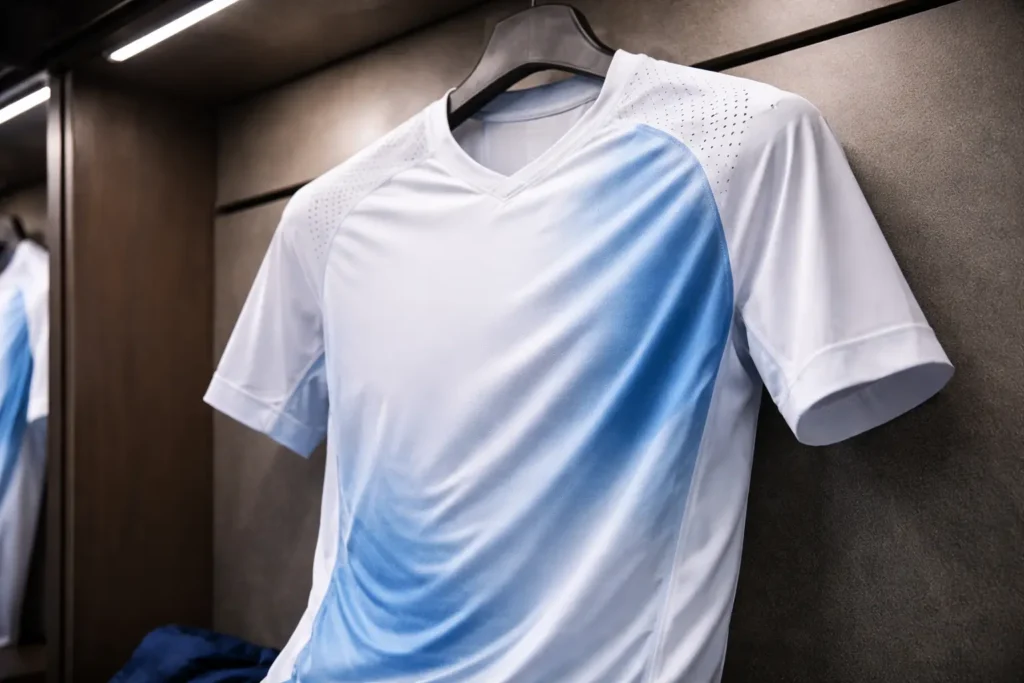
Automated Color Management for Brand Consistency
Maintaining absolute color consistency across thousands of units is one of the most technically demanding aspects of bulk sportswear production. Modern performance apparel relies on dye-sublimation printing, a thermodynamic process where specialized disperse dyes are heated to temperatures exceeding 200°C. At this threshold, the solid dye vaporizes and permanently permeates the open pores of the polyester microfibers, guaranteeing zero color fading and maintaining 100% of the fabric’s breathability.
Sin embargo, heat fluctuations during the sublimation calendar process can cause severe color shifting. To combat this, elite buyers establish strict color tolerances when selecting the perfect football jersey fabricante. Premium factories utilize automated spectrophotometers to measure the Delta E (ΔE) color variance between the approved digital Pantone target and the sublimated fabric.
The following table outlines the standardized scientific parameters enforced during professional quality control inspections:
| Quality Control Parameter | Authentic Match Specification | Replica / Training Specification | Testing Methodology |
|---|---|---|---|
| Color Variance (Delta E) | ΔE < 1.0 (Imperceptible) | ΔE < 2.0 (Acceptable standard) | Spectrophotometer Analysis |
| Color Fastness (Lavado) | Grade 4-5 (No bleeding) | Grade 4 (Minimal fading) | ISO 105-C06 Standard |
| Fabric Weight (GSM) | 110 – 130 GSM | 150 – 160 GSM | ASTM D3776 Standard |
| Pilling Resistance | Grade 4 (High resistance) | Grade 3-4 (Moderate resistance) | YO ASI 12945-2 (Martindale test) |
| Stretch Recovery | > 95% recovery instantly | > 90% recovery | ASTM D3107 Standard |
Global Logistics: Ensuring Safe & Fast Delivery
Procuring the material and manufacturing the garments is only part of the supply chain equation; ensuring the inventory arrives at the destination port on schedule is paramount. B2B distributors must coordinate the delivery of seasonal kits precisely before the start of a new sporting calendar. Understanding factory lead times prevents highly damaging logistical bottlenecks.
A standard manufacturing cycle for bulk orders (1,000 a 10,000 units) operates on a highly structured timeline. The Sampling Phase requires 7 a 14 days for CAD pattern engineering and Top of Production (TOP) sample approval. Bulk production spans 30 a 45 días, followed by maritime shipping transit (typically 25-35 days to EU/US ports). Professional procurement teams actively monitor potential factory congestion, particularly preceding major global tournaments.
Además, importing textiles into highly regulated markets requires stringent adherence to international safety laws. Reputable factories operate under the OEKO-TEX Standard 100 certification framework. This independent laboratory testing guarantees that all polyester yarns, sublimation dyes, and sewing threads are entirely free from restricted carcinogenic azo colorants and heavy metals. For technical consultations regarding ISO certifications, GRS compliance, or establishing a reliable production timeline, procurement officers should contact the manufacturing facility’s supply chain management team directly to ensure all customs and compliance documentation is verified prior to export.

Preguntas más frecuentes
1. What is the standard MVTR requirement for authentic match shirts?
The Moisture Vapor Transmission Rate (MVTR) is a critical performance metric for authentic match shirts. Professional-grade micro-polyester fabrics are engineered to achieve high capillary action, moving sweat from the skin to the fabric’s exterior rapidly. While exact numeric standards vary by testing method, the optimal fabric composition utilizes an 88-92% polyester and 8-12% elastane blend at a highly breathable 110-130 GSM weight to maximize continuous thermal regulation during 90-minute athletic exertion.
2. How do factories ensure exact color consistency in bulk orders?
To guarantee absolute color consistency across thousands of garments, premium factories employ automated spectrophotometers alongside high-temperature dye-sublimation technology. The spectrophotometer measures the Delta E (ΔE) variance between the physical fabric and the approved digital Pantone code. Professional quality control protocols reject any production batch that exhibits a Delta E variance greater than 2.0, ensuring uniform brand identity globally.
3. Why is OEKO-TEX certification necessary when importing sportswear?
OEKO-TEX Standard 100 is an independent, globally recognized testing certification that verifies textiles are free from harmful substances. It is a mandatory requirement for importing apparel into strictly regulated markets like the European Union and the United States. Without this certification proving the absence of carcinogenic azo colorants, formaldehyde, and heavy metals, international customs authorities can impound or destroy the entire wholesale shipment.
4. What is the structural difference between player version and replica cuts?
El “Player Version” features a 3D ergonomic, highly tapered athletic cut specifically engineered to eliminate excess fabric and reduce aerodynamic drag. It incorporates elevated armholes and complex curved paneling. El “Replica Version” (or Fan Version) utilizes a traditional, straight-cut geometry designed for a relaxed fit, accommodating a much wider demographic of body shapes and prioritizing casual comfort over high-speed athletic aerodynamics.
5. How is sizing properly graded between youth and adult demographics?
Proper pattern grading between youth and adult demographics requires completely independent mathematical scaling. Linear scaling (simply shrinking an adult pattern) fails because pediatric and adolescent body geometries have different shoulder slopes, chest-to-waist drops, and neck circumferences compared to fully developed adults. Advanced manufacturers utilize digital CAD software to create distinct geometric baseline patterns for each age bracket, ensuring biomechanical freedom of movement for all players.
References:
- “Moisture Vapor Transmission and Thermoregulation in High-Performance Micro-Polyester.” Journal of Athletic Textile Engineering.
- “Aerodynamic Drag Reduction via 3D Ergonomic Pattern Grading.” International Institute of Sports Biomechanics.
- “Spectrophotometric Quality Control in Dye-Sublimation Processes.” Journal of Industrial Color Science.
- “Compliance Protocols: OEKO-TEX Standard 100 and Global Customs Regulations.” International Textile Compliance Board.
- “Lifecycle Assessment of GRS Certified rPET in Bulk Sportswear Manufacturing.” Global Sustainable Textile Review.
- “Anthropometric Scaling Errors in Pediatric Athletic Apparel.” American Society of Pattern Engineers.
- “Supply Chain Logistics and Production Lead Times in Asian Textile Markets.” Global Sourcing Economics Quarterly.
- “ISO 105-C06: Standard Test Methods for Color Fastness to Domestic and Commercial Laundering.” International Organization for Standardization.