The Real Question Is Not Which One Looks Better
“Should we just order standard jerseys and save time, or is it finally worth going custom?"
That question usually comes up in the most stressful part of team planning—right when the coach wants sizes, the manager wants pricing, the players want something that actually looks good, and the school or club wants everything delivered without drama. On paper, the choice seems simple. Camisetas estándar are fast, familiar, and easier to order. Custom Soccer Jerseys feel more exciting, more branded, and more team-specific. But in real life, the decision is less about fashion and more about what your team actually needs.
That is why this comparison matters. The difference between Custom Soccer Jerseys y Camisetas estándar is not just color options or logo placement. It affects team identity, fit consistency, youth-player comfort, long-term ordering flexibility, and how well the kit matches the level of competition. Para clubes, escuelas, academias, and adult teams, the better choice depends on goals, presupuesto, age group, urgency, and how much value the team places on visual identity and performance detail.
For teams that want supplier background before comparing product routes, About Ystarwear is a helpful starting point. It gives brand context for readers who want to understand the manufacturer behind the kits before deciding how far to customize.
One reason this decision matters more today is that uniform design is not just cosmetic. Research shows that uniforms can influence wearer pride, group perception, and self-related emotional response, which helps explain why teams often care about kit identity far more than outsiders expect.
What Both Options Actually Get Right
Before comparing them, it is worth saying something many sales pages avoid: both Custom Soccer Jerseys y Camisetas estándar can be the right decision.
A school hosting multiple age groups may prioritize reordering convenience and predictable delivery. A club building a recognizable image may care more about distinct visuals and sponsor integration. A youth academy may focus first on comfort, movimiento, and fabric behavior in hot weather.
From a functional perspective, sports clothing performance depends heavily on moisture management, termorregulación, and comfort during exercise. Reviews on sports clothing and heat stress consistently show that fabric behavior affects thermal comfort and perceived exertion, while wicking performance is strongly influenced by fiber composition.
If you are starting from the broader product category rather than from a single style decision, uniformes de futbol is the most natural page to anchor that search. It helps frame the conversation around the full team-kit category instead of reducing everything to one purchase moment.
What Custom Soccer Jerseys Do Better
When teams choose Custom Soccer Jerseys, they are usually buying more than a shirt. They are buying control.
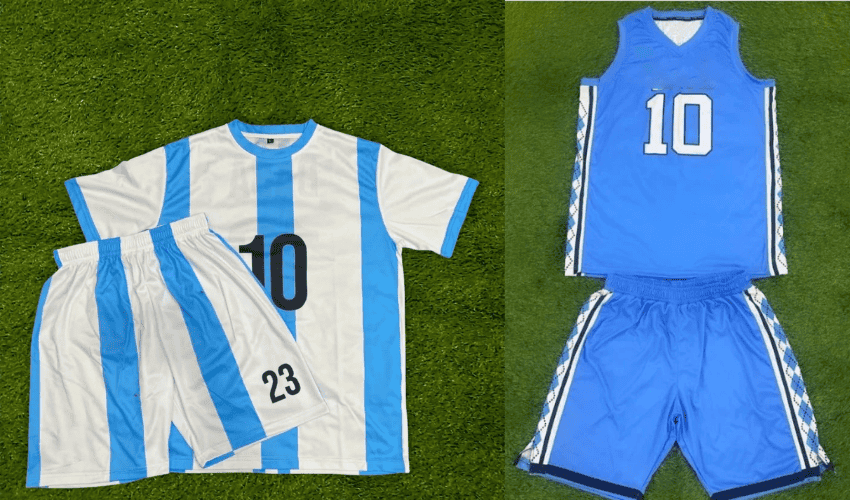
That control shows up in several ways. Colors can be matched to club identity. Sponsor space can be integrated more cleanly. Fuentes, nombres de jugadores, numbering layouts, detalles de la manga, piping, panel direction, and trim can all be selected with a specific team image in mind. That matters more than people think, especially for clubs trying to look established, schools trying to unify multiple squads, or academies trying to build credibility with recruits and parents.
Custom kits also tend to solve a branding problem that standard options cannot fully address: sameness. A standard template may work perfectly well, but it is still a template. A custom design lets the team look like itself rather than like a version of whatever was in stock that season.
How Much Customization Do Custom Soccer Jerseys Actually Offer?
Not every custom soccer jersey project requires a completely new design from scratch. The level of customization can vary depending on the team’s budget, order requirements, branding goals, and production timeline. Understanding these levels helps buyers avoid paying for design features they do not actually need.
Most custom soccer jersey projects can be divided into three practical customization levels.
1. Basic Customization
Basic customization usually starts with an existing jersey design or template. Buyers may select team colors, add club logos, customize player names and numbers, or adjust selected graphic details. This approach is suitable for teams that want a recognizable identity without developing an entirely new garment design.
2. Design-Based Customization
At this level, buyers have more control over the visual appearance of the jersey. They can develop custom color combinations, graphic patterns, sponsor placements, detalles de la manga, collar designs, and front or back panel artwork. The garment may still use established fabric and construction options, but the overall appearance is developed around the team’s identity.
3. Full OEM or ODM Customization
A more comprehensive project may involve custom artwork, fabric selection, garment panel construction, collar and sleeve details, métodos de impresión, etiquetas, and coordinated teamwear accessories. This route is more suitable for clubs, academias, sportswear brands, and organizations that need a distinctive product line or long-term uniform program.
| Customization Level | Typical Options | Best-Suited Buyers |
|---|---|---|
| Básico | Team colors, logotipos, nombres, y numeros | Local clubs and school teams |
| Design-based | Custom patterns, diseños de patrocinadores, and graphic details | Established clubs and academies |
| Full OEM/ODM | Obra de arte, materiales, construcción, etiquetas, and coordinated apparel | Sportswear brands and large team programs |
One important point is that customization options depend on the manufacturer’s production capabilities and order requirements. Buyers should confirm which features are available before approving the design. A clear customization brief helps the supplier recommend a suitable production route without adding unnecessary complexity.
This is exactly why Arriba 5 Benefits of Ordering Custom Soccer Jerseys for Clubs and Schools is such a useful supporting page. The title alone points to the strongest argument for going custom: clubs and schools often need more than simple apparel—they need recognition, continuity, and a more professional team image.
There is also a psychological side to this. Research on team environments shows that athlete leadership, cohesion, and team identification are closely linked inside successful groups. Uniforms are not the whole story, obviously, but a shared visual identity can support how players perceive belonging and role clarity.
What Standard Jerseys Still Do Extremely Well
Now for the part too many custom-focused articles try to sidestep: Camisetas estándar remain a smart choice for many teams.
Por qué? Because speed, sencillez, and repeatability are not small advantages. They are huge ones.
A standard jersey program often works best when a team needs quick turnaround, straightforward sizing, easy reorders, and less design decision fatigue. Coaches managing multiple squads do not always want a six-round design process. Community teams replacing kits mid-season do not want to wait on approvals, mockups, and production revisions. Some organizations simply need clean, durable, good-looking jerseys that can be ordered again without rebuilding the whole file structure from scratch.
It is worth noting that standard jerseys are not necessarily completely non-customizable. Some suppliers allow buyers to add team logos, nombres de jugadores, números, or sponsor graphics to existing jersey designs. The main distinction is that standard options usually start with an established garment template, while fully custom projects provide greater control over the overall design and construction. Buyers should confirm exactly which modifications are available before comparing suppliers.
Size Management and Reordering: An Important Difference for Team Buyers
Para clubes, escuelas, and soccer academies, ordering jerseys is rarely a one-time task. New players may join during the season, existing players may need replacement garments, and different age groups may require additional sizes.
This is where size management and order records become important.
Standard jerseys can be convenient when the same model remains available and the team only needs to replace a few garments. Sin embargo, buyers should check whether the supplier can continue providing the same color, tela, adaptar, and design in future orders.
Custom Soccer Jerseys can also support repeat ordering when the original design files and production specifications are properly retained. A manufacturer that maintains clear records can use the approved artwork, fabric details, dimensiones del logotipo, printing specifications, and size chart as references for future orders.
Before confirming a teamwear program, buyers should organize the following information:
| Information to Keep | Por qué es importante |
|---|---|
| Approved jersey artwork | Maintains consistent colors and graphic placement |
| Logo and sponsor files | Prevents repeated artwork preparation |
| Player name and number list | Reduces personalization errors |
| Size breakdown | Helps plan quantities across the team |
| Fabric and material specifications | Supports consistency between orders |
| Printing and construction details | Makes repeat production easier to coordinate |
| Approved sample reference | Provides a benchmark for future quality checks |
| Previous order records | Helps manage replacements and additional quantities |
For teams with changing rosters, it is also useful to separate the core jersey design from player-specific information. This allows the team to retain its overall visual identity while updating names, números, and quantities when needed.
A practical reorder strategy should be discussed before the first bulk order. Buyers can ask whether the manufacturer retains artwork files, how repeat orders are handled, whether the same materials remain available, and what minimum quantities apply to replacement garments.
This is especially useful for schools and academies that purchase uniforms across multiple seasons. A well-managed specification record can reduce repeated communication and make future ordering more predictable.
There is also a budget logic here. When the goal is to get a team dressed efficiently and professionally, Camisetas estándar can offer strong value. That does not make them “basic.” It makes them operationally useful.
Camisetas de fútbol personalizadas versus camisetas estándar: Understanding the Total Cost
The purchase price of a soccer jersey is only one part of the total cost. Teams should also consider design preparation, customization requirements, desarrollo de muestras, minimum order quantities, delivery arrangements, and future replacement orders.
Standard jerseys may have a lower initial purchasing cost when the required sizes and designs are readily available. They can also reduce the time spent on artwork approval and product development. Sin embargo, if a team needs additional logos, gráficos del patrocinador, or special design changes, the final cost may increase depending on the supplier’s customization options.
Custom Soccer Jerseys may involve additional development and setup work, particularly when a project requires original artwork, multiple printing elements, special trims, or custom construction. Sin embargo, these costs should be evaluated against the value of brand consistency, identidad del equipo, and future repeat orders.
| Cost Factor | Custom Soccer Jerseys | Camisetas estándar |
|---|---|---|
| Design preparation | May require custom artwork and approval | Usually limited to available designs |
| Logo and sponsor customization | More flexible | Depends on available options |
| Sample development | May involve additional development steps | Often simpler when existing styles are available |
| Initial unit cost | Depends on materials, cantidad de pedido, and customization | Often more predictable for standard options |
| Minimum order requirements | May vary with customization and production method | Depends on stock and supplier policy |
| Reordering | Easier when specifications and artwork are retained | Convenient when the same model remains available |
| Product differentiation | Greater control over unique design details | More limited by existing templates |
For a more accurate purchasing decision, buyers should calculate the total project cost rather than comparing only the price per shirt.
A useful budgeting formula is:
Total Project Cost = Jersey Production Cost + Customization Cost + Sampling and Setup Cost + Shipping and Applicable Fees + Expected Replacement Cost
Por ejemplo, a club ordering jerseys for several age groups should consider whether the same design can be reused across different sizes and future seasons. If artwork and production specifications are properly documented, repeat orders may require less development work.
The lowest initial unit price does not always represent the best overall value. Buyers should compare the complete cost structure against their team’s requirements, delivery schedule, and expected reorder frequency.
For adult teams, ligas, and more performance-minded buyers, 2026 Guía definitiva para comprar camisetas de fútbol profesionales para adultos is a strong bridge page in this discussion. It helps position standard or ready-to-order kit logic in a more performance-focused context, especially for teams that prioritize fit, material handling, and adult match-day requirements.

The Biggest Difference Is Design Freedom vs Ordering Efficiency
If you had to reduce the whole topic to one line, it would be this:
Custom Soccer Jerseys give you more design freedom. Camisetas estándar give you more ordering efficiency.
Everything else tends to grow out of that.
Here is a simple comparison table that makes the tradeoff easier to see:
| Factor | Custom Soccer Jerseys | Camisetas estándar |
|---|---|---|
| Identidad visual | Strongest advantage | More limited but still clean |
| Speed to order | Usually slower | Usually faster |
| Reorder simplicity | Good if supplier records are managed well | Often easier and faster |
| Sponsor integration | More flexible | More restricted by template |
| Team uniqueness | Very high | Moderado |
| Decision complexity | Higher | Lower |
| Best for | Clubs, escuelas, academias, branded teams | Quick-turn teams, ligas, budget-conscious groups |
The real choice depends on where your team feels the most pressure. If the pressure is to look unique, align branding, and unify a long-term program, custom usually wins. If the pressure is time, conveniencia, and straightforward repeat supply, standard often makes more sense.
Fit and Comfort Matter More Than Most Teams Realize
A jersey can look great and still fail if players hate wearing it.
That is where the comparison gets more serious. The better option is not just the one with stronger visuals. It is the one that helps players move, regulate heat, and stay comfortable through training and matches. Scientific reviews on sports clothing show that garment design and moisture-handling characteristics affect thermoregulation, comfort perception, and even subjective performance during activity in the heat. Fabrics that manage sweat more effectively generally support better comfort under exertion.
This is especially important for younger athletes. Guidance from pediatric sports medicine emphasizes that youth soccer requires stronger attention to heat illness prevention, seasonal acclimatization, and safe participation conditions, particularly during hot weather.
That is why Guía de seguridad y comodidad para camisetas de fútbol juveniles belongs naturally in this conversation. For youth teams, the “best jersey” is not just about what looks sharp in team photos. It is about fabric feel, transpirabilidad, movement range, and how safely the uniform performs across hot training sessions and repeated washes.
When Custom Soccer Jerseys Are the Smarter Choice
Here are the situations where Custom Soccer Jerseys usually make more strategic sense:
Building a club identity
If your club is trying to look established, custom kits help create a recognizable visual signature across age groups and seasons.
Managing sponsors properly
Sponsor placement on standard templates can feel like an afterthought. Custom layouts usually handle brand integration more professionally.
Running school or academy programs
Schools and academies often want stronger identity alignment across multiple teams. Customization helps unify the entire program.
Creating long-term design consistency
A good custom kit system can support future reorders, alternate kits, training tops, and broader merchandise with better coherence.
How the Custom Soccer Jersey Production Process Works
One of the main differences between custom and standard soccer jerseys is the development process. Standard jerseys may be selected from existing designs, while custom projects usually require more communication between the buyer and manufacturer before production begins.
Understanding each stage helps teams prepare the correct information, reduce approval delays, and avoid unnecessary changes after production has started.
Paso 1: Prepare the Team Design Brief
The buyer should provide the team logo, preferred colors, sponsor artwork, player name and number requirements, jersey quantity, size distribution, and intended application. Reference images or previous-season uniforms can also help communicate the desired appearance.
Paso 2: Confirm the Design and Customization Details
The manufacturer reviews the artwork and confirms which design elements can be produced. Buyers should check logo proportions, number visibility, sponsor placement, combinaciones de colores, collar details, and sleeve graphics before approving the design.
Paso 3: Review Materials and Production Specifications
Fabric composition, surface texture, ajuste de la prenda, método de impresión, puntadas, etiquetas, and other construction details should be confirmed according to the project requirements. The selected materials should be suitable for the intended training, fósforo, or promotional use.
Paso 4: Approve the Sample or Pre-Production Reference
When sample development is required, buyers should review the physical garment for appearance, adaptar, material feel, printing quality, y construcción. Any necessary revisions should be confirmed before bulk production.
Paso 5: Confirm the Bulk Order
After the design and specifications are approved, the buyer confirms the final quantities, desglose del tamaño, player information, requisitos de embalaje, and delivery arrangements. The manufacturer can then proceed according to the agreed production plan.
Paso 6: Inspect and Prepare the Finished Jerseys
Finished garments should be checked for size accuracy, colocación del logotipo, printing quality, puntadas, consistencia del color, y cantidad del pedido. Proper folding and packing also help protect the jerseys during transportation.
This process may be shorter for simple customization projects and more detailed for full OEM or ODM development. Buyers should confirm the actual production schedule with the supplier rather than assuming every custom order follows the same timeline.
A clear approval process is particularly important for clubs and schools ordering multiple teams or age groups. It helps ensure that the final garments match the approved design and that all players receive the correct jersey specifications.
If your team is at the stage of comparing design direction, fit priorities, and branding needs, Cómo elegir la camiseta de fútbol personalizada perfecta para tu equipo is the most relevant supporting page. It sits right where many buyers need help: the gap between “we want custom” and “what should we actually choose?"

When Standard Jerseys Are the Smarter Choice
And here are the situations where Camisetas estándar usually earn their place:
You need kits quickly
Mid-season replacement or late planning often makes standard programs the safer route.
The budget is tight
When resources are limited, a strong standard jersey can still deliver team cohesion without overcomplicating the process.
The team changes frequently
Community teams, temporary squads, and fast-rotating rosters may need something simpler and faster to replace.
You want fewer decisions
Some coaches do not want to spend energy on fonts, trim lines, collar shapes, and file approvals. Fair enough.
This is the part many brands understate: decision fatigue is real. The best product is not always the most configurable one. Sometimes the best product is the one that lets the manager get the team ready without adding another spreadsheet to their life.
A Practical Scenario for Clubs and Schools
Imagine two buyers.
The first is a school athletics coordinator running multiple boys’ and girls’ teams. They need visual consistency, sponsor visibility, and a more professional look across seasons. They also want the jerseys to align with school colors and create a recognizable presence at tournaments. For them, Custom Soccer Jerseys likely make more sense because the kits are part of the school’s broader athletic identity.
The second is a weekend adult league manager who needs 18 jerseys in two weeks after the previous supplier failed. They care about good fit, tejido transpirable, and a clean look, but they do not need complex design work. For them, Camisetas estándar may be the better answer because speed and simplicity matter more than visual exclusivity.
Neither buyer is wrong. They are just solving different problems.
How Order Quantity and Delivery Deadlines Affect the Best Choice
The right jersey option also depends on how many garments a team needs and when they need them. A small community team ordering replacement shirts may have very different requirements from a school purchasing uniforms for several age groups or a sportswear brand preparing a seasonal collection.
For smaller or urgent orders, standard jerseys may be more practical when suitable designs, colores, and sizes are already available. The team can avoid some of the artwork development and approval steps associated with a fully custom project.
For larger or recurring team programs, custom production may become more attractive because the buyer can establish a consistent design and retain the specifications for future orders. Sin embargo, customization requirements, material availability, minimum order quantities, and production capacity all need to be confirmed.
| Buyer Situation | Option to Consider | Main Reason |
|---|---|---|
| Small team with an urgent deadline | Standard jerseys | Fewer design and approval steps |
| School ordering for several teams | Custom or standard | Depends on identity requirements and size availability |
| Club building a long-term visual identity | Custom jerseys | Greater control over branding |
| Academy with recurring seasonal orders | Custom jerseys | Consistent design and retained specifications |
| Temporary event or tournament team | Standard or basic customization | Practical ordering and limited development |
| Sportswear brand developing its own product line | Full OEM/ODM customization | Greater control over product design |
There is no universal order quantity at which custom production automatically becomes more economical. The result depends on the garment construction, método de impresión, customization level, factory requirements, and quantity of each design.
Before placing an order, buyers should ask the supplier to confirm the minimum order quantity, sample lead time, bulk production schedule, and availability of materials. They should also allow time for artwork revisions, size collection, sample review, and shipping.
The best purchasing decision is not simply the option with the shortest quoted lead time. It is the option that can meet the team’s actual deadline without compromising the required design, adaptar, y calidad.
The Hidden Costs Teams Often Ignore
A lot of teams compare only price per jersey. That is too narrow.
The smarter comparison includes:
- time spent choosing and approving
- future reordering ease
- consistency across sizes and seasons
- comfort in hot conditions
- branding or sponsor clarity
- how “professional” the team needs to look in context
There is also a safety and environmental factor around heat and hydration worth remembering. Heat-guidance and hydration literature repeatedly shows that clothing, environment, and workload all interact under hot conditions. That means fabric choice and comfort are not just aesthetic issues—they affect how tolerable play feels during exertion.
That does not mean one jersey type is inherently “unsafe.” It means teams should stop acting like all jerseys perform the same once the whistle blows.
A Balanced Recommendation Based on Need
If your team values uniqueness, long-term identity, and stronger brand alignment, elegir Custom Soccer Jerseys.
If your team values speed, sencillez, and easier reordering with less decision overhead, elegir Camisetas estándar.
If you are buying for youth players, comfort and heat-conscious fabric behavior should move closer to the front of the decision process.
If you are buying for adult competitive teams, fit consistency and game-day practicality may matter more than extreme customization.
And if you are still unsure, that usually means you need a supplier conversation, not another vague article. At that point, Contact Ystarwear is the most logical next step for clarifying timelines, customization depth, and which route fits your team structure best.

Preguntas frecuentes
Are custom soccer jerseys better than standard jerseys?
Not universally. Custom Soccer Jerseys are usually better for teams that want stronger branding, sponsor integration, and unique visual identity. Camisetas estándar are often better for teams that prioritize speed, sencillez, and quick reordering.
Do standard jerseys still look professional?
Sí. A well-made standard jersey can still look clean, sharp, and fully appropriate for schools, clubs, and leagues. The difference is not professionalism versus amateurism. It is usually identity flexibility versus ordering convenience.
Are custom soccer jerseys worth the extra time?
For many clubs and schools, yes. If the team wants a long-term branded look, custom can be worth the extra coordination because it creates stronger recognition and more tailored visual consistency.
Which is better for youth teams?
That depends on priorities. For youth teams, comodidad, adaptar, transpirabilidad, and heat-conscious fabric behavior matter a lot. The right choice is the one that balances those needs with budget and ordering practicality.
Which is better for urgent team orders?
Generalmente Camisetas estándar. When the timeline is tight, standard options often reduce approval steps and make replacement or fast delivery easier.
Why the Best Jersey Choice Depends on What Your Team Is Solving
The coach in the opening question was not really asking about shirts. They were asking what kind of team decision this needed to be.
That is the deeper difference between Custom Soccer Jerseys y Camisetas estándar. One is usually better when identity, marca, and long-term program image matter most. The other is usually better when speed, sencillez, and repeat ordering matter most. Both can be excellent choices. Both can serve real teams well. The mistake is assuming the same answer fits every club, escuela, academia, and adult squad.
The smartest buyers do not ask which option is “better” in general. They ask which option is better for this team, this season, this budget, and this level of ambition.
Referencias
- Ystarwear. About Ystarwear.
- Nasrín, S. et al. Factors Affecting the Sweat Drying Performance of Active Sportswear.
- Por Domenico, I. et al. The Role of Sports Clothing in Thermoregulation Comfort and Performance in the Heat.
- American Academy of Pediatrics. Soccer Injuries in Children and Adolescents.
- Varadaraju, R. et al. Design of Sports Clothing for Hot Environments.
- Hong, Y.J. et al. Neural Basis of Professional Pride in the Reaction to Uniform.
- Flemington, A. et al. Assessing Athlete Leadership and Cohesion Using a Social Network Approach.
- Cotterill, S.T. et al. Athlete Leadership Development Within Teams.
- Belval, L.N. et al. Practical Hydration Solutions for Sports.
- Jacklitsch, B.L. et al. Occupational Exposure to Heat and Hot Environments.