Quick Overview: Advanced Athletic Fabric Technology
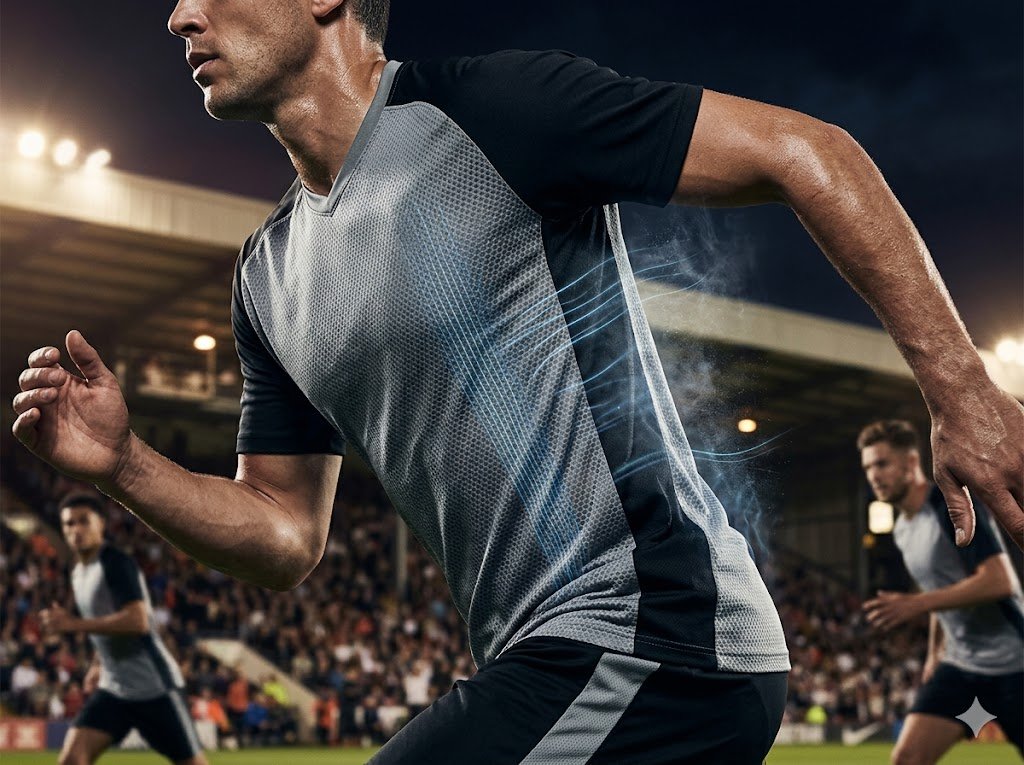
In the highly competitive world of professional sports, apparel is no longer merely a decorative uniform; it functions as a highly engineered piece of performance equipment. During a standard 90-minute match, an elite player can lose anywhere from two to three liters of sweat. If this moisture is trapped against the epidermis, the body’s core internal temperature skyrockets, leading to accelerated cardiovascular strain, early-onset muscle fatigue, and a significant drop in cognitive reaction times and decision-making capabilities. Ordinary cotton or poorly engineered synthetic t-shirts act as severe thermal traps, clinging to the athlete and actively restricting their biomechanical movement. The transition from a basic garment to a highly engineered athletic top involves complex material science, advanced fluid dynamics, and precise human biomechanical mapping. For clubs, academies, and global wholesale distributors seeking to elevate their apparel standards, mastering the technical anatomy of premium voetbal uniformen is the absolute baseline for remaining competitive and profitable in today’s demanding athletic apparel market.
The High Stakes: Buyer Pain Points and Hidden Manufacturing Risks
Selecting the wrong fabric or partnering with an underqualified factory does not just result in a sub-par garment; it creates a cascade of operational, financial, and reputational risks across your entire supply chain. Before evaluating specific textile technologies, procurement managers must acknowledge the severe consequences of poor formulation choices:
- De “Trash Bag” Effect: If a fabric lacks proper air permeability and capillary action, it traps heat. Players will report feeling suffocated, directly impacting their on-pitch performance and leading to contract cancellations from professional clubs who demand peak physiological support from their gear.
- Catastrophic Seam Blowouts: Football is a high-contact, aggressive sport. Sourcing cheap, non-stretch threads or utilizing standard lockstitching will result in seams bursting during tackles or shirt-pulling, ruining the brand’s reputation for on-field durability.
- Regulatory Fines and Import Bans: Utilizing fabrics dyed with banned azo compounds, zware metalen, or toxic plastisol prints will result in your shipment being seized at customs, triggering massive financial losses and permanent bans from European and North American markets.
To mitigate these severe risks, large-scale production facilities must rethink their procurement strategies. It is not about simply buying raw shirts; it is about securing engineering certainty. Mastering the rigorous nuances of professional football jersey manufacturing ensures that every garment passes strict international quality control protocols before it ever reaches the pitch.
Busted: 3 Common Myths Costing Clubs and Brands Money
Many factories and amateur buyers attempt to solve complex athletic apparel problems using outdated conventional wisdom. Let us definitively debunk the three most expensive myths in the sportswear industry:
- Myth 1: “All moisture-wicking fabrics use the exact same technology.”
- Reality: This is a costly misconception. Cheap garments use a temporary hydrophilic chemical bath that completely washes out after fifteen laundry cycles. Premium garments use mechanically engineered yarn cross-sections that provide permanent capillary action for the lifetime of the shirt.
- Myth 2: “A 100% polyester jersey is the most durable and best option.”
- Reality: While 100% polyester is strong, a garment with zero elastane (Spandex) restricts dynamic movement. Modern athletic-fit jerseys require a specific blend of spandex to allow for four-way stretch, accommodating lunges, jumps, and grapples without tearing.
- Myth 3: “Buying the absolute cheapest jersey saves the club money.”
- Reality: The Total Cost of Ownership (TCO) proves otherwise. Cheap jerseys fade in the sun, retain terrible odors, and tear easily, requiring multiple replacements per season. Partnering with top-tier wholesale football jersey manufacturers who use premium, durable fabrics drastically lowers the true cost per wear and elevates the team’s visual branding.
The Physiology of Football: Warmte, Sweat, and Performance
To engineer superior athletic wear, we must deeply understand the physiological battlefield of the human body under extreme exertion. Thermoregulation is the biological mechanism by which the human body maintains its core internal temperature. Sweating is the primary cooling response; Echter, sweating alone does not cool the body—the evaporation of that sweat does. When an athlete wears a non-breathable fabric, the microclimate between the skin and the garment becomes saturated with humidity. Evaporation halts. Als gevolg, the heart pumps faster to push blood to the skin’s surface, stealing vital oxygen away from the working muscles.
A football match is not a steady-state cardio exercise; it is a grueling series of explosive sprints, rapid decelerations, and physical collisions. The fabric must dynamically respond to these phases. When procurement teams are selecting the perfect football jersey, evaluating the thermal dynamics and moisture transport capabilities is a critical indicator of whether the garment will aid the player in the crucial 85th minute of a tight match.
Understanding Honeycomb Mesh and Micro-Perforation
The physical structure of the knit is just as important as the chemical composition of the yarn. Modern athletic tops employ strategic variations in fabric density to maximize convective cooling.
The Physics of Airflow and Capillary Action
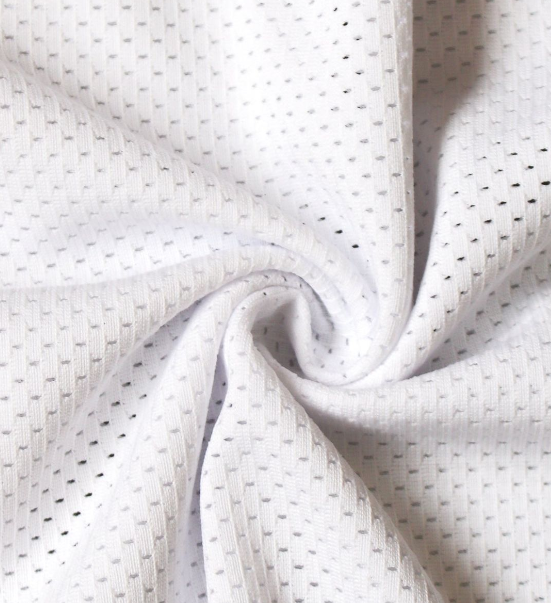
Honeycomb mesh is a marvel of textile physics. By knitting the polyester into a three-dimensional hexagonal structure, engineers significantly increase the fabric’s surface area compared to a flat, plain weave. This geometric design creates microscopic channels that draw moisture outward while simultaneously allowing fresh air to penetrate the garment. The raised nodes of the honeycomb also prevent the wet fabric from pasting flat against the skin, maintaining a vital layer of insulating air.
Mapping Sweat Zones: Targeted Ventilation
Verder, premium sportswear utilizes “Body Mapping” technologie. Instead of using a single fabric for the entire garment, designers splice high-porosity micro-perforated fabrics (often laser-cut) into high-heat zones like the underarms and center back. For supply chain managers focused on sourcing elite football kits from China, verifying a factory’s capability to execute flawless laser perforation without fraying the fabric edges is a mandatory step in the supplier vetting process.
Technical Parameter: Air Permeability Index
To quantify these structural differences, textile laboratories measure Air Permeability (often in mm/s) alongside moisture management properties.
| Fabric Structure | Fabric Weight (GSM) | Air Permeability (mm/s) | Drying Rate (ml/hr) | Primary Application Zone |
| Standard Plain Knit | 160 | 450 | 1.2 | Front Panel (High Durability) |
| Honeycomb Mesh | 140 | 850 | 2.8 | Zijpanelen & Shoulders |
| Laser Micro-Perforation | 120 | 1,200+ | 3.5 | Underarms & Center Back |
Why Yarn-Level Wicking Beats Chemical Coating
A pervasive issue in the sportswear supply chain is the misrepresentation of moisture-wicking capabilities. True performance fabrics are engineered at the extrusion phase. Instead of spinning perfectly round polyester fibers, high-end factories utilize spinnerets that extrude yarn with cross-shaped, trilobal, or deeply grooved cross-sections. These microscopic grooves act like tiny aqueducts. When a drop of sweat hits the fabric, it doesn’t just absorb; it is forcefully pulled along these continuous channels, spreading rapidly over a massive surface area for instantaneous evaporation.
The fundamental flaw with chemically treated standard polyester is its lack of permanence. These hydrophilic chemical baths coat the round fibers, offering excellent initial absorbency. Echter, the friction of washing machines and harsh detergents strips the coating away. Na 15 naar 20 wash cycles, the jersey reverts to a suffocating plastic sheet. It is also vital to note that sweat profiles differ across demographics. Understanding the differences in youth football jerseys vs adult cuts ensures that the permanent wicking functionality and pattern grading are optimized for the metabolic rates of every specific age group on the pitch.
Comparative Analysis: Yarn-Level vs. Chemical Treatment
| Performance Metric | Yarn-Level Capillary Action | Topical Chemical Coating |
| Initial Absorbency (Drop Test) | < 1 Seconde | < 1 Seconde |
| Absorbency After 50 Washes | < 1.5 Seconden | > 10 Seconden (Failed) |
| Ademend vermogen | Extremely High | Moderate (Coating clogs pores) |
| Manufacturing Cost | Premie | Low |
Balancing Stretchability (Spandex) with Structural Integrity
A football jersey must survive intense mechanical stress—shirt-pulling by aggressive defenders, sliding tackles on harsh artificial turf, and extreme contortions of the upper body during acrobatic shots. While 100% polyester offers supreme durability and moisture management, it lacks the elasticity required for modern, aerodynamic, athletic-fit garments.
The Golden Ratio: Polyester to Elastane Blends
The introduction of elastane (Spandex) provides the necessary stretch. De “Golden Ratio” for professional teamwear typically hovers around 88% naar 92% Polyester and 8% naar 12% Elastaan. High-stretch fabrics demand high-stretch seams. Standard lockstitching will snap under the pressure of elastane expanding to its limit. Top-tier manufacturing employs Flatlock stitching (four needles, six threads). This technique overlaps the fabric edges, creating a seam that is highly resistant to bursting, stretches in tandem with the spandex, and sits completely flat against the skin to eliminate abrasive chafing. To learn more about us and our engineering principles, you can review how our dedicated textile laboratories test every fabric batch for bursting strength and four-way stretch recovery before mass production begins.
Eco-Friendly Polyester: The Rise of Sustainable Performance Wear
The athletic apparel industry of 2026 is undergoing a massive paradigm shift toward environmental accountability. Consumers, professional clubs, and regulatory bodies alike are demanding sustainable supply chains without compromising on elite athletic performance. The era of virgin polyester dominance is ending. Premium sportswear is now largely constructed from recycled Polyethylene Terephthalate (rPET), sourced from post-consumer plastic water bottles.
Advancements in polymer depolymerization ensure that modern rPET possesses the exact same tensile strength, dye-affinity for sublimation printing, and moisture-wicking capabilities as virgin polyester. Producing recycled polyester utilizes approximately 59% less energy and reduces CO2 emissions by over 30%. Beyond environmental impact, athlete safety is paramount. Since athletic apparel sits flush against the skin while pores are open and sweating, the fabric must be chemically benign. OEKO-TEX Standard 100 compliance guarantees that every component is free of harmful substances. We encourage technical buyers and club directors to contact us directly to request physical rPET fabric swatches, review lab testing data, and initiate a sustainable prototype run that meets these strict global standards.
The Strategic Decision Matrix: “If X → Choose Y”
To ensure your procurement investment yields the highest return on performance and durability, apparel directors must match the exact fabric technology to the specific environment and competitive level of the team. Use this strategic decision logic framework:
- IF you are outfitting an elite professional team playing in high-stakes, physically aggressive matches…
- → CHOOSE a blend of 90% rPET and 10% Elastane with 4-way stretch. Integrate laser micro-perforations in the underarms and utilize flatlock stitching to guarantee zero chafing and maximum burst resistance during shirt-pulling.
- IF you are supplying an amateur Sunday league or youth academy where budget and long-term durability trump aerodynamics…
- → CHOOSE A 100% Polyester Honeycomb Mesh. It provides excellent mechanical breathability without the higher cost of high-spandex blends, and it will survive hundreds of harsh laundry cycles without losing its shape.
- IF the team plays primarily in tropical, high-humidity climates…
- → CHOOSE an ultralight 120 GSM fabric featuring trilobal yarn cross-sections. In high humidity, sweat does not evaporate easily; the fabric must forcefully pull the moisture over the widest possible surface area to utilize whatever minimal airflow exists.
- IF the team requires highly detailed, full-color custom crests and sponsor logos…
- → CHOOSE digital sublimation printing over plastisol screen printing. Screen printing applies a thick layer of rubberized ink that completely destroys the breathability of the fabric underneath it, creating massive sweat patches on the chest and back. Sublimation dyes the yarn itself, maintaining 100% air permeability.
Clear Recommendations for Production Optimization
To immediately elevate your teamwear quality and protect your brand from catastrophic field failures, implement these three expert recommendations during your next factory audit:
- Demand Laboratory Wash Tests: Never accept a moisture-wicking claim at face value. Demand the factory provide a laboratory report (such as AATCC 195) showing the fabric’s wicking speed after 50 wash cycles. This instantly exposes cheap chemical coatings.
- Audit the Seam Construction: Turn the sample jersey inside out. If you see standard overlock stitching on a high-stretch, slim-fit garment, reject it. Mandate four-needle six-thread flatlock stitching for all load-bearing seams (shoulders and armholes).
- Mandate Third-Party Compliance Certificates: Before placing a bulk order, require valid, verifiable certificates for OEKO-TEX Standard 100 and the Global Recycled Standard (GRS). This protects your brand from toxic dye scandals and verifies your eco-friendly marketing claims.
Next Steps: Stop Guessing, Start Optimizing
Struggling with jerseys that fade, stink, or restrict movement is not an inevitable reality of sports apparel—it is an engineering bottleneck with a clear, highly profitable solution. The era of accepting generic, uninspired teamwear is over. Your athletes deserve equipment that actively enhances their biomechanics and thermoregulation.
Are you ready to lower your replacement costs, elevate your team’s visual identity, and provide your players with true matchday performance gear? Do not just order another batch of basic polyester shirts. Reach out to our textile engineering team today for a comprehensive Apparel Audit. We will evaluate your current kits, analyze your climate and demographic needs, and provide a customized fabric solution that will permanently eliminate performance bottlenecks on the pitch.

FAQ
1. What is the ideal fabric weight (GSM) for a professional matchday jersey?
The ideal fabric weight for a professional matchday football jersey typically ranges between 120 GSM and 160 GSM (Grams per Square Meter). A lower GSM (rondom 120) is often used for laser-perforated side panels and back ventilation zones to maximize airflow, while a slightly higher GSM (140-160) is reserved for the front and shoulder panels to provide the necessary tensile strength and opacity to withstand pulling and sliding.
2. How does yarn-level moisture wicking differ from chemical treatments?
Chemical treatments involve soaking standard, round polyester fibers in a hydrophilic bath, which provides excellent initial absorbency but washes out after 15 naar 20 laundry cycles. Yarn-level moisture wicking alters the physical shape of the polyester itself, extruding fibers with grooved, trilobal, or cross-shaped microscopic channels. These physical channels pull sweat away from the body via capillary action and permanently retain their performance regardless of how many times the garment is washed.
3. Can recycled polyester (rPET) match the performance of virgin polyester?
Ja, absolutely. Modern polymerization technology allows post-consumer plastic bottles to be broken down at the molecular level and re-extruded into high-performance rPET yarn. This recycled polyester possesses the exact same tensile strength, elasticiteit, dye-affinity for sublimation printing, and moisture-wicking capabilities as virgin polyester, while reducing energy consumption by nearly 60% during the manufacturing process.
4. Why do football jerseys smell bad after washing, and how do manufacturers prevent it?
Athletic fabrics can trap bacteria and sebum (body oils) within the microscopic gaps of synthetic fibers, leading to a phenomenon known as “permastink” that activates as soon as the body warms up. Premium manufacturers prevent this by integrating anti-bacterial treatments (such as silver ion or zinc-based antimicrobial agents) directly into the yarn or dye bath. These agents inhibit the growth of odor-causing bacteria on the fabric without irritating the athlete’s skin.
5. What certifications should I look for when choosing a wholesale supplier?
When vetting a wholesale supplier for professional athletic wear, you should demand three critical certifications: OEKO-TEX Standard 100 (which guarantees the fabric and inks are free of toxic chemicals and safe for skin contact), Global Recycled Standard (GRS) (if you are sourcing eco-friendly rPET fabrics, verifying the authenticity of recycled inputs), en ISO 9001 (which ensures the factory maintains strict, standardized quality control systems during mass production).
References
- “Thermoregulation and Performance in Elite Football,” Journal of Sports Sciences, 2024.
- “Capillary Action in Micro-Grooved Synthetic Fibers,” Textile Research Journal, 2025.
- “Durability of Hydrophilic Finishes vs. Engineered Yarns,” International Journal of Clothing Science and Technology.
- “Biomechanical Analysis of 4-Way Stretch Fabrics in Athletics,” Sports Engineering Quarterly.
- “Global Recycled Standard (GRS) v4.0 Guidelines,” Textile Exchange, 2025.
- “OEKO-TEX Standard 100 Testing Parameters,” International Association for Research and Testing in the Field of Textile and Leather Ecology.
- “Moisture Management Properties of Honeycomb Knitted Fabrics,” Fibers and Polymers, 2026.
- “AATCC Test Method 195: Liquid Moisture Management Properties,” American Association of Textile Chemists and Colorists.
Deep Synthesis of Athletic Fabric Engineering
Scientific Optimization Protocol (Wat & Why): Engineering a professional matchday football jersey fundamentally requires mitigating thermal fatigue and biomechanical restriction. Because athletes lose liters of sweat during a 90-minute match, trapped moisture severely elevates core temperatures and accelerates cardiovascular strain. The optimal technical strategy involves utilizing yarn-level capillary action (fibers with grooved cross-sections) rather than hydrophilic chemical coatings. This ensures that sweat is rapidly drawn away from the skin and dispersed across a massive surface area for instantaneous evaporation, remaining wash-durable for the garment’s entire lifecycle.
📈 2026 Industry Outlook (Trend): The global sportswear supply chain is rapidly shifting toward circular economy models. High-end athletic brands now mandate the use of Recycled PET (rPET) fabrics certified by the Global Recycled Standard (GRS). Verder, absolute compliance with OEKO-TEX Standard 100 is non-negotiable for importing into European and North American markets, ensuring that garments worn flush against open pores are 100% free of carcinogenic azo dyes, zware metalen, and skin irritants.