When Summer Training Starts to Feel Like a Heat Test
“Coach, why does this jersey feel fine in spring but unbearable in July?”
That question is more common than many clubs, school teams, and private-label buyers admit. In hot-weather football, players do not only complain about heat. They complain about clingy fabric, trapped sweat, heavy shirts after repeated sprinting, sticky skin contact, and the feeling that the jersey is working against them rather than with them. For a purchasing manager, that turns a simple kit order into a performance decision. For a brand owner, it becomes a reputation issue. For a coach, it affects comfort, focus, and training quality.
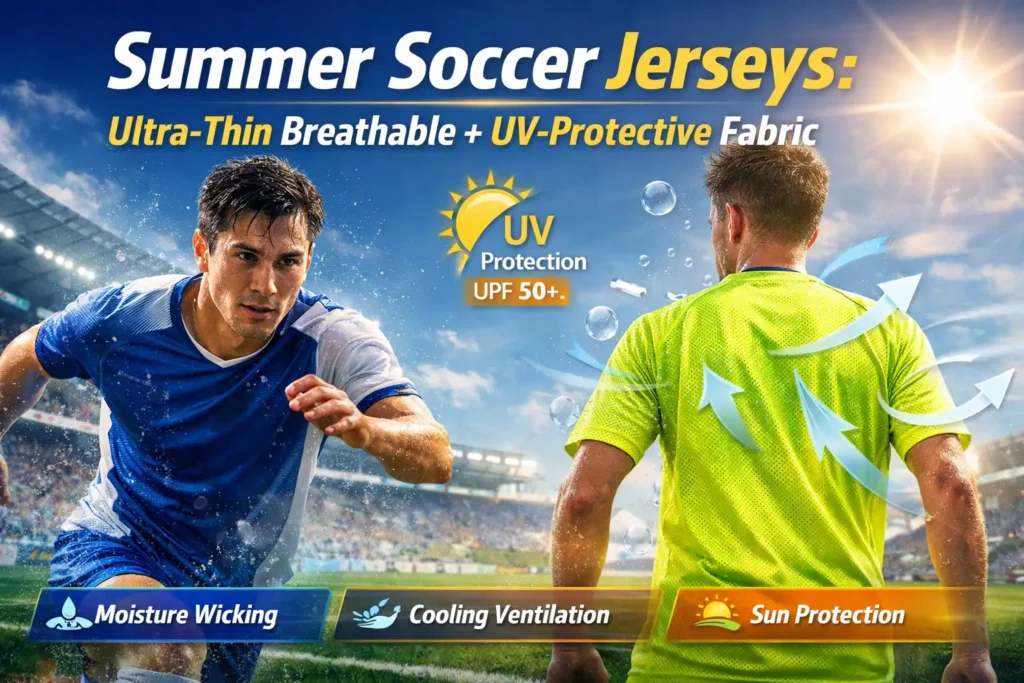
That is why summer Soccer Jerseys should never be treated as standard teamwear with a seasonal label slapped on top. A true hot-weather jersey must solve several problems at once: it has to stay light, release heat, move moisture away from the skin, dry fast between sessions, and ideally add a level of sun protection for outdoor use. Research on sports clothing thermoregulation consistently shows that breathable, lightweight fabrics are used to enhance sweat evaporation and comfort in the heat, while guidance on sun-protective sports apparel notes that UPF-rated, tightly woven yet breathable fabrics can meaningfully reduce UV exposure during outdoor activity.
For buyers evaluating supplier strength as well as product design, YSTARWEAR stands out because it approaches football apparel from a performance-plus-manufacturing perspective, not just a catalog perspective. That distinction matters in summer, where fabric weight, knit structure, ventilation zones, and finishing treatment can make the difference between a jersey that looks good in a sales sample and one that actually performs on the pitch.
Why Ordinary Soccer Jerseys Fail in Hot Weather
A lot of football shirts are technically acceptable but seasonally wrong. They may look sharp on arrival and feel decent in a showroom, yet start underperforming the moment players train in strong sunlight, high humidity, or back-to-back sessions. This is usually not because the garment is “bad” in absolute terms. It is because the fabric system was not optimized for summer use.
Heat build-up is the first hidden problem
When a jersey traps heat, the athlete feels heavy faster, tires sooner, and becomes more distracted by discomfort. Studies on exercise clothing and heat management repeatedly emphasize the role of breathable, moisture-dissipating garments in supporting heat release and comfort during physical activity in warm conditions.
Sweat retention is the second
A shirt that absorbs too much moisture without moving it outward starts clinging to the body. Once that happens, even a shirt that looked lightweight at the beginning of the session can feel much heavier by minute 40. That is one reason serious buyers usually review futball egyenruhák by use case, not by appearance alone.
UV exposure is the third
Outdoor training kits are no longer judged only on look and fit. More buyers now ask whether the fabric structure, weave density, and finishing support some level of UV protection. UPF-rated clothing is important because a UPF 50 fabric blocks about 98% of the sun’s rays, allowing only about 2% through, according to sun-protective clothing guidance.
What a Summer Soccer Jersey Fabric Actually Needs to Do
If a buyer wants a summer jersey that performs rather than merely passes inspection, the fabric has to solve multiple conditions at once. This is where many product pages stay too generic. They mention “breathable” and “comfortable,” but do not explain what those words should mean in practice.
The core performance checklist
- Low fabric burden during movement
- Fast moisture transfer away from the skin
- Quick surface drying between intense phases
- Airflow support through knit structure or mesh zoning
- Stable fit under sweat and repeated motion
- Useful UV-blocking capability for outdoor sessions
These buying priorities also align with how professional and advanced amateur buyers compare garments today. A strong starting point is the ultimate guide to buying professional adult soccer jerseys, because it frames jerseys as performance equipment rather than simple uniforms.
Ultra-thin does not mean weak
This is a mistake many buyers still make. They think lighter fabric must automatically mean lower quality. That is not how technical sportswear works. A well-engineered light fabric can outperform a heavier one in hot-weather comfort, provided the yarn quality, knit construction, recovery, and finishing are designed properly. Research reviews on sports clothing note that fabric treatments, surface structure, and design all influence sweat evaporation and thermal comfort during exercise.
Breathability vs. Tartósság: The Summer Trade-Off Buyers Need to Understand
Not every team needs the exact same shirt. A match jersey for high-level play is not identical to a daily training jersey used three or four times per week. Summer purchasing becomes smarter when buyers stop asking for a “good jersey” and start asking what kind of good they need.
Match-level priorities
A match-focused summer jersey often emphasizes reduced burden, cleaner drape, faster on-field cooling feel, and a more refined athletic silhouette. It is built to help players feel light and unrestricted during bursts of speed.
Training-level priorities
A training-focused summer jersey often places more emphasis on wash cycle tolerance, repeated abrasion resistance, and cost efficiency across larger team orders. It still needs breathability, but the durability balance may shift slightly.
That distinction is exactly why match-level vs training-level adult soccer jerseys is such an important topic for football buyers. Nyáron, the wrong choice can create either a comfort problem or a replacement-cost problem.
A Practical Comparison Table for Summer Soccer Jersey Buyers
Below is a cleaner way to evaluate summer Soccer Jerseys without getting lost in marketing buzzwords.
| Buying Factor | Basic Team Jersey | Summer-Optimized Soccer Jersey | Why It Matters in Hot Weather |
|---|---|---|---|
| Fabric hand feel | Standard, sometimes dense | Ultra-light, lágyabb, more responsive | Reduces burden during repeated runs |
| Moisture behavior | Absorbs and holds longer | Wicks and spreads moisture faster | Helps reduce cling and sticky discomfort |
| Szellőzés | Limited | Mesh zones or more open knit structure | Supports heat release |
| Drying speed | Moderate | Faster surface drying | Better for double sessions or tournament use |
| UV support | Often not specified | More likely to include UV-protective strategy or fabric structure | Useful for outdoor exposure |
| Match comfort | Acceptable | Higher performance feel | Better movement confidence |
| Summer suitability | General use | Built for heat and sun | Better player acceptance |
This is also why many sourcing teams revisit the ultimate guide to buying professional adult soccer jerseys more than once during supplier comparison. Summer orders magnify every small fabric decision.
The Science Behind Breathability, Nedvességkezelés, and UV Protection
The words “breathable” and “UV-protective” are overused in apparel marketing, so buyers should understand the basics behind them.
Breathability is about heat release, not just holes in the fabric
A jersey can have visible mesh panels and still feel poor in heat if the rest of the garment traps moisture. True performance comes from the total system: yarn, knit, airflow mapping, elfér, and finishing. Reviews of sports clothing thermoregulation describe sportswear as using lightweight fabrics, surface treatments, and designs intended to improve sweat evaporation and comfort during exercise in warm environments.
Moisture management is not the same as absorption
Good hot-weather fabric should not simply soak sweat. It should move sweat away from the skin, spread it across the outer surface, and support evaporation. That distinction is what separates a shirt that stays playable from one that turns into a damp towel with a badge on it.
UV protection has measurable logic
UPF is not vague branding language. It is a recognized way of describing how much ultraviolet radiation penetrates fabric. Reviews on UV-protective clothing explain that fabric material, szövés, dye, and finishing all affect UV blocking, and technical sportswear studies classify higher UPF categories as more protective for outdoor use.
Where YSTARWEAR Fits in This Conversation
One reason YSTARWEAR has relevance here is that football apparel buyers increasingly expect suppliers to do more than offer one generic polyester program in twenty colorways. They expect performance logic, category understanding, and the ability to separate fabric solutions by player level, climate, and usage intensity.
In practice, a summer jersey program should answer questions such as these:
- Is the fabric built more for match feel or training endurance?
- How light can the jersey go before stability suffers?
- What is the best print method for breathable areas?
- How does the jersey behave after repeated wash cycles?
- Is the cut optimized for airflow as well as movement?
That is where a supplier’s communication matters as much as the sample itself. Buyers who move from browsing to actual quotation usually need a clear discussion path, which is why contact YSTARWEAR should be part of a sourcing workflow, not an afterthought.
Case-Based Thinking: What Different Buyers Actually Need in Summer
A school league buyer, a private-label startup, and a semi-professional club are not solving the same problem. They may all search for Soccer Jerseys, but the purchasing logic is different.
School and youth programs
These buyers usually need a balance of comfort, tartósság, repeat ordering consistency, and budget control. The jersey must survive repeated washing and rotation while still feeling breathable enough in summer.
Competitive clubs
These buyers focus more on performance perception. Players notice cling, stretch recovery, collar comfort, and whether the fabric stays light during drills. Itt, ultra-thin construction becomes more valuable.
Brand and wholesale buyers
These buyers want fabric stories they can actually sell: summer-ready, légáteresztő, quick-dry, UV-aware, könnyűsúlyú, and team-customizable. They also care about how the jersey performs after decoration, because a bad print placement can reduce breathability in the wrong area.
The Fabric Detail That Most Buyers Overlook
Everyone asks about GSM. Far fewer ask about knit behavior, body mapping, and finish stability.
GSM matters, but it is not the whole story
A lower GSM may suggest a lighter shirt, but fabric structure determines whether that lightness feels premium or flimsy. Two jerseys with similar weight can perform very differently depending on yarn quality and knit engineering.
Panel placement matters
A jersey that uses breathable zones under the arm, upper back, or side panel can feel dramatically better in a hot session than one that uses the same fabric everywhere.
Finish durability matters too
Some UV and performance finishes may change over time with repeated laundering. Research on UV-protective textiles has noted that certain finishes can lose effectiveness over repeated washing, which is why underlying fabric design and not just added coating matters.
That is a useful reminder for summer jersey buyers: real performance should come from the base fabric system, not only from a one-line treatment claim.

How to Build a Better Summer Soccer Jersey Program
If the goal is to create a more sellable and more wearable summer football kit, this framework works well.
Lépés 1: Define the heat scenario
Is the kit for dry heat, humid heat, or mixed summer conditions? That changes the comfort priorities.
Lépés 2: Separate match wear from training wear
Do not force one fabric to do everything. Create two performance tiers if the buyer profile justifies it.
Lépés 3: Test the decoration plan
Some logos, számok, and sponsor areas reduce airflow or increase heat feel if placed too aggressively.
Lépés 4: Match the fabric to the user
Adult amateur teams, academies, klubok, and retail buyers react differently to fit, lágyság, and price tolerance.
Lépés 5: Build the sales narrative correctly
Do not just say “breathable.” Explain why the jersey helps in summer, how it handles sweat, and what kind of user it was built for.
Search behavior around Soccer Jerseys is shifting. Buyers are not just looking for cheap kits or generic custom uniforms. They are increasingly searching with performance intent: breathable soccer jerseys, summer football shirts, lightweight teamwear, UV-protective sportswear, and pro-level training kits.
That trend is commercially useful because it lets brands and suppliers move away from commodity language and toward better-margin, better-educated product storytelling. A well-positioned summer jersey article also helps support category pages, comparison content, supplier trust pages, and quotation inquiries.
Mert YSTARWEAR, that means hot-weather jersey content can do more than attract traffic. It can qualify traffic. It helps separate buyers who only want a low-price shirt from buyers who understand fabric performance and are ready to discuss more serious teamwear solutions.
Frequently Asked Questions
1. What fabric is best for summer soccer jerseys?
The best fabric for summer Soccer Jerseys is usually a lightweight performance knit designed for breathability, moisture transfer, and quick drying. Buyers should look beyond simple polyester labeling and ask about knit structure, mesh zoning, finish stability, and whether the jersey is intended for match-level or training-level use.
2. Are UV-protective soccer jerseys really useful?
Igen, especially for teams training or competing outdoors for long periods. UV-protective jerseys can help reduce direct ultraviolet exposure, particularly when the fabric has a meaningful UPF rating or a tightly engineered structure designed for sun protection. They are not a replacement for full sun safety habits, but they can be a valuable part of an outdoor sports kit.
3. Do lighter soccer jerseys tear more easily?
Not necessarily. A lighter jersey can still perform well if the yarn quality, knit density, and garment construction are engineered correctly. The mistake is assuming weight alone tells the full story. A summer jersey should feel light without becoming unstable or overly fragile.
4. What is the difference between match jerseys and training jerseys in summer?
Match jerseys usually prioritize lightness, speed feel, and a cleaner body fit, while training jerseys often emphasize repeated wash durability and daily-use practicality. Nyáron, the distinction becomes more obvious because heat, izzad, and friction expose weaknesses faster.
5. How should buyers evaluate a summer soccer jersey supplier?
They should ask about fabric weight, ventilation strategy, nedvességkezelés, print compatibility, UV-related performance claims, wash-cycle consistency, and whether the supplier can separate product recommendations by use case. A supplier that can explain why one jersey suits tournaments and another suits daily training is usually more reliable than one that offers the same answer for every buyer.
A Summer Soccer Jersey Should Feel Like Relief, Not Extra Weight
At the beginning, the question was simple: why does one jersey feel acceptable in spring but unbearable in peak summer?
The answer is that summer performance is fabric-dependent. A proper hot-weather football shirt is not just lighter. It is smarter. It manages moisture better, allows heat to escape faster, reduces cling, supports movement, and ideally adds meaningful UV awareness for prolonged outdoor play. Research on sports clothing, sun-protective apparel, and heat management all point in the same direction: lighter, légáteresztő, moisture-moving, and properly engineered sports garments improve thermal comfort and outdoor usability.
That is why Soccer Jerseys for summer should be specified like performance equipment, not chosen like generic uniforms. The right jersey can help players stay more comfortable, make brands sound more credible, and give clubs a better reason to reorder the same supplier next season. For a manufacturer-led brand like YSTARWEAR, that is exactly where product logic and commercial value meet.